THE SHORT ANSWER
What a commercial HVAC replacement actually includes
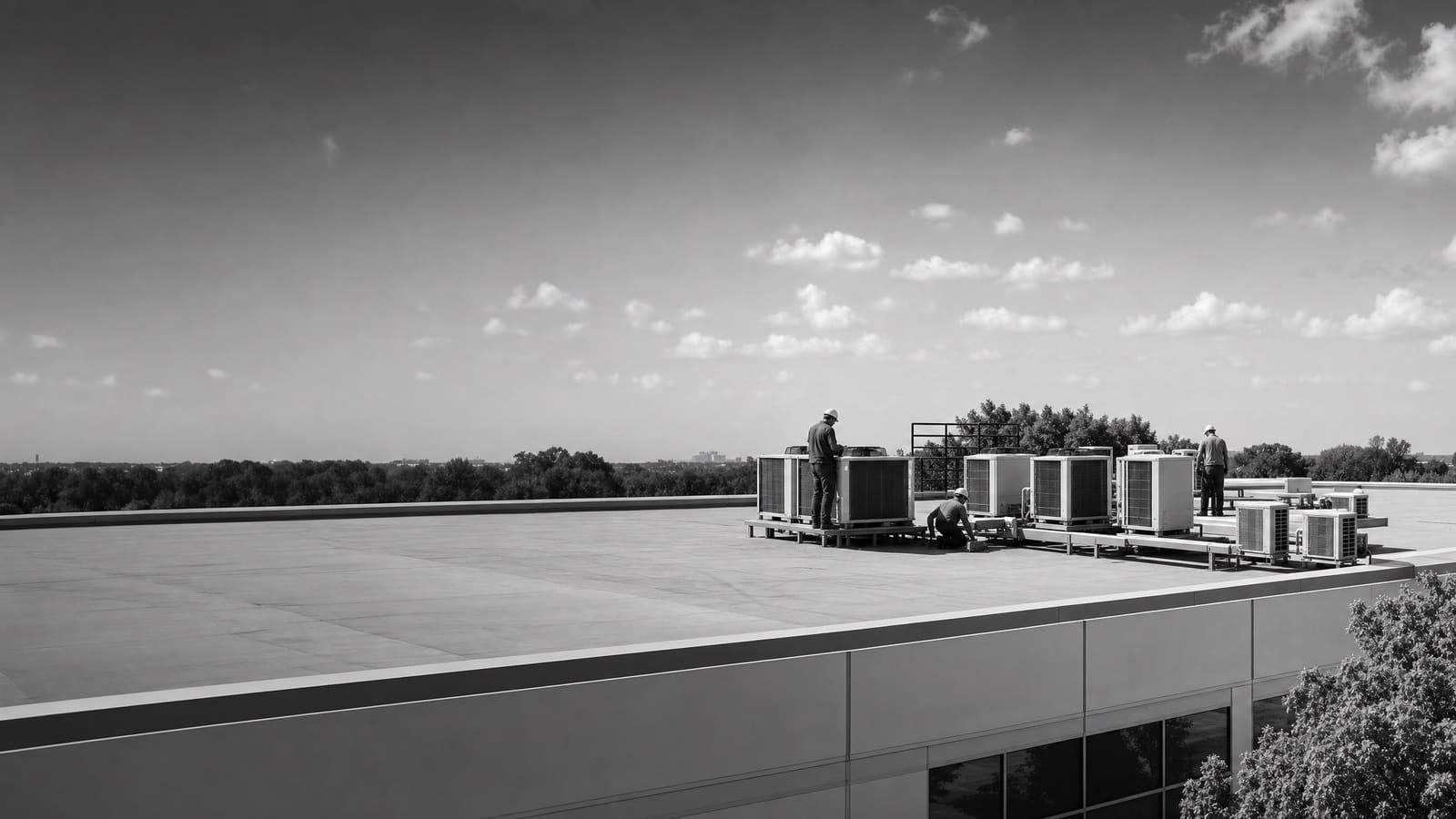
A commercial HVAC replacement covers a load check against how the building is used today, equipment selection with real availability, curb and rigging work, gas or electrical changes, controls integration, and documented commissioning. Replacement usually beats another repair once a unit is past 15 years and running inefficiently — an old, inefficient rooftop unit wastes roughly $900 to $3,700 a year in energy before you count a single service call.
A site review still has to confirm the actual load, the curb and roof structure, available electrical capacity, and crane access before any of that price is real.
THREE WAYS TO GO
Your three real options when a unit is failing
When a rooftop unit starts failing, you have three moves. The right one depends less on the unit than on how long you plan to hold the building and what an outage would cost you.
Most facility teams wait. They replace when the unit fails completely, needs constant service, or stops holding the space. Waiting is the expensive option twice over. An old unit keeps spending money every month it runs, and a failure in season removes your ability to choose — you take whatever is on the shelf, at whatever price, on whatever schedule the crane has open.
Deciding early is what buys you the other two options. If you know a unit is in its last two seasons, you can shop equipment against real lead times, plan the lift around your operating hours, and move the work into a capital cycle instead of an emergency line item. The decision itself is cheap. It is the delay that costs.
WHAT MOVES THE NUMBER
The lines that swing a replacement quote
No two roofs price the same, and the equipment is rarely the part that surprises people. These are the lines that move a commercial replacement quote, with a note on how much each one tends to vary between buildings. All of them should be written down before you sign, not discovered during the lift.
IN PRACTICE
Buy the equipment, not just the install
The crane morning is the visible part of the project and usually the least interesting part. What decides whether you are happy in year three is the equipment decision, and that decision has a short window.
Rooftop units condition close to half of all commercial floor area in the country, so most buyers are choosing inside a well-mapped market rather than a custom one. That works in your favor. High-efficiency models are broadly available — a federal rooftop challenge produced units built to cut energy use by up to half against the older standard, and more than twenty models now exceed that specification. Over 200 organizations working through the rooftop campaign have upgraded more than 43,000 units and cut a combined $37 million a year from their energy bills.
The useful takeaway is not the headline number. It is that the efficiency tier is a real lever, and it prices separately from the install. Ask for the same install scope quoted against two equipment tiers, then hold both against your own run hours. A unit serving a kitchen or a retail box that runs long hours pays back a higher tier much faster than one serving a lightly used office suite.
SCOPE CHECK
Why one replacement is simple and the next one is not
Two replacements on the same street can price very differently. The gap is almost never the unit itself. It is what the roof, the panel, and the parking lot make you do to get the unit there.
LOWER COMPLEXITY
Straight swap conditions
Same tonnage, the existing curb takes a standard adapter, the panel already has capacity, and the crane can set from an accessible corner of the lot. One morning, narrow scope, predictable price.
HIGHER COMPLEXITY
Conditions that add scope
A tonnage change, a new curb footprint, a fuel switch that leans on electrical capacity, tight or occupied lot access, or integration into an existing automation system. Each one adds engineering, schedule, and cost.
BEFORE THE QUOTE
What the site review has to confirm
A replacement quote is only as good as the walk that produced it. Federal guidance on rooftop replacement points at a short list of things that decide the project, and every one of them is a site condition rather than a catalog item.
Electrical capacity comes first, especially if anyone is considering an electric heating option. A heat pump rooftop unit shifts heating load off gas and onto the panel, and if the service cannot carry it, that upgrade belongs in the quote instead of surfacing in month two. Physical constraints come next: curb dimensions, roof structure, clearance around the unit, and the path a crane needs to reach it. Gas lines matter in the other direction — if a unit is coming off gas, someone has to decide whether the line stays capped or gets removed.
Then there are the two constraints nobody notices until they bite. Equipment availability sets your schedule far more than labor does. And a contractor's familiarity with the specific equipment you are buying decides whether commissioning is a formality or a second project.
Get the electrical finding in writing
Panel capacity, available breaker space, and service size should appear in the proposal as findings, not assumptions. It is the single most common reason a clean-looking replacement price moves after the contract is signed.
OWNERSHIP MATH
Two questions that change the answer
Two questions move this decision more than anything on the submittal, and neither one is technical.
The first is how long you hold the building and who pays the utility bill. An owner-occupant and a triple-net landlord look at the same unit with opposite incentives. The second is what your roof looks like after this unit lands. One new unit sitting among old ones is a different service picture than a fleet you are stepping through on a plan.
Neither question has a universally right answer. But both should be settled before you choose an efficiency tier, because the tier is where those two answers turn into dollars.
LEASE STRUCTURE
Who pays the bill you are lowering
If tenants pay utilities and you buy the equipment, a higher efficiency tier costs you and saves them. Settle how that gets recovered through the lease before the tier is chosen, not after.
FLEET SHAPE
What sits on the roof afterward
Refrigerant recovery and service are federally regulated, and a mixed roof means your service contract has to cover more than one generation of equipment. Price that into the maintenance line.
PLANNING AHEAD
Phase a fleet instead of replacing on failure
Most facility teams replace rooftop units the same way: when one dies. Federal guidance is blunt about why that is the expensive habit. Proactively replacing an inefficient unit generally beats replacement-on-failure, and it often beats a like-for-like swap at the end of service life too, because a failure forces you to buy whatever is available rather than what actually fits.
If you have more than two units on a roof, the better move is a schedule. Rank them by age, service history, and run hours. Replace the worst one on a planned lift and put the next two into following capital cycles. You get repeat pricing from the same contractor, you reuse the rigging plan, and you stop paying emergency premiums.
Phasing also spreads the disruption. One crane morning a year is a parking inconvenience. Three unplanned ones in a bad summer is a tenant problem. It also gives you a real answer when someone asks what the HVAC line looks like for the next three years, which is usually the question behind the question.
The lifetime cost of a rooftop unit is mostly energy, not purchase price. A replacement schedule is how you get to choose that energy number instead of inheriting it.
THE QUOTE
Five things every comparable quote should show
Two quotes are only comparable when both show the same things. If one of these is missing, you are not comparing prices. You are comparing assumptions.
01
Equipment and efficiency tier
Make, model, tonnage, and efficiency rating, with the quoted lead time sitting next to it.
02
Curb and structural scope
Adapter or new curb, roofing work, and whether structural review is included or excluded.
03
Rigging and site plan
Crane size, lot closure hours, and who coordinates with tenants and neighbors.
04
Electrical, gas, and controls
Named scope for each, including panel work and building automation integration.
05
Commissioning and closeout
Charge, airflow, and control settings verified and documented, with warranty registration handled.
Get a defensible number
Price the equipment and the building together.
Send the address, operating target, and target opening date. Flux will identify what must be verified before the project can be priced.
Get a free estimateQuestions
Straight answers.
How do you know when replacement beats another repair?
Age and energy waste usually decide it before the repair bill does. Units past 15 years waste substantial energy compared with current models, and an old, inefficient rooftop unit runs roughly $900 to $3,700 a year in wasted energy on its own. Once the unit also needs frequent service or stops holding the space, another repair is buying time at a high monthly rate.
Does a heat pump rooftop unit make sense for this building?
It depends on your heating load and your panel. Heat pump efficiency falls as outdoor temperatures drop and trends toward electric resistance in deep cold, so buildings with a heavy winter heating load often look at dual-fuel or cold-climate heat pump units rather than a straight all-electric swap. Electrical capacity, local energy rates, and equipment availability decide the rest.
What actually sets the schedule?
Equipment availability, not labor. The set and connection work for a packaged unit is short. The wait is getting the right unit in the right configuration, which is why lead time belongs on the quote next to the price rather than in a follow-up call.
What does a commercial replacement cost?
It depends on tonnage, efficiency tier, curb and structural work, crane access, and any electrical or gas changes, so a real number follows a real look at the roof. The other half of the math is what the current unit already costs you every year in wasted energy.
What happens to the refrigerant in the old unit?
It has to be recovered by certified technicians under federal refrigerant handling rules, not vented. That work is a required line on the job, and it is worth confirming it appears on the quote rather than being assumed.
Sources used for this guide
- [1]betterbuildingssolutioncenter.energy.gov — DOE Advanced Rooftop Unit Replacement Guidance
- [2]betterbuildingssolutioncenter.energy.gov — DOE Commercial Heat Pump Rooftop Unit Replacement Guidance
- [3]betterbuildingssolutioncenter.energy.gov — DOE High-Efficiency Commercial Rooftop Unit Toolkit
- [4]energy.gov — DOE Efficient Commercial Rooftop Air Conditioner Program
- [5]epa.gov — EPA Stationary HVAC Refrigerant Management