THE DIRECT ANSWER
What a commercial HVAC replacement includes
A commercial HVAC replacement covers load verification, equipment selection, refrigerant recovery from the old unit, rigging and set, gas and electrical connections, controls integration, and documented startup. Replacement beats one more repair once the unit is old enough to cost you money every month it runs. A single aging, inefficient rooftop unit commonly wastes $900 to $3,700 a year in energy alone, and that is before the next service call.
A site review still has to confirm the real load, the curb and roof structure, electrical capacity at the panel, gas line availability, and crane access before any of that turns into a price.
THE REAL DECISION
Three ways owners handle an aging unit
The decision is almost never whether to replace. It is when. A unit past fifteen years is usually the one quietly draining the energy budget, and waiting for it to die hands the schedule to the equipment instead of to you. A failure in season means buying whatever is available that week, not what fits the building.
A planned replacement puts you in the opposite position. You can compare efficiency tiers, decide whether an electric or dual-fuel unit suits the building's heating load, and hold the crane day for a weekend. It also buys time to confirm electrical capacity, which is the single item most likely to turn a simple swap into an electrical project.
The third path is legitimate. If a unit still has service life and the cabinet is sound, advanced controls can cut runtime without a capital project. Owners have gone both directions for years, and the honest test is whether the equipment can still hold the building through a design day.
WHAT MOVES THE NUMBER
The six lines that decide your price
No two roofs price the same, so the useful thing is knowing which lines are firm and which ones can still move after someone walks the site. These are the six that decide whether the quote you signed is the number you pay.
EQUIPMENT CHOICE
Like-for-like, high-efficiency, or heat pump
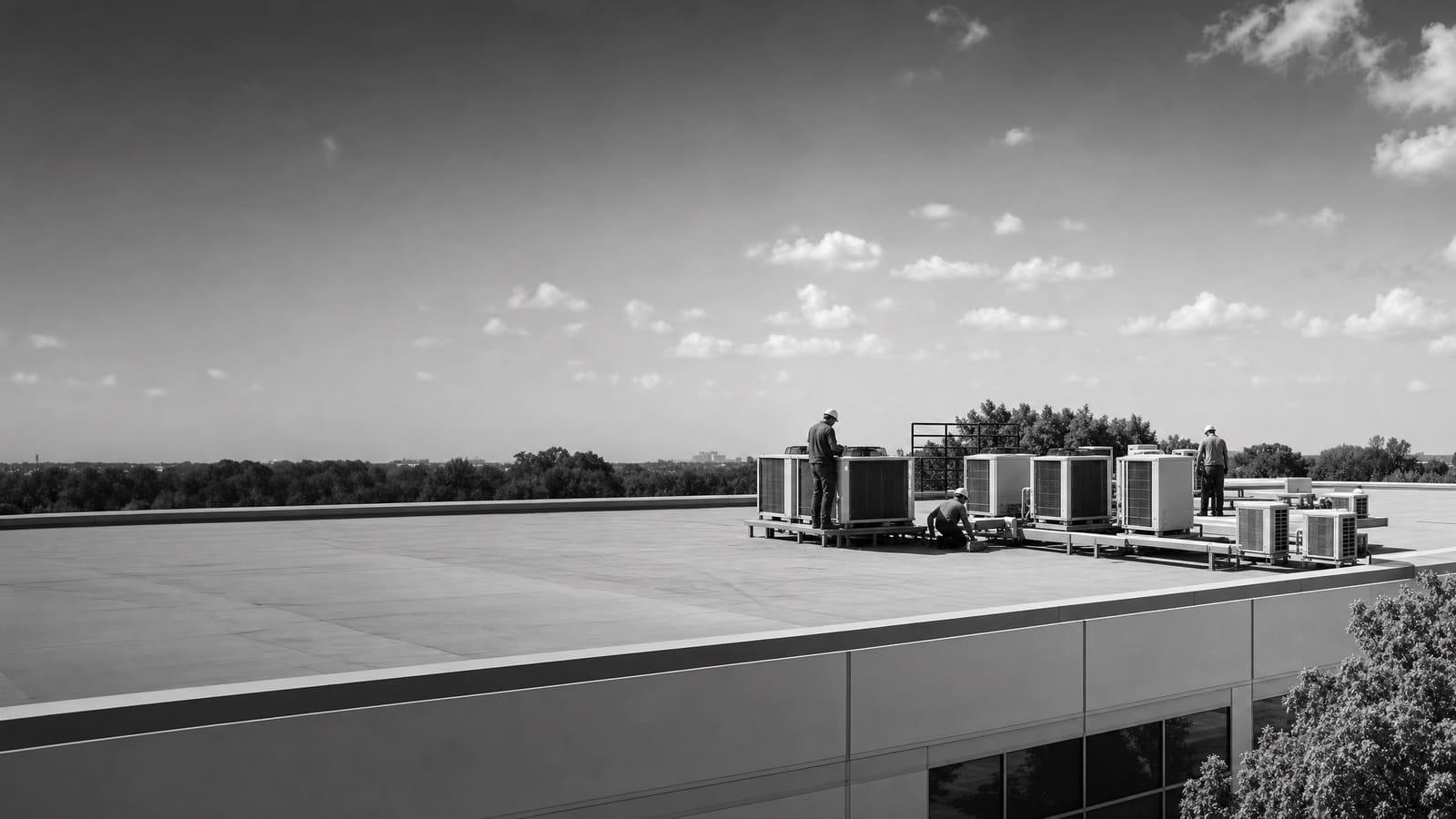
Rooftop units cool close to half of all commercial floor space in the country, so most replacement conversations are really packaged rooftop decisions. You have three honest options, and they are not interchangeable.
Like-for-like is the fastest path back to conditioned space and the right call when the building and its use have not changed. A high-efficiency unit is the middle move: the performance specification that drove this equipment class targeted energy use up to fifty percent below the older standard, and more than twenty models now exceed it. That gap is where the annual waste on an old unit goes back into your pocket.
The third option is a heat pump rooftop unit, available as dual-fuel, all-electric, or cold-climate. Heat pump heating efficiency falls as outdoor temperature drops, trending toward parity with electric resistance heat in deep cold, so buildings that carry a genuine winter heating load usually land on a dual-fuel or cold-climate variant rather than a standard all-electric unit. Building type, equipment availability, electrical capacity at the panel, physical constraints on the roof, existing gas lines, and whether your service contractor knows the technology all feed the same decision.
SCOPE CHECK
What makes a replacement simple or complicated
Two buildings with the same tonnage can price very differently. The split usually comes down to whether anything about the installation has to change besides the box itself.
LOWER COMPLEXITY
Same footprint, same fuel
The new unit matches the old curb, the space is used the way it was designed to be used, existing power and gas are adequate, and a crane can reach the roof from the lot. This is a one-morning lift with predictable pricing.
HIGHER COMPLEXITY
New footprint or new fuel
Larger tonnage, a different cabinet size, or a switch to all-electric heat. Now you are looking at a curb adapter, possible structural review, panel or service capacity, and a longer procurement window while the right unit is sourced.
BEFORE YOU BUY
What a real site review has to confirm
A quote written from a nameplate photo is a starting point, not a commitment. Twenty years changes occupancy, plug load, and how the envelope performs, so sizing off the old nameplate can carry forward a mistake nobody remembers making.
The review should establish the load from how the space is used today, then work outward. Is there physical room on the roof for the cabinet you want, and does the curb line up or does it need an adapter? Will the roof carry the weight? Is there electrical capacity at the panel for a higher-draw unit, and does the existing gas line stay, move, or get abandoned? Can a crane reach, and what does closing that part of the lot cost you in operating disruption?
Equipment availability belongs in the same conversation. Lead time is part of the decision, not a surprise you get after the purchase order. The unit that is right on paper and eleven weeks out may be the wrong answer for a building already running on one good compressor.
Ask for the findings in writing
Load basis, curb and structural condition, available electrical capacity, gas line disposition, and rigging access should all appear in the proposal. If those are missing, the price is provisional and change orders are already likely.
OWNING THE SYSTEM
Two things that outlive the install
The install is a few days. What you are actually buying is fifteen or more years of operating behavior, and two items decide how that period goes. Both are cheap to get right during the project and expensive to fix afterward, which is why they belong in the scope conversation and not in a follow-up call from your service provider six months later.
REFRIGERANT
Recovery and fleet planning
Refrigerant in commercial equipment is handled and recycled under federal rules, so recovery from the old unit is part of the job, not an extra. If your roof holds several units on different refrigerants, plan parts and service around the mix rather than one unit at a time.
PERFORMANCE
Commissioning and warranty
Charge, airflow, and control settings verified against spec are what separate a unit that performs from one that merely runs. Documented startup also protects the manufacturer warranty. Comfort complaints in month two are almost always commissioning that never happened.
PHASING AND LIFETIME COST
When you have more than one unit to replace
Most commercial roofs do not hold one unit, they hold several, usually installed at the same time and now aging at the same rate. Replacing them one failure at a time is the most expensive version of the same project, because every emergency resets your leverage on price, equipment choice, and schedule.
Phasing works. More than two hundred organizations have upgraded over forty-three thousand rooftop units through coordinated replacement programs, saving a combined thirty-seven million dollars a year on energy bills. The mechanism is not complicated: they replaced the worst performers first, on a schedule, with efficiency as a selection criterion rather than an afterthought.
For your building, that means ranking units by age, runtime, and repair history, then setting a replacement order before the next failure picks one for you. Take the units that serve the most sensitive spaces first. Group the lifts so you pay for one crane mobilization instead of three. And when you are pricing, weigh the annual energy waste of each old unit against the premium for a higher efficiency tier. On a unit running year-round, that math often decides the tier by itself.
APPLES TO APPLES
Five things a comparable quote should show
Two bids on the same roof can differ by a wide margin and both be honest, because they scoped different work. Make every bidder show these five items, along with lead time, and the comparison gets simple.
01
Tonnage, efficiency tier, and fuel
The exact model, its rated efficiency, and whether it heats with gas, electric resistance, or a heat pump.
02
Curb, structure, and roof work
Curb adapter, any framing, and how the roof membrane gets closed back up and warranted.
03
Rigging and access plan
Crane size, staging area, which stalls close, and the hours the lift happens.
04
Refrigerant, gas, and electrical scope
Recovery of the old charge, plus any piping, gas line, or panel work included in the price.
05
Commissioning and closeout
Startup readings, airflow and charge verification, control settings, permits, inspections, and the documentation package.
Get a defensible number
Price the equipment and the building together.
Send the address, operating target, and target opening date. Flux will identify what must be verified before the project can be priced.
Get a free estimateQuestions
Straight answers.
When does replacement beat another repair?
Once the unit is old enough that its energy waste is a recurring line item, not a one-time bill. An aging, inefficient rooftop unit can burn $900 to $3,700 a year more than a current one. Add the next compressor and the repair stops competing.
Should you switch to a heat pump rooftop unit?
It depends on your heating load and your panel. Heat pump efficiency drops as outdoor temperatures fall, approaching electric resistance heat in deep cold, so buildings with a real winter heating load usually look at dual-fuel or cold-climate versions rather than a standard all-electric unit.
What most often turns a simple swap into a bigger project?
Electrical capacity and the curb. A higher-draw or all-electric unit can need panel work the old gas unit never required, and a different cabinet size means a curb adapter and sometimes a structural look at the roof.
Who handles the crane, permits, and inspections?
The installing contractor should own the rigging plan, lot coordination, permitting, and inspections as part of the installed price. Confirm the quote says so in writing before you sign, because those are common change-order sources.
Why won't anyone give a firm price over the phone?
Because tonnage is only one of six variables. Curb condition, roof structure, electrical capacity, gas line disposition, and crane access all move the number, and none of them are visible from a nameplate photo. A walk turns a range into a price.
Sources used for this guide
- [1]betterbuildingssolutioncenter.energy.gov — DOE Advanced Rooftop Unit Replacement Guidance
- [2]betterbuildingssolutioncenter.energy.gov — DOE Commercial Heat Pump Rooftop Unit Replacement Guidance
- [3]betterbuildingssolutioncenter.energy.gov — DOE High-Efficiency Commercial Rooftop Unit Toolkit
- [4]energy.gov — DOE Efficient Commercial Rooftop Air Conditioner Program
- [5]epa.gov — EPA Stationary HVAC Refrigerant Management