THE SHORT VERSION
What a commercial HVAC replacement includes
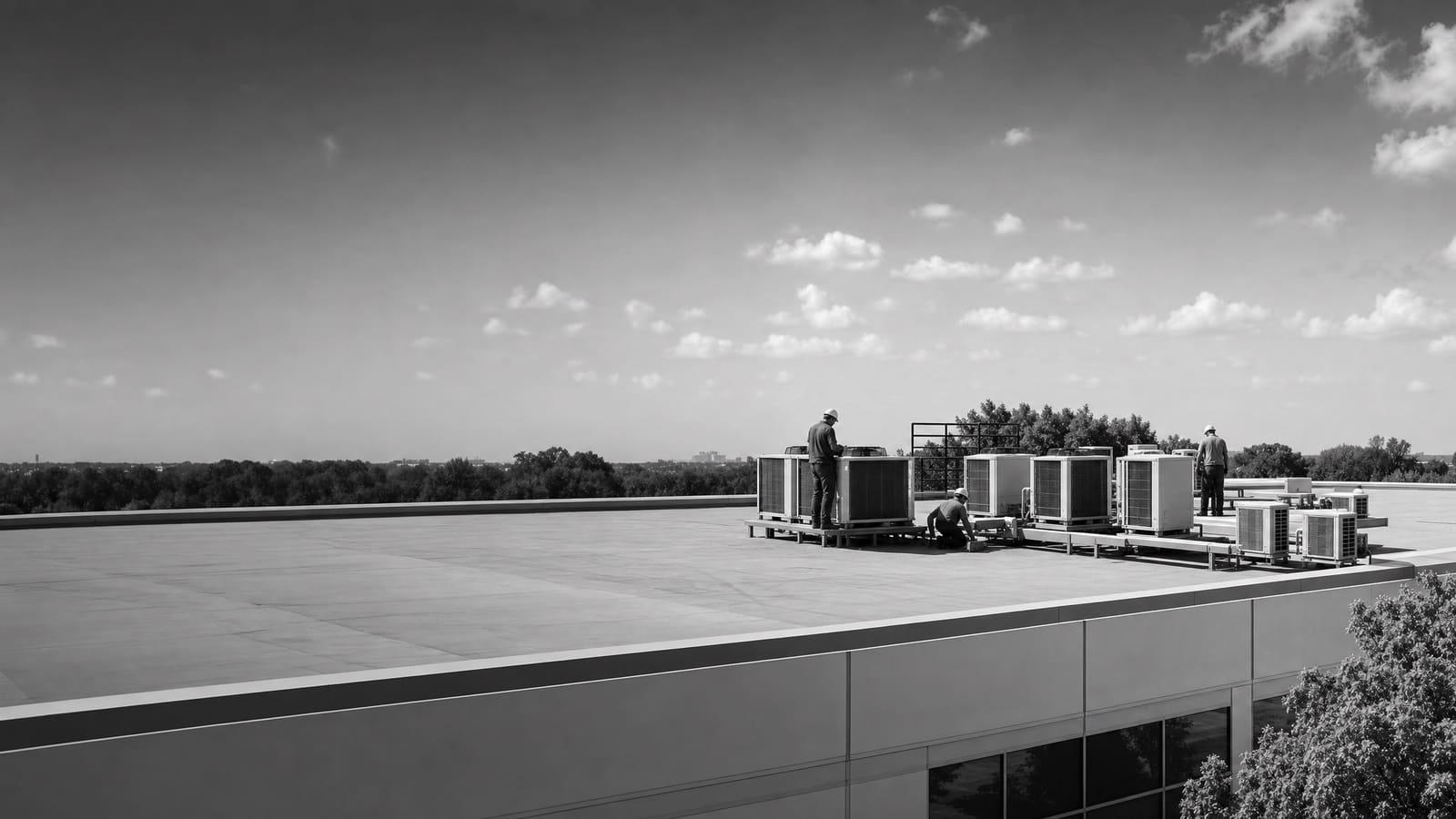
A commercial HVAC replacement covers the load calculation, equipment selection, curb and structural work, electrical and gas connections, the crane set, permits and inspection, and commissioning. Replacement beats another repair once the unit is old enough to burn money on its own. DOE puts the waste from aging commercial rooftop units at roughly $900 to $3,700 per unit each year, and units past fifteen years are the usual offenders.
A site review still has to confirm tonnage against how the space is used today, roof and curb condition, available electrical capacity, and what code items the replacement triggers.
THREE PATHS
Repair, like-for-like, or a better unit
Most buildings reach this decision the same way: a rooftop unit fails in season and the call has to be made in a week. Facility teams often delay replacement until the unit no longer holds the space, needs constant service, or dies outright. DOE guidance is direct about that pattern — replacing an inefficient unit on purpose usually beats both replacement-on-failure and a like-for-like swap at end of life. The three paths below are the real options, and the right one depends on how long you hold the building, what the space does now, and whether the roof and the electrical panel can support a change. Price all three before the crane is scheduled, because after a failure there is rarely time to compare.
WHAT MOVES THE NUMBER
Where the money actually goes
Equipment is only part of the invoice. These are the lines that separate two quotes on the same building, and the ones worth asking about before you compare totals.
IN PRACTICE
How to buy the unit, not just the swap
The nameplate on the old unit tells you what someone sized twenty years ago, not what the space needs now. Occupancy, plug loads, lighting, and interior walls all change. Confirming the load before the order is the cheapest step in the project and the one most often skipped, because it happens while the building is hot and everyone wants a unit on the roof.
Efficiency tier is the second real decision. DOE's rooftop unit challenge pushed manufacturers to build units that cut energy use by up to half against the prior standard, and manufacturers have since offered more than twenty models that exceed that specification. That gap is why a high-efficiency unit can be worth more than its price difference over a long hold, especially in a building that runs long hours.
The third is availability. Equipment options should come with real lead times attached, not a catalog page. DOE lists equipment availability and contractor familiarity as their own decision factors, and that matters more for newer heat pump and low-GWP refrigerant configurations than for a standard gas-electric unit. Ask which units the installer has actually set and started up this year.
SCOPE CHECK
What makes this project simple or hard
Two buildings with the same tonnage can be very different projects. The difference is almost always what sits around the unit, not the unit itself.
LOWER COMPLEXITY
Same unit, same footprint
The existing curb fits, tonnage is unchanged, gas and electric are already sized, and the crane has open lot space. Permitting is routine and the set happens in one morning.
HIGHER COMPLEXITY
Fuel switch or a bigger unit
Going all-electric, adding tonnage, or changing the footprint. Now you are checking service capacity, panel space, roof structure, gas line removal, and which code items come along with the permit.
BEFORE THE QUOTE
What a site review has to verify
A quote is only as good as the walk that produced it. On the roof, the review confirms the actual model and tonnage, the condition of the curb and the deck under it, clearance around the unit, and how a crane would reach it. Inside, it confirms what the space is used for now and where the ductwork actually runs.
The infrastructure questions are where projects get expensive late. DOE's heat pump rooftop guidance groups them plainly: electrical capacity, physical constraints, and gas lines. If the building is a candidate for an electric unit, someone has to look at the panel and the service before the order, not after the unit lands. Physical constraints count too — weight, curb dimensions, and whether the new unit fits the opening it is replacing.
Refrigerant belongs on the same walk. EPA rules under Section 608 govern how refrigerant is handled and recovered when equipment comes out, so removal is regulated work rather than scrap hauling. On a mixed fleet, the review should also note which units run which refrigerant, because that shapes your service and spare-parts plan for years.
Five things to confirm on the roof
Model and tonnage on the nameplate, curb dimensions and deck condition, panel capacity and open breaker space, gas line size and location, and crane reach from the nearest usable lot area.
IN NAMPA
Idaho licensing and permit rules on a commercial job
Idaho regulates HVAC installation at the state level. The administrative rules set minimum standards for HVAC installation practice, define who may do the work through HVAC and specialty HVAC contractor licensing, and cover the journeyman and apprentice technicians those contractors employ. The journeyman path runs on documented experience — sixteen thousand hours under the requirements of the jurisdiction. The same rules govern permits and inspections through the state Division, and they adopt the Idaho Mechanical Code as the technical standard your replacement is inspected against.
One detail catches commercial buyers off guard: for commercial or industrial HVAC work, the permit submission requires a verified copy of bid acceptance along with the permit fee. The paperwork chain between your signed proposal and the permit is not optional, and a contractor who rarely does commercial work in Idaho may not have it ready.
Ask before you sign
Ask for the Idaho HVAC license number, who pulls the mechanical permit, and how the verified bid acceptance gets filed. Confirm the current rule edition and which office holds jurisdiction over your address, since that shapes the schedule more than the crane does.
OWNERSHIP
Two things to settle before the order
A rooftop replacement is a decade-plus decision that usually gets made in a bad week. Two questions settle most of it. The first is your hold period on the building or the lease, because that decides how much up-front premium is worth paying for lower operating cost. The second is your fuel direction, since an electric unit is far easier to plan for now than to retrofit later. Both are ownership questions rather than engineering ones, and the answer should come from you instead of from whoever happens to be on the roof that week.
HOLD PERIOD
Owner-occupied versus leased
An owner holding the building for years captures the energy savings and should weigh the efficient unit seriously. On a short lease with a landlord-owned roof, get the cost split in writing before equipment is ordered.
FUEL PATH
Gas, dual fuel, or all-electric
Heat pump efficiency drops as outdoor temperature falls, which is why DOE separates standard, dual-fuel, and cold-climate heat pump units. In a climate with a real winter heating season, the dual-fuel and cold-climate configurations are the ones worth pricing.
OVER TIME
Phasing a fleet instead of reacting to it
If you own more than one unit, the expensive habit is replacing them one failure at a time. Every emergency swap pays the premium of a rushed schedule and locks in whatever equipment happens to be available that week. A fleet plan turns that into procurement. List every unit with its age, tonnage, refrigerant, and service history, then sort by which one is most likely to fail and most expensive to run.
The upside is not theoretical. Under DOE's Advanced RTU Campaign, more than 200 organizations upgraded over 43,000 rooftop units, and those upgrades save a combined $37 million a year on energy bills. The same math applies at two buildings: the unit you replace on your schedule costs less than the same unit replaced on its own.
Phasing also gives you leverage. Multiple units ordered together buy better pricing and one mobilization instead of three. It lets you standardize on a refrigerant and a controls platform, which cuts what your service contractor has to stock. And it lets you do the electrical work once, during a planned outage, instead of discovering the panel is full on the morning the crane is booked.
THE QUOTE
Five things a comparable quote shows
Two quotes are only comparable when both spell out the same scope. If one is a single line with a number at the bottom, it is not a quote — it is a guess with a signature block. Look for these five.
01
Equipment, spelled out
Manufacturer, model, tonnage, efficiency tier, refrigerant, and heating type. Not "new rooftop unit."
02
A real lead time
The availability date for that specific unit, dated, plus what happens to the schedule if it slips.
03
Everything around the unit
Curb adapter, structural work, electrical, gas, controls, and any code item the replacement triggers.
04
Permits, inspection, and rigging
Who pulls the permit, who files the bid acceptance, who books the crane, and how long the lot is closed.
05
Startup and commissioning
Charge, airflow, and control settings verified against spec and documented, so the warranty holds up.
Get a defensible number
Price the equipment and the building together.
Send the address, operating target, and target opening date. Flux will identify what must be verified before the project can be priced.
Get a free estimateQuestions
Straight answers.
When is replacement better than one more repair?
Once repairs repeat on a unit past about fifteen years, you are paying twice: for the service calls and for the energy the old unit wastes, which DOE estimates at roughly $900 to $3,700 per unit a year. Replacing on purpose beats replacing on failure, because you get to choose the equipment and the schedule.
Does a commercial job in Nampa need a state permit?
Idaho's administrative rules cover HVAC licensing, permits, and inspections, and adopt the Idaho Mechanical Code as the standard the work is inspected against. For commercial or industrial work, the permit submission requires a verified copy of bid acceptance along with the fee. Confirm the current rule edition and which office holds jurisdiction over your address.
Should we switch to a heat pump rooftop unit?
It depends on the panel, the gas line, and the winter. Heat pump heating efficiency falls as outdoor temperatures drop, which is why DOE separates standard, dual-fuel, and cold-climate units. In a climate with a genuine heating season, price a dual-fuel or cold-climate configuration rather than assuming a standard heat pump covers it.
What happens to the refrigerant in the old unit?
It has to be recovered properly. EPA rules under Section 608 of the Clean Air Act govern the handling and recycling of refrigerant in stationary air-conditioning and heat pump equipment, so removal is regulated work rather than scrap hauling. Ask for the recovery to be documented in the closeout package.
How do we compare two quotes that differ a lot?
Line them up on scope, not on the total. Confirm both list the same tonnage and efficiency tier, the same curb and electrical work, the same permit responsibility, and commissioning at the end. Most large gaps come from one quote leaving something out that you will pay for later anyway.
Sources used for this guide
- [1]betterbuildingssolutioncenter.energy.gov — DOE Advanced Rooftop Unit Replacement Guidance
- [2]betterbuildingssolutioncenter.energy.gov — DOE Commercial Heat Pump Rooftop Unit Replacement Guidance
- [3]betterbuildingssolutioncenter.energy.gov — DOE High-Efficiency Commercial Rooftop Unit Toolkit
- [4]energy.gov — DOE Efficient Commercial Rooftop Air Conditioner Program
- [5]epa.gov — EPA Stationary HVAC Refrigerant Management
- [6]adminrules.idaho.gov — 2024 Idaho Administrative Code Archive