THE DIRECT ANSWER
What a commercial HVAC replacement actually includes
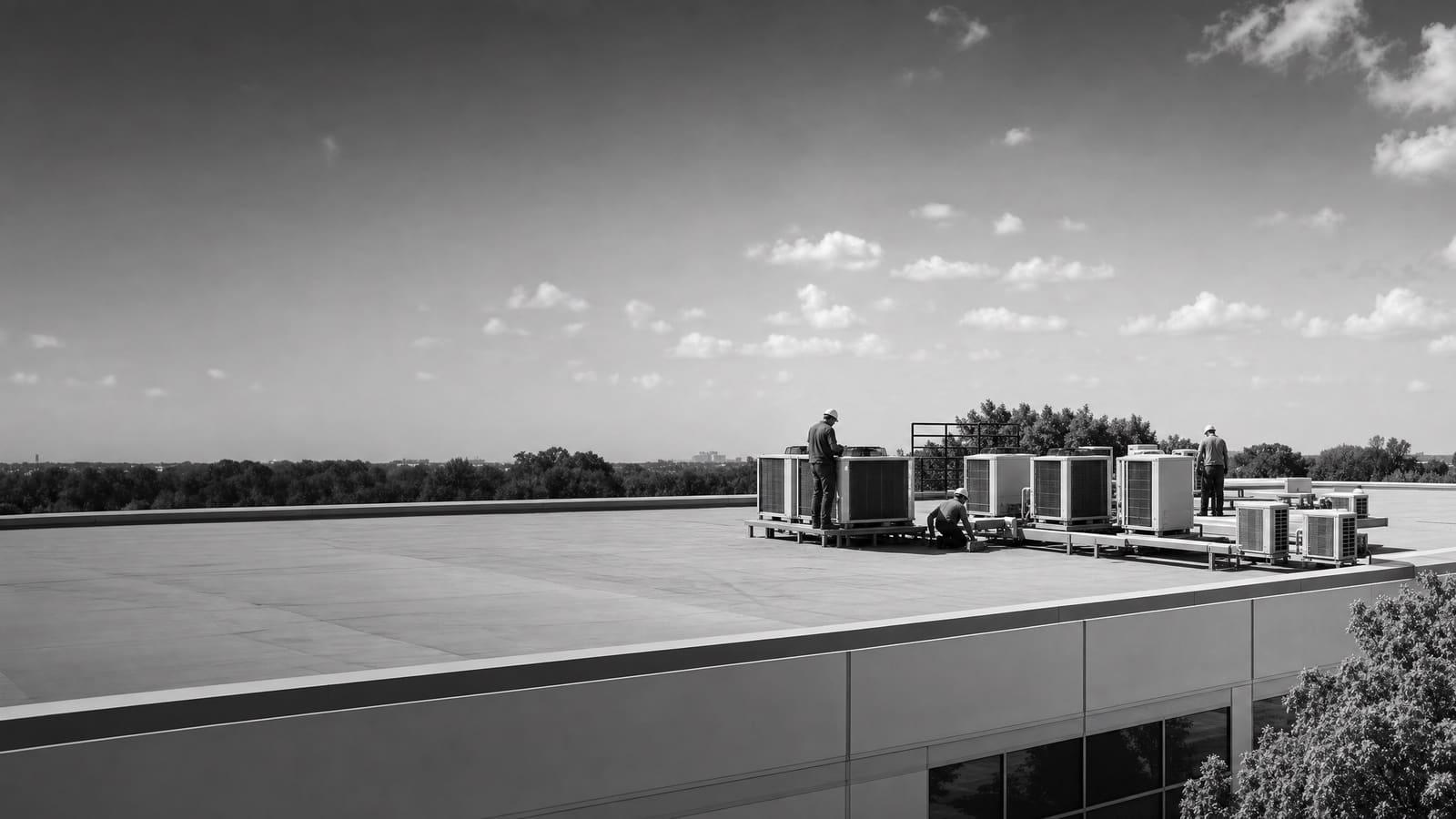
A commercial HVAC installation is a load check, an equipment selection, a rigging and permit plan, and a documented startup. Replacement beats one more repair once the unit needs frequent service, can no longer hold the space, or has passed fifteen years. Rooftop units past that age waste substantial energy: an old, inefficient unit can cost $900 to $3,700 a year in wasted energy before it ever fails.
A site review has to confirm three things before any price is real: the load the space carries today, whether the roof and curb can take the new unit, and whether the electrical service and gas line support the equipment you want.
THREE WAYS FORWARD
Your three real options when a unit is failing
Most buildings arrive at this decision the same way. A unit is limping, the service calls are stacking up, and someone asks whether to fix it again. There are only three honest answers, and the right one depends on how much life the rest of the system has.
The trap is waiting for total failure. Replacement-on-failure means you take whatever unit is available that week, at whatever price, on whatever schedule the crane and the permit office allow. Planning the same swap six months earlier usually costs less and always disrupts less, because you choose the equipment instead of accepting it.
The second question is heating. If your old unit burned gas, you now have a real choice between another gas unit, a dual-fuel heat pump, and an all-electric heat pump. That choice is not just an efficiency preference — it changes your electrical scope, your gas line, and what your building does during a hard cold snap.
WHAT MOVES THE NUMBER
The budget lines that actually swing
No one can quote a commercial replacement from a tonnage number alone. These are the lines that separate a routine swap from a project, and each one is worth asking about before you compare two proposals.
IN PRACTICE
How to choose the equipment, not just the size
Start with the load, not the nameplate. A unit installed twenty years ago was sized for the building as it was then. Occupancy changed, lighting changed, plug loads changed, and the envelope may have been improved. Carrying the old tonnage forward carries the old mistake forward too, which is how buildings end up with units that short-cycle and never quite hold humidity.
Then decide what the unit burns. Heat pump rooftops are close cousins of standard air-conditioning rooftops — same cabinet, same crane day — with the added ability to run the refrigerant cycle backward for heat. Across most of the South, today's heat pump rooftops are capable of handling most or all of the winter heating demand, and Murfreesboro sits inside that region. What tips the answer is your electricity price against your gas price, and whether the building can absorb a hard cold snap on electric backup heat.
Finally, ask what the market can actually deliver. Equipment availability and the local contractor bench are real constraints, not footnotes. A unit that is perfect on paper and twelve weeks out is a worse choice than a very good unit sitting in a regional warehouse when your building is running on one working rooftop in August.
TWO KINDS OF PROJECT
What makes this simple, and what makes it a project
Two replacements with the same tonnage can be very different jobs. What separates them is almost never the unit itself — it is the infrastructure the unit lands on, and how much of that has to change.
LOWER COMPLEXITY
Same fuel, same footprint
The new unit matches the old cabinet on a curb adapter. Existing electrical service and gas line carry it without change. The lot has clear crane reach, and the building can give up a weekend morning. This is a one-day set with a routine permit.
HIGHER COMPLEXITY
Fuel switch or a bigger box
Going all-electric puts new demand on the panel and may strand a gas line. A larger unit adds weight and footprint, which pulls in structural review. Tight roof access, occupied hours, or a specialty unit with a long lead time stretch the schedule well past one morning.
BEFORE YOU PRICE IT
What a site review has to settle
A useful site review answers a fixed set of questions, and the questions are the same whether you own one building or forty. What is the actual load today? Can the roof and the existing curb take the unit being proposed? Does the electrical service have headroom for the equipment you want, including any backup heat? Is there a gas line, and does it stay or go? Can a crane reach the unit, and what does the lot have to give up on the day?
Two more questions get skipped and shouldn't be. The first is availability: what is really in stock, and what is a lead time dressed up as a delivery date. The second is the crew, because the equipment you choose is only as good as the people who commission it. Unfamiliar equipment installed by an unfamiliar crew is where the comfort complaints in month two come from.
Walk the roof with the contractor before you accept a number. A proposal written from a nameplate photo and a phone call is an estimate. A proposal written after someone stood next to the unit and opened the panel is a price.
Make them show the checklist
Ask for the review in writing: load basis, curb and structural condition, electrical capacity, gas line disposition, crane access, and confirmed equipment availability. If a contractor can't put those six lines on paper before quoting, the number is a guess and the change orders are already coming.
IN MURFREESBORO
The Tennessee license rule that decides who can bid
Tennessee draws a hard line at $25,000. Above that number, an HVAC contractor needs a state contractor's license with the CMC-C classification, or the broader CMC full mechanical classification. Below it, most projects are regulated locally, and the city or county sets the license, permit, and inspection requirements itself.
Almost any commercial rooftop replacement lands above that line. That makes license class a bid-qualification question, not paperwork you sort out later. A contractor without the right classification cannot legally hold the project, and finding that out after the unit is ordered is an expensive way to learn it.
The smaller work is where it gets local. On a repair-scale job under $25,000, the requirements come from Murfreesboro and Rutherford County rather than the state — and where the Fire Marshal's electrical inspectors do the inspecting, the electrical side of an HVAC permit can require a state Limited Licensed Electrician, though a CMC-C contractor's license also satisfies it.
Ask for the license number, not the logo
Before you compare bids, confirm each contractor holds an active CMC-C or CMC classification, and confirm with the City of Murfreesboro which office issues the mechanical permit and who inspects the electrical work. Both answers take one phone call, and both change who can legally do the job.
AFTER THE CRANE LEAVES
Two things that outlive the install
The install is one morning. The ownership decisions you make around it last far longer, and they are much easier to get right before the purchase order than after.
The first is timing across a fleet. If you run more than one rooftop, the units are almost certainly the same age, which means they will fail inside the same narrow window. Sequencing those replacements on your budget calendar instead of on the equipment's failure calendar is the single largest lever most owners have.
The second is what's inside the box. Refrigerant handling in commercial equipment is federally regulated, and the rules follow the unit for its whole life. That is a service-contract question, not an installation-day question.
OWNERSHIP
Plan the fleet, not the failure
Replacing proactively usually beats replacing on failure, and it beats a like-for-like swap at end of life. You pick the equipment, the price, and the week — instead of taking whatever is available the day the unit dies.
OPERATING
Refrigerant follows the unit
Federal rules govern how refrigerant is recovered, serviced, and documented in commercial equipment. Mixed fleets need that written into the service contract, so certified labor and the right parts are lined up before a leak, not after.
THE LONG NUMBER
Phasing, procurement, and what the unit costs to own
Purchase price is the smallest part of the number. The unit stays on the roof long after the invoice clears, and the difference between an efficiency tier you chose and one you accepted shows up every month it runs. When a single aging rooftop can waste $900 to $3,700 a year on its own, the payback math on a better unit is usually shorter than the budget conversation implies.
Procurement is where owners lose ground. Lead times are the real schedule, and they do not respond to urgency. Order early enough that you are choosing equipment rather than accepting substitutes, and get availability written next to the price so a change in one is visible against the other.
If you have several units, phase them deliberately. Replace the worst performer first, run it a season, and use the actual utility data to justify the rest of the program. That sequencing does two useful things: it gives your finance side a real number instead of a projection, and it lets your crew and your controls absorb one unit at a time instead of all of them during the same August.
APPLES TO APPLES
Five things every quote should show
Two proposals are only comparable when they scope the same work. Ask every bidder to put these five on the page, and the gap between a real price and a low number becomes obvious in about ninety seconds.
01
The specified unit, in full
Make, model, tonnage, efficiency tier, and heating type — gas, dual-fuel, or heat pump — not just "like for like."
02
Curb, roof, and structural scope
Curb adapter or new curb, any roof patching, and whether structural review is included or excluded.
03
Electrical and gas scope
Service capacity confirmed, disconnect and whip, and what happens to the existing gas line.
04
Rigging, access, and lead time
Crane day, lot closure, working hours, and the equipment availability date sitting next to the price.
05
Startup, commissioning, and permits
Charge, airflow, and controls verified in writing, refrigerant recovered per federal rules, permits and inspections named as included.
Get a defensible number
Price the equipment and the building together.
Send the address, operating target, and target opening date. Flux will identify what must be verified before the project can be priced.
Get a free estimateQuestions
Straight answers.
When is replacement better than another repair?
Once a unit needs frequent service, can no longer hold the space, or has passed fifteen years, replacement usually wins. Rooftop units past that age waste substantial energy, and replacing proactively costs less than replacing on failure, when you take whatever equipment is available that week.
Should you switch to a heat pump rooftop unit?
Across most of the South, today's heat pump rooftops handle most or all of the winter heating demand, so it is a real option here. Check three things first: your electricity price against gas, your electrical service capacity, and how the building rides out a hard cold snap on backup heat.
What license does a commercial HVAC contractor need in Murfreesboro?
Tennessee requires a state contractor's license with the CMC-C classification, or the broader CMC full mechanical classification, on HVAC projects over $25,000. Under that amount, Murfreesboro and Rutherford County set the license, permit, and inspection rules, so confirm both before you compare bids.
What if the budget won't cover replacement this year?
Retrofitting an existing unit with advanced controls is a legitimate middle path when the unit still has life in it. It cuts waste without a crane day or a permit, and it buys time to plan the replacement on your calendar instead of the equipment's.
Does a new unit change how the system is serviced?
Refrigerant handling in commercial equipment is federally regulated for the life of the unit, covering recovery at removal, certified technicians, leak repair, and recordkeeping. If your fleet ends up running more than one refrigerant, write that into the service contract so parts and certified labor are lined up in advance.
Sources used for this guide
- [1]betterbuildingssolutioncenter.energy.gov — DOE Advanced Rooftop Unit Replacement Guidance
- [2]betterbuildingssolutioncenter.energy.gov — DOE Commercial Heat Pump Rooftop Unit Replacement Guidance
- [3]betterbuildingssolutioncenter.energy.gov — DOE High-Efficiency Commercial Rooftop Unit Toolkit
- [4]energy.gov — DOE Efficient Commercial Rooftop Air Conditioner Program
- [5]epa.gov — EPA Stationary HVAC Refrigerant Management
- [6]support.commerce.tn.gov — HVAC Projects Less Than $25,000