THE DIRECT ANSWER
What commercial HVAC replacement includes
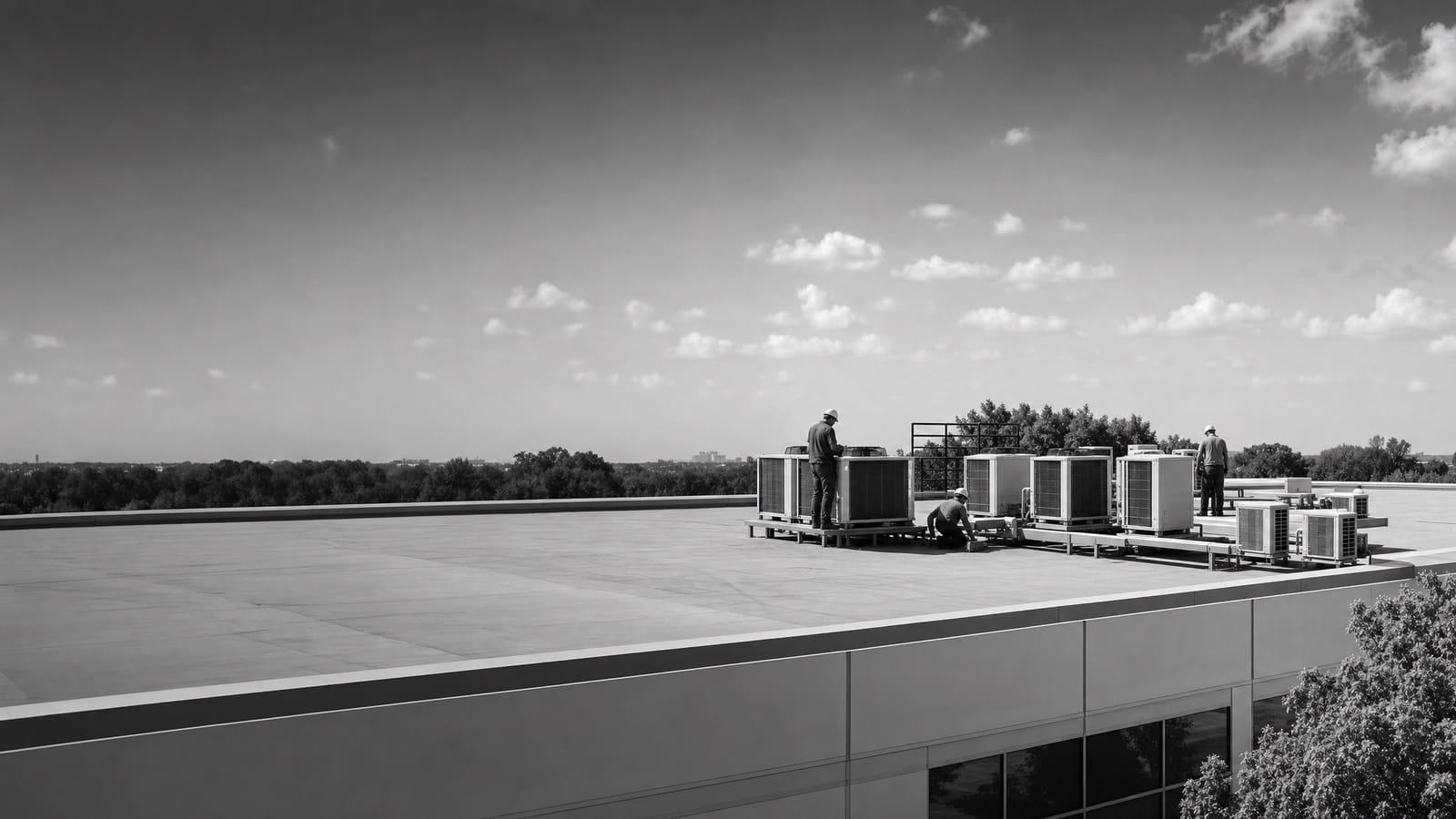
Commercial HVAC replacement covers load review, equipment selection, permits, removal, rigging, utility connections, controls, startup, and commissioning. Replacement becomes more useful than another repair when an older unit needs frequent service, cannot hold comfort, or risks failing during occupied hours. DOE guidance notes that rooftop units over 15 years old can waste substantial energy compared with newer equipment.
A site review should confirm the actual load, roof curb, structure, electrical capacity, gas service, ventilation, controls, drainage, crane access, and equipment availability.
THREE OPERATING CHOICES
Choose the replacement path before choosing a model
Start with the business problem. A failed compressor does not always mean the whole system should be replaced. Yet repeated repairs can hide a larger cost: unreliable operation, rising maintenance, poor temperature control, and rushed replacement after final failure.
A like-for-like rooftop unit can simplify the job when the space, load, curb, utilities, and operating schedule have not changed. Right-sizing is more useful after a tenant change, remodel, occupancy shift, or equipment upgrade. A heat pump rooftop unit adds another decision. DOE guidance says climate, utility costs, emissions goals, building type, electrical capacity, physical constraints, gas lines, equipment availability, and contractor knowledge should all be reviewed.
Ask for more than one technically sound choice when possible. The quote should show why each option fits, what building changes it needs, and how it affects the installation schedule.
BUDGET STRUCTURE
What moves an installed HVAC price
The supplied research does not support one universal installed price. Compare the complete scope instead of comparing equipment totals alone.
EQUIPMENT FIT
Compare systems by how the building operates
Packaged rooftop units combine major heating, cooling, and air-moving parts in one outdoor cabinet. They are common across commercial buildings and condition nearly half of U.S. commercial floor area. They can be practical where the roof, ducts, utilities, and service access already support them.
A high-efficiency rooftop unit can lower energy use compared with an old, inefficient unit, but the result depends on more than a published rating. Fan control, part-load performance, ventilation, economizer operation, thermostat schedules, duct condition, and commissioning all affect real operation. DOE documented older commercial rooftop units wasting $900 to $3,700 per unit annually in historical program findings. That is evidence of the opportunity in inefficient units, not a forecast for a specific Mountain View building.
Heat pump rooftop units cool like conventional air-conditioning units and provide reverse-cycle heating. DOE says they are well suited to mild-to-moderate winter heating, while the final choice still depends on local utility rates, electrical capacity, heating load, emissions goals, and infrastructure. Compare an all-electric heat pump, a dual-fuel option, and a conventional replacement only when each one can meet the same load and operating requirements.
PROJECT COMPLEXITY
A simple swap and an engineered change are different jobs
The equipment may look similar from the parking lot, but changes to capacity, weight, utilities, ventilation, controls, or roof layout can turn a replacement into a larger project.
LOWER COMPLEXITY
Compatible replacement
The selected unit fits the existing curb, load, electrical service, fuel, ducts, drainage, controls, and lift plan. The quote should still include permits, startup, commissioning, and closeout.
HIGHER COMPLEXITY
System or infrastructure change
A capacity change, heat pump conversion, heavier unit, new curb, added ventilation, electrical upgrade, duct revision, or automation integration needs added design and coordination.
SITE REVIEW
Measure the building before ordering the unit
Begin with the existing equipment record. Capture the manufacturer, model, serial number, capacity, heat type, voltage, refrigerant, curb dimensions, control points, and service history. A nameplate photo helps, but it does not prove that the old unit was sized correctly.
Review the space as it operates now. Note occupied hours, head count, process loads, computers, cooking or production equipment, exterior exposure, ventilation needs, and rooms with recurring complaints. Recent remodels or tenant changes can make the old capacity a poor guide. Oversizing can also cause short cycling and weak humidity control, so added capacity is not an automatic cure for comfort trouble.
The roof review should cover safe access, curb condition, drainage, nearby exhaust, service clearances, roofing details, and the path for rigging. The contractor should also inspect ducts, filters, outside-air components, gas piping, electrical service, disconnects, condensate routing, thermostats, and building automation. If a heat pump is under consideration, verify available electrical capacity before treating electrification as a simple equipment substitution.
Ask for written assumptions
The proposal should state the load basis, reused components, excluded repairs, utility assumptions, access plan, equipment lead time, and conditions that could trigger a change order.
OWNER PRIORITIES
Balance continuity with long-term performance
Planned replacement gives an owner time to compare capacity, efficiency, heat source, controls, and infrastructure before a failure removes those choices. DOE guidance describes proactive replacement of inefficient and underperforming rooftop units as potentially smarter than waiting for failure or making an automatic like-for-like purchase.
Reliability still comes first for many facilities. Review which spaces can lose conditioning, how long an outage can last, and whether work can be phased. A multi-unit property may benefit from replacing the weakest units first while using the same controls strategy and a manageable set of equipment families. Keep the decision tied to measured condition and operating risk rather than age alone.
OPERATIONS
Protect occupied hours
Define shutdown windows, temporary measures, noise limits, roof access, parking controls, tenant notices, and weather limits before the installation date.
OWNERSHIP
Plan the service life
Compare maintenance access, parts strategy, controls support, warranty terms, expected energy use, refrigerant service, and staff training with the purchase price.
INSTALLATION DAY
Plan the work so the lift is the easy part
Before delivery, the team should confirm the ordered model against the approved submittal, field dimensions, weight, curb or adapter, electrical data, heat source, controls, and accessories. The rigging plan should identify crane position, lifting path, exclusion zones, roof protection, traffic control, and weather limits. Occupants need a clear outage window and a contact for schedule changes.
After the old equipment is isolated, qualified workers must recover and manage refrigerant under federal requirements. EPA rules address refrigerant handling and recycling for stationary air-conditioning and heat pump equipment. The quote should identify removal and lawful disposal of the old unit rather than leaving those tasks unclear.
Once the new unit is set, the crew connects ducts, power, gas where used, condensate, controls, and outside air. Startup is not the finish line. Commissioning should verify airflow, temperatures, refrigerant operation, fan response, heating and cooling stages, ventilation, safeties, schedules, sensors, alarms, and automation points. Record the settings. A system that merely turns on may still waste energy or create comfort calls.
PROCUREMENT
Compare total scope, not the lowest first number
Send the same scope request to every bidder. Include operating hours, known comfort issues, available plans, equipment records, access limits, desired schedule, and any electrification or emissions goals. Require bidders to identify the exact proposed equipment and major accessories. “Replace rooftop unit” is too broad for a sound comparison.
Separate the base installation from options. Useful alternates may include a higher-efficiency unit, heat pump configuration, controls upgrade, curb work, duct repair, electrical work, or phased replacement of several units. Each alternate should explain its effect on price, schedule, infrastructure, and operation. Do not count an incentive unless its current eligibility, funding, deadline, and application sequence have been verified for the exact project. No current Mountain View incentive is established by the supplied research.
Review lifetime effects alongside the initial price. Consider expected energy use, maintenance needs, repair access, replacement parts, controls compatibility, refrigerant service, and the cost of an unplanned outage. An efficient unit can underperform when airflow, schedules, sensors, or outside-air settings are wrong. That is why commissioning and usable closeout documents are part of the purchase, not optional polish.
QUOTE CHECKLIST
Five things every comparable quote should show
A clear proposal lets an owner compare the same result across bidders and reduces disputes after equipment is ordered.
01
Exact equipment
List model, capacity, efficiency, heat type, voltage, refrigerant, accessories, controls, warranty, and stated availability.
02
Complete field scope
Define demolition, disposal, curb, roof, ducts, drains, electrical, gas, ventilation, controls, rigging, and protection.
03
Permits and coordination
State who prepares applications, answers reviews, schedules inspections, coordinates access, and closes the permit.
04
Startup and commissioning
Name every test, required report, control sequence, balancing task, deficiency correction, and owner training item.
05
Price boundaries
Show allowances, alternates, taxes, exclusions, payment terms, lead-time assumptions, schedule, and change-order triggers.
Get a defensible number
Price the equipment and the building together.
Send the address, operating target, and target opening date. Flux will identify what must be verified before the project can be priced.
Get a free estimateQuestions
Straight answers.
When is replacement better than another commercial HVAC repair?
Replacement deserves serious review when an older unit needs frequent repairs, cannot maintain occupied conditions, uses excessive energy, has difficult parts support, or creates unacceptable failure risk. DOE notes that rooftop units over 15 years old can waste substantial energy compared with newer models. Age alone is not the decision; combine condition, repair history, performance, and operating risk.
Should a Mountain View business replace its rooftop unit like-for-like?
Like-for-like can work when the building use, load, curb, utilities, ventilation, and controls remain suitable. Recalculate or verify the load after changes to occupancy, hours, equipment, envelope, or floor plan. A compatible cabinet does not prove that the old capacity is still correct.
Is a commercial heat pump rooftop unit worth considering?
Yes, as one evaluated option. DOE identifies mild-to-moderate winter heating as a strong application for heat pump rooftop units, but the choice still requires a review of heating loads, electricity and gas costs, electrical capacity, physical space, emissions goals, equipment availability, and contractor capability.
How much does commercial HVAC installation cost in Mountain View?
The supplied research does not establish a reliable local installed range. Price depends on equipment capacity and efficiency, curb and structural work, crane access, electrical or gas changes, ducts, controls, permits, commissioning, and schedule. Ask for an itemized installed proposal after a field review.
Who should handle refrigerant from the old commercial unit?
Qualified HVAC personnel should recover and manage it as required by EPA Section 608 rules. The installation proposal should state who handles recovery, recycling or disposal, related records, and removal of the old equipment.
What should happen during HVAC commissioning?
The team should verify airflow, heating and cooling stages, fan operation, temperatures, refrigerant performance, ventilation, safeties, schedules, sensors, alarms, and building automation points. The owner should receive recorded settings, startup reports, warranty information, and operating guidance.
Should incentives be included in the project budget?
Treat incentives as unconfirmed until the current program administrator verifies eligibility, funding, deadlines, equipment requirements, and whether approval must occur before purchase or installation. The supplied research does not establish a current Mountain View incentive for August 2026.
Sources used for this guide
- [1]betterbuildingssolutioncenter.energy.gov — DOE Advanced Rooftop Unit Replacement Guidance
- [2]betterbuildingssolutioncenter.energy.gov — DOE Commercial Heat Pump Rooftop Unit Replacement Guidance
- [3]betterbuildingssolutioncenter.energy.gov — DOE High-Efficiency Commercial Rooftop Unit Toolkit
- [4]energy.gov — DOE Efficient Commercial Rooftop Air Conditioner Program
- [5]epa.gov — EPA Stationary HVAC Refrigerant Management
- [6]californiacity-ca.gov — HVAC Permits