THE DIRECT ANSWER
What a commercial HVAC replacement actually includes
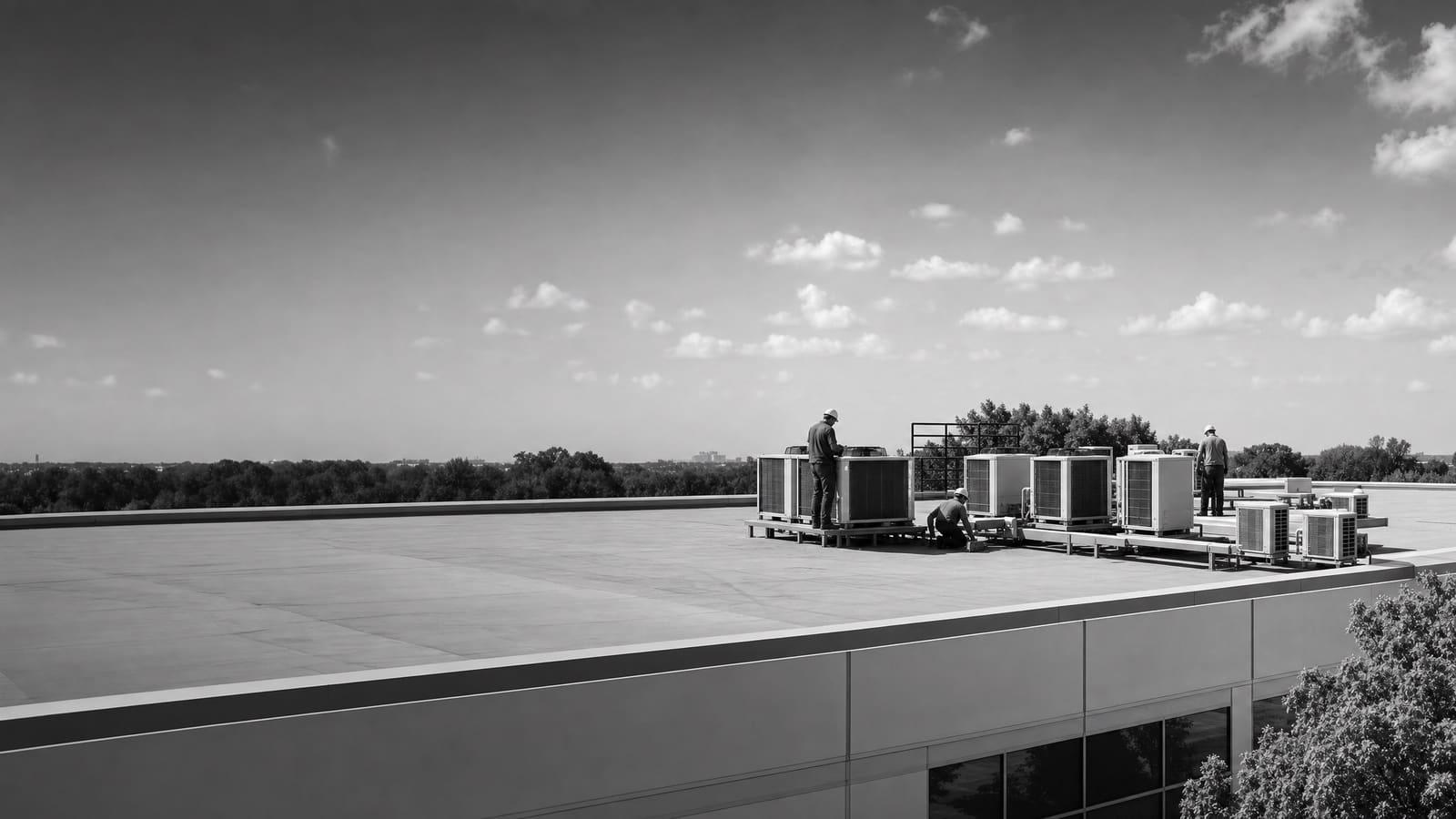
A commercial HVAC replacement is four jobs in one: confirm the load the building carries today, select equipment that is actually available on your schedule, get the old unit off and the new one set and connected, and commission the system so it performs to spec. Another repair stops making sense once a unit is past fifteen years and failing in season. Old, inefficient rooftop units waste roughly $900 to $3,700 each per year, and that number usually settles the argument.
A site review still has to confirm tonnage against current occupancy, the curb and the roof structure under it, available electrical capacity, and crane access before any price is real.
THREE WAYS TO GO
Three ways to handle an aging rooftop unit
Rooftop units cool close to half of all commercial floor space in the country, so this is the decision most facility owners meet first. Units past fifteen years are the ones worth putting on a list. Most buildings still wait for failure, which is the most expensive way to buy equipment: you take whatever is available, on whoever's schedule, during the week you can least afford to be down.
Replacing before failure is the move that gives you leverage over price, timing, and specification. From there the question is what you put back. A straight swap is fastest and cheapest to engineer. A higher-efficiency unit or a heat pump costs more up front and pays back through the utility bill for the rest of the unit's service life. There is also a middle path worth pricing on units that still have life left: keep the equipment and retrofit advanced controls instead of replacing the box.
WHAT MOVES THE NUMBER
Where a commercial HVAC installation budget actually goes
There is no universal installed price for a commercial unit, and any number quoted before someone looks at the roof is a guess. What there is, is a short list of line items that decide where your project lands. Ask for each one separately on the quote so you can compare two bids without guessing what is buried in a lump sum.
IN PRACTICE
Choose the equipment before you argue about the price
The nameplate on the old unit is a record of what someone thought the building needed fifteen or twenty years ago. Occupancy changed. Lighting changed. Plug loads changed. Sometimes a wall moved. Carrying the old tonnage forward carries the old sizing mistake forward too, and oversized equipment short-cycles, handles humidity poorly, and wears itself out early. Confirm the load first, then decide whether the answer happens to be the same size.
The second fork is fuel. Heat pump rooftop units are close cousins of standard air-conditioning units — similar footprint, similar install — but they heat by running the cycle backward instead of burning gas. Their heating efficiency falls as outdoor temperatures drop, so they suit buildings with mild to moderate winter heating loads. Across most of the South and West, today's heat pump rooftop units can cover most or all of the winter heating a commercial building needs. Whether that pencils out for your building depends on your electricity and gas rates, the electrical capacity at your panel, and any incentives available when you buy.
The third fork is efficiency tier. High-performance rooftop units were built to cut energy use by up to half compared with the older standard, and more than twenty models now exceed that specification. That is the range you are choosing inside of when you compare a base unit against a premium one.
SCOPE CHECK
What makes one replacement simple and another complicated
Two buildings on the same street can get very different quotes for the same tonnage. The difference is rarely the equipment itself. It is what the building makes you do to get the unit up there and running.
LOWER COMPLEXITY
Same size, same spot, clear access
Matching tonnage on the existing curb, a roof that already carries the load, enough electrical capacity at the panel, and a lot with room to set a crane for one morning. The schedule is measured in days once the equipment lands.
HIGHER COMPLEXITY
New size, new fuel, or tight access
Larger tonnage or a new footprint pulls in curb adapters and structural review. Switching fuel pulls in panel and feeder capacity. Occupied tenants and restricted hours push the lift into nights or weekends, and that cost shows up before a single unit ships.
BEFORE YOU BUY
What a site review has to confirm
A good scoping visit is not a sales call with a tape measure. It should end with enough documented detail that two contractors could quote the same job and you could compare the numbers honestly.
Start on the roof: nameplate data, actual condition, curb dimensions, and whether the deck underneath still carries the load. Then the load itself — how the space is used now, how many people are in it, what equipment runs in it, and what hours it keeps. Then the utilities: the electrical panel and what capacity is left in it, the feeder to the unit, the gas line if there is one, and where condensate goes.
Then the logistics nobody prices until it is too late. Where the crane sets up, how far it has to reach, how many stalls close and for how long, and which hours your tenants can live with. Finally the handling rules. Federal regulations govern how refrigerant in the old equipment is recovered and recycled — it cannot simply be vented — so recovery and disposal belong in the written scope, not in someone's assumption.
A quote that arrives without those answers behind it is a price on a guess.
The scoping question that saves the most money
Ask what the contractor found on the roof that they did not expect. A visit that turns up nothing — no curb surprise, no panel constraint, no access problem — usually means nobody looked hard enough, and the difference resurfaces as a change order in week three.
OWNERSHIP MATH
Two things that outlast the install
The install is a week. The consequences run for the rest of the equipment's service life. Two of them are worth deciding on purpose instead of inheriting.
The first is what the unit costs to run. A single old, inefficient rooftop unit can waste $900 to $3,700 a year, and a roof carrying several of them is losing real money before anyone files a comfort complaint. Efficiency tier is the one line on the quote that keeps paying after the invoice clears.
The second is who pays and who benefits. In a leased building the owner usually buys the equipment while the tenant pays the power bill. That split is why so many roofs end up with the cheapest acceptable unit on them. Read the lease before you write the spec, because the answer changes what a sensible budget looks like.
OPERATING COST
Efficiency is a long-horizon decision
The premium between a base unit and a high-efficiency one is paid once. The utility difference is paid every month the unit runs. Put both numbers over the equipment's service life before the up-front price decides for you.
LEASE STRUCTURE
Who pays, who benefits
When the tenant pays the power bill and the owner buys the box, nobody is naturally motivated to spend more for a better unit. Check whether the lease allows cost recovery on capital improvements before you settle the specification.
PHASING AND PROCUREMENT
Handling a whole roof without doing it all at once
Most buildings do not have one aging rooftop unit. They have several, and they fail one at a time, always in season. The fix is boring: build the list before the first failure. Walk the roof, write down every unit's age, tonnage, model, and condition, and sort by which one is most likely to quit next.
That list becomes a replacement order you control. One this quarter, two next fiscal year, the failing one now. Buying on a plan gets better pricing than emergency work, keeps the specification consistent across the roof, and lets your service contractor stock parts for a fleet instead of a museum.
Procurement is where lead time lives. Availability moves with the season and with the specification — standard tonnage in a common configuration ships sooner than a special order with a nonstandard curb or a premium efficiency package that has to be built. Ask for availability in writing next to the price. A cheaper unit that lands weeks later is not cheaper if the space sits hot in the meantime.
And keep the operating math in the file. A unit quietly wasting a few thousand dollars a year is funding part of its own replacement. When you can show that on paper, the capital request stops being an emergency and starts being a plan.
COMPARE LIKE FOR LIKE
Five things a commercial HVAC quote should show
Two bids on the same roof can differ by a wide margin and both be honest, because they are pricing different scopes. These five lines make them comparable. When one bid is missing them, that is usually where the difference is hiding.
01
Equipment, tonnage, and efficiency tier
Model number, capacity, and the efficiency rating — not just "new rooftop unit."
02
Lead time in writing
Real availability for the unit specified, dated, and what changes if it slips.
03
Curb, structural, and roof work
Adapter, framing, curb condition, and any roof patching, priced as its own line.
04
Rigging, permits, and inspections
Who owns the crane, the lot closure, the permit applications, and the inspection sign-off.
05
Startup, commissioning, and documentation
Charge, airflow, and controls verified against spec, plus the paperwork the warranty depends on.
Get a defensible number
Price the equipment and the building together.
Send the address, operating target, and target opening date. Flux will identify what must be verified before the project can be priced.
Get a free estimateQuestions
Straight answers.
When does replacement beat another repair?
Age and repair frequency decide it. Units past fifteen years waste substantial energy compared with current equipment, and an old, inefficient rooftop unit can burn $900 to $3,700 a year on its own. Once repairs are recurring, that waste plus the next repair bill usually outruns the case for keeping it.
Should you replace like-for-like or resize?
Confirm the load either way. If occupancy, equipment, and layout are unchanged, a like-for-like swap is often right and is the cheapest path to engineer. If the space is used differently than it was, right-sizing fixes comfort and humidity problems the old unit was never going to solve.
Is a heat pump rooftop unit a good replacement for a gas unit?
Often, in mild to moderate winter climates. Heat pump rooftop units install much like standard units but heat electrically, and their efficiency drops as outdoor temperatures fall. Across most of the South and West, current models can cover most or all of a commercial building's winter heating. Your electric and gas rates, panel capacity, and available incentives decide the rest.
How much does a commercial HVAC installation cost?
Nobody can name a real number before seeing the roof, because tonnage, curb work, electrical capacity, and crane access move it more than the equipment does. Ask for those as separate lines. Then put the operating cost beside them — an old unit's annual energy waste is part of the comparison.
How long does the work actually take?
The visible part is short. The crane arrives, stalls are coned, the old unit comes off, and the new one lands on a curb adapter measured weeks earlier. The honest variable is equipment lead time, which is why availability belongs on the quote right next to the price.
What happens to the refrigerant in the old unit?
It has to be recovered and handled under federal regulations covering stationary air-conditioning and heat pump equipment, not vented to the atmosphere. Make sure recovery and disposal of the old equipment appear in the written scope so there is no argument about it on removal day.
Sources used for this guide
- [1]betterbuildingssolutioncenter.energy.gov — DOE Advanced Rooftop Unit Replacement Guidance
- [2]betterbuildingssolutioncenter.energy.gov — DOE Commercial Heat Pump Rooftop Unit Replacement Guidance
- [3]betterbuildingssolutioncenter.energy.gov — DOE High-Efficiency Commercial Rooftop Unit Toolkit
- [4]energy.gov — DOE Efficient Commercial Rooftop Air Conditioner Program
- [5]epa.gov — EPA Stationary HVAC Refrigerant Management