THE DIRECT ANSWER
Commercial HVAC replacement and installation in Milpitas.
A complete commercial HVAC replacement covers sizing, equipment selection, removal, rigging, curb or pad work, utility connections, controls, permits, startup, testing, and handoff. Replacement is often more useful than another repair when an aging unit fails often, cannot hold comfort, uses obsolete parts, or no longer fits the building load.
A site review must verify the load, roof or pad, electrical service, gas connection, ventilation, controls, access, and shutdown limits.
START WITH THE OPERATING DECISION
Choose the replacement path before choosing a model
The old unit gives the project team a starting point, but its nameplate does not prove what the building needs now. Occupancy, operating hours, lighting, process equipment, walls, windows, and ventilation needs may have changed. A load review helps prevent another oversized or undersized system.
Next, decide whether the project should preserve the current heating source or consider a heat pump rooftop unit. Heat pumps can provide cooling and reverse-cycle heating. DOE guidance says climate, utility rates, emissions goals, electrical capacity, physical limits, gas service, equipment availability, and contractor knowledge all belong in that choice.
Finally, decide whether this is an emergency swap or a planned capital project. An emergency favors available equipment and a short outage. A planned project gives the owner more room to compare efficiency, controls, electrical work, and long-term operating needs.
BUILD THE REAL BUDGET
What changes the installed price
There is no supported universal installed price for a Milpitas commercial system. The useful number is a site-specific total that separates equipment, enabling work, access, controls, and closeout.
EQUIPMENT CHOICES
Compare systems by how the building must operate
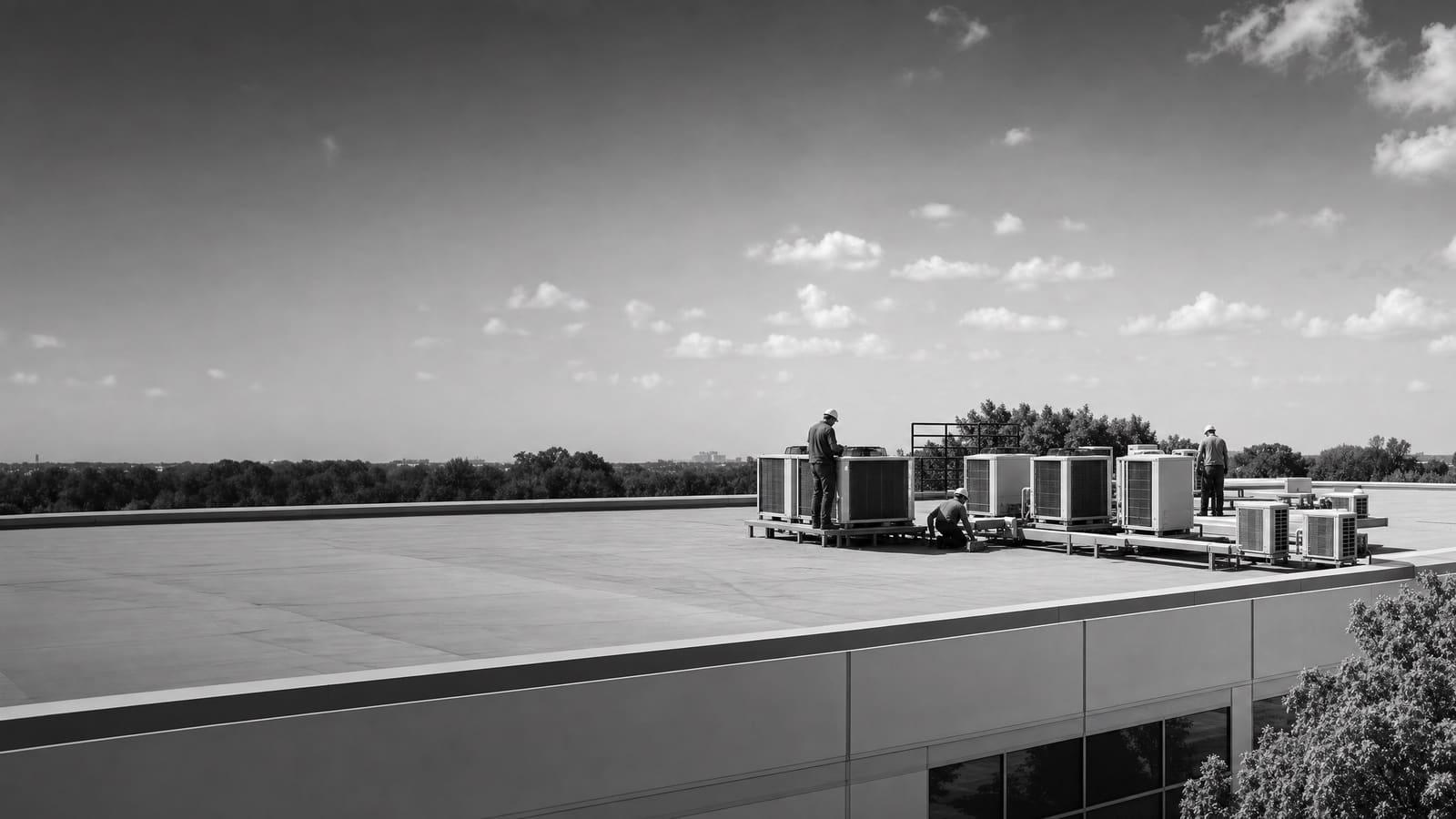
Packaged rooftop units combine major heating, cooling, and airflow components in one cabinet. They are common across commercial buildings and can make replacement more direct when the existing roof opening, curb, duct layout, and utilities remain usable. A curb adapter may connect a new cabinet to the existing opening, but it must be measured and included before equipment is ordered.
A higher-efficiency rooftop unit may add staged or variable operation and better controls. The value depends on the building schedule, load pattern, maintenance plan, and utility impact. Compare performance at the conditions the building will actually face, not just the largest number on a product sheet. DOE has documented that older commercial rooftop units can waste substantial energy, while advanced units and controls can reduce use in suitable applications.
Heat pump rooftop units add electric heating through the refrigeration cycle. They can support electrification and emissions goals, but they are not an automatic drop-in choice. Review heating demand, electrical capacity, gas removal or retention, backup heat, controls, available products, and projected utility bills. For a deeper screening path, see commercial heat pump conversion.
PROJECT COMPLEXITY
A simple swap and a building change are different projects
Two units with the same capacity can require very different work. The quote should reflect the physical building and operating plan, not just the equipment schedule.
LOWER COMPLEXITY
Compatible replacement
The verified load is similar, the curb or pad works, utilities have capacity, controls are simple, access is open, and the shutdown can happen in one planned window.
HIGHER COMPLEXITY
Modified system
Capacity or fuel changes, structural work, tight rigging, electrical upgrades, duct changes, tenant phasing, complex controls, or limited shutdowns require more design and coordination.
SITE REVIEW
Confirm conditions before equipment is released
Start with the current equipment schedule and nameplate photos, then inspect what those records cannot show. Confirm the roof curb or equipment pad, duct transitions, service clearances, condensate route, outside-air path, gas piping, electrical disconnect, feeder, breaker, and control wiring. Note corrosion, roof damage, blocked access, and anything that would prevent safe removal.
The load review should reflect present use. Record occupied hours, people, plug loads, process heat, ventilation needs, comfort complaints, and spaces that behave differently from the rest of the building. A unit that short-cycles may be oversized, poorly controlled, or serving a changed load. A unit that runs continuously may have a capacity, airflow, envelope, maintenance, or control problem. Replacement should address the cause where practical.
Then plan the work area. Identify crane placement, delivery staging, parking or loading impacts, roof access, fall protection needs, tenant communication, noise limits, and the acceptable outage. If cooling or ventilation cannot stop, the scope may need temporary service or phased work. These details should be settled before the contractor promises a firm installation date.
Bring useful evidence
Provide nameplates, equipment schedules, service history, utility data, control drawings, roof information, operating hours, comfort complaints, and known shutdown limits.
OWNERSHIP VIEW
Balance urgent reliability with lifetime operation
A failed unit creates pressure to buy whatever is available. That can be reasonable when the building cannot operate without it, but the owner should still know what is being carried forward. Ask whether the old capacity remains correct, whether the curb and utilities limit future choices, and whether a quick selection will create service or control problems.
For planned work, compare more than first cost. Include expected energy use, maintenance access, filters, controls, refrigerant service, warranty terms, parts support, staff familiarity, and the cost of future interruptions. DOE guidance notes that proactive replacement of inefficient or underperforming rooftop units can be smarter than waiting for failure. The strongest plan ranks units by condition and operating importance, then replaces the highest-risk equipment while there is still time to choose.
OWNER-OCCUPIED
Protect operations and asset value
Give weight to comfort, uptime, energy use, maintainability, documentation, and a replacement sequence that reduces surprise failures.
TENANT-OCCUPIED
Define responsibility and disruption
Confirm lease duties, access, notice, after-hours work, temperature needs, controls, billing boundaries, and who approves added scope.
PROJECT DELIVERY
Plan procurement, rigging, installation, and startup as one job
Do not order from the model number alone. The approved submittal should match capacity, voltage, phase, heating type, airflow arrangement, curb interface, controls, accessories, refrigerant, efficiency, and service clearances. Record the promised ship date, what can change it, where the unit will be stored, and who carries the risk if dimensions or accessories are wrong.
Before the lift, confirm the rigging plan, roof protection, weather decision, utility shutdown, duct and curb materials, electrical parts, controls hardware, and inspection sequence. Notify occupants and protect entrances, parking, loading, and nearby equipment. The crew should have a recovery plan if hidden damage appears after the old unit is removed.
Startup is not the same as turning the thermostat on. Commissioning should verify airflow, fan operation, heating and cooling stages, refrigerant condition, condensate drainage, ventilation, sensors, safeties, schedules, alarms, and communication with the building automation system. The owner should receive settings, test results, warranty information, manuals, filter details, training, and an updated equipment record. That closeout package gives the maintenance team a clean starting point.
REFRIGERANT AND SERVICE
Plan for the old charge and the new service model
Commercial HVAC replacement involves more than disconnecting the old refrigerant circuit. EPA Section 608 rules govern the handling and recycling of refrigerants in stationary air-conditioning and heat pump equipment. The project scope should state who recovers the old refrigerant, how it is handled, and what records or disposal documentation will be provided.
For the new unit, identify the refrigerant and the service procedures it requires. Ask whether the maintenance provider has the correct training, tools, recovery equipment, replacement parts, and safety practices. This matters when a property has a mixed fleet with several refrigerants and equipment generations.
The owner should also know what remains after the installation. Old split-system line sets, abandoned gas piping, unused wiring, control devices, or stored cylinders should not become an undefined maintenance burden. Put removal, capping, labeling, and lawful handling in the written scope. Clear asset records help future technicians understand what is active and what has been retired.
Make refrigerant work explicit
The quote should identify recovery, handling, documentation, the new refrigerant, required service practices, and responsibility for abandoned components.
COMPARE QUOTES
Five items every comparable proposal should show
A low total can hide excluded work. Ask each bidder to organize the proposal around the same five items so differences are visible before award.
01
Defined equipment
List model, capacity, efficiency, fuel, voltage, airflow, refrigerant, options, accessories, availability, and approved substitutions.
02
Complete installation scope
Include removal, recovery, rigging, curb or pad work, ductwork, utilities, drainage, controls, weatherproofing, and disposal.
03
Allowances and exclusions
Show assumed crane access, structural limits, electrical capacity, roof repairs, temporary service, after-hours work, and hidden-condition rules.
04
Schedule and disruption plan
State procurement milestones, outage duration, phasing, occupant notice, inspections, weather limits, and responsibility for delays.
05
Testing and handoff
Require startup results, commissioning checks, controls verification, training, manuals, warranties, permits, inspections, and closeout records.
Get a defensible number
Price the equipment and the building together.
Send the address, operating target, and target opening date. Flux will identify what must be verified before the project can be priced.
Get a free estimateQuestions
Straight answers.
When should a commercial HVAC unit be replaced instead of repaired?
Replacement deserves serious review when an older unit fails often, cannot maintain comfort, needs hard-to-source parts, wastes energy, or no longer matches the building load. DOE guidance notes that rooftop units over 15 years old can waste substantial energy compared with newer models. The decision should still consider repair cost, condition, operating importance, and the effect of an unplanned failure.
Should a Milpitas business replace a rooftop unit with the same size?
Not without checking the load. The old capacity is useful evidence, but occupancy, hours, equipment, ventilation, and the building envelope may have changed. A right-sized replacement can address short cycling, uneven temperatures, poor humidity control, or a unit that runs constantly. If current use and performance support the old size, a compatible replacement may remain practical.
What should happen before a commercial HVAC quote is final?
The contractor should inspect the equipment, curb or pad, ductwork, roof or structure, drainage, controls, electrical service, gas connection, ventilation, and access. The buyer should provide operating hours, comfort complaints, service history, plans when available, and shutdown limits. Firm pricing should also identify allowances, exclusions, equipment availability, and responsibility for hidden conditions.
Is a heat pump rooftop unit a good replacement choice?
It can be, but the answer depends on the building. DOE recommends considering climate, heating demand, electricity and gas costs, emissions goals, electrical capacity, physical constraints, equipment availability, and contractor knowledge. Compare an all-electric or dual-fuel option with a conventional replacement using the same load assumptions and operating schedule.
Who should handle the crane, permits, and inspections?
Responsibility should be written into the proposal. A complete installed scope normally assigns coordination for rigging, site control, permit work, inspections, utility shutdowns, and closeout. Do not assume those items are included because the quote says installation. Ask for each responsibility, allowance, and exclusion in plain language.
How long does commercial HVAC replacement take?
The supplied research does not support one universal duration. Timing depends on equipment availability, submittal approval, permits, curb or structural work, electrical changes, controls, crane access, inspections, weather, and the allowed outage. Ask for separate procurement and on-site schedules, plus a plan for delays and temporary conditioning if operations cannot stop.
What commissioning should be included after installation?
The contractor should verify airflow, fan operation, heating and cooling stages, refrigerant condition, drainage, ventilation, sensors, safeties, schedules, alarms, and controls communication. The owner should receive recorded settings, startup results, warranty documents, manuals, filter information, training, and an updated equipment schedule.
How should old refrigerant be handled during replacement?
EPA Section 608 requirements apply to refrigerant handling and recycling for stationary air-conditioning and heat pump equipment. The proposal should identify the responsible party for recovery, handling, records, and lawful disposal. It should also name the new refrigerant so the owner can confirm future service tools, training, parts, and safety practices.
Sources used for this guide
- [1]betterbuildingssolutioncenter.energy.gov — DOE Advanced Rooftop Unit Replacement Guidance
- [2]betterbuildingssolutioncenter.energy.gov — DOE Commercial Heat Pump Rooftop Unit Replacement Guidance
- [3]betterbuildingssolutioncenter.energy.gov — DOE High-Efficiency Commercial Rooftop Unit Toolkit
- [4]energy.gov — DOE Efficient Commercial Rooftop Air Conditioner Program
- [5]epa.gov — EPA Stationary HVAC Refrigerant Management
- [6]californiacity-ca.gov — HVAC Permits