THE DIRECT ANSWER
What a commercial HVAC replacement includes
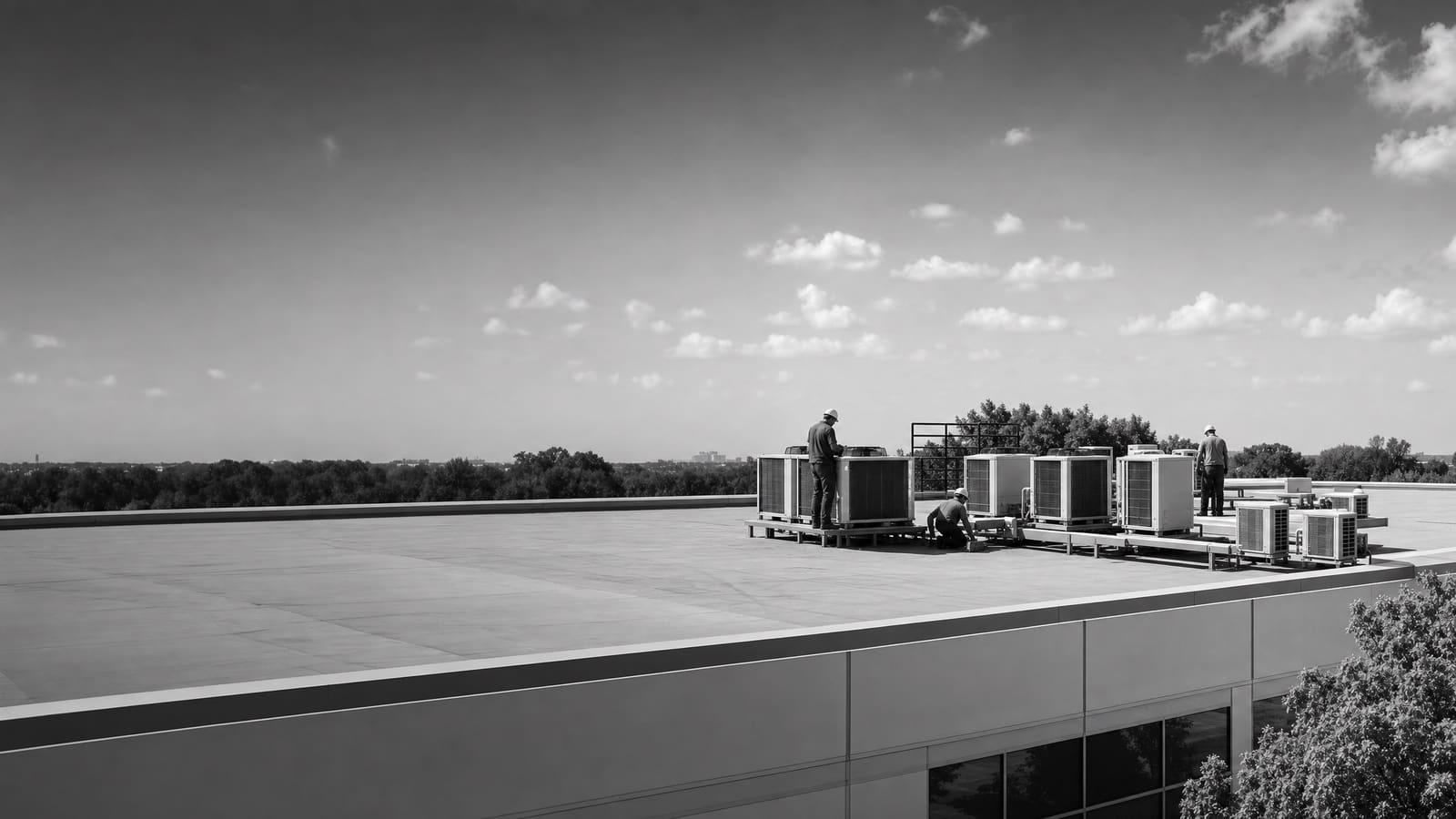
A commercial HVAC replacement covers a fresh load calculation, equipment selection, permit drawings, removal and rigging of the old unit, curb and connection work, and commissioning before handoff. Replacement beats another repair once a rooftop unit is past about fifteen years, because units that old can waste roughly $900 to $3,700 a year each against current models. Past that point, repair dollars buy time rather than performance.
A site review still has to confirm tonnage against how the space is used today, plus curb and decking condition, available electrical capacity, and crane access. Those four items move both the price and the schedule.
THREE PATHS
What you put back on the curb
Miami Gardens buildings are cooling-dominated, so the real question is not whether to replace but what replaces it. Three paths cover almost every rooftop project. A like-for-like swap puts the same equipment type back on the same curb and gets the space conditioned fastest. A high-efficiency unit costs more up front and pays back through the operating bill; a federal performance specification set the target for these designs at cutting rooftop energy use by up to half against the standard in place at the time. A heat pump rooftop unit adds reverse-cycle heating, and DOE guidance points to the South as a region where today's heat pump rooftop units can carry most or all of the winter heating demand. Which one wins depends on how long you plan to hold the building and what the electrical service can support.
WHAT MOVES THE NUMBER
Where the money actually goes
No two roofs price the same, so read a proposal line by line instead of as one number. These are the items that move the total most, and the ones most often missing from a thin quote.
BUYING GUIDANCE
How to choose the unit you will actually keep
The most expensive mistake in a rooftop replacement is buying the nameplate instead of the load. A unit installed twenty years ago was sized for a floor plan, an occupancy, and a set of internal loads that may not exist anymore. Lighting got more efficient, the office got denser, or the warehouse added a packing line. Ask for the load calculation, not just the tonnage that was already up there.
Timing is the second decision. DOE guidance is blunt about the common pattern: facility teams tend to wait until a unit no longer holds the space, needs constant service calls, or fails outright. Replacing on failure removes every option you had. Equipment choice, efficiency tier, incentive paperwork, and scheduling all collapse into whatever can be on a truck this week. Planned replacement keeps those options open and usually costs less.
Third, ask what is genuinely available. Equipment availability and contractor familiarity with a specific technology are listed as real adoption factors for a reason. A unit that looks perfect on paper but sits twelve weeks out can lose to a good unit you can set next month, especially when a tenant is uncomfortable right now.
SIDE BY SIDE
Simple swap or a project
Two rooftop replacements can carry the same tonnage and price very differently. What separates them is how much of the building has to change around the new unit.
STRAIGHTFORWARD
Same footprint, same fuel
The new unit matches the old one's type and size, lands on the existing curb with an adapter, and reuses the power and gas connections already there. Permit scope stays mechanical, and the on-site work is mostly rigging and commissioning.
MORE INVOLVED
New size, new fuel, or new spot
Growing the tonnage, moving to all-electric equipment, or relocating the unit pulls in structural review, electrical capacity work, and sometimes retiring a gas line. DOE guidance flags electrical capacity, physical constraints, and gas lines as the infrastructure items to check before committing.
SCOPING THE WORK
What a real site review covers
A quote written from a nameplate photo is a starting point, not a commitment. Before the number is firm, someone should be on the roof. The curb gets measured and the decking around it checked, because an undersized or soft curb is the most common reason a one-day swap becomes a three-day one. The disconnect and available electrical capacity get verified against what the new unit draws, which matters most when the replacement is all-electric equipment. Gas piping, if it stays, gets confirmed for size and condition.
Then the review moves to the ground. Where does the crane set up, how far does it have to reach, and how many stalls does that take out of service? A tight lot, or a tenant who cannot lose their entrance, may push the lift to a night or a weekend. That belongs in the price, not in a change order later.
Finally, the review should capture how the building runs. Operating hours, lease terms, and any space that cannot go warm for a shift decide whether the work happens in one push or in phases with temporary cooling.
Ask for this before you sign
A firm quote should name the exact model, the curb solution, the electrical work included, the crane plan and closure window, and who pulls the permit. If any one of the five is blank, what you are holding is still an estimate.
IN MIAMI GARDENS
Permit drawings are a design cost, not just paperwork
Florida commercial alteration permitting treats HVAC work as a design submittal rather than a form. When the scope includes installing or relocating equipment such as HVAC, mechanical plans are required, and those plans must be signed and sealed by a Florida licensed architect or engineer. Energy calculations are required whenever the scope includes heating, ventilation, or air conditioning, and the drawings have to show where the equipment sits. If the tonnage or footprint grows, roof framing plans and details come into scope too.
That changes one practical decision. The design work belongs in your budget and your calendar from day one, not after equipment is ordered. Confirm the exact submittal checklist with the building department having jurisdiction over your Miami Gardens address before you commit to a start date, since local requirements and review times vary.
Start the drawings while you are still shopping
Sealed mechanical plans and energy calculations take time to produce and time to review. Beginning them the week a unit fails is how a replacement stretches from weeks into a season. Run the design step in parallel with equipment comparison.
OWNERSHIP FACTORS
Two questions that decide the value of the swap
Rooftop units condition close to half of all commercial floor area in the country, which makes this equipment the largest single energy decision most building owners make. Two ownership questions usually settle whether the higher-efficiency path is worth paying for: how long you intend to hold the building, and who pays the utility bill. An owner-occupant captures the savings directly and can set their own payback threshold. A landlord on leases where tenants pay the meter has to justify the same spend a different way, usually through comfort complaints, service call volume, and what the equipment is worth at sale. Neither answer is wrong. But settle it before the efficiency tier is chosen, because that is the cheapest change to make on paper and the most expensive to make after the order is placed.
HOLD PERIOD
How long the building stays yours
A unit installed this year will likely outlast your current hold plan and your current tenant. If a sale or refinance is in view, the warranty and the commissioning documentation on a new unit matter as much as the operating savings do.
WHO PAYS THE METER
Lease structure changes the math
When tenants pay utilities, efficiency savings land in their pocket rather than yours. The owner's return shows up as fewer service calls, fewer comfort complaints, and equipment that never becomes a lease negotiation item.
PHASING AND PROCUREMENT
Replacing a fleet instead of a unit
If your roof carries more than one unit, treat them as a fleet with staggered ages rather than a run of separate emergencies. Pull the nameplate data on every unit, note the install year, and sort by age and service history. Anything past fifteen years is a candidate, and the ones with repeat service calls move to the front of the line.
Buying as a fleet changes what you can negotiate. Units replaced together can share one crane mobilization, one permit effort, and one round of controls work, and they let you phase the spend across budget years instead of absorbing it all at once. It also lets you standardize on one manufacturer and one refrigerant, which keeps parts, service training, and spare inventory simple.
That last point carries more weight during a refrigerant transition than it normally would. New commercial equipment ships on newer refrigerants, so a partially replaced roof means a split service strategy. Federal Clean Air Act rules govern how refrigerant is handled, recovered, and recycled in stationary air conditioning equipment, and that work is part of every removal. Ask your service contractor how they plan to cover a roof running two refrigerants during the years the fleet is in transition.
COMPARING QUOTES
Five things a comparable quote shows
Two proposals are only comparable when both state the same five things. If one leaves an item blank, you are not comparing price. You are comparing how much risk each contractor decided to keep on their own side of the page.
01
Exact model and efficiency tier
Manufacturer, model number, tonnage, and efficiency level, so it is obvious whether the two bids are the same machine.
02
Lead time in writing
Realistic availability for that specific unit, dated, plus what happens to the price if the date slips.
03
Curb, structural, and electrical scope
What is included on the roof and at the panel, and what would come back as a change order.
04
Rigging plan and closure window
Crane size, staging area, stalls affected, and the hours the lift will actually happen.
05
Permits, commissioning, and documentation
Who pulls the permit, who seals the drawings, and which startup readings you receive at handoff.
Get a defensible number
Price the equipment and the building together.
Send the address, operating target, and target opening date. Flux will identify what must be verified before the project can be priced.
Get a free estimateQuestions
Straight answers.
When does replacement beat another repair?
Age and repeat service calls are the clearest signals. Rooftop units past about fifteen years can waste roughly $900 to $3,700 a year each compared with current equipment, so a unit that is old, inefficient, and back on the service log is usually spending your money twice. Replace before it fails, while you still control the timing.
Does a heat pump rooftop unit make sense in South Florida?
Often, yes. Heat pump rooftop units are most efficient where winters are mild to moderate, and DOE guidance identifies the South as a region where today's units can handle most or all of the winter heating demand. The item to verify first is electrical capacity, since all-electric equipment can need service work the old unit did not.
What do the permit drawings have to include?
In Florida commercial alteration permitting, mechanical plans are required when the scope includes installing or relocating HVAC equipment, and they must be signed and sealed by a Florida licensed architect or engineer. Energy calculations are required for HVAC scope, and the drawings must show equipment location. Confirm the full checklist with the building department for your address.
What happens to the refrigerant in the old unit?
It gets recovered by a certified technician. Federal Clean Air Act rules govern the handling, recovery, and recycling of refrigerant in stationary air conditioning equipment, so removal is regulated work rather than something to skip. That step should appear as a line on the quote, not as an assumption.
Should we replace like-for-like or resize the unit?
Run the load calculation either way. If the space and how it is used have not changed, like-for-like is often the right and fastest call. If occupancy, equipment, or the envelope changed since the last install, resizing fixes comfort problems the old unit was never able to solve.
Sources used for this guide
- [1]betterbuildingssolutioncenter.energy.gov — DOE Advanced Rooftop Unit Replacement Guidance
- [2]betterbuildingssolutioncenter.energy.gov — DOE Commercial Heat Pump Rooftop Unit Replacement Guidance
- [3]betterbuildingssolutioncenter.energy.gov — DOE High-Efficiency Commercial Rooftop Unit Toolkit
- [4]energy.gov — DOE Efficient Commercial Rooftop Air Conditioner Program
- [5]epa.gov — EPA Stationary HVAC Refrigerant Management
- [6]tampa.gov — Permit Application Guide Commercial Alteration