THE DIRECT ANSWER
What a commercial HVAC replacement includes
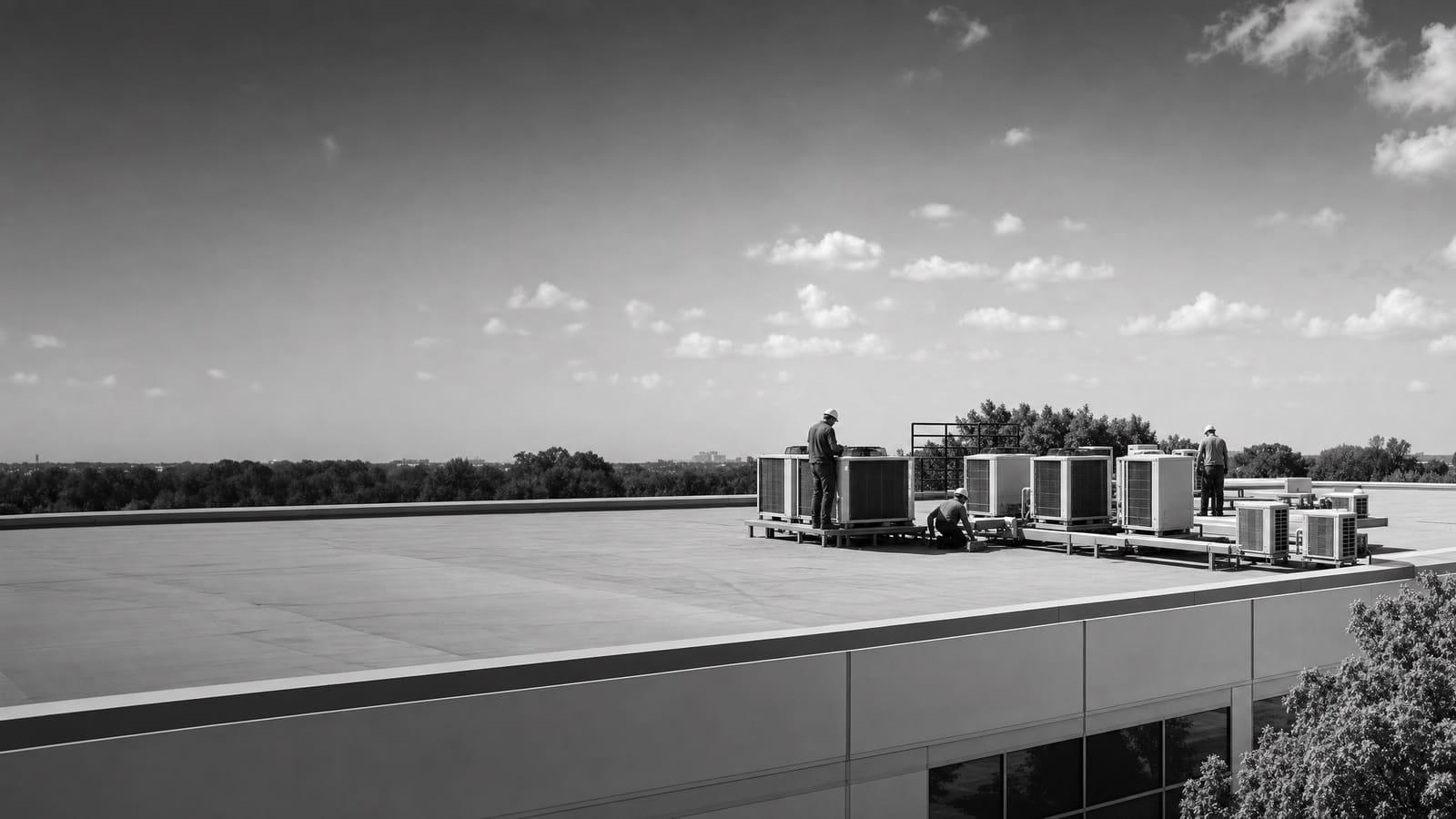
Commercial HVAC replacement includes load review, equipment selection, permits, removal, rigging, utility connections, controls work, refrigerant handling, startup, testing, and owner handoff. Replacement becomes more useful than another repair when an older unit is unreliable, no longer holds comfort, or needs frequent service. DOE notes that rooftop units over 15 years old may waste substantial energy compared with newer models.
A site review must confirm capacity, roof and curb conditions, electrical service, fuel connections, outside-air needs, drainage, access, controls, and current equipment availability.
THREE OPERATING CHOICES
Choose the result before choosing the equipment
A replacement can restore the old design, correct the design, or change how the building heats and cools. Start with the business need. If the space still has the same hours, occupancy, equipment, and comfort pattern, a close replacement may limit design changes. If the use has changed, repeating the old capacity can preserve hot rooms, humidity problems, noise, and short cycling.
A heat-pump rooftop unit adds reverse-cycle heating to the cooling system. DOE identifies climate, utility costs, emissions goals, building type, equipment supply, electrical capacity, physical limits, gas service, and contractor knowledge as key screening points. That makes electrification a building decision, not a box-selection shortcut.
High-efficiency equipment may reduce energy use, but the full system must support it. Airflow, controls, schedules, sensors, outside air, and commissioning affect the result. Ask each bidder to describe the operating outcome, not only the model number.
BUDGET STRUCTURE
What moves an installed commercial HVAC price
The supplied research does not support one universal installed cost. Build the budget from visible scope lines so bidders price the same job and explain their allowances.
EQUIPMENT FIT
Compare systems by how the building operates
Packaged rooftop units combine major heating and cooling parts in one cabinet. They are common across commercial buildings and can make replacement practical when the roof, curb, ducts, and utilities support the new unit. A close match may reduce field changes, but the contractor should still verify the load and airflow. The old nameplate shows what was installed, not what the building needs now.
A high-efficiency rooftop unit can be useful where cooling runs for long hours and controls can use its features. Compare part-load operation, fan control, ventilation control, service access, filters, warranty terms, and local parts support. A premium efficiency label alone does not fix poor ductwork, wrong schedules, failed sensors, or excess outside air.
Heat-pump rooftop units provide cooling and reverse-cycle heating. DOE says they are especially suited to mild-to-moderate winter heating, while also calling for review of electrical capacity, physical constraints, utility impacts, and backup heat. If the existing system uses gas, the proposal should state whether gas remains, is removed, or serves a backup role. It should also identify any added electrical load before equipment is ordered.
PROJECT COMPLEXITY
A box swap and a building change are different projects
The simplest replacement preserves a sound design. Complexity rises when capacity, weight, footprint, utilities, ventilation, controls, or operating needs change.
LOWER COMPLEXITY
Compatible replacement
The current load remains valid, the curb and ducts fit, utilities have capacity, controls are simple, and lifting access is clear. The quote should still include testing and closeout.
HIGHER COMPLEXITY
Redesign or conversion
Changed occupancy, persistent humidity, added ventilation, different heat, limited electrical capacity, structural questions, or automation integration may require engineering and more field coordination.
SITE REVIEW
Measure the conditions that can change the order
Begin above the ceiling and on the roof, not at a product catalog. Record every unit’s model, serial number, capacity, voltage, heat type, refrigerant, curb size, weight, condition, served area, and control point. Review service records for compressor trouble, leaks, motor failures, drain problems, and repeated comfort calls. The pattern may show that the unit is failing, but it can also expose a duct, control, or operating problem that replacement alone will not solve.
Then check the occupied space. Note hours, people, lighting, plug loads, process heat, doors, pressure relationships, temperature complaints, and humidity complaints. Inspect filters, coils, fans, dampers, drain paths, ducts, insulation, diffusers, and outside-air openings. Confirm available voltage and electrical protection. For a fuel change, document panel capacity, conductor routes, gas disposition, and any backup heating plan.
Finally, plan the work area. Verify roof access, lifting reach, staging space, protected paths, shutdown limits, weather exposure, and tenant or customer impacts. These facts turn a rough equipment allowance into a buildable scope.
Useful first records
Provide nameplate photos, roof and mechanical plans, controls information, utility data, service history, occupancy schedules, comfort complaints, and any planned change in use.
OWNERSHIP VIEW
Plan for uptime and the full service life
A planned replacement gives the owner time to compare equipment, verify infrastructure, coordinate shutdowns, and resolve roof or control work before failure. DOE says owners often wait until rooftop units stop conditioning the space, require frequent maintenance, or fail. It also describes proactive replacement of inefficient, underperforming units as a potentially smart business move.
Do not treat energy claims as guaranteed savings. Historic DOE work found that older commercial rooftop equipment could waste significant energy, and high-efficiency designs showed real-world savings. Your result still depends on load, climate, rates, schedules, ventilation, controls, installation, and maintenance. Ask for an operating-cost comparison built from stated assumptions. Keep those assumptions with the purchase record so performance can be checked later.
PLANNED WORK
Protect operations
Coordinate equipment supply, lifting, shutdowns, temporary conditions, inspections, and tenant notice before the existing unit becomes an emergency.
LIFE-CYCLE VALUE
Compare more than first cost
Review expected energy use, maintenance needs, filters, controls, warranty coverage, parts access, refrigerant strategy, and service training.
INSTALLATION DAY
How the project should move from order to handoff
After selection, the contractor should confirm submittals before release. The submittal must match capacity, voltage, heating configuration, efficiency, dimensions, weight, curb arrangement, fans, filters, controls, and accessories. Long-lead items and approved alternatives should be named. Do not accept an open substitution that can change power, weight, controls, or performance without review.
Before shutdown, complete permits, field measurements, fabrication, lift planning, safety planning, controls preparation, and delivery checks. Define who protects the roof, disconnects and recovers refrigerant, removes the old unit, handles utilities, installs transitions, seals openings, restores controls, and schedules inspection. EPA rules govern refrigerant handling and recycling for stationary air-conditioning and heat-pump equipment, so the quote should assign this work to qualified personnel and require records.
Startup is not the finish line. Commissioning should confirm rotation, voltage, current, refrigerant condition, airflow, temperatures, fan operation, heating, drainage, dampers, safeties, sensors, schedules, alarms, and automation points. The owner should receive startup sheets, approved submittals, warranties, manuals, control information, refrigerant records, and training.
QUOTE CHECK
Five things every comparable proposal should show
Put the same requirements in each bid request. A low total is not comparable if it leaves engineering, rigging, controls, testing, or closeout for later.
01
1. Exact equipment
List model, capacity, efficiency, heat, voltage, refrigerant, accessories, warranty, availability, and substitution rules.
02
2. Included field work
Name removal, rigging, curb, roof, duct, drain, electrical, gas, controls, protection, disposal, and cleanup.
03
3. Design and approvals
Assign load review, plans, engineering, permits, fees, inspections, and responses to reviewer comments.
04
4. Testing and acceptance
State startup readings, airflow work, controls checks, deficiencies, acceptance standards, and who corrects failed tests.
05
5. Schedule and exclusions
Show lead time, shutdown, phasing, allowances, exclusions, change-order rates, payment terms, and closeout deliverables.
Get a defensible number
Price the equipment and the building together.
Send the address, operating target, and target opening date. Flux will identify what must be verified before the project can be priced.
Get a free estimateQuestions
Straight answers.
When should a commercial rooftop unit be replaced instead of repaired?
Replacement deserves a full comparison when an older unit needs frequent repairs, no longer maintains comfort, has recurring refrigerant or compressor trouble, or creates serious downtime risk. DOE notes that rooftop units over 15 years old can waste substantial energy compared with newer models. Age alone is not the decision. Compare repair scope, reliability, expected remaining service, energy use, refrigerant strategy, and the effect of another failure on operations.
Should the new commercial HVAC unit match the old unit’s capacity?
Not automatically. Confirm the current load before ordering. Occupancy, hours, lighting, equipment, ventilation, envelope work, and space use may have changed since the old system was selected. A close replacement can be sensible when the original design remains valid. If the building has hot rooms, humidity issues, short cycling, or a changed use, repeating the nameplate may repeat the problem.
Is a commercial heat-pump rooftop unit a good choice in Miami Beach?
It can be a useful option because heat-pump rooftop units provide cooling and reverse-cycle heating, and DOE identifies mild-to-moderate winter conditions as a favorable application. The decision still requires a site-specific review of heating demand, electric rates, electrical capacity, backup heat, physical fit, equipment supply, controls, emissions goals, and any existing gas service.
How much does commercial HVAC installation cost in Miami Beach?
The supplied research does not establish a reliable universal installed range for Miami Beach. Price depends on equipment capacity and configuration, efficiency, availability, roof and curb work, rigging, electrical or gas changes, ducts, ventilation, controls, permits, testing, and phasing. Ask for an itemized installed proposal after a field review, with allowances and exclusions stated clearly.
What records should the owner receive after installation?
Request approved equipment submittals, permit and inspection closeout, startup sheets, test and balance information when included, controls documentation, refrigerant records, warranty registrations, manuals, equipment schedules, training notes, and a list of unresolved items. These records help protect the warranty and give the service team a clear baseline.
Can the building remain open during commercial HVAC replacement?
Often, but the answer depends on which spaces the equipment serves, the shutdown length, roof and lifting access, noise, weather, inspections, and whether temporary conditioning is needed. The proposal should show each outage, affected area, work window, protection plan, tenant notice, and recovery plan. Multi-unit projects can sometimes be phased to preserve partial service.
Who is responsible for refrigerant during replacement?
The proposal should assign recovery, handling, recycling or disposal, charging, leak-related work, and documentation to qualified personnel. EPA Section 608 rules address refrigerant handling and recycling for stationary air-conditioning and heat-pump equipment. Make this responsibility explicit before work starts, especially when removing older equipment.
How can an owner compare high-efficiency equipment fairly?
Compare the same load, operating schedule, ventilation assumptions, utility inputs, and control sequence. Review part-load performance, fan control, heating method, maintenance needs, filters, warranty, parts access, and commissioning. Historic DOE programs demonstrated that high-efficiency rooftop units can save energy, but a project estimate should state its assumptions instead of promising the same result for every building.
Sources used for this guide
- [1]betterbuildingssolutioncenter.energy.gov — DOE Advanced Rooftop Unit Replacement Guidance
- [2]betterbuildingssolutioncenter.energy.gov — DOE Commercial Heat Pump Rooftop Unit Replacement Guidance
- [3]betterbuildingssolutioncenter.energy.gov — DOE High-Efficiency Commercial Rooftop Unit Toolkit
- [4]energy.gov — DOE Efficient Commercial Rooftop Air Conditioner Program
- [5]epa.gov — EPA Stationary HVAC Refrigerant Management
- [6]tampa.gov — Permit Application Guide Commercial Alteration