THE SHORT ANSWER
What commercial HVAC replacement includes
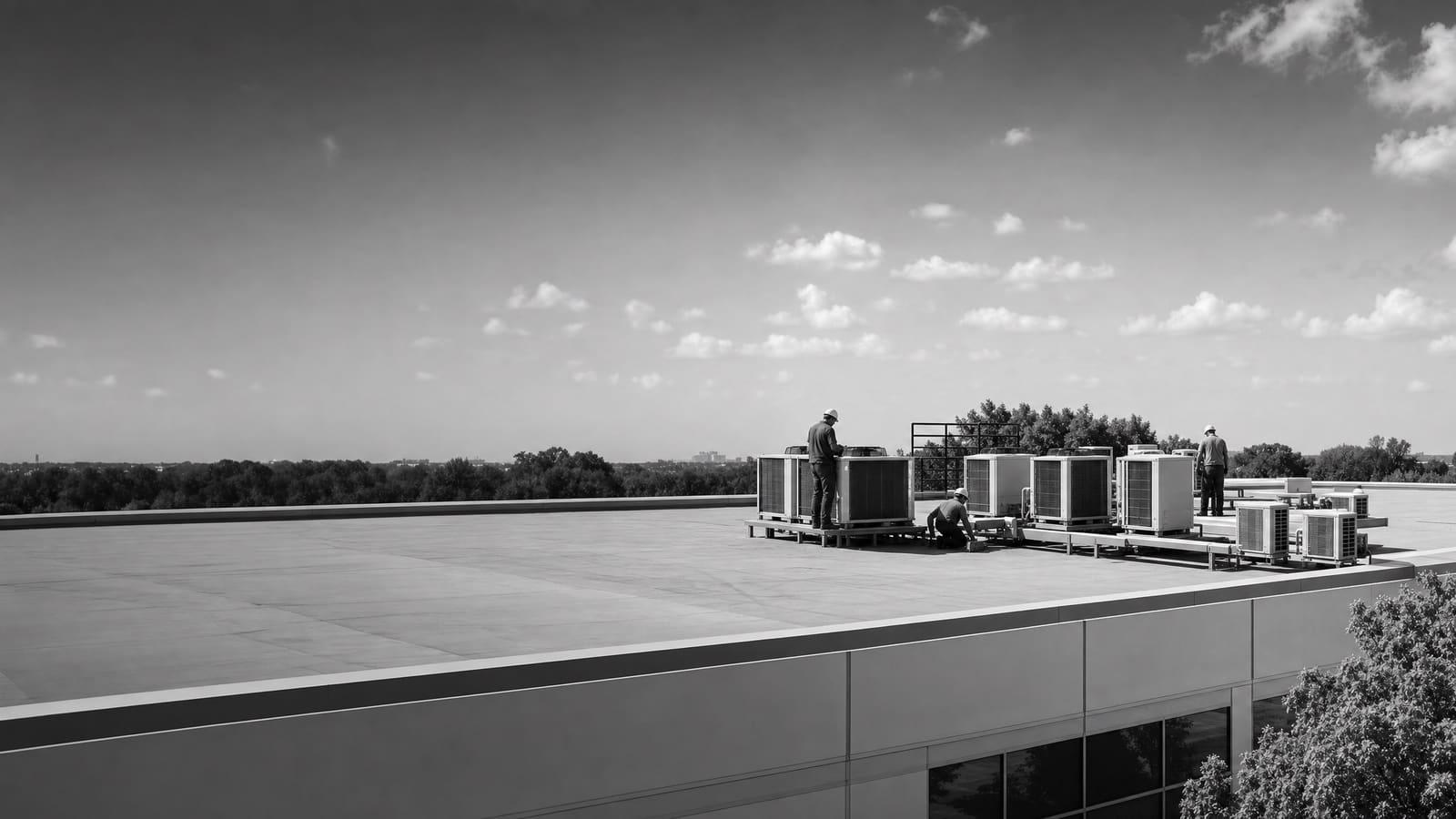
Commercial HVAC replacement covers load review, equipment selection, permits, removal, rigging, connections, controls, startup, testing, and handoff. Replacement becomes more useful than another repair when an older unit needs frequent service, cannot hold the space conditions, or risks failing during a critical season. DOE guidance flags rooftop units over 15 years old for closer replacement review.
A site review must verify the load, roof and curb, electrical or gas service, ventilation, controls, access, drainage, and equipment availability.
THREE OPERATING CHOICES
Choose the project path before choosing a model
Start with the business problem. A failed unit may require the fastest safe route back to service. A working but unreliable unit gives you time to compare efficiency, heating source, controls, and lifecycle needs. A changed space may need a fresh load review instead of another unit with the old capacity.
This matters because a familiar replacement can preserve hidden problems. Oversized equipment may cycle poorly. Undersized equipment may miss peak loads. A unit selected only from its nameplate may not reflect new occupancy, added electronics, revised hours, or changes to the building shell.
Ask the contractor to explain the operating choice before presenting product options. The proposal should show whether the plan is a direct replacement, a right-sized upgrade, or a planned conversion. It should also name the assumptions behind that choice.
BUDGET STRUCTURE
What moves the installed price
No supplied evidence supports one universal installed price. A useful budget separates the equipment from the work needed to make it fit, operate, and pass inspection.
EQUIPMENT CHOICES
Compare systems by how the building must operate
Packaged rooftop units remain a common commercial choice. They place heating, cooling, ventilation, and controls in one outdoor cabinet. A direct replacement can be practical when the roof opening, utilities, airflow, space use, and capacity remain suitable. It still needs field measurements. A matching capacity does not guarantee a matching footprint, curb, weight, electrical demand, controls interface, or ventilation setup.
Higher-efficiency rooftop equipment can reduce energy use, but brochure efficiency is not the whole decision. Compare part-load operation, fan control, heating performance, service access, filter needs, controls compatibility, and expected hours. DOE has documented meaningful energy waste from older commercial rooftop units, yet actual savings depend on the existing unit and how the building runs.
Heat-pump rooftop units provide cooling and reverse-cycle heating. All-electric, dual-fuel, and cold-climate designs serve different needs. The choice should account for winter loads, electricity and gas costs, electrical capacity, physical constraints, backup heat, emissions goals, equipment supply, and contractor experience. If replacing gas heat is under review, see commercial heat pump conversion for the added questions that belong in that study.
PROJECT COMPLEXITY
A simple swap and a complex replacement need different plans
The unit itself may look similar in both projects. The difference is how much surrounding infrastructure must change and how much operational risk the owner must manage.
LOWER COMPLEXITY
Existing conditions still fit
The verified load is similar, curb and duct layout can remain, utilities are adequate, controls are simple, and crane access is clear. The quote can focus on coordinated removal, installation, startup, and closeout.
HIGHER COMPLEXITY
The building must adapt
Capacity, weight, footprint, heating source, electrical demand, ventilation, controls, or operating hours change. The project may need engineering, structural review, utility work, staged shutdowns, and deeper commissioning.
SITE REVIEW
What should be checked before the order is placed
Begin with the equipment record: model, serial number, capacity, heat type, refrigerant, age, repair history, and current faults. Then inspect the installed conditions. Measure the curb and duct openings. Record electrical service, breaker and disconnect data, gas supply when present, condensate routing, outside-air setup, filters, controls, and roof access. Check whether the roof can support the proposed arrangement and whether water can be kept out during the work.
The load review should reflect current use. Include occupied hours, people, lighting, plug loads, process heat, ventilation needs, envelope changes, and any rooms with unusual temperature or humidity needs. Comfort complaints also matter. Hot and cold zones, noise, odors, pressure problems, and short cycling can point to issues that a box swap will not solve.
Finally, plan the work from the ground up. Confirm crane reach, staging, parking or drive impacts, overhead conflicts, delivery access, tenant notices, shutdown limits, weather protection, and a recovery plan if the lift cannot proceed. These details turn an equipment purchase into an executable project.
Do not order from the old nameplate alone
Use the nameplate to identify the existing system, then verify the present load and every physical, utility, ventilation, and controls connection before approving equipment.
MERIDIAN PROJECT CONTROL
Confirm the current permit path before procurement
Idaho's archived 2024 HVAC rules describe licensing requirements for contractors and technicians, along with permits and inspections for HVAC installation work. The archive also states that commercial or industrial HVAC permit work requires a verified copy of bid acceptance with the proper permit fee. Because this is an archived rule set and the project date is August 2026, do not treat its edition or procedure as current without confirmation.
Before releasing equipment, identify the authority handling the address and ask what current mechanical, electrical, structural, or related reviews apply. Put permit preparation, fees, inspections, corrections, and closeout ownership in the proposal. This prevents an unclear administrative task from delaying a scheduled shutdown or crane date.
Use the current rules, not an old assumption
Have the contractor verify current Meridian-area requirements for the exact address, scope, and equipment before the order, lift plan, and shutdown date are fixed.
OWNER PRIORITIES
Balance first cost with operating risk
A lower purchase price can be reasonable when the unit fits the load, connects cleanly, and supports the building's operating plan. It is less useful when exclusions leave the owner paying later for curb work, controls, electrical changes, permits, or startup corrections.
Also price the cost of disruption. A failure during peak weather can force emergency decisions and reduce equipment choice. Planned replacement gives the team time to compare systems, coordinate occupants, prepare the roof, and stage work. DOE guidance notes that proactive replacement of inefficient or underperforming rooftop units can make better business sense than waiting for failure. The decision still belongs to the specific building, budget, and service history.
OWNERSHIP VIEW
Look beyond the purchase
Compare energy, maintenance access, filters, controls support, warranty terms, refrigerant service, expected repairs, and replacement parts. State every assumption used in the lifecycle comparison.
OPERATIONS VIEW
Protect occupied hours
Define allowable outages, temporary conditioning needs, noisy work windows, access controls, weather limits, tenant notices, and the person authorized to make field decisions.
PHASING AND PROCUREMENT
Buy the project in the order it must happen
Start planning while the existing system still runs when possible. Rank units by condition, service calls, space criticality, comfort performance, and failure impact. This creates a replacement sequence instead of letting the next breakdown choose the budget. For multiple units, decide whether to replace them together or in phases. A combined project may simplify mobilization and controls work, while phasing can protect cash flow and keep more of the building conditioned.
Do not approve a proposal that separates price from availability. Ask for the quoted model, acceptable alternates, expected availability, substitution rules, and the date through which pricing remains valid. Confirm that an alternate will still fit the curb, utilities, controls, ventilation needs, and permit documents. A model number alone is not an installed solution.
Schedule backward from the shutdown. Complete field verification, engineering when needed, permit review, equipment release, curb or adapter fabrication, controls preparation, rigging, occupant notices, and weather decisions before the lift. Keep enough time after startup for balancing, controls checks, correction work, training, and document delivery. Final payment terms can be tied to defined closeout items rather than the moment the unit first turns on.
QUOTE CHECKLIST
Five things every comparable quote should show
Ask each bidder to use the same scope and assumptions. A clear comparison should show equipment, field work, responsibilities, schedule, and proof of completed performance.
01
Exact equipment
List model, capacity, efficiency, heat type, refrigerant, options, warranty, availability, and approved alternates.
02
Complete installed scope
Show removal, disposal, rigging, curb, duct, roof, electrical, gas, drainage, controls, and weatherproofing.
03
Permits and responsibilities
Name who handles applications, fees, inspections, engineering, corrections, access, notices, and closeout.
04
Schedule and exclusions
State procurement assumptions, shutdown length, work hours, site impacts, allowances, exclusions, and change-order rates.
05
Startup and acceptance
Require airflow, charge, heating, ventilation, controls, alarms, training, warranty registration, and final documentation.
Get a defensible number
Price the equipment and the building together.
Send the address, operating target, and target opening date. Flux will identify what must be verified before the project can be priced.
Get a free estimateQuestions
Straight answers.
When should a commercial rooftop unit be replaced instead of repaired?
Replacement deserves a serious review when an older unit needs frequent repairs, cannot maintain required conditions, uses too much energy, has hard-to-source parts, or creates unacceptable failure risk. DOE guidance notes that rooftop units over 15 years old can waste substantial energy compared with newer models. Age alone does not make the decision. Compare repair history, present condition, expected remaining life, operating impact, and the installed replacement scope.
Should a Meridian business replace HVAC equipment with the same capacity?
Only after confirming that the capacity still fits. The old nameplate is useful for identification, but it is not a current load calculation. Review occupancy, hours, internal equipment, ventilation, layout, envelope changes, and comfort complaints. If the building use and loads remain stable, a similar capacity may be reasonable. If they changed, right-sizing can prevent the new unit from carrying forward old comfort and cycling problems.
What is included in a commercial HVAC installation?
A complete scope can include site verification, load review, equipment procurement, permits, removal, refrigerant handling, disposal, crane or other rigging, curb and duct work, roof weatherproofing, electrical or gas connections, condensate drainage, controls integration, startup, testing, training, warranty registration, and closeout documents. The proposal should identify every included task and every owner responsibility.
How much does commercial HVAC replacement cost in Meridian?
The supplied research does not support a reliable universal installed range. Commercial pricing depends on capacity, equipment type, efficiency, availability, roof and curb conditions, crane access, utility changes, ventilation, controls, permits, and shutdown requirements. Request an itemized installed quote after a field review. Compare the same scope across bidders, including allowances and exclusions, rather than comparing equipment-only totals.
Is a commercial heat-pump rooftop unit a good replacement choice?
It can be, but the answer depends on the building. Review winter heating loads, local utility costs, electrical capacity, physical space, gas service, backup heat, operating hours, emissions goals, equipment availability, and contractor experience. Compare all-electric, dual-fuel, and cold-climate options where relevant. The study should show utility and infrastructure assumptions instead of promising savings from equipment type alone.
Who should handle permits and inspections?
The contract should name the responsible party. Idaho's archived 2024 rules describe contractor licensing, HVAC permits, and inspections, but a 2026 project must follow the current requirements for its address and scope. Ask the installing contractor to verify the applicable authority and list permit preparation, fees, inspections, correction work, and final approvals in the proposal.
What commissioning should happen before the system is accepted?
Acceptance should go beyond confirming that the unit starts. Verify cooling and heating operation, refrigerant setup where applicable, airflow, outside air, fan operation, temperature response, drainage, controls points, schedules, alarms, safeties, and communication with the building automation system. Collect startup records, test results, warranty registration, operating information, training records, and final equipment data.
How should refrigerant be handled during replacement?
EPA Section 608 rules govern refrigerant handling and recycling for stationary air-conditioning and heat-pump equipment. The proposal should include lawful recovery of refrigerant from removed equipment and identify disposal responsibilities. Also record the refrigerant used by the new system so maintenance staff, service vendors, labels, and future parts planning match the installed equipment.
Sources used for this guide
- [1]betterbuildingssolutioncenter.energy.gov — DOE Advanced Rooftop Unit Replacement Guidance
- [2]betterbuildingssolutioncenter.energy.gov — DOE Commercial Heat Pump Rooftop Unit Replacement Guidance
- [3]betterbuildingssolutioncenter.energy.gov — DOE High-Efficiency Commercial Rooftop Unit Toolkit
- [4]energy.gov — DOE Efficient Commercial Rooftop Air Conditioner Program
- [5]epa.gov — EPA Stationary HVAC Refrigerant Management
- [6]adminrules.idaho.gov — 2024 Idaho Administrative Code Archive