THE DIRECT ANSWER
What a commercial HVAC replacement actually includes
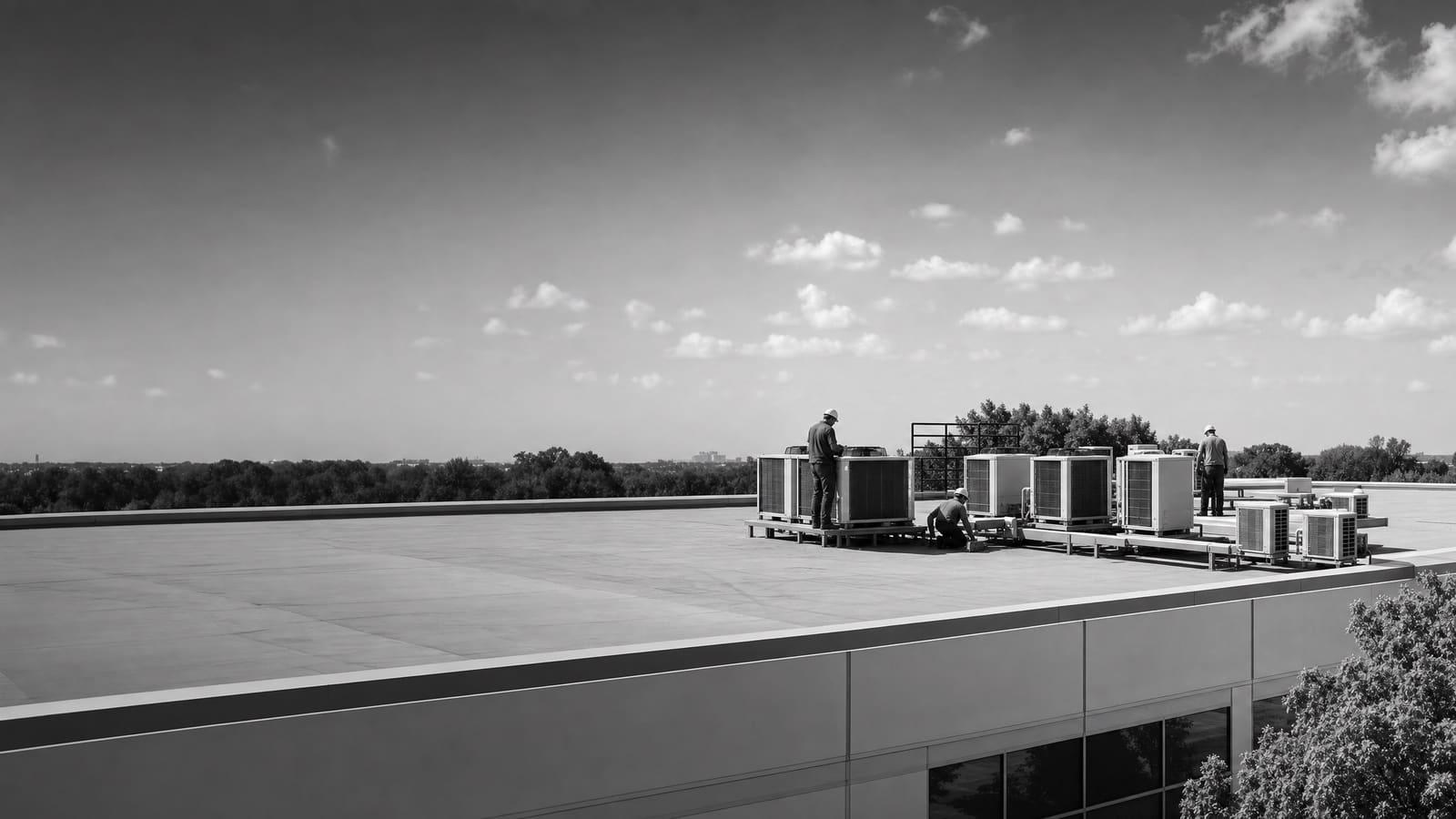
A commercial HVAC replacement covers the load calculation, the unit itself, the curb adapter, the crane set, gas or electrical connections, controls integration, recovery of the old refrigerant, permits, and commissioning. Replacement beats one more repair once a rooftop unit passes roughly fifteen years, needs service in season, or no longer holds the space. Department of Energy figures put the annual energy waste of an old, inefficient commercial rooftop unit at roughly $900 to $3,700 per unit, which is the cost that keeps running while you decide.
A site review still has to confirm tonnage against current occupancy, the curb and roof structure, available electrical capacity, and crane access before any of that becomes a real number.
THREE PATHS
The three replacement paths for a Merced roof
Most buildings land on one of three paths, and the right one depends on what the space does now and what the roof and panel can support. Department of Energy guidance is blunt about the common trap: owners delay until a unit fails outright, then take whatever equipment is available that week. That is the most expensive version of this project, because the emergency removes every choice below.
Deciding early lets you compare a straight swap against a high-efficiency unit and against a heat pump unit on the same roof, with real availability attached to each. The heat pump question is worth asking here. Department of Energy guidance finds that across most of the U.S. West, today's heat pump rooftop units can address most or all of a building's winter heating demand, which makes it a live option rather than an experiment. The infrastructure check — electrical capacity, physical constraints on the roof, existing gas lines — decides whether it is practical at your address.
WHAT MOVES THE NUMBER
The lines that decide your installed price
These are the lines that move a rooftop quote the most. The tag shows how much each one can swing between an easy roof and a hard one.
CHOOSING EQUIPMENT
How to pick the unit before you pick the price
Start with the load, not the nameplate. A unit installed twenty years ago was sized for the occupancy, lighting, and equipment of that era. Offices got emptier and denser at the same time. Retail changed out its lighting. A warehouse added a packing line. Sizing off the old label carries forward whatever was wrong the first time, and an oversized unit short-cycles, controls humidity poorly, and wears out early.
Then decide how far up the efficiency ladder to go. The federal push behind high-efficiency rooftop units was built on a performance specification aimed at cutting unit energy use by up to half against the older standard, and more than two hundred organizations have since upgraded tens of thousands of units under that campaign. Your payback depends on run hours and local rates, but the direction is consistent: keeping an old unit is the expensive option.
If the heat pump question is open, work the infrastructure checklist before the equipment list. Department of Energy guidance points at electrical capacity, physical constraints on the roof, existing gas lines, equipment availability, contractor familiarity with the technology, and incentives. Any one of those can turn a good idea into a long project. Ask early and you get the answer while you still have time to choose.
SIDE BY SIDE
What separates an easy roof from a hard one
Two replacements at the same tonnage can price very differently. What separates them is usually access and infrastructure rather than the equipment. Here is what pushes a project into each column.
LOWER COMPLEXITY
Straight swap conditions
Same tonnage and fuel, a matched curb adapter, an open lot for the crane, gas and electrical service already adequate, and controls the new unit can join without a redesign. Usually a one-morning set and a short permit path.
HIGHER COMPLEXITY
What stretches the schedule
More tonnage than the roof last carried, structural review, a tight or shared lot, a fuel switch that touches the electrical service, or a specialty unit with a long build slot. These are planned projects, not same-week fixes.
SCOPING THE JOB
What a site review has to confirm
A quote that arrives without anyone standing on the roof is a guess wearing a number. The visit is short, but it settles the things that decide both price and schedule.
The reviewer should measure the existing curb and confirm whether an adapter fits or the opening has to be reworked. They should read the electrical panel and confirm capacity for the unit you are considering, which matters most when an electric option is on the table. They should look at how a crane reaches the unit: where it sets up, what it swings over, how many stalls close, and for how long. They should confirm the gas line if the new unit still burns gas, and check how the current controls talk to the rest of the building.
They should also look at the ductwork and the outside air path. A new unit connected to undersized or leaking duct will not deliver what its data sheet promises, and that shows up as a comfort complaint two months after the crane leaves. None of this takes long. Skipping it is how change orders happen.
Ask for the findings in writing
Have the site review come back as a short written list: curb condition, electrical capacity, crane setup and closure time, duct and outside-air findings, and any code item the replacement triggers. That list is what makes two quotes comparable.
LOCAL CONTEXT
Permits and inspection on a Merced project
California building departments treat mechanical work as permitted work, and a rooftop replacement is a mechanical upgrade that usually pulls electrical scope along with it. So the permit is part of the project, not an optional formality, and the inspection window shapes your timeline as much as the crane does.
Practically, that means the installing contractor should carry the permit, schedule the inspection, and price both inside the installed number. A quote that quietly leaves permitting to you is not the cheaper quote, it is the incomplete one. Ask who pulls it, when it gets pulled, and what happens to the schedule if the inspector needs a second visit. On a building that cannot lose cooling twice, that answer is worth as much as the price.
Confirm the requirements before booking the crane
Verify with the City of Merced building division which permits your replacement needs and how inspections are scheduled, then build that window into the timeline before the crane date is set rather than after.
OWNERSHIP
Two questions worth settling before the quote
Rooftop equipment usually outlives the person who signed for it, so a decision that feels financial today becomes an operating decision for the next decade. Two of them are worth settling early.
The first is timing: whether you replace on your schedule or on the equipment's. Department of Energy guidance describes the familiar pattern of delaying a purchase until the unit fails completely, and that is the version that costs the most, because failure sets the timing, the model, and the price all at once.
The second is who benefits. In a leased building, the owner often writes the check while the tenant sees the utility savings, unless the lease says otherwise. That split quietly decides how far up the efficiency ladder anyone is willing to go.
TIMING
Planned versus failure-driven
A planned swap lets you compare units, wait for a stocked model, and pick a low-traffic week. A failure in August removes all three of those choices and usually costs more to solve.
LEASE STRUCTURE
Who pays and who saves
Before choosing an efficiency tier, check how the lease handles capital work and utility pass-through. It changes which unit is the right buy, not just which one is cheapest to install.
PHASING AND LIFETIME COST
Planning a roof with more than one unit
If the roof carries several units, resist treating them as one giant purchase or as five unrelated emergencies. Walk the roof once and record age, tonnage, refrigerant, and condition for every unit, then rank them. Units past fifteen years with a service history go in the first phase. Units with life left get a maintenance plan and a target date.
Phasing pays off at purchasing. One crane mobilization can set more than one unit. One permit cycle can cover related work. Ordering two or three units together often earns a better price and a single delivery window instead of three separate lead times. A fleet that turns over on a planned rhythm also keeps you from having to replace everything at once a decade from now.
On lifetime cost, keep the comparison honest. Put the installed price next to expected energy cost, the service contract, and the parts picture, including which refrigerant the new unit uses, since a mixed fleet means stocking and training for more than one. Set that against the $900 to $3,700 a year that Department of Energy figures attribute to an old, inefficient rooftop unit. Across a fifteen-year service life, that gap is often larger than the price difference between the units you are comparing.
BEFORE YOU SIGN
Five things a comparable quote should show
Two quotes are only comparable when they show the same things. Ask for these five in writing before you compare prices, because a missing line is usually where the change order lives.
01
The sizing basis
The load calculation behind the tonnage, not just the model number of the unit being removed.
02
Equipment and lead time
Make, model, tonnage, efficiency tier, refrigerant, and the real availability window for that specific unit.
03
Scope of the roof work
Curb adapter, structural work, duct and outside-air changes, and any gas or electrical modifications.
04
Crane and site plan
Rigging plan, setup location, which stalls close and for how long, and the weather contingency.
05
Permits, commissioning, warranty
Who pulls the permit, who schedules inspection, what startup documentation you receive, and what the warranty requires.
Get a defensible number
Price the equipment and the building together.
Send the address, operating target, and target opening date. Flux will identify what must be verified before the project can be priced.
Get a free estimateQuestions
Straight answers.
How do I know it is time to replace instead of repairing again?
The usual signals are age past roughly fifteen years, repeat service calls during the cooling season, and a space the unit can no longer hold. Department of Energy guidance notes that owners often delay until a unit fails completely, and that replacing proactively is frequently the better business decision. An old, inefficient rooftop unit is estimated to waste $900 to $3,700 a year on its own, which is a cost that keeps running while you defer.
How fast can a failed rooftop unit be replaced?
The set itself is short once the unit, the crane, and the permit are lined up. The honest variable is equipment availability, which is why lead time belongs on the quote right next to the price. Inspection scheduling matters too. If the building cannot go without cooling, ask about temporary cooling in the same conversation.
Does a heat pump rooftop unit make sense here?
Often it is worth pricing. Department of Energy guidance finds that across most of the U.S. West, today's heat pump rooftop units can handle most or all of the winter heating demand, and dual-fuel versions exist for buildings that want a gas backstop. The deciding factors are electrical capacity at the panel, physical constraints on the roof, existing gas lines, equipment availability, and any incentives open at the time you buy.
What happens to the refrigerant in the old unit?
It has to be recovered and handled under EPA rules issued through Section 608 of the Clean Air Act, which govern how refrigerant is handled and recycled in stationary air conditioning equipment. That makes removal and disposal regulated work with a real cost. It should appear as a line on the quote rather than as an assumption.
How much does a commercial HVAC installation cost in Merced?
There is no single installed price, because tonnage, curb and roof condition, crane access, and any electrical or gas changes each move the number substantially. The useful move is to require the same five lines from every bidder: sizing basis, equipment and lead time, roof scope, crane and site plan, and permits with commissioning. Then the prices in front of you are actually describing the same project.
Sources used for this guide
- [1]betterbuildingssolutioncenter.energy.gov — DOE Advanced Rooftop Unit Replacement Guidance
- [2]betterbuildingssolutioncenter.energy.gov — DOE Commercial Heat Pump Rooftop Unit Replacement Guidance
- [3]betterbuildingssolutioncenter.energy.gov — DOE High-Efficiency Commercial Rooftop Unit Toolkit
- [4]energy.gov — DOE Efficient Commercial Rooftop Air Conditioner Program
- [5]epa.gov — EPA Stationary HVAC Refrigerant Management
- [6]californiacity-ca.gov — HVAC Permits