THE DIRECT ANSWER
What a commercial HVAC replacement actually includes
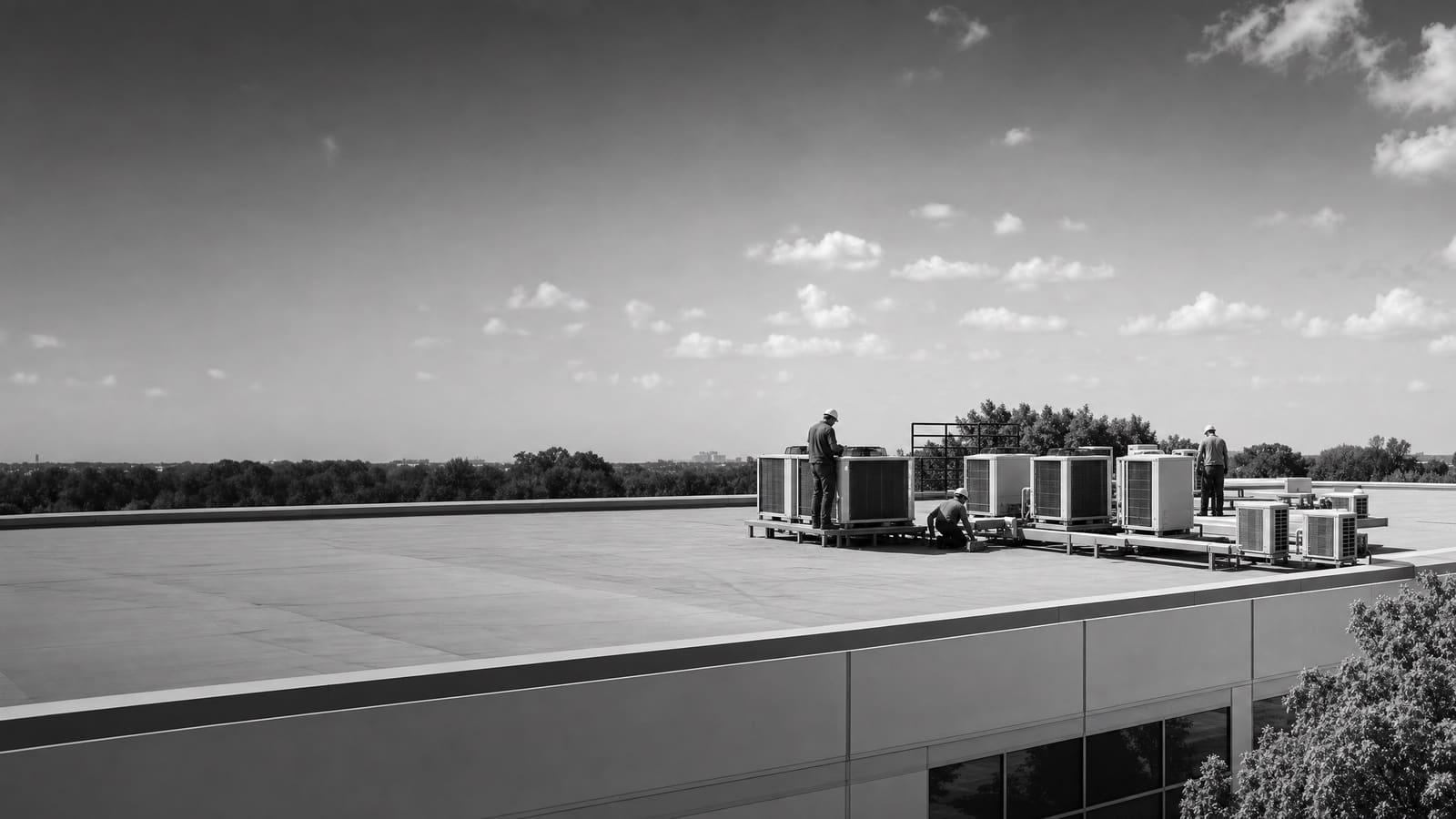
A commercial HVAC replacement covers the load check, equipment selection, permits, removal with certified refrigerant recovery, the rigging and set, reconnection of power, gas, duct and controls, then commissioning. Replacement beats one more repair when the unit is past about fifteen years, when in-season failures repeat, or when the box no longer holds the space. Federal analysis puts the annual energy waste from an old, inefficient rooftop unit between $900 and $3,700.
A site review still has to confirm curb size and roof framing, available electrical capacity, crane reach and lot closure, and which current-code items a replacement adds that the old unit never carried.
THE THREE CHOICES
How to replace, not just what to replace
Most commercial buildings here run packaged rooftop units, the equipment type that conditions close to half of all commercial floor space nationally. That makes the decision narrow and concrete. You are choosing between putting the same kind of box back, stepping up to a high-efficiency unit sized to how the building is used today, or moving the heating side to a heat pump. Federal guidance holds that heat pump rooftop units are a fit for most of the West, where winters are mild enough for the heat pump to carry most or all of the heating load. None of the three is automatically cheaper to own. The deciding facts are on your roof and in your electrical panel, and they are worth confirming before you price anything.
WHAT MOVES THE NUMBER
The lines that decide the price
These are the items that actually move a rooftop replacement number. Ask for each one priced separately, so you can compare two quotes without guessing what each contractor assumed.
BUYING GUIDANCE
Decide what the new unit has to fix
The most useful thing you can do before taking bids is decide what problem the new unit has to solve. If the building is comfortable and the only issue is that a twenty-year-old unit finally quit, a like-for-like replacement is honest work. If people have complained about the same corner for years, or the unit short-cycles every August, then the old nameplate is the wrong specification to copy. A load calculation based on current occupancy, plug loads, lighting, and operating hours costs a fraction of the equipment and decides everything downstream of it.
The second decision is efficiency, and it is arithmetic rather than philosophy. Federal work on rooftop units found old, inefficient equipment wasting roughly $900 to $3,700 per unit each year. That is the number that makes a higher tier pay or not pay against your run hours. A building running long cooling hours recovers the premium faster than a warehouse conditioning one office corner.
The third is timing. Replacing on failure removes both of the first two choices, because you take whatever unit is available that week, at whatever price, on whatever date the crane has open.
SIDE BY SIDE
Why one replacement is simple and another is not
Two rooftop replacements on the same street can differ by weeks of schedule and a wide margin of price. The difference is almost always access, electrical capacity, and how far the new unit strays from what the building already supports.
LOWER COMPLEXITY
Straight swap on an open roof
Similar tonnage and footprint, an existing curb an adapter fits, gas and power already sized for the unit, an open lot with crane reach, and a tenant who can give up a few stalls for one morning.
HIGHER COMPLEXITY
Bigger unit, tight site, new fuel
Growing tonnage or footprint, framing that needs review, a switch to all-electric heating that tests the panel, restricted crane access from tight setbacks, or a tenant that cannot lose conditioning during business hours.
SCOPING THE JOB
What the site review has to answer before a price is real
A number is only real after someone has stood in three places: the roof, the electrical room, and the parking lot.
On the roof, the review confirms the existing curb dimensions and whether an adapter fits, the condition of the membrane around the unit and who warranties the patch, clearances around the new footprint, and how the duct connections land. In the electrical room, it confirms available capacity, breaker space, and whether the disconnect and conductors serve the unit as ordered. That matters most if you are weighing an all-electric unit, because heating that used to come from gas now comes out of the panel. In the lot, it confirms crane reach, staging, and how many stalls close for how long.
Two more items belong in the review. Ask which refrigerant the new unit ships with, so service planning across a mixed roof is not a surprise two years later. And ask how the old charge is recovered, because federal rules govern the handling and recycling of refrigerant when equipment comes down, and that work belongs to the installer with documentation.
Before you take a number seriously
Ask whether the walk included the roof, the electrical room, and the parking lot. A price written from a nameplate photo is a starting range, not a quote. The three places a rooftop project goes over budget are the curb, the panel, and the crane.
MENIFEE SPECIFICS
Permits and inspections on a Menifee replacement
In California, replacing rooftop equipment is permitted work. Building departments here require permits for mechanical upgrades and repairs, along with the electrical and plumbing work that comes with them, so a rooftop swap is normally filed as a mechanical permit plus electrical. Ask early whether a larger unit adds anything else to the submittal. This matters for your schedule more than for your budget. The permit needs to be issued before the crane date, and inspection has to be arranged after the set, or a unit that is physically running is still not a closed job. Emergency replacements are permitted work too. The paperwork moves fast, but it still moves.
One concrete step
Confirm in writing that the installer pulls the mechanical and electrical permits, schedules inspection, and owns any corrections. Then book the crane after the permit is issued, not before. That one sequencing choice prevents most rescheduled lifts.
OWNERSHIP
Two questions that change the answer
Two questions decide more about a rooftop replacement than the equipment brand: when you replace, and how many buildings you are deciding for. Owners who wait for failure hand both the timing and the equipment choice to whatever is on a truck that week. Owners who plan get to compare units, schedule the crane outside peak season, and negotiate. Owners with several roofs get a second benefit a single-site owner does not, which is one specification repeated across the portfolio. Both questions are worth answering before the first bid, because they change which units you should be pricing at all.
PLANNED VS FORCED
Replace before the unit decides
Federal guidance notes that managers often delay until a unit needs constant service or fails outright. Proactive replacement usually beats replacement-on-failure, and often beats a like-for-like swap at end of life, because you keep the choice of equipment, price, and date.
ONE ROOF VS MANY
Standardize across the portfolio
Replacing to a single specification simplifies parts, service, and controls. A federal rooftop campaign reported more than 200 organizations upgrading over 43,000 units, cutting a combined $37 million a year from their energy bills.
PHASING AND PROCUREMENT
Order, lead time, and cost over the hold period
If you have more than one unit on the roof, replace them in a deliberate order rather than all at once or one at a time by accident. Age, service history, and which unit serves the space people complain about are better ranking tools than tonnage. Once the order is set, a single crane mobilization can often cover two or three units in one visit, which is real money on a small roof.
Procurement is where schedules break. Commercial equipment is ordered, not stocked, and the higher the efficiency tier or the more specific the configuration, the longer the wait. Ask for the lead time in writing next to the price, and ask what the fallback unit is if the first one slips. That one question separates a contractor who has checked availability from one who has not.
Lifetime cost is the last frame. The purchase is one payment, but the electricity, gas, filters, and service calls run for as long as you hold the building. The federal focus on rooftop equipment exists because the gap between an old unit and a current one appears on every bill, every month, for fifteen years or more. Price the decision over the hold period, not over the invoice.
COMPARING BIDS
Five things a comparable quote should show
Two rooftop quotes are only comparable when both spell out the same five things. If one is missing an item, that is not a lower price. That is a different scope.
01
Equipment, stated plainly
Make, model, tonnage, heating type, efficiency tier, and the refrigerant the unit ships with.
02
Availability, not just price
The lead time for the exact unit quoted, and the fallback if that unit slips.
03
Curb, structure, and roof work
The adapter, any framing review, and how the membrane is patched and warranted.
04
Crane and site plan
Lift date, staging, stalls closed, hours of the closure, and who notifies tenants.
05
Permits and commissioning
Who files, who meets the inspector, and what startup documentation you receive.
Get a defensible number
Price the equipment and the building together.
Send the address, operating target, and target opening date. Flux will identify what must be verified before the project can be priced.
Get a free estimateQuestions
Straight answers.
When is replacement smarter than another repair?
Once a unit is past about fifteen years, repeat repairs are usually buying time on equipment that is already losing money. Federal analysis pegs the annual waste from an old, inefficient rooftop unit at roughly $900 to $3,700. Repeat in-season failures and a unit that no longer holds the space are the other two signals.
Does a commercial HVAC replacement in Menifee need a permit?
Yes. California building departments require permits for mechanical upgrades and repairs, plus the electrical work that comes with them, so a rooftop replacement is normally filed as mechanical plus electrical. Put permit filing, inspection scheduling, and any corrections in the installer's written scope, and set the crane date after the permit is issued.
Is a heat pump rooftop unit a good fit for this climate?
Federal guidance says heat pump rooftop units are an appropriate solution across most of the U.S. West, where mild winters let the heat pump carry most or all of the heating load. The limits are practical rather than climate-driven: available electrical capacity, equipment availability, and whether your gas service is staying.
What causes surprise costs on a rooftop replacement?
Three things, almost every time. The curb, when the new footprint does not match the old one and framing needs review. The panel, when an all-electric unit needs more capacity than the building has. And the crane, when reach or staging turns a one-morning lift into a bigger closure than anyone priced.
How do I compare two bids that are far apart?
Line them up item by item rather than on the total. Check equipment tier and tonnage, curb and roof work, crane and lot plan, current-code items, permits, and commissioning. A gap usually traces to one missing line, not to a better price. Ask each contractor to explain their number against that list.
Sources used for this guide
- [1]betterbuildingssolutioncenter.energy.gov — DOE Advanced Rooftop Unit Replacement Guidance
- [2]betterbuildingssolutioncenter.energy.gov — DOE Commercial Heat Pump Rooftop Unit Replacement Guidance
- [3]betterbuildingssolutioncenter.energy.gov — DOE High-Efficiency Commercial Rooftop Unit Toolkit
- [4]energy.gov — DOE Efficient Commercial Rooftop Air Conditioner Program
- [5]epa.gov — EPA Stationary HVAC Refrigerant Management
- [6]californiacity-ca.gov — HVAC Permits