THE DIRECT ANSWER
What commercial HVAC replacement includes
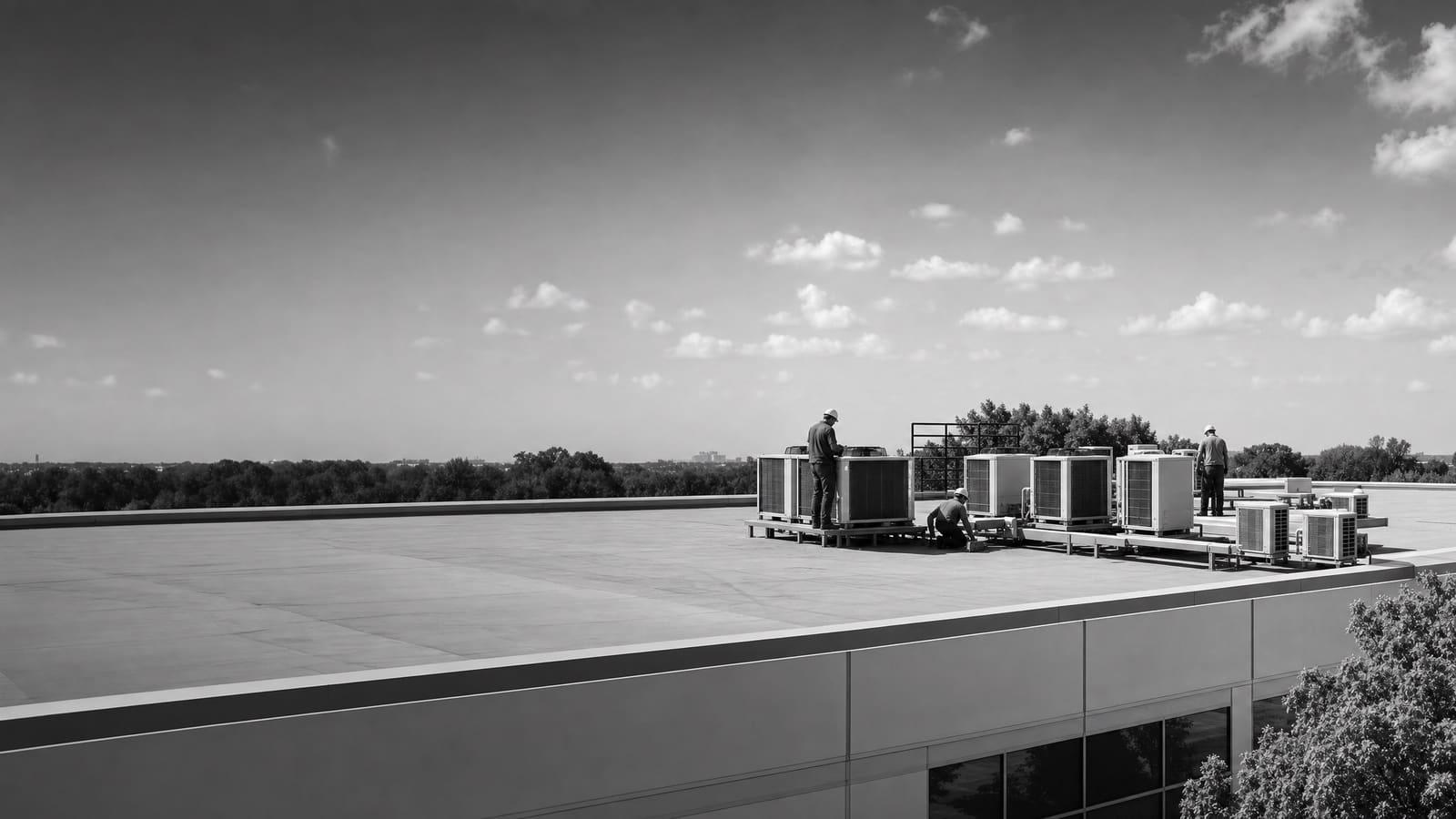
Commercial HVAC replacement includes load review, equipment selection, permits, removal, rigging, curb or connection work, controls, startup, and commissioning. Replacement becomes more useful than another repair when an older unit fails often, cannot hold the space conditions, or keeps consuming repair money without restoring dependable service. DOE guidance flags rooftop units over 15 years old for closer replacement review.
A site review must verify capacity, roof and curb fit, equipment weight, electrical service, fuel, ventilation, drainage, controls, crane reach, and occupied-hour limits.
THREE OPERATING CHOICES
Choose the replacement path before choosing a model
Start with the business problem. A failed unit may demand a fast swap, but speed should not hide a poor fit. If the space still has the same use, occupancy, schedule, and internal equipment, a close replacement may reduce design and connection work. If those conditions changed, repeat sizing based only on the old nameplate can carry an old comfort problem into a new unit.
A heat pump rooftop unit adds another choice. It can provide cooling and reverse-cycle heating, but the decision depends on climate, utility costs, electrical capacity, physical space, gas service, equipment availability, and operating goals. DOE guidance says these factors should be checked at the site or portfolio level. A controls upgrade can also be valuable when the main equipment remains sound. Compare each path by installed scope, downtime, expected maintenance, utility impact, and service support.
BUDGET DRIVERS
What moves the installed price
The supplied research does not support one universal installed price. Ask bidders to separate the equipment from the site work so you can see why totals differ.
EQUIPMENT FIT
Compare equipment by the work it must do
Packaged rooftop units combine major heating, cooling, and air-moving parts in one roof-mounted cabinet. They are common in commercial buildings and can make replacement direct when the new footprint, capacity, connections, and weight remain close to the old unit. A different cabinet may need a curb adapter. A larger change may affect ducts, framing, electrical service, gas piping, controls, and the lift plan.
A heat pump rooftop unit cools like an air-conditioning rooftop unit and also provides reverse-cycle heating. Options may include all-electric, dual-fuel, or cold-climate designs. Do not choose from the equipment label alone. Model winter performance, utility use, electrical demand, backup heat, and the effect of removing or retaining gas. DOE notes that heat pump efficiency falls as outdoor temperature drops, so equipment and backup strategy must match the location and load.
High-efficiency equipment can reduce waste, but rated efficiency is not the whole result. Airflow, ventilation, control sequences, sensor placement, and occupied schedules determine how the system behaves. Ask for performance data at the conditions that matter to your building, plus a written startup and commissioning record.
PROJECT COMPLEXITY
A box swap and a system change are different projects
The amount of change around the unit often matters more than the act of setting it. Classify the project early so the bid includes the right design, review, trades, and outage plan.
LOWER COMPLEXITY
Close replacement
The new unit stays in the same location with similar size, shape, weight, fuel, capacity, curb conditions, and controls. Existing services still require field verification.
HIGHER COMPLEXITY
Changed system
Capacity, fuel, location, dimensions, weight, structure, electrical demand, duct layout, ventilation, or control logic changes. Expect more design and coordination.
SITE REVIEW
Inspect beyond the nameplate
A nameplate starts the equipment search, but it does not define the full installation. The survey should record model, capacity, voltage, phase, heating input, refrigerant, cabinet dimensions, curb dimensions, weight, duct openings, controls, and service clearances. It should also document roof condition, drainage, access route, crane setup, overhead conflicts, parking impacts, and where workers can isolate power and fuel.
Inside the building, review hot and cold complaints, occupied hours, ventilation needs, thermostat locations, tenant changes, and heat from lighting or operating equipment. Compare these facts with service history. Repeated compressor, heat-exchanger, fan, control, or refrigerant problems may support replacement, while a contained repair may still make sense for equipment that otherwise performs well.
The final scope should identify what is reused and what is replaced. That includes curb, ducts, dampers, sensors, drain, disconnect, wiring, gas piping, thermostat, automation points, and roof flashing. If a bidder assumes an item is suitable without checking it, that assumption belongs in writing.
Bring useful records
Provide nameplate photos, service tickets, utility history, controls information, roof plans, comfort complaints, operating schedules, and known future space changes.
MEDFORD PROJECT REVIEW
Equipment changes can expand mechanical plan review
Oregon's commercial mechanical plan review checklist makes replacement details important. It identifies review triggers that include an appliance rating change of more than 10 percent, a different fuel type, a rooftop unit whose size or shape is not within 10 percent of the original, or a rooftop unit moved from its former location. It also asks about equipment weight, dimensional changes, transition curbs, economizers, and structural modifications.
That does not mean every replacement follows the same review path. It means the survey and quote should state these changes clearly. Confirm current permit and plan-review requirements with the authority handling the Medford project before ordering equipment or scheduling a crane.
Make the submittal match the field
Record old and new ratings, dimensions, location, weight, fuel, curb details, economizer scope, and structural work before procurement begins.
OWNERSHIP VIEW
Balance outage risk with lifetime operation
Waiting for failure can delay choices until comfort, inventory, tenants, or operating hours are at risk. DOE guidance notes that owners often delay rooftop replacement until service falls short, maintenance becomes frequent, or the unit fails. A planned project gives time to verify the load, compare technologies, complete review, coordinate the roof, and choose an outage window.
The lowest initial total may still omit work that appears later as a change order. Compare the expected life of the installation through maintenance access, filters, belts, sensors, controls, refrigerant service, warranty rules, and local technician support. For multiple units, consistent controls and service parts may be valuable, but each zone still needs a suitable capacity and sequence.
REACTIVE
Replace after failure
Restores service under pressure, but equipment availability and outage limits may narrow the choices. Keep a temporary-conditioning and communication plan.
PLANNED
Replace before failure
Allows load review, procurement, permit coordination, tenant notice, and phased work before the old unit controls the schedule.
DELIVERY PLAN
Phase the work around the building
Begin with scope and field measurements, then confirm equipment selections before release. The project team should check submittals against actual voltage, capacity, dimensions, weight, curb, duct openings, heat source, controls, and service clearances. Long-lead or special equipment should not be treated as available until the supplier confirms it. Substitutions need the same technical review as the first choice.
Before installation, settle crane placement, delivery route, roof protection, parking controls, tenant notices, utility shutdowns, weather limits, and who can approve a schedule change. Stage curb adapters, transitions, wiring materials, controls parts, and weatherproofing before the old unit is removed. Multi-unit sites may benefit from phasing so one area remains conditioned while another is offline.
Handoff is more than turning the unit on. Verify airflow, rotation, electrical readings, heating and cooling operation, ventilation, drains, safeties, sensors, control sequences, alarms, schedules, and automation points. Record settings and deficiencies. The owner should receive manuals, warranty steps, approved submittals, startup reports, controls documentation, filter information, and a clear list of remaining work.
QUOTE CHECKLIST
Five things every comparable quote should show
Normalize bids before comparing totals. Each proposal should name the equipment, included site work, exclusions, schedule assumptions, and proof required at handoff.
01
Selected equipment
List capacity, efficiency, heat type, voltage, controls, accessories, weight, dimensions, availability, and warranty.
02
Removal and installation
Define recovery, disposal, rigging, curb, ducts, roofing, drainage, electrical, fuel, insulation, and weatherproofing.
03
Design and approvals
State who handles calculations, drawings, permits, plan review, fees, inspections, and structural coordination.
04
Operating disruption
Show shutdown length, phasing, crane limits, parking impacts, tenant coordination, weather assumptions, and temporary conditioning.
05
Testing and handoff
Require startup, airflow and controls checks, deficiency correction, training, manuals, reports, and warranty registration.
Get a defensible number
Price the equipment and the building together.
Send the address, operating target, and target opening date. Flux will identify what must be verified before the project can be priced.
Get a free estimateQuestions
Straight answers.
When should a commercial rooftop unit be replaced instead of repaired?
Review replacement when an older unit needs frequent repairs, cannot maintain the required space conditions, wastes energy, or creates unacceptable failure risk. DOE guidance specifically notes that rooftop units over 15 years old may waste substantial energy compared with newer models. Age alone does not decide the project; combine it with condition, repair history, performance, parts support, and operating impact.
Should the new HVAC unit match the old capacity?
Not automatically. A close match can be sensible when the building use, occupancy, schedule, ventilation, envelope, and internal loads remain stable. Recalculate or verify the load when those conditions changed or when the old system never controlled the space well. A larger unit is not a reliable cure for airflow, zoning, controls, or ventilation problems.
Is a commercial heat pump rooftop unit a good replacement option?
It can be, but the site must support it. Compare all-electric, dual-fuel, and other available designs against winter heating needs, utility rates, electrical capacity, backup heat, gas service, physical fit, equipment availability, emissions goals, and service support. Model expected operation instead of assuming that one technology wins for every building.
What permit details matter for a Medford rooftop replacement?
Document changes in equipment rating, fuel, location, size, shape, weight, curb, economizer, and structure. Oregon's commercial checklist identifies several of these conditions as plan-review triggers, including certain changes greater than 10 percent. Confirm the current project-specific requirements with the responsible local authority before ordering equipment.
How should refrigerant be handled during replacement?
The scope should identify the existing and new refrigerants, recovery work, disposal responsibilities, piping compatibility, leak checks, charging, and service documentation. EPA Section 608 rules govern refrigerant handling and recycling for stationary air-conditioning and heat-pump equipment. Qualified personnel should perform the refrigerant work.
How can buyers compare commercial HVAC bids fairly?
Give each bidder the same field information and require the same schedule of scope. Compare equipment, exclusions, curb and duct work, roofing, crane work, utilities, controls, permits, testing, commissioning, warranty, and outage assumptions. A low total is not comparable when major installation work sits in allowances or exclusions.
Sources used for this guide
- [1]betterbuildingssolutioncenter.energy.gov — DOE Advanced Rooftop Unit Replacement Guidance
- [2]betterbuildingssolutioncenter.energy.gov — DOE Commercial Heat Pump Rooftop Unit Replacement Guidance
- [3]betterbuildingssolutioncenter.energy.gov — DOE High-Efficiency Commercial Rooftop Unit Toolkit
- [4]energy.gov — DOE Efficient Commercial Rooftop Air Conditioner Program
- [5]epa.gov — EPA Stationary HVAC Refrigerant Management
- [6]oregon.gov — Inspector Training Program Registration