THE SHORT ANSWER
What a commercial HVAC replacement actually includes
A commercial replacement covers the load calculation, equipment selection, rigging and set, mechanical and electrical connections, controls, permits, and documented commissioning — not just the box on the roof. Replacement usually beats one more repair once a packaged rooftop unit passes fifteen years, because equipment that old wastes substantial energy and tends to fail in season. Older inefficient rooftop units run roughly $900 to $3,700 each in wasted energy every year, which often funds the upgrade before the next breakdown does.
A site review still has to confirm tonnage against how the building is used now, whether the existing curb and roof framing take the new unit, and whether the electrical service has room.
THREE PATHS
The three replacement choices worth pricing
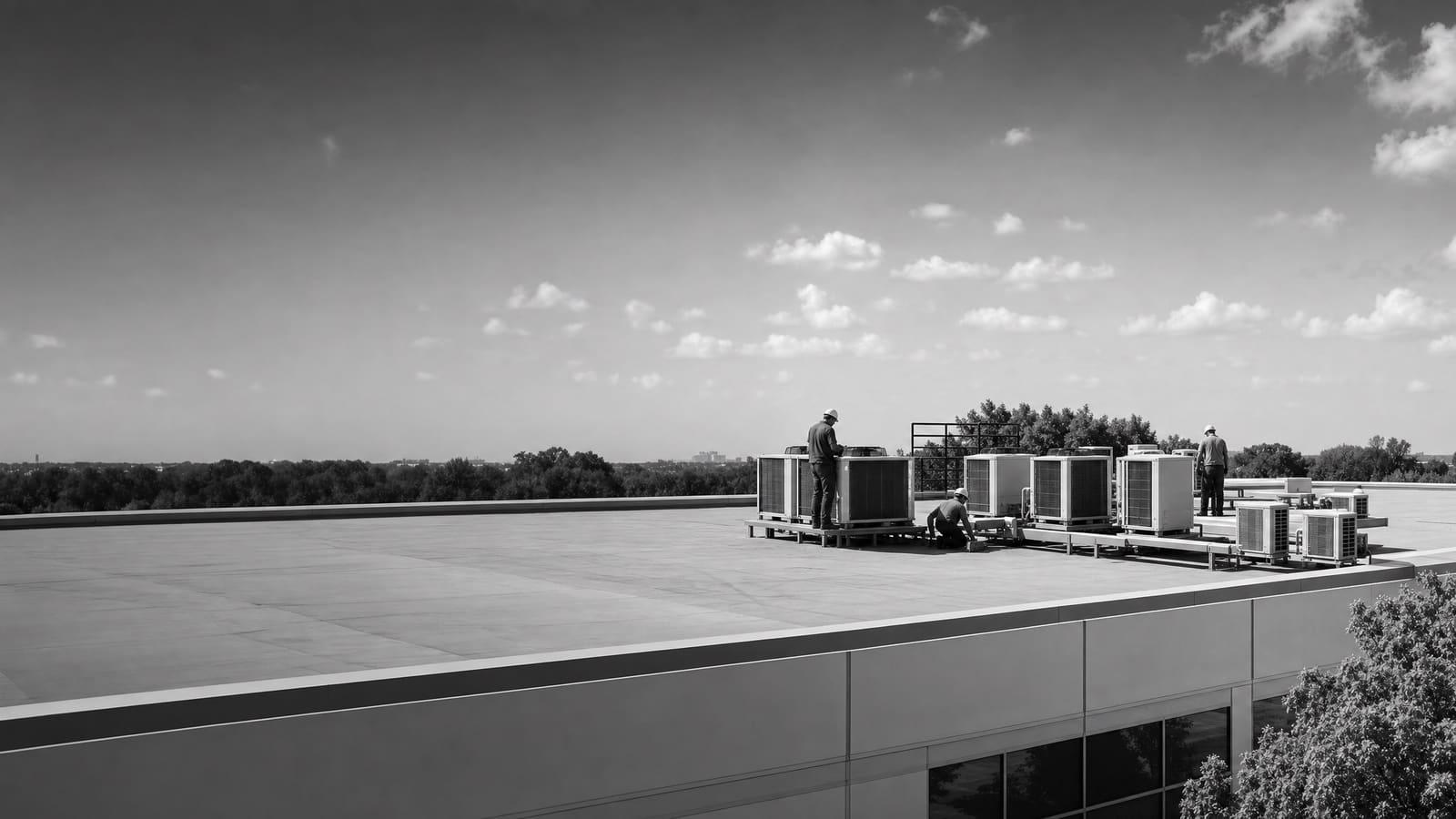
Most Manteca commercial buildings run packaged rooftop units, the equipment that conditions close to half of all commercial floor space in the country. When one reaches the end of its life, there are three honest choices, and they are not equally good on every roof.
The default is like-for-like: same tonnage, same fuel, same curb. It is fast and cheap to engineer, but it carries forward whatever sizing error the old unit had.
The second is a high-efficiency replacement. Federal work with manufacturers produced units built to cut energy use by up to half against the older baseline, and more than twenty models now exceed that specification, so this is a stocked option rather than a special order.
The third is a heat pump rooftop unit, all-electric or dual fuel. Across the West, current heat pump rooftop units are capable of covering most or all of a building's winter heating demand, which makes the electric path more plausible here than in a cold-winter market. Panel capacity, existing gas service, and the rates you actually pay decide it.
WHAT MOVES THE NUMBER
The lines that decide the price
The unit itself is rarely the surprise on a Manteca rooftop quote. Access, roof structure, and electrical capacity are.
HOW TO BUY IT
Buying the replacement instead of reacting to it
Most commercial rooftop units get replaced the day they die, mid-season, with whatever a distributor can put on a truck. That is the most expensive way to buy one. A unit past fifteen years is already wasting real money, and it is also the unit most likely to quit on a hot afternoon when your choices narrow to whatever is in stock.
Planned replacement changes the math twice. You buy on your schedule, which means you specify the efficiency tier you want rather than accepting the tier that happens to be available. And you get to compare paths honestly: a straight changeout, a higher-efficiency unit, or advanced controls on equipment that still has service life left. That last option is real. Plenty of owners take most of the available savings from a controls retrofit and defer the capital a few more seasons.
The decision is not sentimental. Look at the unit's age, its repair history over the last two seasons, whether it still holds the space on design days, and what a new unit would take off the bill. When three of those four point the same direction, replacement is the cheaper answer even though the invoice is bigger.
SIDE BY SIDE
Simple changeout or a real project
Not every replacement carries the same risk. The difference is usually settled on the roof and in the electrical room, before anyone quotes a price.
LOWER COMPLEXITY
Straight changeout
Same tonnage, same fuel, the existing curb accepts the new unit, and the lot has room for the crane. Roof framing already carries the weight and the panel has capacity. The old unit comes off and the new one goes on in one planned visit, and the permit path is simple.
HIGHER COMPLEXITY
Fuel switch or resize
Tonnage changes, the footprint needs an adapter, or an all-electric unit needs service capacity the building does not have. Add gas abandonment, structural review, a tight lot, or an occupied tenant directly below, and the job needs phasing rather than just a crane date.
BEFORE THE QUOTE
What the site review has to confirm
A useful walk starts with the load, not the nameplate. Twenty years of tenants changes occupancy, plug loads, lighting heat, and sometimes the envelope, so the tonnage that was right in 2005 may be wrong in both directions today. Oversized equipment short-cycles and never dehumidifies properly. Undersized equipment loses the space on the worst week of the year.
From there the review is physical. Does the existing curb match the new footprint, or does it need an adapter? Will the roof framing take the weight of the unit you are considering? Where does the crane set up, how far does it have to reach, and how many parking stalls close while it works? Is the electrical service sized for the unit, and is there panel space for it?
Fuel questions come next. If a heat pump unit is on the table, the review has to cover electrical capacity, physical constraints on the roof, and what happens to the existing gas line. Equipment availability belongs in the same conversation, because the model that pencils best is worth nothing if it lands two months after you need it. Finally, ask what incentives apply to the tier you are specifying and what the application requires.
A nameplate photo is a budget number, not a price
If a contractor quotes from a photo alone, treat the figure as planning information. It is genuinely useful early. It is not a number you should sign, because nothing about the curb, the panel, the roof framing, or the crane path has been verified yet.
IN MANTECA
Permits and sequencing on a Manteca roof
Permits are not optional on a commercial changeout. California building departments require a permit for mechanical upgrades and repairs, and they treat re-roofing as separate permitted work rather than part of the mechanical scope. That matters for sequencing in Manteca. If the roof membrane is within a few years of replacement, doing the roof and the rooftop unit as one coordinated project keeps you from paying twice for crane time, curb work, and flashing around the same opening.
Climate helps the electric option here. Across the West, current heat pump rooftop units can cover most or all of a building's winter heating demand, so an all-electric or dual-fuel unit is a serious candidate on a Manteca roof rather than a stretch. Settle the permit path with the city before the crane is scheduled, because inspection timing is usually what moves a set date.
Ask who pulls what
Have the contractor name every permit the project pulls — mechanical, electrical, and any structural review — and say plainly who submits them and who meets the inspector. A finished changeout waiting on an inspection is still a building without cooling.
OWNERSHIP
Two things that change the answer
The right equipment decision depends on who holds the asset and how many units you are responsible for. A single owner-occupied building and a leased suite inside a multi-tenant property can face the same failed unit and arrive at different answers, and both can be correct.
WHO HOLDS THE ASSET
Owner, landlord, or tenant
A rooftop unit will outlast most lease terms, so the party paying for it is not always the party collecting the savings. Settle that before you pick an efficiency tier. Owner-occupied buildings can justify the higher tier on operating cost alone; split responsibilities need the lease language checked first.
ONE UNIT OR A FLEET
Standardizing across a roof
If you have several units aging together, choosing one manufacturer and one control platform simplifies service, spare parts, and training. Mixed fleets with different refrigerants and controls cost more to maintain than the equipment difference suggests, and they make each future replacement its own research project.
PHASING AND PROCUREMENT
Replacing several units without a bad year
Buildings rarely have one tired unit. They have four that were installed the same week and are now aging on the same schedule. Replacing them all at once is clean but capital-heavy. Replacing them one failure at a time means every decision gets made under pressure, at whatever price and lead time the market offers that day.
The middle path is a written replacement order. Rank the units by age, repair spend, and how critical the space they serve is, then commit to a pace — one or two a year — and hold to it. That approach is not theoretical. More than two hundred organizations working through a federal upgrade program have replaced or retrofitted over 43,000 rooftop units, saving a combined $37 million a year on energy. The savings come from the sequence being planned, not from any one heroic project.
Procurement follows the same logic. Lock the model and the efficiency tier early, get the lead time in writing, and confirm what any applicable incentive requires and when the application has to be filed, since eligibility often depends on the timing. Then look at lifetime cost rather than the invoice. A unit chosen on purchase price alone gets paid for again, quietly, every month it runs.
THE CHECKLIST
Five things a comparable quote shows
Two quotes are only comparable when both spell out the same scope. If one of these is missing, ask for it before you compare prices.
01
The unit and the load behind it
Model, tonnage, and efficiency tier, plus the load calculation that justifies the size — not a tonnage copied off the old nameplate.
02
Equipment lead time in writing
Current availability for the exact model quoted, stated next to the price, so the schedule is honest from day one.
03
Rigging and access plan
Crane size, setup location, reach, how many stalls close, and for how long.
04
Curb, structural, electrical, and gas scope
Adapter or new curb, any framing work, electrical capacity and connections, and what happens to the existing gas line.
05
Permits, commissioning, and warranty
Who pulls permits, who meets inspectors, and the documented startup — charge, airflow, and control settings verified — that keeps the warranty intact.
Get a defensible number
Price the equipment and the building together.
Send the address, operating target, and target opening date. Flux will identify what must be verified before the project can be priced.
Get a free estimateQuestions
Straight answers.
When is replacement better than another repair?
Once a packaged rooftop unit is past about fifteen years, it is wasting substantial energy and is the unit most likely to fail in season. Weigh age, the last two seasons of repair spend, whether it still holds the space on design days, and what a new unit would cut from the bill.
Does a heat pump rooftop unit make sense in Manteca?
It is a real candidate. Across the West, today's heat pump rooftop units can handle most or all of a building's winter heating demand. The decision turns on electrical service capacity, what happens to the existing gas line, and the electric and gas rates your building actually pays.
What happens to the refrigerant in the old unit?
Federal rules under Section 608 of the Clean Air Act govern how refrigerant is handled and recycled in stationary air conditioning equipment. It has to be recovered properly rather than vented, and that recovery is part of the removal scope on any changeout.
What is the real schedule variable on a changeout?
Rarely the set itself. It is equipment lead time and inspection timing. Ask for current availability on the exact model quoted, and settle the permit path with the city before the crane date is booked.
Can advanced controls replace a full changeout?
Sometimes. Owners can either replace an old unit with a more efficient one or retrofit advanced controls, depending on which pencils better. On equipment with service life left, controls can capture much of the savings and push the capital out a few seasons.
Sources used for this guide
- [1]betterbuildingssolutioncenter.energy.gov — DOE Advanced Rooftop Unit Replacement Guidance
- [2]betterbuildingssolutioncenter.energy.gov — DOE Commercial Heat Pump Rooftop Unit Replacement Guidance
- [3]betterbuildingssolutioncenter.energy.gov — DOE High-Efficiency Commercial Rooftop Unit Toolkit
- [4]energy.gov — DOE Efficient Commercial Rooftop Air Conditioner Program
- [5]epa.gov — EPA Stationary HVAC Refrigerant Management
- [6]californiacity-ca.gov — HVAC Permits