THE SHORT VERSION
What a commercial HVAC replacement actually includes
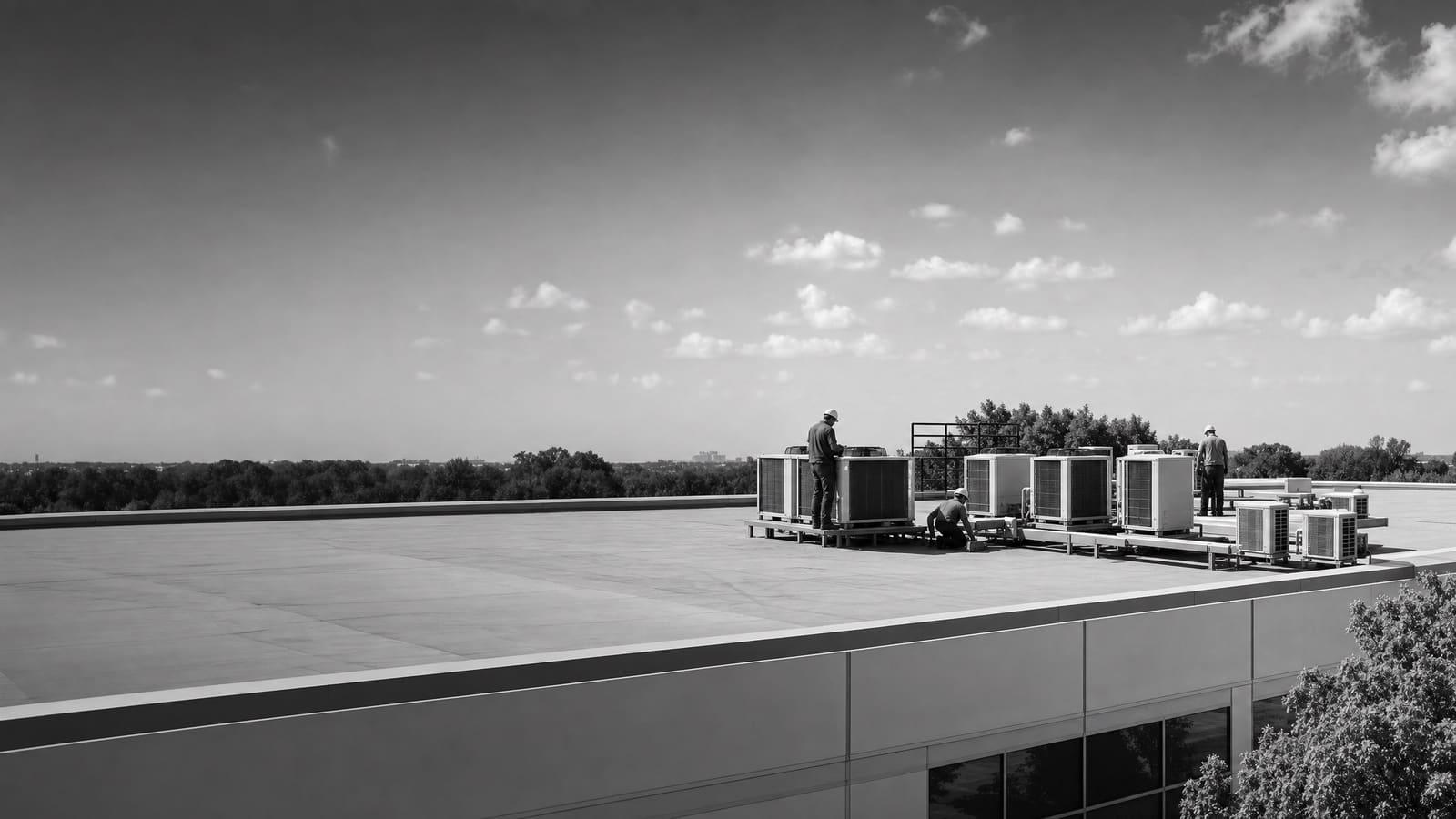
A commercial HVAC replacement covers the load calculation, equipment selection, rigging and set, the curb, power and gas connections, controls, and commissioning. Replacement beats another repair once the unit is past roughly fifteen years and the failures start stacking up. Federal research puts the annual waste of an old, inefficient rooftop unit at roughly $900 to $3,700, so a second compressor on a tired machine often costs more over five years than a new unit would.
A site review still has to confirm the real load, the roof curb and structure, available electrical capacity, and crane access before any number on a quote means anything.
THREE WAYS TO GO
Three paths when the unit is at end of life
Most buildings land on one of three moves, and the right one depends on how much of the problem is the box and how much is how it runs. Federal rooftop guidance is blunt about this: owners can replace an old unit with a more efficient one, or retrofit it with advanced controls, depending on which makes better financial sense. Both save real money. More than 200 organizations upgraded over 43,000 rooftop units through that effort and cut a combined $37 million a year from their energy bills.
The third path is a fuel decision rather than a box decision. Heat pump rooftop units are close cousins of the air-conditioning units they replace, but they add reverse-cycle heating, which touches your gas line, your electrical service, and your operating cost picture all at once. Decide that one before you order, not after the crane is booked.
WHAT MOVES THE NUMBER
Where commercial installation budgets actually move
No two roofs price the same, so treat these as the lines that separate a cheap bid from a complete one. Each item below either sits in the scope from the start or shows up later as a change order.
IN PRACTICE
Choose the equipment before you choose the contractor
Start with age and duty, not with the brand. Federal guidance treats fifteen years as the point where a rooftop unit begins wasting real money against a current model, and it names the trap most owners fall into: waiting until the unit no longer conditions the space, needs constant service, or fails outright. A breakdown in July picks the equipment for you, and it almost never picks the unit you would have chosen with three weeks to think.
The second question is whether you keep burning gas. Heat pump rooftop units are built on the same platform as the air-conditioning units they replace, and they heat by running the refrigerant cycle in reverse. Their heating efficiency falls as the outdoor temperature drops, and near the bottom of the range it approaches plain electric resistance heat. That is why the equipment comes in three shapes — dual-fuel, all-electric, and cold-climate — and why the pick is a building decision rather than a preference. A dual-fuel unit keeps gas heat for the coldest stretch. A cold-climate unit is built to hold efficiency further down the scale.
Then check what the building can actually feed. Electrical capacity, physical fit on the existing curb, and the fate of the gas line are the three infrastructure items that quietly kill an otherwise good equipment choice, and all three are cheaper to find during scoping than during the install.
COMPLEXITY CHECK
Simple swaps versus involved projects
Two replacements of the same tonnage can be completely different projects. What separates them is how much has to change around the unit — the curb, the service, the fuel, and the schedule.
LOWER COMPLEXITY
Same fuel, same footprint
The new unit lands on the existing curb with an adapter, keeps the same fuel and roughly the same electrical draw, and the space is used the way it was when the old unit went in. The rigging plan is short, and the building can usually stay open through the set.
HIGHER COMPLEXITY
New fuel, new footprint, or occupied hours
Fuel switching, a larger unit, or a roof that needs structural review all add scope. So does a tenant that cannot lose conditioning during business hours. These projects need the electrical service verified, the gas line resolved, and the crane day fitted around operations.
BEFORE THE QUOTE
What a real site review has to settle
A quote written from a nameplate photo is a starting point, not a price. The site review is where the scope stops being a guess.
Load comes first. The old unit's tonnage records what the building needed the year it was installed, not what it needs now. Occupancy, plug loads, lighting, and any envelope work all move that number, and both oversizing and undersizing show up later as comfort complaints no service call can fix.
Then the physical checks. Does the new unit sit on the existing curb, or does it need an adapter or structural work? Can the crane reach the position, and how many stalls does that close, for how long? Is there electrical capacity for the unit you want, and if not, does that change the equipment or the service?
Refrigerant is the last piece and the easiest to skip. What is in the old unit is regulated under EPA Section 608, which governs how refrigerant is handled and recovered rather than vented. That work belongs in the written scope, along with who performs it.
Ask for this in writing
Before you sign, get the load basis, the curb and structural finding, the electrical capacity check, the crane and lot plan, and the refrigerant recovery scope on paper. Five lines. A bid missing three of them is not cheaper, it is incomplete.
OWNING THE DECISION
Two things that outlast the install
The installation takes a week of your attention. The consequences run for the next fifteen or twenty years, and two of them deserve to be decided on purpose instead of by default. The first is when you replace. Federal rooftop guidance is direct that proactively replacing an inefficient unit is often the smarter business move than replacing on failure, or even than a like-for-like swap at the end of service life. The second is what happens to the rest of the roof once the units up there no longer match each other.
TIMING
Planned beats reactive
A planned replacement lets you compare equipment, price efficiency tiers against your actual utility spend, and schedule the crane for a slow week. A failure in season collapses all of that into whatever is on the truck. The difference rarely shows on the invoice. It shows in the fifteen years after it.
FLEET
Mixed roofs need a plan
Once one unit is replaced, the roof carries two generations of equipment with different refrigerants, controls, and parts. That is manageable, but it should be planned. Service contracts, spare parts, and the replacement order for the remaining units all follow from it.
OVER THE LIFE OF THE UNIT
Phasing, procurement, and cost after year one
If you own more than one unit, resist replacing them one emergency at a time. Rank the roof by age, condition, and how much each unit costs you to run, then replace in that order across two or three budget cycles. The oldest, hardest-working unit usually carries the biggest share of that annual waste, and it is the one worth doing first.
Procurement is where schedules break. Equipment availability is a genuine constraint on rooftop projects, and so is finding installers who know the technology you picked — especially when you move from a straight air-conditioning unit to a heat pump. Ask for availability next to price on every option, and treat a quote without a lead time as unfinished.
Incentives are worth checking before you order rather than after. Utility and program incentives for high-efficiency and heat pump rooftop units exist in many markets, and eligibility usually depends on the equipment selected and on applying before the work happens. Verify what applies to your building and your utility while the equipment decision is still open. An incentive found after installation is usually an incentive lost.
QUOTE CHECKLIST
Five things a comparable quote should show
Bids only compare when they cover the same work. Ask every contractor to show these five items in the same order, and the differences in price stop being mysterious.
01
Equipment, tonnage, and efficiency tier
The exact model, its capacity, and the efficiency level, with the load basis that justifies the size.
02
Lead time next to price
When the unit can actually be on site. A price without availability is not a schedule.
03
Curb, structural, and rigging scope
Adapter or new curb, any structural review, crane reach, and how long lot access is closed.
04
Utility connections and capacity
Electrical service verification, gas line disposition, and any upgrade the selected unit requires.
05
Commissioning and refrigerant handling
Startup, airflow, charge, and controls verified against spec, plus recovery of the old refrigerant.
Get a defensible number
Price the equipment and the building together.
Send the address, operating target, and target opening date. Flux will identify what must be verified before the project can be priced.
Get a free estimateQuestions
Straight answers.
When is replacing better than one more repair?
Once a unit is past about fifteen years and needs frequent service, replacement usually wins. Federal estimates put the annual waste of an old, inefficient rooftop unit at roughly $900 to $3,700, and that cost repeats every year the repair buys you.
Should we switch to a heat pump rooftop unit?
It depends on the building, not the trend. Heat pump units lose heating efficiency as outdoor temperatures fall, which is why cold-climate and dual-fuel models exist. Check electrical capacity, physical fit, and the gas line before committing.
How much does a commercial HVAC installation cost?
There is no honest universal number. Tonnage, efficiency tier, curb and structural work, crane access, and electrical capacity move it more than anything else. Get the load and the site review done first, then the quote means something.
Do we have to replace, or can controls fix it?
If the equipment still has service life and the real problem is that it runs full tilt all day, an advanced controls retrofit can be the better financial move. If the unit is old and failing, replacement is the one that pays.
What happens to the old refrigerant?
It gets recovered, not vented. EPA Section 608 regulates the handling and recycling of refrigerant in stationary air conditioning and heat pump equipment, so recovery should appear in the written scope along with who performs it.
Sources used for this guide
- [1]betterbuildingssolutioncenter.energy.gov — DOE Advanced Rooftop Unit Replacement Guidance
- [2]betterbuildingssolutioncenter.energy.gov — DOE Commercial Heat Pump Rooftop Unit Replacement Guidance
- [3]betterbuildingssolutioncenter.energy.gov — DOE High-Efficiency Commercial Rooftop Unit Toolkit
- [4]energy.gov — DOE Efficient Commercial Rooftop Air Conditioner Program
- [5]epa.gov — EPA Stationary HVAC Refrigerant Management