THE SHORT ANSWER
What a commercial HVAC replacement actually includes
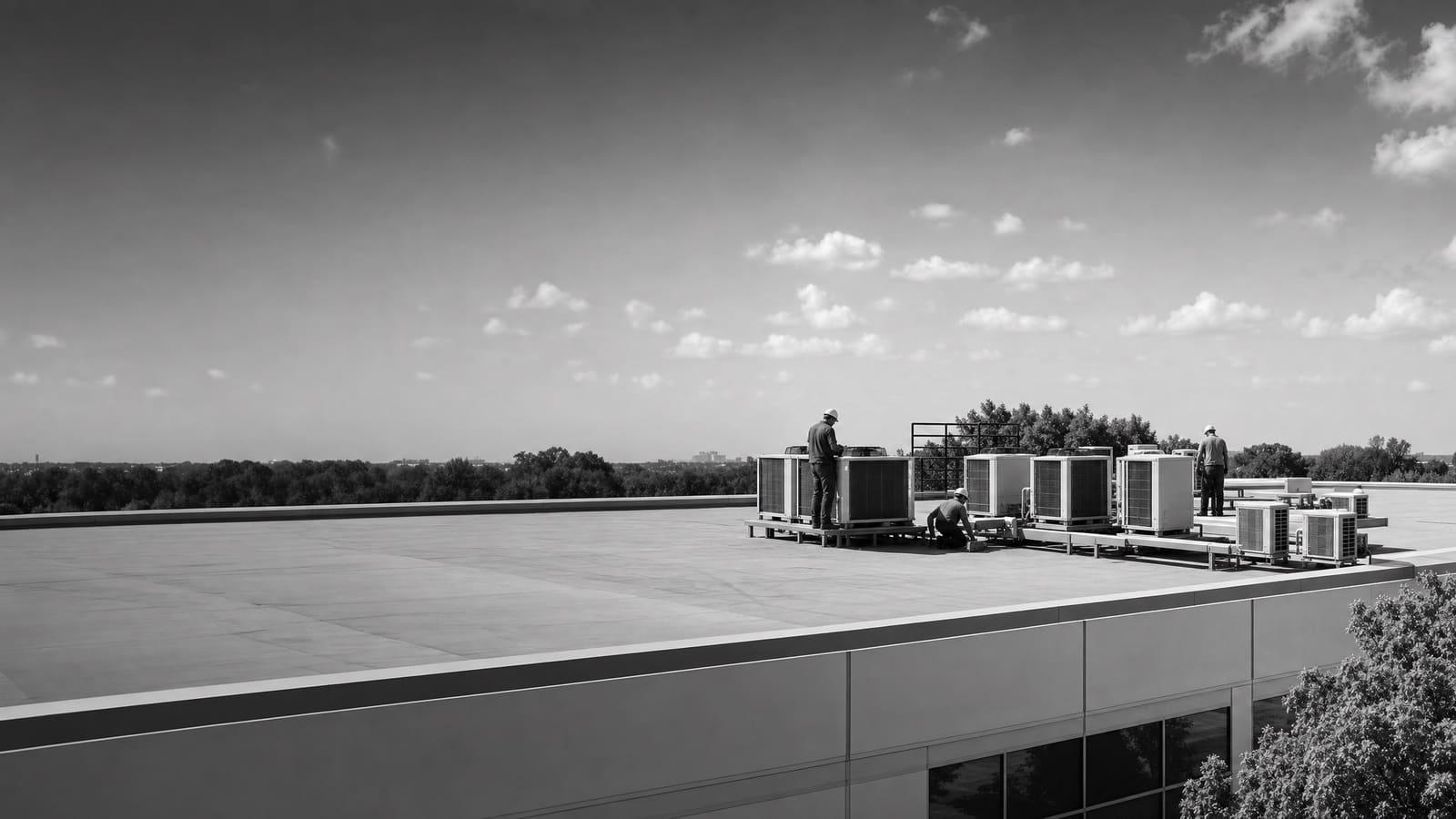
A commercial HVAC replacement is a project, not a swap. It covers a confirmed load, equipment selected against real availability, curb and roof work, gas and electrical connections, permits and inspections, controls integration, and documented startup. Replacement beats one more repair once a rooftop unit is past fifteen years or so. Old, inefficient rooftop units waste roughly $900 to $3,700 each per year, and that meter runs every month you keep patching.
A site review has to verify the roof structure and curb, available electrical capacity, gas line size, crane reach and lot access, and whether the existing unit is still sized for how the space is used now.
THREE PATHS
Repair again, swap like-for-like, or plan an upgrade
Three paths sit in front of most owners, and the cheapest one on paper is rarely the cheapest one over five years.
Waiting for failure is a choice, not a neutral position. It looks free until the unit dies in July, the matching model is weeks out, and you are renting portable cooling while tenants complain. Planned replacement usually beats replacement-on-failure, and it often beats a like-for-like swap made at the very end of a unit's service life.
The other two paths are both planned. Like-for-like keeps the curb, the connections, and the sizing you already have. A right-sized or higher-efficiency replacement costs more engineering up front and pays it back through the utility bill and through comfort complaints that finally stop.
Pick by how long you will hold the building and how much the space has changed since the old unit went in.
WHAT MOVES THE NUMBER
The lines that separate two quotes for the same tonnage
These are the items that make two quotes for the same tonnage land thousands apart. Ask which of them is included and which is an allowance, because an allowance is a number that moves after the crane leaves.
CHOOSING EQUIPMENT
Gas heat, heat pump, or dual fuel
The equipment choice worth real thought is what the new unit uses for heat. A gas-heat packaged unit is the familiar answer and is still a good one. A heat pump rooftop unit does the same cooling and heats by running the cycle backward, and across most of the South today's heat pump rooftop units are capable of handling most or all of the winter heating demand on their own. Macon sits in that mild-winter band, which makes the option practical rather than experimental.
Heat pump heating does get less efficient as outdoor temperatures drop, and at the bottom it trends toward the cost of electric resistance heat. That is why a dual-fuel unit — heat pump for most hours, gas burner for the cold snap — is often the low-drama pick on a building that already has gas at the roof.
Three things decide it, and none are on the brochure. Electrical capacity, because an all-electric unit pulls more service. Physical constraints, because footprint and curb have to work. And what happens to the gas line if you abandon it. Add availability: confirm the model you selected can ship on your schedule, and that whoever installs it has commissioned that equipment before.
COMPLEXITY
What makes one replacement simple and another one long
Not every replacement is the same project. Two things set the complexity: how much has to change at the roof, and how much has to change below it.
LOWER COMPLEXITY
Same size, same fuel, same curb
A like-for-like swap where the footprint matches, electrical and gas are already sized, and the crane has open reach. Permitting is straightforward and the on-site work is a planned morning rather than a week of disruption.
HIGHER COMPLEXITY
New size, new fuel, or a tight site
Larger tonnage, an all-electric conversion that needs added service capacity, a curb adapter plus structural review, or a roof reachable only by closing an access drive. These move the schedule and the number more than the equipment does.
SCOPING
Why the site review is the quote
A price written from a nameplate photo is a planning number. It is useful for budgeting and it is not a commitment, and any contractor who presents it as one is guessing on your behalf.
The site review is where the number gets real. Someone should be on the roof measuring the existing curb, checking the deck and the support under it, and asking whether the unit is even in the right place for how the space is used now. Twenty years of tenant changes move loads around. A unit sized for a floor of desks serves a different building than one now full of network gear.
Below the roof, the review covers the electrical panel and its available capacity, the gas line and its size, condensate routing, and how the new unit will talk to whatever controls you already run. Outside, it covers the crane: where it sets up, how far it has to reach, which stalls close, and for how long.
Ask for the findings in writing. A scope that lists what was verified is the only honest way to compare two quotes that both say "replace RTU-3."
What a real site review produces
A written scope naming existing tonnage and curb dimensions, verified electrical and gas capacity, the rigging plan and lot closure, the permits being pulled, and the commissioning steps included. If any of those are missing, the quote has an allowance hiding in it.
PERMITS IN GEORGIA
Equipment replacement is permitted work
Commercial mechanical work in Georgia cities is permitted work, and equipment replacement is not the exception people assume it is. Published commercial permit guidance is explicit: a contractor who repairs, alters, or replaces a mechanical system has to obtain a permit, and electrical, gas, and mechanical work each carry their own permit requirement. The exemptions cover portable equipment and replacing a minor part that does not change the equipment's approval. A full rooftop unit swap is neither.
There is a sensible carve-out for emergencies. Where an equipment replacement has to happen immediately, the work can proceed and the permit application is submitted the next working business day. That is the rule to know before a unit dies in August, because it means the honest answer to "can you start tomorrow?" is yes — with paperwork following, not skipped.
Settle this before the crane is booked
Have your contractor confirm the permit path with the Macon-Bibb County building department in writing as part of the quote: who files it, whether electrical is pulled separately, and what triggers structural review if tonnage or footprint grows.
OWNERSHIP
Two questions that outrank the equipment spec
Two questions decide more than the model number does: how long you hold the building, and who pays the power bill.
An owner-occupant keeps both halves of the trade — the capital cost and the savings — so a higher efficiency tier becomes a straightforward math problem. A landlord on leases where tenants pay utilities is spending capital to lower someone else's bill, which is why those buildings tend toward like-for-like swaps unless the lease structure says otherwise.
The second question is fleet strategy. If you have six rooftop units of similar age, replacing them one failure at a time leaves you with six models, six parts inventories, and six service learning curves.
HOLD PERIOD
How long you keep the building
Efficiency pays back monthly, so a five-year hold and a twenty-year hold justify different equipment. If a sale is likely, a documented new unit with transferable warranty is worth more at closing than a marginal efficiency step.
FLEET
One unit or a roof full of them
Standardizing model and refrigerant across a fleet cuts parts inventory and service surprises. Planned batch replacement also gives you leverage on lead time and price that a single emergency swap never will.
PHASING AND PROCUREMENT
Buying replacements as a plan, not an emergency
If you own more than one aging unit, stop treating them as separate emergencies. Group them. A phased plan replaces the worst performers first, schedules lifts in shoulder season when a partial outage is survivable, and orders equipment early enough that lead time is a calendar item instead of a crisis. Organizations that ran rooftop upgrades this way — more than two hundred of them, across more than forty-three thousand units — cut a combined thirty-seven million dollars a year from their energy bills.
Full replacement is not the only move on that list. On a unit that is still mechanically sound, retrofitting advanced controls is a legitimate alternative that captures part of the savings without the capital cost of new equipment. Price it next to replacement instead of assuming.
Two procurement details save real money. First, incentive programs for high-efficiency rooftop equipment tie eligibility to specific efficiency levels and frequently require approval before equipment is ordered, so confirm the terms before anything ships. Second, the old unit's refrigerant is regulated: it has to be recovered and handled properly under federal rules, not vented. That belongs in the scope and on the invoice.
Then price the decision over the life of the unit. The equipment line is one number. The bill it produces every month for the rest of its service life is the bigger one.
QUOTE CHECKLIST
Five things a comparable quote has to show
Two quotes are only comparable when both show the same five things. Ask for them in this form and the differences stop being mysterious — the low bid either earns it or explains itself.
01
Equipment, tonnage, and efficiency tier
Model number, capacity, heating type, refrigerant, and the efficiency rating — not "or equivalent unit."
02
Confirmed lead time
A ship date for the specific model quoted, and what happens to price and schedule if that date slips.
03
Roof and rigging scope
Curb adapter or new curb, any structural work, crane setup and reach, lot closure hours, and who notifies tenants.
04
Connections and controls
Electrical capacity verified, gas or refrigerant line changes, condensate routing, and the exact controls integration included.
05
Permits, commissioning, and warranty
Which permits are pulled and by whom, refrigerant recovery, startup and airflow verification documented, and the warranty terms that documentation protects.
Get a defensible number
Price the equipment and the building together.
Send the address, operating target, and target opening date. Flux will identify what must be verified before the project can be priced.
Get a free estimateQuestions
Straight answers.
When does replacement beat one more repair?
Once a rooftop unit is past about fifteen years, the math usually flips. Old, inefficient units waste roughly $900 to $3,700 each per year, and that loss continues while you keep paying for parts. Planned replacement also beats replacement-on-failure, which is the version where the unit picks the date.
Is a heat pump rooftop unit a real option in Macon?
Yes. Across most of the South, current heat pump rooftop units can handle most or all of the winter heating demand on their own. Efficiency drops in a hard cold snap, so a dual-fuel unit is often the safer pick on a building that already has gas at the roof. Confirm electrical capacity first.
Do we need a permit just to replace an existing unit?
Plan on it. Georgia commercial permit guidance requires a permit to repair, alter, or replace a mechanical system, and electrical and gas work carry their own. Only portable equipment and minor parts that do not change the equipment's approval are exempt. Emergency replacements proceed with the application filed the next working business day.
What happens to the refrigerant in the old unit?
It is recovered, not vented. Federal rules govern how refrigerant in stationary air conditioning equipment is handled and recycled, and recovery has to be done by a certified technician. Make sure recovery appears in the written scope so it is not treated as an extra after the crane leaves.
Why won't anyone quote an installed price over the phone?
Because the parts that move the number are not visible in a nameplate photo. Curb match, roof structure, available electrical capacity, gas line size, and crane access can each shift the total more than the equipment does. A photo gets you a planning conversation. A roof visit gets you a price you can hold someone to.
Sources used for this guide
- [1]betterbuildingssolutioncenter.energy.gov — DOE Advanced Rooftop Unit Replacement Guidance
- [2]betterbuildingssolutioncenter.energy.gov — DOE Commercial Heat Pump Rooftop Unit Replacement Guidance
- [3]betterbuildingssolutioncenter.energy.gov — DOE High-Efficiency Commercial Rooftop Unit Toolkit
- [4]energy.gov — DOE Efficient Commercial Rooftop Air Conditioner Program
- [5]epa.gov — EPA Stationary HVAC Refrigerant Management
- [6]augustaga.gov — FAQs - CivicPlus.CMS.FAQ