THE SHORT ANSWER
What a commercial HVAC replacement actually covers
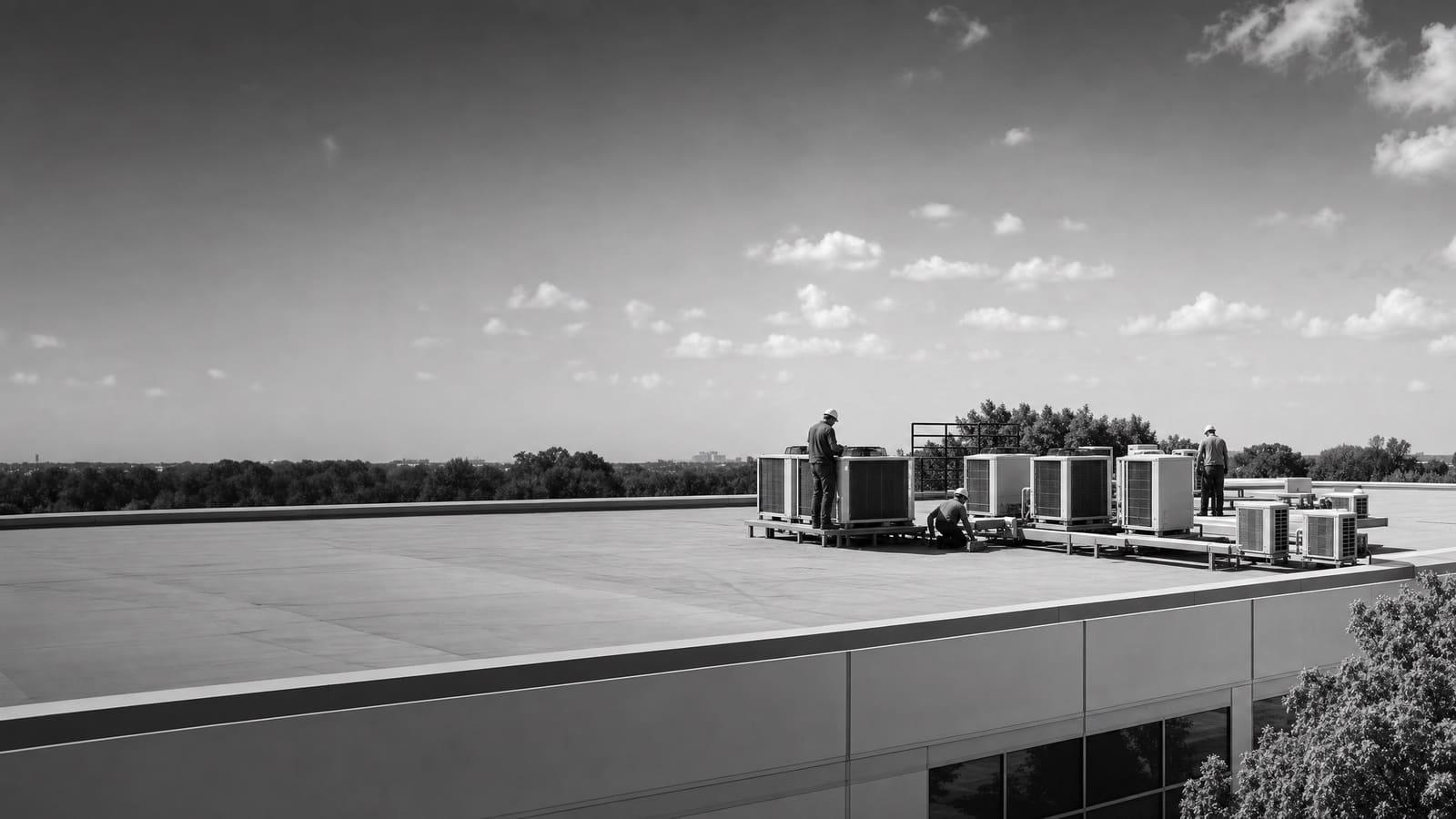
A commercial HVAC replacement covers the load calculation, equipment selection, rigging and set, gas, electrical and refrigerant connections, controls integration, permits, and commissioning. Replacement beats another repair once a unit is past roughly fifteen years and losing capacity. Federal estimates put the annual waste from an old, inefficient rooftop unit between $900 and $3,700 per unit — a cost that repeats every year and that repairs never recover.
A site review still has to confirm curb and structural fit, available electrical capacity, crane access, and whether the current tonnage matches how the space is used today.
THREE WAYS TO GO
The three real options when a unit is at end of life
Most buyers are choosing between three paths. The right one depends on how much runway the building has and on what the space is doing now.
Replace on failure is the option nobody picks on purpose. It costs the most in downtime and hands you whatever unit is on a truck that week.
Planned like-for-like keeps the curb, the connections, and the fuel source. It is the fastest install and the cheapest engineering, and it is the right call when the space and its use have not changed.
A high-efficiency or heat pump replacement changes the equipment class. The federal rooftop unit challenge targeted models cutting energy use up to half against the old standard, and more than twenty models now exceed that specification. Heat pump rooftop units add reverse-cycle heating, which matters if you want off the gas meter — but they need electrical capacity, and their heating efficiency falls as outdoor temperatures drop.
WHAT MOVES THE NUMBER
The budget lines that actually swing
Installed price is driven mostly by what surrounds the unit, not by the box itself. These are the lines that separate two quotes on the same building. Ask for each one priced out, not folded into a single number.
HOW TO BUY IT
Buying the install, not just the equipment
The equipment is the part everyone compares, and it is rarely where quotes differ. Two contractors can name the same model and land far apart on price because one priced the curb adapter, the rigging plan, the permit, and a documented startup, and the other left those for a change order. Put the scopes side by side before you look at the totals.
Start from the load, not the nameplate. A unit installed twenty years ago was sized for the occupancy, lighting, plug load, and envelope of that building at that time. Lighting alone has changed enough in most commercial spaces to move the cooling load. Carrying the old tonnage forward is a decision, and it should be one you made on purpose.
Then decide how long you plan to hold the building. Rooftop systems cool close to half of all US commercial floor area, and once they pass fifteen years the efficiency gap against current equipment gets expensive to keep paying. If the hold period is short, a like-for-like swap protects capital. If you are keeping the asset, the efficiency tier and the controls are where money comes back — year after year, on a bill you were going to pay anyway.
SCOPE CHECK
What makes an install simple or complicated
Before anyone quotes, you can usually tell which side of this line your project sits on. It sets the schedule, the permit path, and how much engineering the job needs.
LOWER COMPLEXITY
Same footprint, same fuel
Matching tonnage on the existing curb, fuel source unchanged, open roof access, and a lot that can give up stalls for a morning. The engineering is light and the set is a single planned event.
HIGHER COMPLEXITY
A new class of equipment
Tonnage or footprint changes, fuel type changes, electrical service is tight, or the crane needs a street closure. Expect structural review, a longer approval path, and phased work around occupied hours.
THE SITE REVIEW
What a walk-through has to establish
A quote written from a nameplate photo is a starting number, not a price. The visit that turns it into a real one is short, and it answers a specific list.
On the roof: curb dimensions and condition, the structure under it, clearances around the unit, and how the existing ductwork lands. Federal guidance on heat pump rooftop conversions puts three physical constraints ahead of almost everything else — electrical capacity, physical space, and existing gas lines — because those are what turn a straightforward swap into a project.
On the ground: where the crane sets up, what it can reach, how many stalls close, and for how long. At the panel: whether available service supports the unit you want, which matters most when the replacement moves heating from gas to electric.
The last item is refrigerant. Anyone opening the old unit is working under EPA rules for handling refrigerant in stationary air-conditioning equipment, so recovery by a certified technician and disposal of the old unit belong in the written scope rather than in an assumption.
Ask for the constraints in writing
The three answers that change a quote most are available electrical capacity, curb and structural fit, and crane access. If a proposal does not state all three, it has priced the equipment, not the job.
OWNERSHIP CONSIDERATIONS
Two things that outlive the install
The install ends in a day. The two decisions below follow the building for the full service life of the equipment, and both are far easier to get right while the unit is still being selected than after it is running.
They come down to the same question: who operates this, and with what information? A unit nobody can see into gets serviced on complaints instead of on data, which is the most expensive maintenance schedule there is. Neither item costs much at selection time. Both cost real money to retrofit.
MIXED FLEETS
Refrigerant and parts planning
New commercial equipment ships on newer low-GWP refrigerants. Day-one operation is unaffected, but a roof with four old units and one new one now needs two service and spare-parts paths. Sequence the remaining replacements deliberately.
VISIBILITY
Controls and who watches them
Decide before startup whether the unit reports into building automation and who reads the alarms. Trend data is what turns a comfort complaint into a specific fix instead of a truck roll and a guess.
PHASING AND PROCUREMENT
When you have more than one unit to replace
Almost nobody has exactly one aging unit. A typical commercial roof carries a group of them installed within a few years of each other, which means they tend to fail within a few years of each other too. Replacing them one at a time as they die is the most expensive version of the same project: separate mobilizations, separate crane days, separate approvals, and no negotiating leverage.
Phasing changes that. Group the units by age and condition, replace the worst two or three in one mobilization, and standardize the model so parts, controls, and service procedures match across the roof. The federal rooftop campaign worked at exactly this scale — more than 200 organizations upgraded over 43,000 units and cut a combined $37 million a year from their energy bills — because per-unit savings multiply fast across a portfolio.
Procurement follows the same logic. Equipment lead time, not labor, sets your schedule, so options should arrive with real availability attached and a price that holds for a stated window. Timing a replacement to the shoulder season instead of a July failure buys better pricing, a calmer crane day, and a building that never goes without cooling in the first place.
BEFORE YOU SIGN
Five things every quote should state
If two proposals both show these five items, you can compare them honestly. If one is missing three of them, the lower number is not the lower price.
01
The load basis
Whether the tonnage came from a calculation or from the old nameplate, stated plainly.
02
Equipment and availability
Model, efficiency tier, and a real lead time with a date the quoted price holds until.
03
Rigging and access plan
Crane size, staging location, how many stalls close, and the hours the work happens.
04
Everything the roof needs
Curb adapter, structural work, electrical or gas changes, and refrigerant recovery and disposal.
05
Startup and documentation
Charge, airflow, and control settings verified against spec, with results handed over in writing.
Get a defensible number
Price the equipment and the building together.
Send the address, operating target, and target opening date. Flux will identify what must be verified before the project can be priced.
Get a free estimateQuestions
Straight answers.
When does replacement beat another repair?
Once a unit is past about fifteen years, repairs stop buying much. Federal estimates put the annual waste from an old, inefficient rooftop unit between $900 and $3,700, and that cost repeats every year the unit stays on the roof. If capacity is dropping and service calls are clustering, the repair is buying time, not performance.
Why won't anyone give a flat installed price?
Because the box is the predictable part. Curb work, crane access, electrical capacity, and controls swing the total more than the equipment does, and none of them can be priced from a photo. Ask for those lines itemized rather than for a single number you can't compare.
Should a gas rooftop unit be replaced with a heat pump?
It comes down to three checks: available electrical capacity, physical space for the new unit, and what your heating load looks like on the coldest days. Heat pump efficiency falls as outdoor temperatures drop, so buildings with heavy winter heating usually evaluate dual-fuel or cold-climate models rather than a straight all-electric swap.
How long does the install actually take?
The visible work is short when it is planned well — the set and connection is a single scheduled event. Equipment lead time is the real calendar driver, which is why availability belongs on the quote right next to the price.
What happens to the refrigerant in the old unit?
It has to be recovered and handled under EPA rules for stationary refrigeration and air-conditioning equipment before the old unit leaves the roof. Recovery by a certified technician and disposal of the removed equipment should be named in the scope, not assumed.
Sources used for this guide
- [1]betterbuildingssolutioncenter.energy.gov — DOE Advanced Rooftop Unit Replacement Guidance
- [2]betterbuildingssolutioncenter.energy.gov — DOE Commercial Heat Pump Rooftop Unit Replacement Guidance
- [3]betterbuildingssolutioncenter.energy.gov — DOE High-Efficiency Commercial Rooftop Unit Toolkit
- [4]energy.gov — DOE Efficient Commercial Rooftop Air Conditioner Program
- [5]epa.gov — EPA Stationary HVAC Refrigerant Management