THE SHORT ANSWER
What a commercial HVAC replacement actually includes
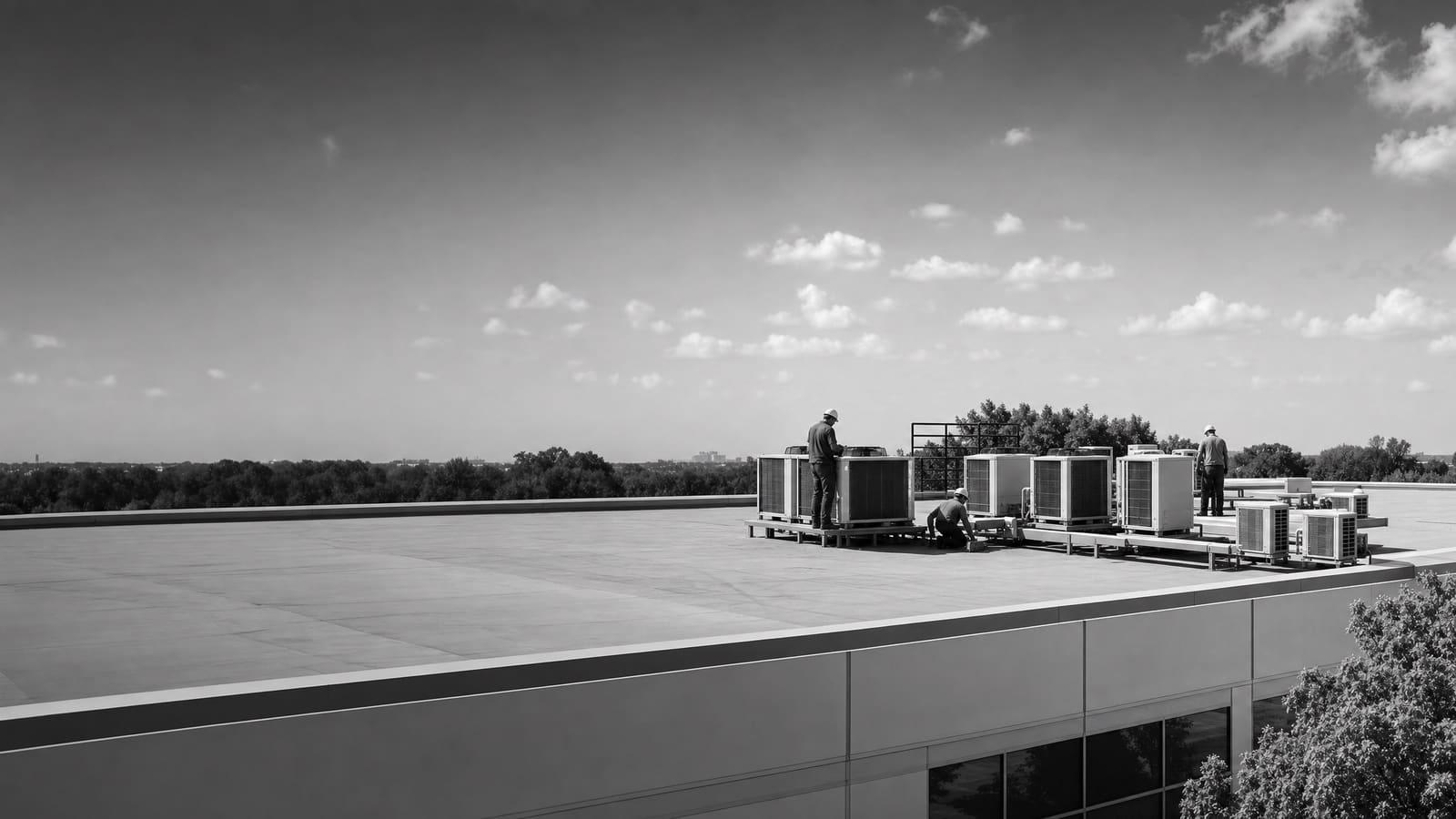
Commercial HVAC replacement covers more than the equipment. A complete project confirms the load for how the space is used now, selects a unit against real lead times, handles curb and structural work, sets the unit by crane, reconnects gas, power and refrigerant, integrates controls, pulls permits, and commissions the system. Replacement usually beats another repair once a unit is past fifteen years, because the Department of Energy puts the annual waste from an old, inefficient rooftop unit at $900 to $3,700.
A site review has to verify curb size and roof framing, electrical capacity at the unit, gas line sizing, crane reach and lot access, and whether replacement triggers code items the old unit never had.
THREE WAYS TO PLAY IT
Three ways owners approach replacement
Most facility managers delay a new rooftop unit until the old one fails, needs constant service, or stops holding the space. That is a strategy, and it is the most expensive one. The Department of Energy frames the choice three ways: wait for failure, plan a like-for-like swap at the end of service life, or replace proactively with a more efficient unit before the old one quits. The third option is often the better business decision, because you buy the equipment on your schedule, in your budget cycle, with the crane day chosen instead of assigned. The tradeoff is real: proactive replacement spends capital on a unit that still runs. Which one fits depends on what the unit costs you to keep alive, how disruptive an in-season failure would be to tenants or production, and whether the building will still be yours in five years.
WHAT MOVES THE NUMBER
Where the installation budget actually goes
Nobody can quote a commercial replacement from a phone call, and any number offered before someone looks at the roof is a guess. These are the lines that move a real quote. Two buildings with identical tonnage can land far apart on all six.
CHOOSING EQUIPMENT
Gas heat, heat pump, or dual fuel
The biggest equipment question on a replacement today is what heats the building. A packaged rooftop unit can heat with gas, with a reverse-cycle heat pump, or with both in a dual-fuel arrangement. Heat pump rooftop units are close mechanical cousins of the air-conditioning units most commercial roofs already carry, and rooftop equipment conditions nearly half of all U.S. commercial floor space, so the swap is not exotic. What changes is the heating math.
Heat pump efficiency falls as the outdoor temperature drops, and at the cold end it trends toward parity with plain electric resistance heat. That is why the Department of Energy describes heat pump rooftop units as best suited to mild-to-moderate winter heating, and why cold-climate and dual-fuel versions exist for buildings that see real winter load. For a Longmont building, your winter design temperature and your actual heating hours are the deciding numbers, not a preference for one fuel over the other.
Three practical things settle it. First, electrical capacity: an all-electric unit asks more of the panel, and the crane day is the wrong time to find that out. Second, utility rates, because a fuel switch only pays if your electric and gas prices make it pay. Third, availability, since heat pump models and tonnages do not stock as deeply as standard gas-electric units. A good quote answers all three before it recommends one.
COMPLEXITY
What makes one replacement simple and another hard
Two rooftop replacements on the same street can be a one-morning job and a three-week project. The difference is almost never the equipment. It is what the roof, the electrical panel, and the parking lot allow.
LOWER COMPLEXITY
Straight swap, same footprint
Same tonnage and fuel, the existing curb fits or takes a standard adapter, the panel has capacity, and the crane sets up in a lot you control. Permits stay mechanical and electrical, work happens off-hours, and tenants see traffic cones rather than an outage.
HIGHER COMPLEXITY
New size, new fuel, or tight access
Tonnage or footprint grows, so structural review enters. All-electric heat means feeder and panel work. Street-side or shared-lot access means a bigger crane, permits for the lift, and a narrow window. Controls that must talk to an existing automation system add a commissioning day.
BEFORE YOU BUY
What a real site review has to settle
A site review is the difference between an installed price and an estimate you will renegotiate later. It should take a couple of hours on the roof, not a walk past the building.
The reviewer should photograph the nameplate and confirm tonnage, voltage, phase, and refrigerant. They should measure the existing curb and determine whether the candidate unit lands on it or needs an adapter. They should look at the deck and framing under that curb, because a heavier unit is a structural question. They should open the disconnect and confirm available capacity, and trace the gas line if the replacement keeps gas heat. Then they should walk the lot with the crane in mind: where it sets up, what it has to reach over, how many stalls come out of service, and for how long.
The load calculation is the step most often skipped. A twenty-year-old nameplate reflects the occupancy, lighting, and plug loads of twenty years ago. Sizing the new unit off the old sticker copies every mistake forward, and oversizing shows up later as short cycling, poor dehumidification, and comfort complaints nobody can explain.
Ask for this in writing
Before you sign, get the load calculation, the curb and structural finding, the confirmed electrical capacity, the crane and lot plan with closure hours, and the equipment lead time in writing. Anything left verbal becomes a change order.
OWNING THE SYSTEM
Two things replacement changes after day one
A replacement does not end at startup. It changes what your service contract has to cover, what parts a technician can carry on the truck, and what documentation you need if a warranty claim comes up two winters from now. Two items catch owners off guard more than any others, and both are easier to settle before the unit is set than after. Neither is a reason to delay a project. They are line items worth handling while you still have leverage with the installer, because after final payment the same questions come back as billable service calls.
REFRIGERANT
New equipment, new service rules
EPA rules under Section 608 of the Clean Air Act govern how refrigerant is handled, recovered, and recycled in stationary air-conditioning and heat pump equipment. New units ship on newer refrigerants, so a mixed rooftop fleet means your provider stocks and handles more than one. Confirm that in the service contract.
LEASED SPACE
Who pays, who benefits
In a leased building the split matters. If the landlord buys the unit and the tenant pays the utility bill, an efficiency upgrade saves money for whoever is not writing the check. Settle the cost share and the efficiency tier before the equipment is ordered, not after it lands.
PLANNING AHEAD
Phasing a fleet and buying for the whole life
If you have more than one aging unit, replacing them one at a time as each fails is the most expensive path available. It puts every purchase in emergency conditions and spreads your roof across several refrigerants and a few control platforms. Phasing works better. Rank the units by age, service history, and what each one costs to keep running, then replace the worst two in a budget year and standardize on one manufacturer and one control approach as you go. Programs run this way add up: more than 200 organizations working under a federal rooftop upgrade campaign have replaced or retrofitted over 43,000 units, saving a combined $37 million a year on energy bills.
Lead time deserves a place in that plan. Equipment availability is one of the items the Department of Energy flags for owners weighing heat pump rooftop units, and it applies to any specialized configuration. If you know a unit is in its last winter, order the replacement before the season it is likely to quit, not during it. The cheapest crane day is the one you scheduled.
THE QUOTE
Five things a comparable quote shows
Two quotes are only comparable when both show the same five things. If one leaves an item blank, it is not cheaper, it is incomplete. Ask for these before you compare prices.
01
Equipment, spelled out
Manufacturer, model, tonnage, heating type, efficiency tier, and refrigerant. Not "a 10-ton unit."
02
Lead time next to the price
The realistic ship date for that exact model, and what the alternate is if it slips.
03
Curb, structure, and roofing
Whether the unit lands on the existing curb, what adapter or framing is included, and who patches the roof.
04
Crane and site plan
Crane size, setup location, stalls closed, hours of the lift, and who pulls the permits.
05
Commissioning and documentation
Startup, charge, airflow, and controls verified against spec, with a report you keep for the warranty file.
Get a defensible number
Price the equipment and the building together.
Send the address, operating target, and target opening date. Flux will identify what must be verified before the project can be priced.
Get a free estimateQuestions
Straight answers.
When does replacing a rooftop unit beat repairing it?
Once a unit passes about fifteen years, wasted energy and repair frequency usually overtake the cost of a planned replacement. The Department of Energy puts the yearly waste from an old, inefficient rooftop unit at $900 to $3,700. Weigh that against what your last two repairs cost.
How long does a commercial HVAC installation take?
The visible work on a single packaged rooftop swap is short. The schedule is set by equipment lead time, not by the crane. Ask for the ship date on your exact model before you plan around a date.
Should we switch from gas heat to a heat pump?
It depends on your winter heating load, your electric and gas rates, and whether the electrical service can carry an all-electric unit. Heat pump efficiency falls as outdoor temperatures drop, which is why cold-climate and dual-fuel versions exist for buildings with real winter demand.
Can we just replace like-for-like off the old nameplate?
You can, and it is fast, but it carries forward whatever the old sizing got wrong. Run the load calculation against how the space is used today. If occupancy and equipment have not changed, like-for-like will confirm itself.
What does a commercial HVAC installation cost?
There is no honest universal number. Tonnage and efficiency tier, curb and structural work, crane access, electrical capacity, and controls integration move the total enough that two buildings with the same tonnage land far apart. The price follows a real look at the roof.
Does new equipment mean a different refrigerant?
New commercial units ship on newer refrigerants. Day-one operation is the same, but EPA Section 608 rules govern handling and recovery, and a mixed fleet means your service provider has to support more than one.
Sources used for this guide
- [1]betterbuildingssolutioncenter.energy.gov — DOE Advanced Rooftop Unit Replacement Guidance
- [2]betterbuildingssolutioncenter.energy.gov — DOE Commercial Heat Pump Rooftop Unit Replacement Guidance
- [3]betterbuildingssolutioncenter.energy.gov — DOE High-Efficiency Commercial Rooftop Unit Toolkit
- [4]energy.gov — DOE Efficient Commercial Rooftop Air Conditioner Program
- [5]epa.gov — EPA Stationary HVAC Refrigerant Management