THE SHORT VERSION
What a commercial HVAC replacement actually includes
A commercial HVAC replacement covers load confirmation, equipment selection, rigging and set, mechanical and electrical connections, controls, and commissioning against spec. Replacement beats another repair once a unit is losing real money every month instead of just failing occasionally. Department of Energy figures put that waste at roughly $900 to $3,700 per unit each year for old, inefficient rooftop equipment, and units past fifteen years are the usual suspects.
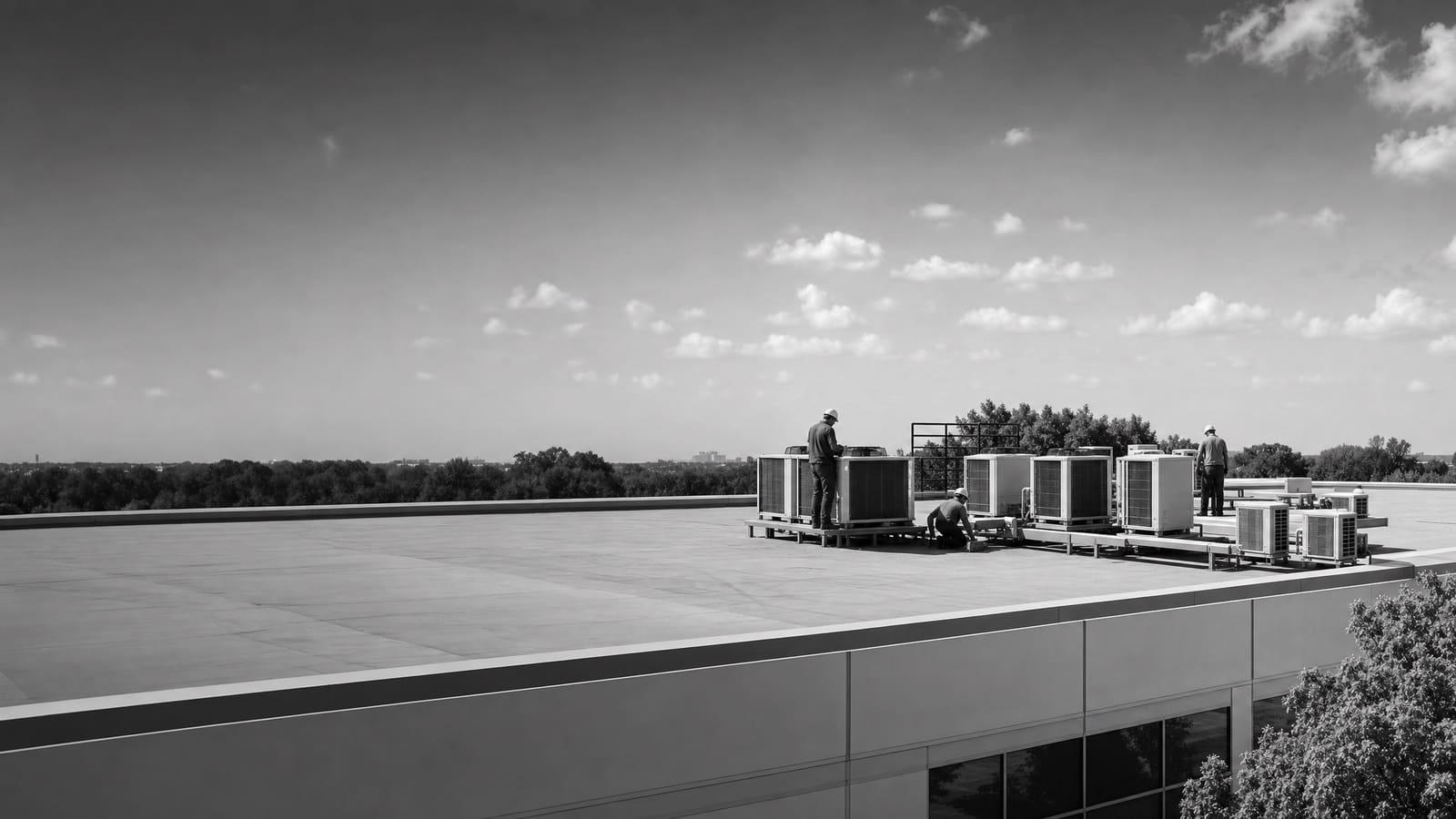
No honest number comes before someone looks at the roof. A site review has to confirm tonnage against current use, curb and structural condition, crane access, and the electrical and gas service already at the unit.
THREE WAYS TO GO
Three replacement paths worth pricing
Almost every rooftop replacement lands in one of three buckets, and the right one depends on what you plan to do with the building.
Like-for-like is the fastest path back to conditioned space. Same curb, same connections, same fuel. It also carries forward whatever sizing decision the last owner made, which is fine if the space is used the way it was.
A high-efficiency unit costs more up front and changes the operating math. Department of Energy work on rooftop units pushed manufacturers to build equipment that cuts energy use by up to half against the older baseline, and more than twenty models now exceed that specification. This is off-the-shelf equipment, not a science project.
A heat pump rooftop unit replaces gas heating with reverse-cycle heating, or splits the difference in a dual-fuel arrangement. Federal guidance flags the same short list every time: climate, utility rates, electrical capacity at the unit, physical constraints, and installer familiarity. Answer those before you fall in love with a spec sheet.
The tie-breaker is usually run hours. A unit working long days on a schedule that is not going to change earns the higher tier. A unit conditioning a lightly used space rarely does.
WHAT MOVES THE NUMBER
Where the money actually goes
There is no universal installed price for a commercial rooftop unit, and anyone quoting one sight-unseen is guessing. These are the line items that separate a routine swap from a project, roughly in the order they surprise people.
IN PRACTICE
How to decide without guessing
The most expensive version of this project is the one nobody planned. A unit fails in season, the building needs air today, and the only question anyone asks is what fits on the existing curb. That path is sometimes correct, but it is never a decision. It is a default.
Federal guidance on rooftop replacement makes the same point in gentler language: facility managers tend to wait until a unit fails completely, when proactively replacing inefficient equipment is often the better business move than replacing on failure or swapping like-for-like at end of life. Rooftop systems condition close to half of all commercial floor space in the country, so this is not an edge case. It is the most common capital decision commercial buildings face.
The practical move is to decide before the failure. Walk the roof once and write down age, tonnage, fuel, and condition for every unit. The oldest, hardest-working unit is the one to price out now, while you can still compare options and wait for the equipment you want. The unit you replace under pressure costs more and will almost certainly be whatever the supply house has on the floor that week. Ranking takes an afternoon, and it is the cheapest hour in the whole project.
COMPLEXITY CHECK
What makes a swap simple or hard
Two buildings can carry the same tonnage on the roof and get quotes that differ by a wide margin. The difference is almost never the box itself. It is what the box has to connect to, and how hard it is to get up there in the first place.
LOWER COMPLEXITY
Straight replacement
Same tonnage and fuel, a curb in good shape, an open lot for the crane, adequate electrical service already at the unit, and simple thermostat controls. The work becomes a planning exercise, and the schedule is driven mostly by equipment availability.
HIGHER COMPLEXITY
Changed conditions
New tonnage or footprint, an aging curb, a tight or occupied lot, a switch away from gas heat, or integration into a building automation system. Each one adds a trade, a lead time, and usually a review before anyone lifts anything.
BEFORE THE QUOTE
What a site review has to confirm
A quote is only as good as the walk that produced it. On a rooftop replacement the site review has a short, unglamorous checklist, and skipping any part of it is how change orders get born.
Start with the load. The nameplate on a twenty-year-old unit describes a building that may no longer exist. Occupancy shifts, lighting gets replaced, plug loads change, and envelope work happens. Sizing from current use is what finally fixes the comfort complaints the old unit could never resolve.
Then the infrastructure. Federal heat pump guidance is blunt about this: electrical capacity, physical constraints, and gas lines decide whether an electric option is even on the table, well before efficiency ratings matter. A panel that cannot carry the new load turns a one-morning swap into an electrical project with a schedule of its own.
Ask, too, what the new unit has to talk to. Controls integration is the line item most often assumed and least often priced. Finally, the handling side: refrigerant in stationary air conditioning and heat pump equipment is regulated under the Clean Air Act, and recovery from the old unit is part of the job, not an afterthought.
The four things to nail down
Current load versus nameplate, curb and structural condition, electrical and gas service at the unit, and crane access with a realistic closure window. Everything else on the quote flexes around those four.
OWNERSHIP CONSIDERATIONS
Two things that outlast the install
The install ends in a morning. What you own afterward lasts well over a decade, and two decisions made during the project shape most of that time.
The first is refrigerant. New commercial equipment ships on newer refrigerants, which matters less on day one than it does in year four, when a mixed fleet needs parts and a service contract. The second is who holds the paper. Commissioning documentation, startup readings, and warranty registration are what turn a warranty claim into a phone call instead of an argument. Neither one shows up when you compare two bid totals, which is exactly why both get skipped. Both are cheap to get right during the project and expensive to reconstruct later.
REFRIGERANT
Plan for the mixed fleet
Handling and recovery of refrigerant in stationary air conditioning and heat pump equipment is federally regulated. If you run several units of different ages, decide early how service and spare parts get covered across all of them.
DOCUMENTATION
Own the commissioning record
Startup readings, airflow, charge, and control settings should be written down and handed to you. That record protects the warranty and gives the next technician a baseline instead of a guess.
OVER TIME
Phasing a roof full of units
Buildings rarely have just one rooftop unit, and units almost never fail on a convenient schedule. When you have several, treat the roof as a program rather than a series of emergencies.
Rank the units by age and run hours, not by which one complained most recently. Price the top two together, because a second unit on the same crane day costs less than a second crane day. Then set a replacement order and a rough year for each one, so the capital request is already written when the next unit quits.
The reason to bother is what operating savings compound into. Old, inefficient rooftop units waste somewhere in the range of $900 to $3,700 per unit each year. Across the more than two hundred organizations that upgraded rooftop equipment through the federal campaign, more than forty-three thousand units produced a combined $37 million in annual utility bill savings. Those are portfolio numbers, not a promise for your building, but they explain why proactive replacement usually beats replacement on failure. The unit you choose on your own schedule is almost always cheaper to buy and cheaper to run than the one chosen for you by a breakdown.
COMPARING QUOTES
Five things a comparable quote shows
Two quotes are only comparable when they describe the same scope. If one runs a page and the other runs a paragraph, you are not looking at a price difference. You are looking at a scope difference that will show up later.
01
Equipment, spelled out
Make, model, tonnage, efficiency tier, heating type, and the expected availability date for that specific unit.
02
Curb and structural scope
Whether a curb adapter is included, and what happens if the roof structure needs work once the old unit is off.
03
Rigging and site plan
Crane size, staging area, lot closure hours, permits and inspections, and who coordinates with tenants.
04
Utility connections
Electrical, gas, and refrigerant work included at the unit, plus any service upgrade the new equipment triggers.
05
Commissioning and closeout
Startup, charge and airflow verification, controls setup, documentation handed over, and warranty registration.
Get a defensible number
Price the equipment and the building together.
Send the address, operating target, and target opening date. Flux will identify what must be verified before the project can be priced.
Get a free estimateQuestions
Straight answers.
When does replacing a rooftop unit beat repairing it again?
Once the repairs stop being isolated events. Federal guidance points at units past fifteen years as the ones quietly wasting energy and money, and old, inefficient rooftop equipment is estimated to waste roughly $900 to $3,700 per unit each year. At that point another repair is just buying time on a losing position.
Should you replace like-for-like or resize the unit?
Confirm the load either way. If occupancy, equipment, and use match what the building looked like when the old unit went in, like-for-like is often right. If any of that changed, sizing from current use is what fixes the comfort complaints the old unit could never resolve.
Is a heat pump rooftop unit a good swap for a gas unit?
Sometimes. Heat pump rooftop units heat most efficiently in mild to moderate winter conditions and lose efficiency as outdoor temperatures fall, which is why dual-fuel and cold-climate versions exist. Check electrical capacity at the unit, utility rates, and installer experience before committing to all-electric.
What happens to the refrigerant in the old unit?
It gets recovered. Refrigerant in stationary refrigeration, air conditioning, and heat pump equipment is regulated under Section 608 of the Clean Air Act, which covers handling and recycling. Recovery belongs in the written scope of work and should be performed by certified technicians.
Why do rooftop replacement quotes vary so much?
Because they are rarely quoting the same scope. Curb adapters, structural work, electrical capacity, gas changes, crane access, and controls integration all move independently. The equipment is the most visible line on the page and often not the one separating two bids.
Sources used for this guide
- [1]betterbuildingssolutioncenter.energy.gov — DOE Advanced Rooftop Unit Replacement Guidance
- [2]betterbuildingssolutioncenter.energy.gov — DOE Commercial Heat Pump Rooftop Unit Replacement Guidance
- [3]betterbuildingssolutioncenter.energy.gov — DOE High-Efficiency Commercial Rooftop Unit Toolkit
- [4]energy.gov — DOE Efficient Commercial Rooftop Air Conditioner Program
- [5]epa.gov — EPA Stationary HVAC Refrigerant Management