THE DIRECT ANSWER
What a commercial HVAC replacement includes
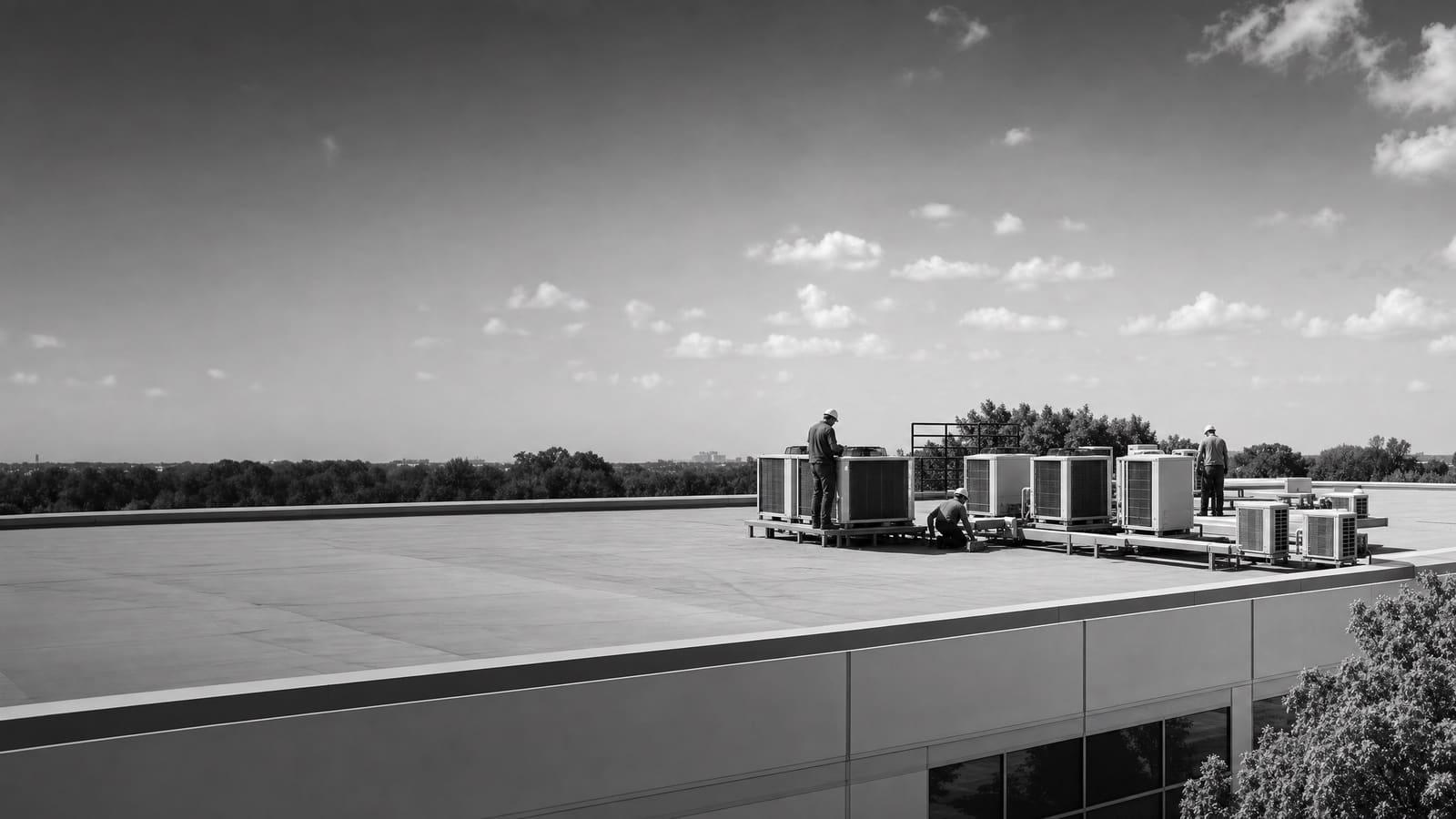
Commercial HVAC replacement includes load review, equipment selection, removal, rigging, connection work, controls, startup, testing, and refrigerant handling. Replacement becomes more useful than another repair when an older unit fails often, cannot hold the space conditions, or creates rising maintenance risk. DOE guidance notes that rooftop units over 15 years old can waste substantial energy compared with newer equipment.
A site review must confirm the present load, roof or equipment-room fit, utilities, ventilation, controls, access, and any work beyond the unit itself.
THREE OPERATING CHOICES
Choose the replacement path before choosing a model
Start with the business problem. A failed unit may call for a fast replacement, but speed should not hide a poor fit. A planned project gives the owner time to study energy use, repair history, space changes, and future operating needs.
DOE says owners often delay replacement until a rooftop unit stops providing enough heating or cooling, needs frequent maintenance, or fails. That approach can force a rushed purchase. Proactive replacement creates room to compare high-efficiency, heat-pump, dual-fuel, and conventional options before availability controls the decision.
The old nameplate is useful, but it is not a complete design. Occupancy, hours, ventilation needs, internal equipment, and space use may have changed. Confirm whether the old capacity still matches the building. Then compare choices on installed scope, operating impact, service needs, and expected ownership period.
WHAT MOVES THE BUDGET
Price the whole installation, not just the equipment
The supplied research does not support one universal installed price. A useful budget separates the major variables so bidders price the same job.
EQUIPMENT CHOICES
Compare rooftop systems by how the building operates
Packaged rooftop units are common across commercial buildings and condition nearly half of U.S. commercial floor area. Their main appeal is a compact package that combines major heating, cooling, and air-moving functions. A replacement may be conventional cooling with separate heat, a heat-pump rooftop unit, a dual-fuel model, or a higher-efficiency version of the existing arrangement.
A heat-pump rooftop unit provides reverse-cycle heating as well as cooling. DOE guidance says the decision should consider geography, utility costs, emissions goals, building type, equipment availability, contractor knowledge, and incentives. It should also test electrical capacity, physical limits, and existing gas infrastructure. An all-electric choice can require more than changing the cabinet. Electric resistance backup, service capacity, wiring, and controls may affect the project.
Dual-fuel equipment can keep a fuel-based heating option while adding heat-pump operation. Conventional replacement may remain practical when infrastructure changes would be extensive or the owner needs the simplest compatible scope. Higher efficiency can be valuable, but compare performance at the building’s actual hours and loads. Ask how fans, compressors, controls, ventilation, and part-load operation differ—not only for a headline efficiency rating.
PROJECT COMPLEXITY
Know whether the job is a swap or a redesign
Two units with similar capacity can create very different projects. The existing curb, distribution, power, fuel, controls, and access determine how much work sits outside the equipment price.
LOWER COMPLEXITY
Compatible replacement
The new unit fits the mounting arrangement, load, utilities, duct path, and controls with limited changes. The quote should still cover removal, rigging, connections, startup, testing, and refrigerant recovery.
HIGHER COMPLEXITY
System or infrastructure change
Capacity, fuel, voltage, footprint, weight, ventilation, distribution, or automation changes. This path needs deeper field verification and a clear division of mechanical, electrical, structural, controls, and roofing work.
SITE REVIEW
Build the scope from field conditions
Begin with an equipment inventory. Record model and serial information, capacity, heating type, refrigerant, voltage, controls, service history, and the spaces each unit serves. Note leaks, repeated failures, noise, weak airflow, uneven temperatures, humidity problems, and operating complaints. These details show whether the issue is the unit, the distribution system, the controls, or a mix.
Next, review how the space works today. Confirm occupied hours, headcount, process loads, doors, exhaust, outside-air needs, and any planned change in use. A replacement that copies an old sizing error can preserve short cycling, poor control, or wasted energy.
The field review should also trace the installation path. Check roof or pad condition, supports, clearances, service access, drain routes, duct connections, electrical service, fuel piping, control wiring, and lifting or removal needs. For a heat-pump option, DOE specifically identifies electrical capacity, physical constraints, gas lines, equipment availability, and contractor knowledge as decision points. Document assumptions with photos and written notes so every bidder sees the same conditions.
Ask for two scopes when the choice is unclear
Price a compatible replacement and a better-performing alternative against the same load, access, controls, testing, and closeout requirements. This makes the added work visible.
OWNERSHIP VIEW
Balance failure risk with lifetime value
Waiting for failure can delay spending, but it can also remove choice. Emergency timing may narrow available models and leave little time to study load, infrastructure, or operating cost. DOE says proactive replacement of inefficient and underperforming rooftop units can be a smart business move compared with replacement after failure.
Do not treat energy savings as automatic. An older DOE example found that inefficient commercial rooftop units could waste significant money each year, but that historical range is not a forecast for a Livermore property. Your result depends on the existing unit, replacement performance, hours, loads, controls, maintenance, and utility rates. Use actual bills and interval or control data when available.
OPERATING CONTINUITY
Plan before failure
Prioritize units with frequent repairs, poor conditioning, critical service areas, difficult access, or limited replacement choices. Plan phasing and temporary measures before an outage.
LIFETIME COST
Compare more than first price
Review installed scope, expected energy use, maintenance needs, parts strategy, controls, warranty, service access, and the length of time the owner expects to keep the asset.
PHASING AND PROCUREMENT
Turn the selected system into a workable project
Order equipment only after confirming the field conditions that control fit. Submittals should match the quoted capacity, heating configuration, voltage, airflow, efficiency, accessories, controls, refrigerant, dimensions, weight, and connection points. Review substitutions with the same care. A model that appears equal may change the curb, electrical work, control sequence, or service clearances.
Build the schedule backward from the service interruption. Include design review, equipment approval, procurement, enabling work, rigging, shutdown, removal, installation, controls, startup, testing, inspection, and closeout. If several units serve the property, phased replacement can preserve occupied areas and spread operational risk. Decide which spaces can lose conditioning and which need temporary support.
Refrigerant work needs explicit responsibility. EPA rules under Clean Air Act Section 608 address refrigerant handling and recycling for stationary air-conditioning and heat-pump equipment. The quote should state who recovers refrigerant, manages cylinders, documents the work, and disposes of removed equipment. At turnover, collect startup reports, control settings, test results, warranties, manuals, equipment schedules, and updated asset records. Closeout documents make later service faster and help protect the value of the installation.
COMPARE QUOTES
Five items every comparable proposal should show
Require the same information from each bidder. A short lump-sum description can hide exclusions, weak commissioning, or major work left to the owner.
01
Defined equipment
List model, capacity, heat type, voltage, efficiency, refrigerant, accessories, warranty, availability, and approved alternatives.
02
Complete installation scope
State removal, rigging, mounting, duct, drain, piping, electrical, fuel, roofing, controls, patching, and cleanup responsibilities.
03
Operating and shutdown plan
Show phasing, affected areas, expected outages, access limits, protection measures, and any temporary conditioning.
04
Startup and proof
Require airflow, temperature, controls, ventilation, safety, drainage, sequence, and manufacturer startup checks with written results.
05
Exclusions and closeout
Identify allowances, exclusions, change-order rates, owner work, training, manuals, warranties, refrigerant records, and final asset data.
Get a defensible number
Price the equipment and the building together.
Send the address, operating target, and target opening date. Flux will identify what must be verified before the project can be priced.
Get a free estimateQuestions
Straight answers.
When should a commercial rooftop unit be replaced instead of repaired?
Replacement deserves serious review when the unit is over 15 years old, fails often, cannot provide adequate heating or cooling, or needs frequent maintenance. DOE identifies those conditions as common reasons owners finally replace rooftop equipment. The decision should also consider the repair cost, parts outlook, energy performance, service criticality, and whether another failure would disrupt the business.
Should a replacement match the old unit’s capacity?
Not automatically. Use the old nameplate as a starting point, then confirm the present building load and operating conditions. Occupancy, schedules, internal equipment, ventilation, envelope conditions, and space use may have changed. Like-for-like capacity is most defensible when the space still operates as designed and the old system provided stable comfort without short cycling or long run times.
Is a commercial heat-pump rooftop unit a good replacement option?
It can be, but the answer depends on more than climate. DOE guidance calls for reviewing utility costs, emissions goals, building type, equipment availability, electrical capacity, physical constraints, gas infrastructure, contractor knowledge, and incentives. Compare all-electric, dual-fuel, and conventional options on the same load and operating schedule. Verify current incentives separately because programs and deadlines can change.
What should commissioning include after installation?
Commissioning should prove that the system does more than turn on. The contractor should verify airflow, temperatures, drainage, safety devices, heating and cooling stages, fan operation, ventilation, sensors, schedules, and control sequences. Record the final settings and test results. If the system connects to building automation, confirm commands, alarms, trends, and occupied or unoccupied operation.
Who should handle refrigerant from the removed equipment?
The proposal should assign refrigerant recovery and documentation to qualified personnel working under applicable EPA Section 608 requirements. It should also state who supplies recovery cylinders, manages the recovered material, checks the new system, and disposes of removed equipment. Do not leave this responsibility implied in a general demolition line.
How can owners compare HVAC installation bids fairly?
Give every bidder the same equipment criteria, field information, operating constraints, and testing requirements. Then compare model details, installation inclusions, exclusions, allowances, shutdowns, controls, commissioning, warranties, and closeout records. Ask bidders to separate optional improvements from the base replacement. This exposes scope gaps that a bottom-line price alone cannot show.
How long should a commercial HVAC replacement project take?
The supplied research does not support one standard duration. Timing depends on equipment availability, design needs, field verification, access, enabling work, rigging, controls, testing, and required reviews. Ask for a schedule that separates procurement from on-site work and identifies the actual service outage. A clear sequence is more useful than a single completion estimate.
What information should an owner provide before requesting a quote?
Provide equipment nameplate photos, service records, known failures, utility history if available, operating hours, occupancy patterns, comfort complaints, control information, roof or equipment-room access, and any planned change in use. Also identify spaces that cannot lose conditioning. Better input helps the contractor distinguish a simple replacement from a project that needs load, electrical, distribution, or control changes.
Sources used for this guide
- [1]betterbuildingssolutioncenter.energy.gov — DOE Advanced Rooftop Unit Replacement Guidance
- [2]betterbuildingssolutioncenter.energy.gov — DOE Commercial Heat Pump Rooftop Unit Replacement Guidance
- [3]betterbuildingssolutioncenter.energy.gov — DOE High-Efficiency Commercial Rooftop Unit Toolkit
- [4]energy.gov — DOE Efficient Commercial Rooftop Air Conditioner Program
- [5]epa.gov — EPA Stationary HVAC Refrigerant Management