THE SHORT VERSION
What a commercial HVAC replacement includes
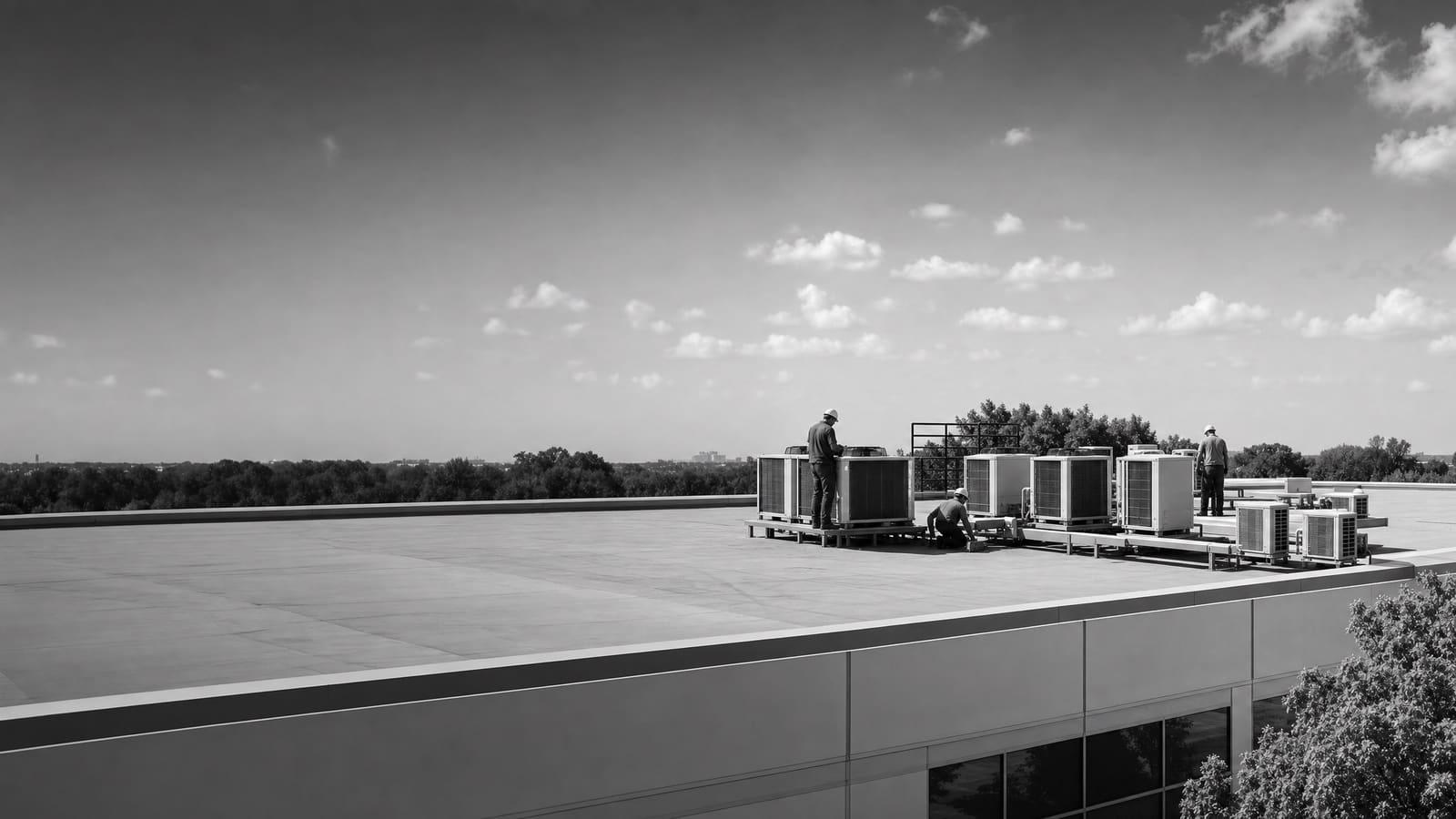
A commercial HVAC replacement is a load check, an equipment decision, a rigging and connection plan, and a documented startup. Replacement beats one more repair when the unit is old enough that its energy waste is structural rather than fixable. DOE puts the energy waste of an old, inefficient rooftop unit at roughly $900 to $3,700 a year, and flags units past 15 years as the ones to plan around rather than nurse. Waiting for failure removes your ability to choose.
A site review still has to confirm the actual load, the curb and structural condition, available electrical capacity, and crane access before any of that applies to your roof.
THE THREE PATHS
Three ways to handle an aging commercial unit
Most buildings drift into the first option by default. DOE's guidance for rooftop equipment is blunt about the cost of that drift: facility managers usually delay a new unit until the old one fails, stops holding the space, or needs constant service, and by then the choice is gone.
Which path wins depends on the unit's age and condition, how long you hold the building, and whether the space is used the way it was when the equipment was originally specified. The controls retrofit is the one buyers forget. DOE treats it as a legitimate alternative to replacement when the existing unit still has service life left. Price all three against the same confirmed load, not against each other's marketing.
WHAT MOVES THE NUMBER
The lines that decide your installed price
The gap between two bids is rarely the equipment itself. These are the lines that separate a clean swap from a project. Ask for each one as its own number on the quote so you can compare bids on something other than the bottom line.
IN PRACTICE
Choosing the equipment before the crane is booked
The biggest fork in a replacement is whether the new unit heats with gas or with a heat pump. Rooftop heat pumps are close cousins of standard air-conditioning rooftops, but they run the refrigeration cycle in reverse to heat. DOE's guidance sorts them into three families: dual-fuel units that keep a gas burner for the coldest hours, all-electric units that fall back on electric resistance heat, and cold-climate units built to hold capacity at low outdoor temperatures.
For buildings across the U.S. South, DOE's read is that today's heat pump rooftops are an appropriate solution and are capable of carrying most or all of the winter heating load. Heat pump efficiency falls as outdoor temperature drops, trending toward parity with electric resistance heat at the bottom. That is the whole argument in one sentence: the milder the heating season, the better the electric case looks, and cheaper electricity strengthens it further.
The counterweight is the February 2021 Texas freeze, which DOE cites directly. Southern buildings do see sharp, short bursts of heating demand, and a design that ignores those hours will eventually meet them. Dual-fuel exists for exactly that shape of year. Decide which family you are in before anyone quotes a model number, because it changes electrical scope, gas scope, and lead time.
TWO KINDS OF JOB
The clean swap and the project
Before you budget, work out which of these two jobs you actually have. The difference is not the equipment. It is what the building forces the installation to touch.
LOWER COMPLEXITY
Straight replacement
Same tonnage, same fuel, an existing curb in good condition, clear crane access from the lot, and no controls change. Permitting is routine and the visible disruption is a morning of coned-off parking stalls.
HIGHER COMPLEXITY
Replacement that becomes a project
A fuel switch, added electrical capacity, a weight or footprint change that triggers structural review, tight or shared access that limits crane placement, or a building automation tie-in. Each one adds an approval, a trade, or a lead time. Usually all three.
BEFORE YOU BUY
What the site review has to settle
A quote written from a nameplate photo is a starting number, not a price. The nameplate tells you what was installed once. It does not tell you what the space needs now, and years of tenant turnover, added plug load, lighting retrofits, and envelope work usually move that answer.
DOE's checklist for rooftop decisions works well as a scoping outline, and most of it is not about the equipment. It asks about the building's heating load and local energy prices, the building type and how it is used, whether the model you want is actually available, and whether the infrastructure supports it: electrical service capacity, physical constraints on the roof, and what happens to the gas line. It also asks a question buyers skip, which is whether contractors nearby are experienced with the equipment class you are considering. A unit nobody in the area can commission well is a maintenance problem you buy on purpose.
Incentives belong in the same conversation, early. Programs for efficient rooftop equipment change on their own schedules, and eligibility usually ties to the specific model and efficiency tier you select. Confirming what applies before the order is placed is worth far more than discovering it afterward.
Ask for this before you sign
A confirmed load calculation, the curb and structural condition, available electrical capacity, the crane and access plan, the controls scope, and a written lead time for the exact model quoted. Anything a bidder skips here becomes a change order later.
AFTER THE INSTALL
Two things that outlast the install day
The installation takes a week of your attention. The consequences run for the life of the equipment. Two of them are worth deciding deliberately instead of inheriting by accident.
The first is refrigerant. New commercial equipment ships on current-generation refrigerants, and EPA rules under Section 608 govern how refrigerant in stationary air-conditioning and heat pump equipment is handled, recovered, and recycled. That is a service-practice and technician-certification question rather than a day-one operating question, but it shapes what your service contract has to cover once one roof carries two refrigerant generations at the same time.
The second is what happens to the rest of the roof. Most buildings replace units one at a time, at failure, spread across a decade. That is the most expensive possible schedule and the one that produces the most mismatched fleet.
SERVICE
Mixed-refrigerant fleets
Once one unit is new and the others are not, your service contract covers two refrigerant generations, two parts inventories, and two sets of handling rules. Put that in the contract rather than discovering it during a summer call.
SCHEDULE
Fleet sequencing
Knowing the age and condition of every unit on the roof lets you replace in a planned order and buy in groups. It also turns the next failure into a scheduling annoyance instead of an emergency purchase.
THE LONGER VIEW
Buying for the ten-year number
Rooftop equipment conditions close to half of all commercial floor space in the country, which is why the federal push to make it more efficient was so large. DOE's high-performance specification challenged manufacturers to build units that used up to 50% less energy than the standard of the time, then funded third-party verification so owners were not buying on a data sheet alone. Through the campaign that followed, more than 200 organizations upgraded over 43,000 rooftop units and cut a combined $37 million a year from their energy bills. A minimum-efficiency standard finalized in December 2015 locked much of that gain in for everyone buying since.
The practical lesson for a single building is about sequencing. If the efficiency gap between a base unit and a high-efficiency unit is worth real money per unit per year, then the order you replace in matters nearly as much as what you replace with. Start with the oldest, hardest-working units on the longest run hours, because that is where the annual waste concentrates.
It also argues for group procurement wherever you can manage it. Bidding three units together instead of one at a time buys better pricing, one mobilization, one permit cycle, and a fleet that ages together. The failure-driven approach delivers none of that and costs the most.
COMPARE ON THIS
Five things a comparable quote shows
Bids that look far apart are usually pricing different scopes. Make every bidder show these five and the comparison becomes real. Anything missing here is not a discount. It is a change order with a later date on it.
01
Equipment, tier, and availability
Make, model, tonnage, efficiency tier, and a written lead time for that exact unit.
02
Curb, structural, and roofing scope
Adapter curb or new curb, any structural review triggered, and who patches the roof around it.
03
Rigging and access plan
Crane size, staging location, stalls closed, and the hours the lot is affected.
04
Electrical, gas, and controls
Service capacity, disconnect, gas line disposition, and the building automation tie-in, each priced on its own line.
05
Startup, commissioning, and documentation
Charge, airflow, and control settings verified against spec, with the report that keeps the warranty intact.
Get a defensible number
Price the equipment and the building together.
Send the address, operating target, and target opening date. Flux will identify what must be verified before the project can be priced.
Get a free estimateQuestions
Straight answers.
When is replacement better than another repair?
When the unit is old enough that the waste is structural rather than fixable. DOE flags rooftop units past 15 years as the ones that quietly burn money, and puts the annual energy waste of an old, inefficient unit at roughly $900 to $3,700. Repeat service calls stacked on top of that rarely pencil out.
Should a Lewisville building consider a heat pump rooftop unit?
It belongs on the list. DOE's position is that today's heat pump rooftops are an appropriate solution across most of the U.S. South and are capable of carrying most or all of the winter heating load. Whether it wins for your building depends on electrical capacity, energy prices, and how you plan for short cold snaps.
What is the alternative to replacing the unit outright?
Retrofitting the existing unit with advanced controls. DOE treats that as a legitimate alternative when the unit still has useful service life, since you capture part of the savings without a crane day. It stops making sense once the equipment itself is the problem.
How much does commercial HVAC installation cost?
There is no honest single number, because tonnage, curb condition, electrical scope, and crane access move it more than the equipment does. Price it as four separate lines and compare bids line by line. On the operating side, DOE's figures put an old inefficient unit's annual energy waste at roughly $900 to $3,700, which belongs in the same math.
Does a new unit change how the system is serviced?
It can. New equipment ships on current-generation refrigerants, and EPA Section 608 rules govern how refrigerant in stationary air-conditioning and heat pump equipment is handled, recovered, and recycled. Nothing changes on day one, but a roof running two refrigerant generations needs a service contract that accounts for both.
Sources used for this guide
- [1]betterbuildingssolutioncenter.energy.gov — DOE Advanced Rooftop Unit Replacement Guidance
- [2]betterbuildingssolutioncenter.energy.gov — DOE Commercial Heat Pump Rooftop Unit Replacement Guidance
- [3]betterbuildingssolutioncenter.energy.gov — DOE High-Efficiency Commercial Rooftop Unit Toolkit
- [4]energy.gov — DOE Efficient Commercial Rooftop Air Conditioner Program
- [5]epa.gov — EPA Stationary HVAC Refrigerant Management