THE DIRECT ANSWER
What a commercial HVAC replacement actually includes
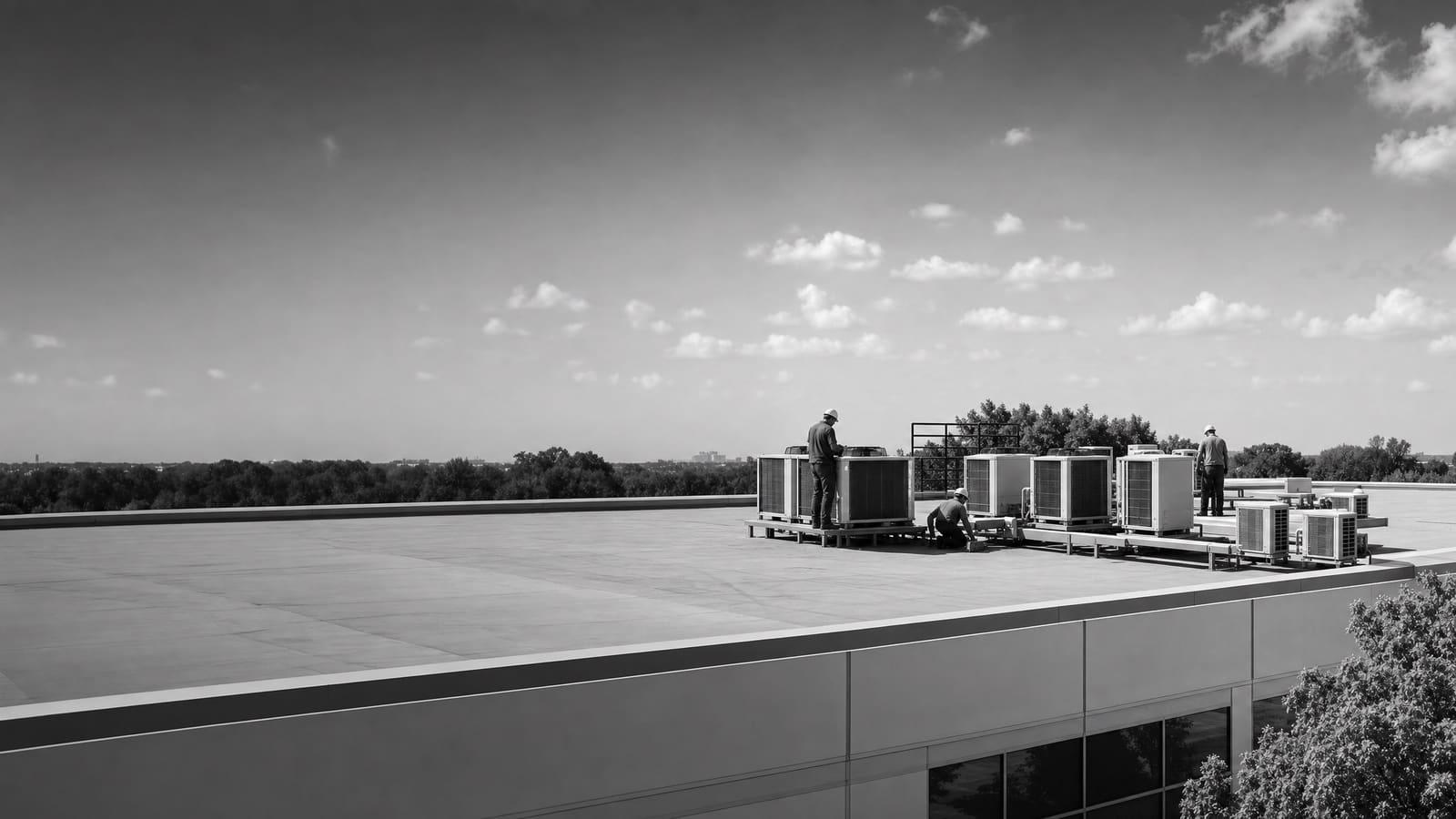
A commercial replacement covers load confirmation, equipment selection, rigging and set, refrigerant recovery from the old unit, gas and electrical connections, controls integration, and documented startup. Replacement beats another repair once a unit is past roughly fifteen years and no longer holding the space. Department of Energy work puts the annual waste from an old, inefficient rooftop unit at $900 to $3,700 per unit — often more than the repair being debated.
A site review still has to confirm tonnage against current occupancy, curb and structural condition, electrical service capacity, and crane access before any of that applies to your roof.
THREE WAYS TO GO
Three replacement paths worth pricing
Most buildings have three real options, and a single lump-sum bid rarely tells you which one you are being sold. A like-for-like swap puts the same class of equipment back on the same curb — fastest, simplest, and it inherits every sizing decision made twenty years ago. A high-efficiency upgrade keeps the same fuel mix but buys down operating cost; the market is deep enough now that more than twenty rooftop models exceed DOE's high-performance specification. A heat pump rooftop unit changes the heating source itself, either all-electric or dual fuel with a gas backup. That third path needs the most homework, because it turns on electrical capacity at the roof, your site's winter design temperature, and whether gas service stays. Price at least two of the three. The spread between them tells you more about your building than any single number will.
WHAT MOVES THE NUMBER
Where installation budgets actually move
No two roofs price the same, and the lines below are where quotes separate from each other. Ask every bidder to show them as their own numbers instead of folding them into one figure. That is how you tell a thorough bid from an optimistic one.
IN PRACTICE
Choosing the equipment before you choose the contractor
The most expensive mistake in commercial HVAC is not overpaying for a unit. It is waiting for the unit to die and then taking whatever is on the truck. DOE guidance is blunt about this pattern: facility managers usually delay replacement until the equipment fails, needs constant service, or stops conditioning the space. Replacement-on-failure is the worst version of the purchase. You lose the ability to compare equipment, you lose access to incentive programs that require pre-approval, and you take whatever lead time the market happens to be running that week.
Planning ahead changes what you are allowed to buy. Rooftop units condition close to half of all commercial floor space in the country, so the model field is deep and the efficiency spread between units is wide. A proactive replacement lets you price a high-efficiency unit against a baseline one and decide with real numbers in front of you. A failure replacement almost always ends in a like-for-like swap by default, because there is no time for anything else.
Start with age and service history, not with a bid. If a unit is past fifteen years, has needed repeat repairs, and misses setpoint on design days, it belongs on a replacement schedule this year rather than on the emergency list next July.
SCOPE CHECK
What makes this simple or complicated
Two buildings with identical tonnage can be a two-day job and a two-month job. The difference is almost never the equipment itself. It is what the replacement touches on the way in.
LOWER COMPLEXITY
Same footprint, same fuel
The existing curb fits or takes a standard adapter, tonnage stays flat, the roof already carries the load, gas and electrical service are unchanged, and the lot gives the crane clear reach. Permits stay routine and the set happens in a morning.
HIGHER COMPLEXITY
New load, new fuel, or tight access
Tonnage grows, the footprint changes, or the building goes all-electric and the service needs upsizing. Now add structural review, a longer permit path, possible utility coordination for capacity, and a crane plan that closes part of the lot for a day or more.
THE SITE REVIEW
What a real walkthrough has to confirm
A quote written from a nameplate photo is a starting point, not a price. Before anyone commits to equipment, someone should be on the roof answering a specific list of questions.
Start with load. Twenty years of tenant changes, added plug load, lighting retrofits, and envelope work mean the original tonnage describes a building that no longer exists. Confirm it against how the space is used now. Then work through the physical constraints DOE flags for any rooftop replacement: curb dimensions and condition, structural capacity for the new weight, a clear path for the crane, and whether adjacent equipment blocks the set.
Infrastructure comes next, and it is where heat pump projects live or die. Electrical capacity at the panel and at the service, existing gas line routing, and whether either has to change all belong in the walkthrough notes. Finally, confirm the contractor has installed the equipment class you are actually buying. DOE treats contractor availability and knowledge as its own consideration for heat pump rooftop units, which makes it a fair thing to ask about directly.
Ask for the walkthrough notes in writing
A bidder who measured the curb, opened the panel, and studied crane reach can hand you those notes on request. A bidder who cannot is pricing an assumption, and that assumption tends to reappear as a change order after the crane is already scheduled.
OWNERSHIP QUESTIONS
Two things to settle before you sign
Installation decisions outlive the installation. The two questions below shape what the building costs to run for the next fifteen to twenty years, and both are far easier to answer before equipment is ordered than after it lands.
The first is refrigerant. New commercial equipment ships on newer low-GWP refrigerants, and EPA regulations under Section 608 of the Clean Air Act govern how refrigerant is handled, recovered, and recycled in stationary cooling and heat pump equipment. On a single-unit building that is a footnote. On a roof with a fleet, it becomes a service and parts planning question worth answering now.
The second is who owns performance after startup. A unit that runs is not the same as a unit that performs to spec, and the gap between them usually surfaces as comfort complaints in month two.
REFRIGERANT
Plan for a mixed fleet
Replace one of six units and you now run two refrigerant families on one roof. Confirm your service contractor is certified for and stocks both, then stage the remaining replacements so the split does not stretch across a decade.
COMMISSIONING
Buy the verification, not just the unit
Charge, airflow, economizer operation, and control settings should be measured against spec and documented at handoff. That record is what backs a warranty claim and what the next contractor reads when something drifts.
PLANNING AHEAD
Phasing a multi-unit roof and buying on your own schedule
If your building carries more than one rooftop unit, the smartest version of this project is rarely all of them at once and rarely one at a time forever. Group them by age and condition, replace the worst two together, and let a single crane day carry both. One mobilization split across two units costs less than two separate mobilizations, and the permit and inspection work overlaps instead of repeating.
Procurement rewards lead time. Equipment availability is one of the standard considerations DOE lists for rooftop replacement, and it is the variable most buyers discover far too late. A unit ordered in winter for a summer install gets you model choice and an efficiency decision. The same unit ordered in July gets you whatever is warehoused.
Lifetime cost is the frame that makes the rest coherent. Purchase price is one line; the energy the unit burns for the next two decades is a much larger one. The DOE Advanced RTU Campaign tracked more than 43,000 upgraded units across 200-plus organizations, and those upgrades cut a combined $37 million a year from energy bills. That is the argument for spending more on the unit and less on the emergency.
COMPARING BIDS
Five things every comparable quote should show
Bids only compare when they show the same things. If one quote is a single number and another is itemized, you are not choosing between contractors — you are choosing between levels of disclosure. Ask for these five in writing.
01
Equipment model, tonnage, and efficiency tier
The exact model number, not a class. Efficiency ratings stated plainly so two bids can be compared on operating cost, not just first cost.
02
Quoted lead time with an order date
Availability belongs next to the price. A price with no lead time attached is half a quote.
03
Curb, structural, and rigging scope
Who supplies the adapter, whether structural review is included, and what the crane plan and lot closure actually look like.
04
Electrical, gas, and refrigerant work
Service or panel changes, gas line modifications, and recovery of the old charge, each priced as its own line.
05
Commissioning and documented startup
Startup readings, controls integration, and the handoff package named as deliverables rather than assumed.
Get a defensible number
Price the equipment and the building together.
Send the address, operating target, and target opening date. Flux will identify what must be verified before the project can be priced.
Get a free estimateQuestions
Straight answers.
When does replacing a rooftop unit beat repairing it again?
Age, repair history, and performance together. Units past fifteen years lose meaningful efficiency against current models, and the energy an old unit wastes each year often exceeds the repair being debated. When that same unit misses setpoint on design days and keeps needing service, the next repair is money spent on borrowed time.
Should a Lehi building consider a heat pump rooftop unit?
It comes down to three checks: electrical capacity at the roof, your site's winter design temperature, and whether gas service stays. Heat pump heating efficiency falls as outdoor temperature drops, which is why DOE separates all-electric, cold-climate, and dual-fuel rooftop units. Dual fuel keeps a gas backup for the coldest hours and is often the lower-risk path where winter heating load is real.
How long does a commercial HVAC installation take?
The visible part is short — the crane set and connections for a packaged rooftop unit happen quickly once everything is staged. The real schedule driver is equipment lead time, plus anything the replacement triggers: structural review, an electrical upgrade, or a permit path longer than a straight swap. Pin down the order date, not just the install date.
What happens to the refrigerant in the old unit?
It gets recovered, not vented. EPA regulations under Section 608 of the Clean Air Act govern how refrigerant is handled and recycled in stationary refrigeration, air conditioning, and heat pump equipment. Recovery should appear as a line on the quote and be performed by certified technicians.
Is a high-efficiency unit worth the higher first cost?
Usually, for equipment that runs long hours in a building you plan to keep. DOE's high-performance rooftop specification targeted units that cut energy use by up to 50% against the prior standard, and more than twenty models now exceed it. Price a baseline and a high-efficiency unit side by side, then compare them across the full service life rather than at purchase.
Sources used for this guide
- [1]betterbuildingssolutioncenter.energy.gov — DOE Advanced Rooftop Unit Replacement Guidance
- [2]betterbuildingssolutioncenter.energy.gov — DOE Commercial Heat Pump Rooftop Unit Replacement Guidance
- [3]betterbuildingssolutioncenter.energy.gov — DOE High-Efficiency Commercial Rooftop Unit Toolkit
- [4]energy.gov — DOE Efficient Commercial Rooftop Air Conditioner Program
- [5]epa.gov — EPA Stationary HVAC Refrigerant Management