THE DIRECT ANSWER
Commercial HVAC replacement and installation in Leander.
A commercial HVAC replacement should include load review, equipment selection, removal, rigging, curb or pad work, utility connections, controls, startup, testing, and handoff documents. Replacement becomes more useful than another repair when an older unit needs frequent service, cannot hold comfort, or creates growing downtime and energy waste.
A site review must confirm the existing unit, current space use, access, electrical capacity, gas service, airflow, controls, and physical fit.
START WITH THE DECISION
Repair, replace in kind, or improve the system?
The right choice depends on more than the failed part. Review the unit's age, service history, refrigerant condition, comfort record, energy use, and effect on operations. DOE guidance says rooftop units over 15 years old can waste substantial energy compared with newer models. It also notes that owners often wait until equipment fails, needs frequent maintenance, or no longer conditions the space well.
A repair may still make sense when the unit is otherwise dependable and the failure is limited. A planned replacement becomes stronger when service calls repeat or one breakdown can stop business. If the space has changed, do not copy the old nameplate without checking the load. The old unit may have been oversized, undersized, or selected for a use that no longer exists.
WHAT MOVES THE BUDGET
Price the full installed scope
The supplied research does not support a universal installed-price range. A useful budget separates equipment from the work needed to place, connect, control, test, and support it.
EQUIPMENT CHOICES
Choose the system around the building
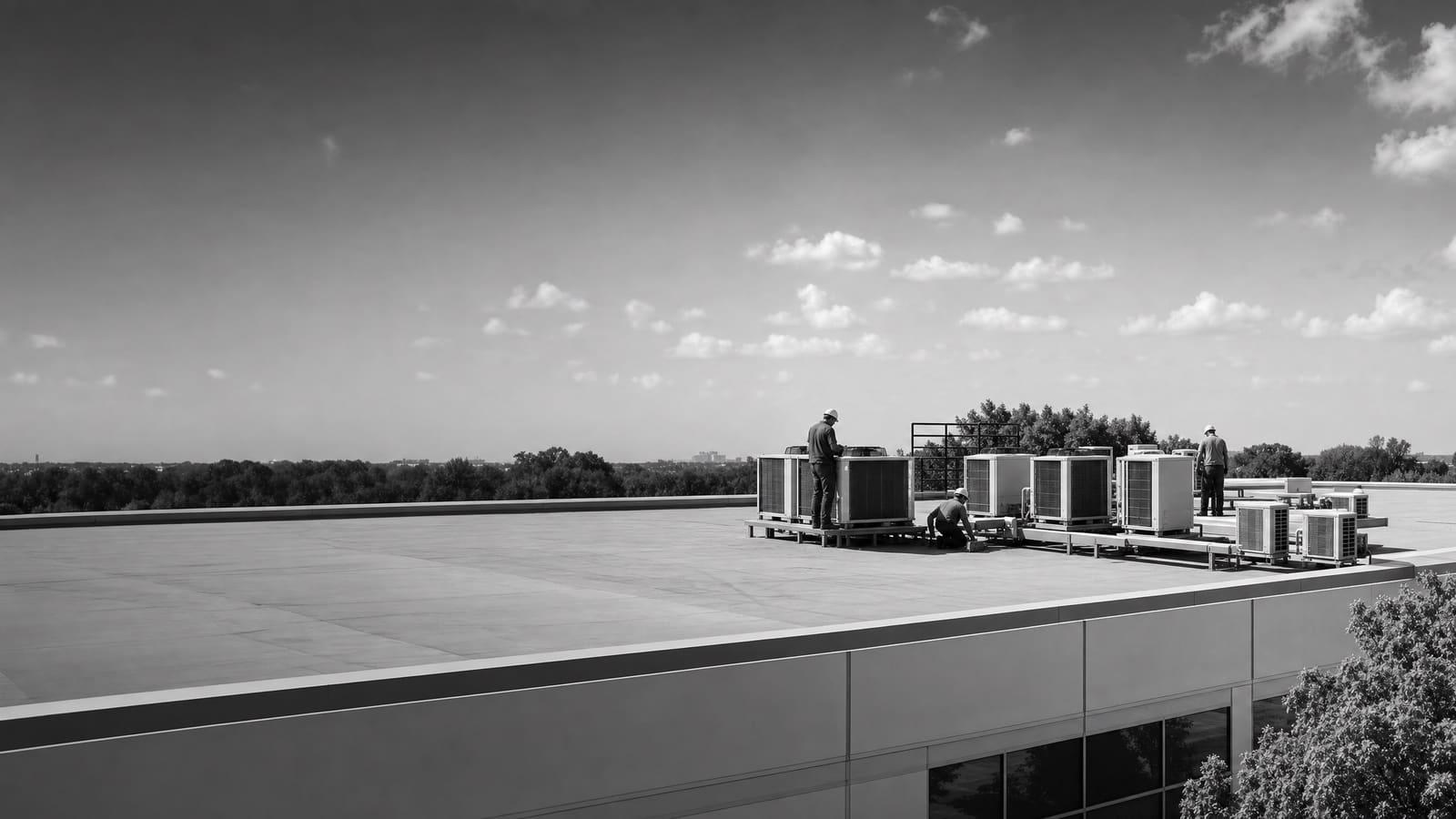
Packaged rooftop units remain common across commercial buildings. They combine heating, cooling, and ventilation functions in one outdoor cabinet. A direct replacement can reduce design and field work when the existing curb, ducts, utilities, controls, and capacity remain suitable. It should not be called like for like until those conditions are checked.
A higher-efficiency rooftop unit may lower energy use, but its value depends on operating hours, load pattern, controls, maintenance, and installed cost. DOE documented older commercial rooftop equipment wasting significant energy and found that high-efficiency units can produce real savings. That history supports comparing efficiency tiers, but it does not promise the same savings for every building.
Heat-pump rooftop units provide cooling and reverse-cycle heating. DOE says they are similar to conventional air-conditioning rooftop units, with heating added through the refrigeration cycle. An all-electric, dual-fuel, or other heat-pump design should be reviewed against electrical capacity, physical constraints, gas infrastructure, utility rates, equipment availability, and winter heating needs. The quote should show any backup heat and electrical work instead of hiding them in an allowance.
PROJECT COMPLEXITY
A box swap and a system change are different projects
Two units with the same nominal capacity can require very different field work. Classify the project before comparing totals.
LOWER COMPLEXITY
Compatible replacement
The new unit fits the existing arrangement, the load remains valid, utilities are adequate, controls are simple, and roof access is clear. The scope still needs startup and documented testing.
HIGHER COMPLEXITY
Changed capacity or system
A different footprint, fuel, voltage, airflow plan, control sequence, or capacity can require adapters, duct changes, electrical work, engineering, added coordination, and longer shutdown planning.
SITE REVIEW
Confirm the conditions before equipment is ordered
Start with equipment records and a physical survey. Record the model, serial number, nominal capacity, voltage, heating type, refrigerant, control connections, curb dimensions, duct arrangement, and service clearances. Review repair history, comfort complaints, operating hours, and any rooms that have changed use. A nameplate identifies the old machine; it does not prove the correct replacement load.
Next, trace how the installation reaches the equipment. For a rooftop unit, confirm roof access, lift reach, staging space, overhead limits, protected surfaces, and the effect of a closure on customers or staff. Inspect the curb, transitions, drains, power, disconnect, gas connection, ventilation path, and control wiring. For a heat-pump option, check electrical capacity and how heating will operate under demanding conditions.
The survey should end with a written basis of design. It should state what remains, what changes, what assumptions were made, and what must be resolved before release. This makes competing proposals easier to compare and reduces change orders caused by an incomplete scope.
Do not order from the nameplate alone
Confirm the present load and field conditions first. A matching capacity label does not guarantee compatible airflow, heat, power, controls, curb dimensions, or service access.
OPERATIONS AND OWNERSHIP
Plan for the shutdown and the years after it
The installation plan should protect the facility during removal, connection, and startup. Decide which areas can lose conditioning, when work may occur, who receives notices, and what temporary measures are needed. A planned replacement gives the owner more control than a failure during occupied hours.
The purchase also changes the maintenance plan. Confirm filter sizes, belt or drive requirements, control access, replacement parts, warranty steps, and technician needs. EPA rules govern refrigerant handling in stationary air-conditioning and heat-pump equipment, so recovery and disposal belong in the contractor's scope. Keep the startup report, equipment data, warranty information, and refrigerant records with the facility files.
DAY OF WORK
Control disruption
Set the shutdown window, access route, staging area, safety boundaries, weather decision, tenant notice, and responsible contacts before crews arrive.
AFTER HANDOFF
Protect the investment
Keep test results, sequences, warranties, training notes, filter data, refrigerant information, and maintenance requirements in one accessible equipment record.
PHASING AND PROCUREMENT
Replace critical units before failure controls the schedule
For a building with several rooftop units, rank equipment by consequence of failure. Age matters, but it is not the only signal. Include service frequency, leak history, comfort performance, energy use, parts availability, area served, and whether another unit can support the space. DOE guidance notes that proactive replacement of inefficient, underperforming rooftop units can be a smart business choice compared with waiting for failure.
Phasing can spread capital needs and preserve operations. It can also create a mixed fleet with different controls, filters, refrigerants, parts, and service procedures. Decide whether standardizing future purchases has enough operational value to shape the first phase. Bundle units only when the access plan, procurement timing, and occupied-space needs support it.
Compare life-cycle consequences, not efficiency labels alone. Include purchase and installation, expected maintenance, energy use, controls, infrastructure changes, downtime exposure, and the expected holding period for the property. Treat incentives as time-sensitive and verify them directly before using them in an approval case. None of the supplied research establishes a current Leander incentive.
QUOTE CHECKLIST
Five items every comparable proposal should show
Give each bidder the same basis of design. Then compare equipment, field scope, exclusions, schedule, and proof of performance line by line.
01
Exact equipment selection
List model, capacity, heating type, efficiency, voltage, refrigerant, options, availability, and approved substitutions.
02
Complete installed scope
Define removal, recovery, disposal, rigging, curb or pad work, ducts, drains, power, fuel, controls, and weatherproofing.
03
Access and operating plan
State staging, shutdowns, closures, protection, work hours, notices, temporary needs, and responsibilities.
04
Testing and acceptance
Require airflow, charge, heating, cooling, ventilation, controls, alarms, safeties, and operating sequence to be verified.
05
Commercial terms and handoff
Show price, allowances, exclusions, schedule, payment terms, warranty, training, manuals, startup reports, and closeout records.
Get a defensible number
Price the equipment and the building together.
Send the address, operating target, and target opening date. Flux will identify what must be verified before the project can be priced.
Get a free estimateQuestions
Straight answers.
When should a commercial rooftop unit be replaced instead of repaired?
Consider replacement when the unit needs frequent service, cannot maintain comfort, causes costly downtime, or has become inefficient and unreliable. DOE guidance flags rooftop units over 15 years old for closer review, but age alone does not decide the project. A limited failure on an otherwise dependable unit may still justify repair.
Should the new HVAC unit match the old unit's capacity?
Not automatically. Confirm how the space is used today and whether occupancy, equipment, ventilation, envelope conditions, or operating hours changed. The old nameplate is useful field data, but copying it can preserve an old sizing error.
What is included in a commercial HVAC installation?
A complete scope can include survey, load review, equipment, removal, refrigerant recovery, disposal, rigging, curb or pad work, duct transitions, drains, electrical work, gas work, controls, startup, testing, training, warranties, and closeout records. The proposal should say exactly which items are included.
Is a commercial heat-pump rooftop unit worth considering?
Yes, when its heating performance, electrical needs, utility impact, physical fit, equipment availability, and operating goals work for the site. Compare all-electric and dual-fuel choices with a conventional replacement on the same installed-scope basis.
How should commercial HVAC installation quotes be compared?
First make sure every contractor priced the same equipment basis and field scope. Compare model details, exclusions, allowances, access, utility changes, controls, shutdown plan, testing, schedule, warranty, and handoff documents. A low total with major omissions is not a comparable quote.
What should happen during HVAC commissioning?
The contractor should verify cooling, heating, airflow, ventilation, refrigerant condition, drains, controls, alarms, safeties, and the intended operating sequence. The owner should receive the results in writing, along with manuals, warranty information, and training.
Who should handle refrigerant from the removed unit?
The installation scope should assign proper refrigerant recovery, handling, records, and equipment disposal to qualified parties. EPA Section 608 rules apply to refrigerant handling for stationary air-conditioning and heat-pump equipment.
Can a multi-unit property phase its HVAC replacements?
Yes. Rank units by failure risk, service history, area served, comfort problems, efficiency, and operational consequence. Phasing can spread capital needs, but the owner should also plan for the parts, controls, refrigerants, filters, and training required by a mixed equipment fleet.
Sources used for this guide
- [1]betterbuildingssolutioncenter.energy.gov — DOE Advanced Rooftop Unit Replacement Guidance
- [2]betterbuildingssolutioncenter.energy.gov — DOE Commercial Heat Pump Rooftop Unit Replacement Guidance
- [3]betterbuildingssolutioncenter.energy.gov — DOE High-Efficiency Commercial Rooftop Unit Toolkit
- [4]energy.gov — DOE Efficient Commercial Rooftop Air Conditioner Program
- [5]epa.gov — EPA Stationary HVAC Refrigerant Management