THE DIRECT ANSWER
What commercial HVAC replacement includes
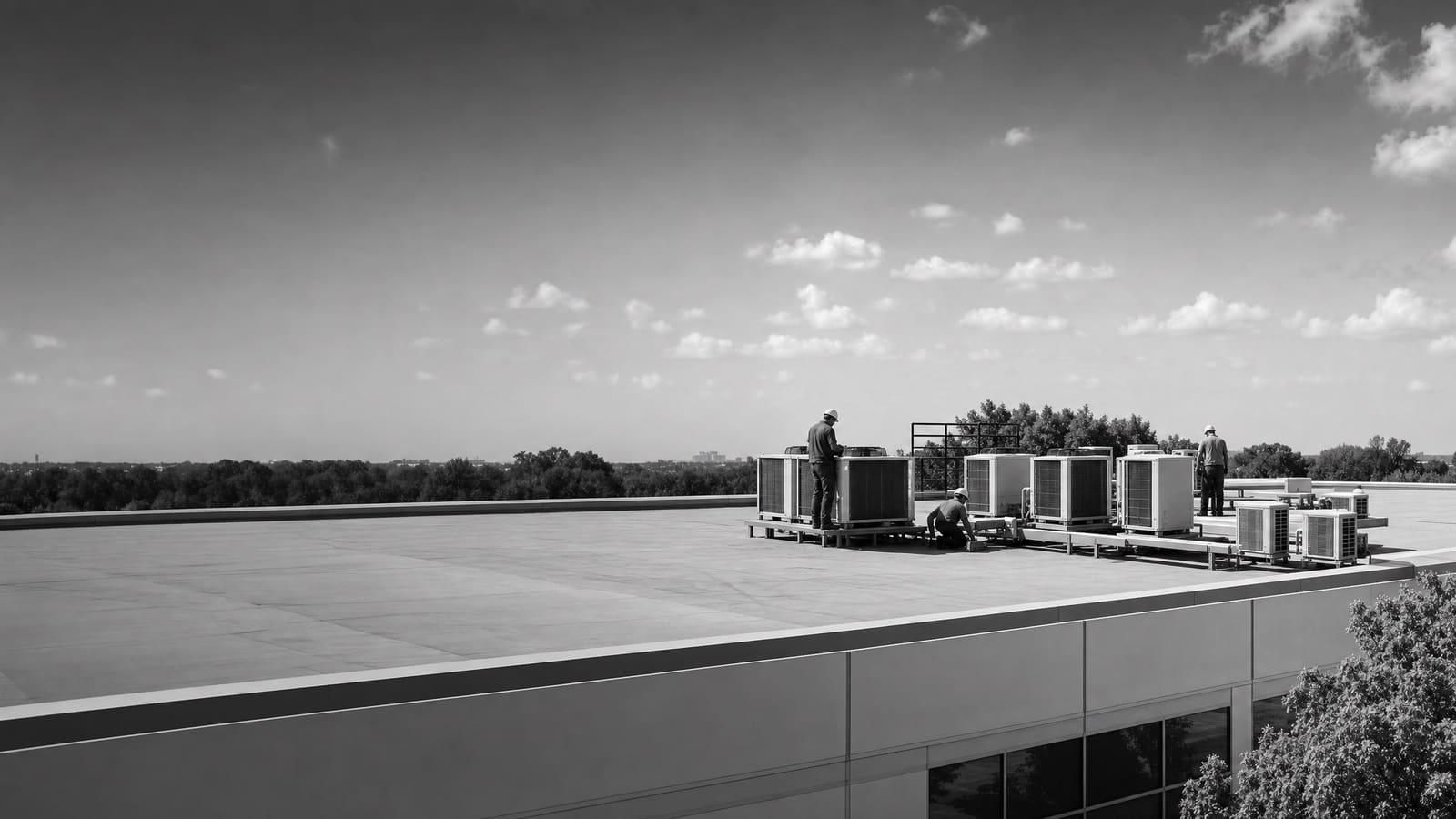
Commercial HVAC replacement includes load review, equipment selection, removal, rigging, needed connection changes, controls work, startup, and commissioning. Replacement is often more useful than another repair when an older unit needs frequent service, cannot hold the space conditions, or creates growing downtime risk. DOE notes that rooftop units over 15 years old can waste substantial energy compared with newer models.
A site review should verify the load, curb and roof conditions, access, electrical service, fuel, controls, ventilation needs, and equipment availability.
THREE OPERATING CHOICES
Repair, replace in kind, or improve the system
Start with the business problem, not an equipment catalog. A repair can be the right bridge when the failure is isolated, parts are available, and the unit still meets the building load. A like-for-like replacement can reduce design work, but it may repeat an old sizing or comfort problem. A right-sized, higher-efficiency, or heat pump rooftop unit asks for more review before purchase. It may change electrical demand, heating energy, controls, or physical connections.
DOE guidance supports proactive review instead of waiting for total failure. It also says heat pump rooftop decisions should account for geography, utility costs, emissions goals, building type, equipment supply, electrical capacity, physical limits, gas lines, contractor knowledge, and incentives. Those questions belong in the buying process even when the final choice is a standard air-conditioning rooftop unit.
BUDGET STRUCTURE
What moves an installed price
The supplied research does not support a universal installed cost. A useful budget separates equipment from the labor, access, infrastructure, and verification needed to deliver a working system.
EQUIPMENT SELECTION
Choose the unit around the building you operate now
The old unit is a useful reference, but it is not a complete design. Confirm how the space is used now. Review occupancy, operating hours, internal equipment, ventilation, comfort trouble, and any building changes. A unit that is too small may struggle at peak load. A unit that is too large may cycle poorly and make control harder. The goal is not simply more capacity. It is dependable operation at the conditions the facility needs.
Packaged air-conditioning rooftop units remain a common commercial choice. A higher-efficiency model may reduce energy use, but the buyer should compare the added equipment cost, expected operating pattern, controls, and maintenance needs. DOE reported that commercial rooftop systems condition nearly half of U.S. commercial floor area and has documented meaningful energy savings from efficient replacements and advanced controls. That broad result is a reason to evaluate efficiency, not a promise about one building.
A heat pump rooftop unit adds reverse-cycle heating. It may support electrification or emissions goals, but it is not an automatic upgrade. Review electrical capacity, heating demand, backup heat, gas service, utility rates, equipment availability, and the service team's experience. Ask for a simple operating comparison based on your facility rather than a general claim.
PROJECT COMPLEXITY
A box swap and a system change are different projects
The equipment may look similar from the parking lot, yet the installation scope can be very different. Define which condition applies before comparing bids.
LOWER COMPLEXITY
Compatible replacement
The existing capacity still fits, the curb and duct path can be reused, utilities match, controls are simple, and access is clear. The quote should still include removal, rigging, connections, startup, commissioning, and closeout.
HIGHER COMPLEXITY
Changed load or infrastructure
New space use, comfort complaints, electrical limits, fuel changes, curb work, difficult access, automation integration, or phased operations require added planning. These conditions may call for engineering and a more detailed sequence of work.
SITE REVIEW
Turn a walk-through into an installable scope
Begin with the equipment record. Gather model and serial information, service history, known refrigerant issues, control details, utility data, and a list of comfort complaints. Then inspect the parts of the project that do not appear on a nameplate. That includes roof or equipment-room access, support conditions, duct connections, drainage, outdoor-air paths, electrical service, fuel connections, sensors, and automation points.
The review should also map how work affects the facility. Mark delivery and lifting areas. Identify spaces that cannot lose conditioning during business hours. Note security, noise, dust, and tenant rules. If several units serve the site, decide whether work can be phased. A planned sequence may protect operations and give the owner time to confirm results before repeating the design.
Ask the contractor to record assumptions and exclusions. If a curb adapter, electrical upgrade, duct repair, temporary cooling plan, or control interface is not confirmed, the quote should say how it will be handled. Clear unknowns are easier to manage than a low bid built on silent assumptions.
Useful information to bring
Provide nameplate photos, roof or mechanical-room access photos, service records, control screenshots, operating hours, comfort complaints, planned space changes, and any outage limits.
OWNER PRIORITIES
Protect operations now and ownership value later
A replacement decision has two time frames. The first is the installation window: how the building stays safe and usable while equipment is removed, set, connected, and tested. The second is the service life: how the selected equipment affects energy use, repairs, parts, controls, and future replacement planning.
Do not let an urgent outage erase the second question. DOE guidance notes that owners often delay replacement until a rooftop unit cannot condition the space, needs frequent maintenance, or fails. A simple condition plan can identify aging units and prepare choices before the next failure. It can also group similar units, standardize controls, and reserve complex projects for planned shutdowns.
DAY OF WORK
Continuity plan
Define shutdown limits, protected areas, staging, access control, weather decisions, temporary measures, and who can approve field changes. Give occupants and operators one clear schedule.
YEARS OF OPERATION
Ownership plan
Compare maintenance access, parts strategy, controls, expected operating needs, warranty duties, and energy use. Record the final configuration so future service starts with accurate information.
PROCUREMENT AND PHASING
Buy a complete outcome, not a loose collection of parts
A commercial HVAC bid should connect one equipment selection to one complete installation scope. Require a model or defined performance basis, included accessories, stated availability, installation responsibilities, and acceptance tests. An allowance can be reasonable when a condition cannot yet be opened or measured, but it should name the condition, amount basis, and approval path. Avoid comparing one bid that includes controls and commissioning with another that stops after power-up.
For a multi-unit property, build a replacement order around condition and consequence. Give early attention to equipment that serves critical rooms, has repeated failures, lacks practical backup, or would cause a major operating loss. Similar units may be grouped when that improves procurement and field setup. Different building loads should not be forced into one design only for purchasing convenience.
Plan refrigerant handling as part of removal and service. EPA rules under Clean Air Act Section 608 address refrigerant handling and recycling for stationary air-conditioning and heat pump equipment. The quote should place recovery, lawful handling, and disposal responsibility with qualified parties. Closeout should identify the new equipment, refrigerant, warranty steps, control settings, test results, and recommended maintenance tasks.
BID COMPARISON
Five items every comparable quote should show
Normalize these five items before choosing a proposal. If one is missing, request a written revision instead of assuming it is included.
01
Equipment basis
Show capacity, heating type, efficiency basis, refrigerant, accessories, controls, warranty, availability, and approved substitutions.
02
Removal and installation
Define shutdown, recovery, disposal, delivery, rigging, supports, curb or duct work, drainage, connections, protection, and cleanup.
03
Infrastructure changes
List electrical, gas, structural, ventilation, control, automation, and distribution work, including allowances and exclusions.
04
Startup and acceptance
Require airflow, operating checks, safeties, sensors, schedules, controls, and documented commissioning before final acceptance.
05
Schedule and closeout
State lead time, work sequence, outage window, payment points, change process, training, manuals, warranty records, and test reports.
Get a defensible number
Price the equipment and the building together.
Send the address, operating target, and target opening date. Flux will identify what must be verified before the project can be priced.
Get a free estimateQuestions
Straight answers.
When is replacement better than another commercial HVAC repair?
Replacement deserves serious review when an older unit needs frequent service, cannot maintain required conditions, uses excessive energy, has difficult parts support, or creates unacceptable failure risk. DOE says rooftop units over 15 years old can waste substantial energy compared with newer equipment. Age alone does not decide the project. Compare repair scope, condition, performance, operating cost, and the effect of another outage.
How much does commercial HVAC installation cost in League City?
The supplied research does not establish a reliable local installed-price range, so a universal number would be misleading. Price depends on capacity, equipment type, efficiency, availability, rigging, access, curb and duct work, electrical or fuel changes, controls, commissioning, and operating constraints. Ask for an itemized installed quote after a site review, then compare identical scopes.
Should a replacement match the old rooftop unit size?
Not automatically. Use the old unit as a starting point, then confirm current occupancy, hours, internal loads, ventilation, space changes, and comfort history. A similar size may be correct when the building and use have stayed stable. Changed use or persistent comfort trouble is a reason to review the load before ordering.
Is a commercial heat pump rooftop unit worth considering?
Yes, as one option. A heat pump rooftop unit can provide cooling and reverse-cycle heating, and it may support electrification goals. DOE recommends reviewing geography, utility costs, heating demand, emissions goals, electrical capacity, physical limits, gas service, equipment availability, and contractor knowledge. Compare it with a standard rooftop unit using the building's actual operating needs.
What should happen during commissioning?
The team should confirm that the installed equipment operates as intended, not merely that it turns on. The scope should cover airflow, operating modes, safeties, sensors, schedules, control commands, drainage, and documented settings. The owner should receive test results, equipment records, warranty requirements, and basic operating guidance.
Can several commercial HVAC units be replaced in phases?
Yes. Phasing can reduce disruption, spread purchasing, and let the owner verify one design before repeating it. Rank units by condition, service history, space importance, backup options, and failure impact. The plan should also account for procurement, repeated rigging, control compatibility, and how mixed equipment will be maintained.
Who should handle refrigerant from the removed equipment?
The installation scope should assign refrigerant recovery and handling to qualified parties and include proper disposal documentation. EPA Section 608 rules address handling and recycling of refrigerants in stationary air-conditioning and heat pump equipment. Do not leave this duty unclear between the owner, installer, and disposal provider.
Sources used for this guide
- [1]betterbuildingssolutioncenter.energy.gov — DOE Advanced Rooftop Unit Replacement Guidance
- [2]betterbuildingssolutioncenter.energy.gov — DOE Commercial Heat Pump Rooftop Unit Replacement Guidance
- [3]betterbuildingssolutioncenter.energy.gov — DOE High-Efficiency Commercial Rooftop Unit Toolkit
- [4]energy.gov — DOE Efficient Commercial Rooftop Air Conditioner Program
- [5]epa.gov — EPA Stationary HVAC Refrigerant Management