THE DIRECT ANSWER
Commercial HVAC replacement and installation in Lawrence.
A commercial HVAC installation should include load review, equipment selection, removal, rigging, connections, controls, startup, commissioning, and owner handoff. Replacement becomes more useful than another repair when the unit cannot hold conditions, needs frequent service, or is old enough that another major repair only delays the same capital project.
A site review must verify the existing unit, served space, roof or equipment-room access, utility connections, controls, electrical capacity, and physical clearances.
FIRST DECISIONS
Choose the operating result before choosing equipment
The best replacement is not always a copy of the old unit. Start with the result the building needs. A quick like-for-like swap may restore service with fewer changes, but it can preserve poor sizing or weak controls. A right-sized replacement can better match current occupancy, schedules, internal heat, ventilation, and comfort needs. A heat pump rooftop unit can add electric heating, but that choice needs a closer review of winter performance, electrical capacity, utility costs, physical constraints, available models, and backup heat. Make these choices before bids go out. Otherwise, contractors may price different outcomes under similar-looking proposal titles, leaving the owner to compare numbers that do not represent the same job.
BUDGET STRUCTURE
What moves the installed price
There is no supported universal installed price for this project. Ask bidders to separate equipment from the work required to deliver a complete, operating system.
EQUIPMENT SELECTION
Compare systems by how the building actually runs
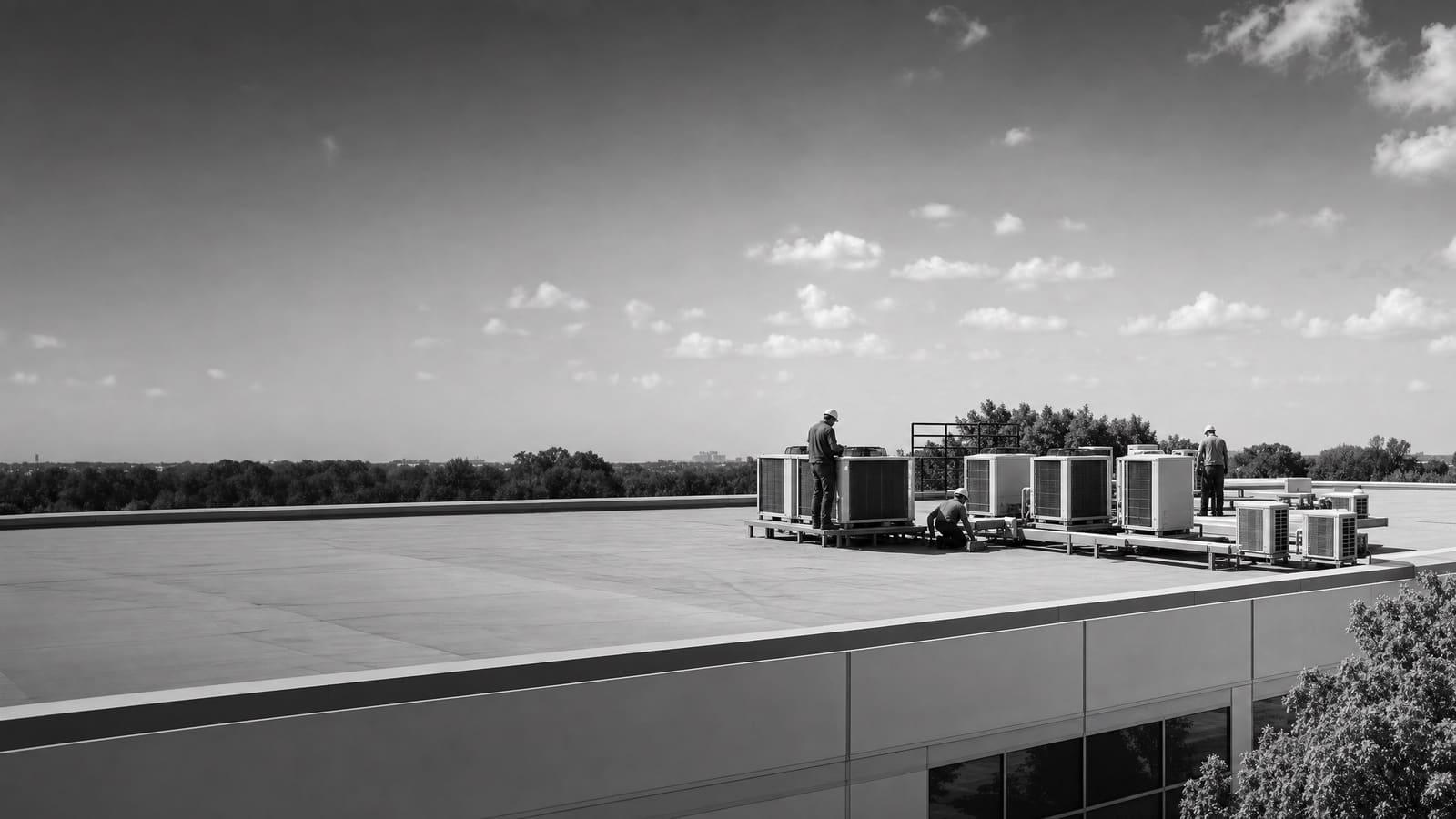
Packaged rooftop units serve a large share of commercial floor area. They combine major heating, cooling, and ventilation functions in one outdoor cabinet. That can make replacement more direct when the roof curb, duct layout, utility connections, and controls remain suitable. A direct replacement still deserves a load check. The old nameplate tells you what was installed, not what the building needs now.
A conventional air-conditioning rooftop unit normally relies on a separate heating source. A heat pump rooftop unit uses reverse-cycle heating as well as cooling. Available approaches can include all-electric, dual-fuel, and cold-climate configurations. The right choice depends on heating load, outdoor conditions, electricity and gas costs, electrical capacity, physical space, equipment availability, contractor knowledge, and the owner's emissions goals. Heat pump efficiency generally falls as outdoor temperature drops, so backup heat and peak electrical demand must be part of the design.
High-efficiency equipment can reduce energy use, but performance depends on the whole installation. Airflow, controls, outside air, sensors, duct conditions, and operating schedules can help or defeat the equipment rating. Ask for a selection report that states capacity, efficiency, heating method, electrical data, airflow, outside-air basis, sound considerations, control sequence, and major assumptions.
PROJECT COMPLEXITY
A box swap and a system change are different projects
Two proposals may name similar equipment while carrying very different labor, design, schedule, and operating risk. Sort the project into the right complexity level before comparing totals.
LOWER COMPLEXITY
Compatible replacement
The served use is stable, capacity remains suitable, utilities are adequate, controls are simple, and the new unit fits the existing location with limited transitions. The quote can focus on removal, setting, reconnection, startup, and closeout.
HIGHER COMPLEXITY
Redesign or conversion
Capacity, fuel, voltage, ventilation, controls, location, or operating goals change. The project may need load analysis, electrical study, new distribution work, structural review, staged shutdowns, and a more detailed commissioning plan.
SITE REVIEW
Investigate the building before fixing the scope
Begin with records, then verify them in the field. Collect equipment schedules, service history, control drawings, utility data, prior comfort complaints, operating hours, and any planned changes to the space. At the unit, record the nameplate, refrigerant, heating source, voltage, disconnect, controls, filter arrangement, outside-air path, curb or pad, duct connections, drainage, clearances, and signs of leakage or corrosion.
Walk the served area as well. Note rooms that run hot or cold, pressure problems, unusual odors, noise, closed diffusers, added process loads, and occupancy that differs from the original plan. These details help distinguish failed equipment from distribution or control problems. Replacing capacity without finding the actual cause can leave the owner with a new unit and an old complaint.
The access plan belongs in this review. Confirm how old equipment leaves, how new equipment arrives, where lifting or staging can occur, what areas must close, and which operations cannot lose conditioning. For occupied buildings, define temporary service, protection, shutdown notices, and daily cleanup before construction begins.
What the survey should produce
Ask for a written basis of design, verified existing conditions, identified unknowns, access plan, shutdown assumptions, equipment schedule, control intent, and list of owner decisions.
OWNERSHIP VIEW
Balance outage risk with lifetime performance
A failed unit can force a fast purchase with limited equipment choices and weak negotiating power. Planned replacement gives the owner time to confirm loads, compare configurations, review infrastructure, coordinate occupied areas, and procure around operations. DOE guidance notes that rooftop units over 15 years old can waste substantial energy compared with newer models, while facility teams often wait until comfort falls, maintenance becomes frequent, or the unit fails.
Age alone does not settle the decision. Review condition, repair pattern, energy use, refrigerant needs, controls, remaining major components, and the effect of failure on the business. Then compare the cost of keeping the unit with the full value of replacement, including energy, maintenance, downtime, comfort, ventilation, and future service support.
RUN TO FAILURE
Protect near-term cash
This can fit a reliable, noncritical unit with available parts and backup capacity. It also accepts emergency scheduling, uncertain availability, repeated repairs, and possible disruption during peak demand.
PLANNED REPLACEMENT
Control the project
This supports better surveys, comparable bids, coordinated shutdowns, equipment choices, and commissioning. Prioritize units with poor condition, frequent service, weak performance, or serious business impact if they fail.
PROCUREMENT AND PHASING
Build a schedule that protects operations
The project schedule should separate design, approvals, submittals, equipment release, enabling work, removal, setting, connections, startup, commissioning, and closeout. Do not treat the delivery date as the completion date. Controls work, balancing, corrections, training, and final records may follow the physical set.
For a multi-unit property, decide whether to replace by condition, business criticality, area, or equipment family. Grouping similar units may simplify design, controls, training, filters, parts, and service. Phasing by area can reduce disruption, but it may spread mobilization and management across more work periods. Keep enough operating capacity during each phase and define what happens if weather, delivery, or startup does not follow the plan.
Procurement should also address refrigerant management. Stationary air-conditioning and heat pump equipment is covered by federal refrigerant handling and recycling rules. The scope should identify who recovers refrigerant, documents the work, manages removed equipment, and handles any refrigerant remaining on site. For a mixed fleet, record the refrigerant used by each new unit so service teams can plan tools, training, recovery, and parts without confusion.
QUOTE CHECK
Five items every comparable quote should show
Require the same scope format from every bidder. A low total is not useful when key work appears later as an exclusion, allowance, or change order.
01
Equipment and performance
List model, capacity, efficiency, heating type, refrigerant, airflow, electrical data, accessories, availability, warranty, and every approved alternate.
02
Removal and installation scope
Define recovery, demolition, disposal, rigging, curbs, transitions, roofing interfaces, ductwork, piping, wiring, fuel work, drainage, insulation, and weather sealing.
03
Controls and operating sequence
State sensors, thermostats, alarms, scheduling, outside-air operation, heating stages, economizer functions if included, and building-system integration.
04
Schedule and site responsibilities
Show procurement assumptions, work hours, shutdowns, access, staging, protection, temporary conditioning, owner duties, cleanup, and delay terms.
05
Testing and closeout
Include startup reports, airflow checks, control testing, deficiency correction, training, manuals, warranty registration, equipment records, and final acceptance.
Get a defensible number
Price the equipment and the building together.
Send the address, operating target, and target opening date. Flux will identify what must be verified before the project can be priced.
Get a free estimateQuestions
Straight answers.
When is replacement better than another commercial HVAC repair?
Replacement deserves serious review when the unit no longer maintains conditions, repairs are becoming frequent, major components are failing, energy performance is poor, or an outage would disrupt the business. DOE guidance also identifies rooftop units over 15 years old as strong candidates for closer evaluation. Age is a screening point, not a stand-alone order to replace.
Should a new commercial rooftop unit match the old capacity?
Not automatically. Confirm the current heating, cooling, ventilation, occupancy, schedule, and internal loads. Matching the old nameplate can be reasonable when the building use and performance remain sound. If the space changed or the old system had persistent comfort problems, a fresh load review is more useful.
Is a heat pump rooftop unit a good replacement choice?
It can be, especially when electric heating supports operating or emissions goals. The decision should examine winter heating needs, electricity and gas costs, electrical capacity, backup heat, physical constraints, equipment availability, controls, and service readiness. Compare modeled operation with conventional and dual-fuel options before selecting.
What should happen during commercial HVAC commissioning?
Commissioning should verify that the installed system performs according to the approved design and control sequence. Typical checks include airflow, heating and cooling operation, sensors, safeties, outside air, staging, schedules, alarms, and control integration. Results, corrections, settings, and owner training should be documented.
How can owners compare commercial HVAC installation bids?
Issue one scope and require bidders to use the same response format. Compare the exact equipment, installation work, controls, schedule, exclusions, allowances, testing, training, warranties, and owner responsibilities. Ask bidders to explain every difference instead of comparing the bottom-line totals alone.
What information should an owner provide before the site visit?
Provide equipment schedules, nameplate photos, service records, control information, operating hours, utility history, comfort complaints, planned space changes, access limits, and critical shutdown windows. Better records reduce assumptions, but the contractor should still verify important conditions in the field.
Can several rooftop units be replaced in phases?
Yes. A phased plan can rank units by condition, criticality, area, or equipment family. The plan should preserve enough capacity for occupied spaces, account for procurement and weather risk, define temporary measures, and keep controls and commissioning consistent across phases.
Who should handle refrigerant from the removed equipment?
The contract should assign recovery, documentation, recycling or disposal, and management of removed equipment to qualified parties. Federal rules govern refrigerant handling for stationary air-conditioning and heat pump equipment, so this work should be explicit rather than left as an informal field assumption.
Sources used for this guide
- [1]betterbuildingssolutioncenter.energy.gov — DOE Advanced Rooftop Unit Replacement Guidance
- [2]betterbuildingssolutioncenter.energy.gov — DOE Commercial Heat Pump Rooftop Unit Replacement Guidance
- [3]betterbuildingssolutioncenter.energy.gov — DOE High-Efficiency Commercial Rooftop Unit Toolkit
- [4]energy.gov — DOE Efficient Commercial Rooftop Air Conditioner Program
- [5]epa.gov — EPA Stationary HVAC Refrigerant Management