THE SHORT VERSION
What a commercial HVAC replacement actually includes
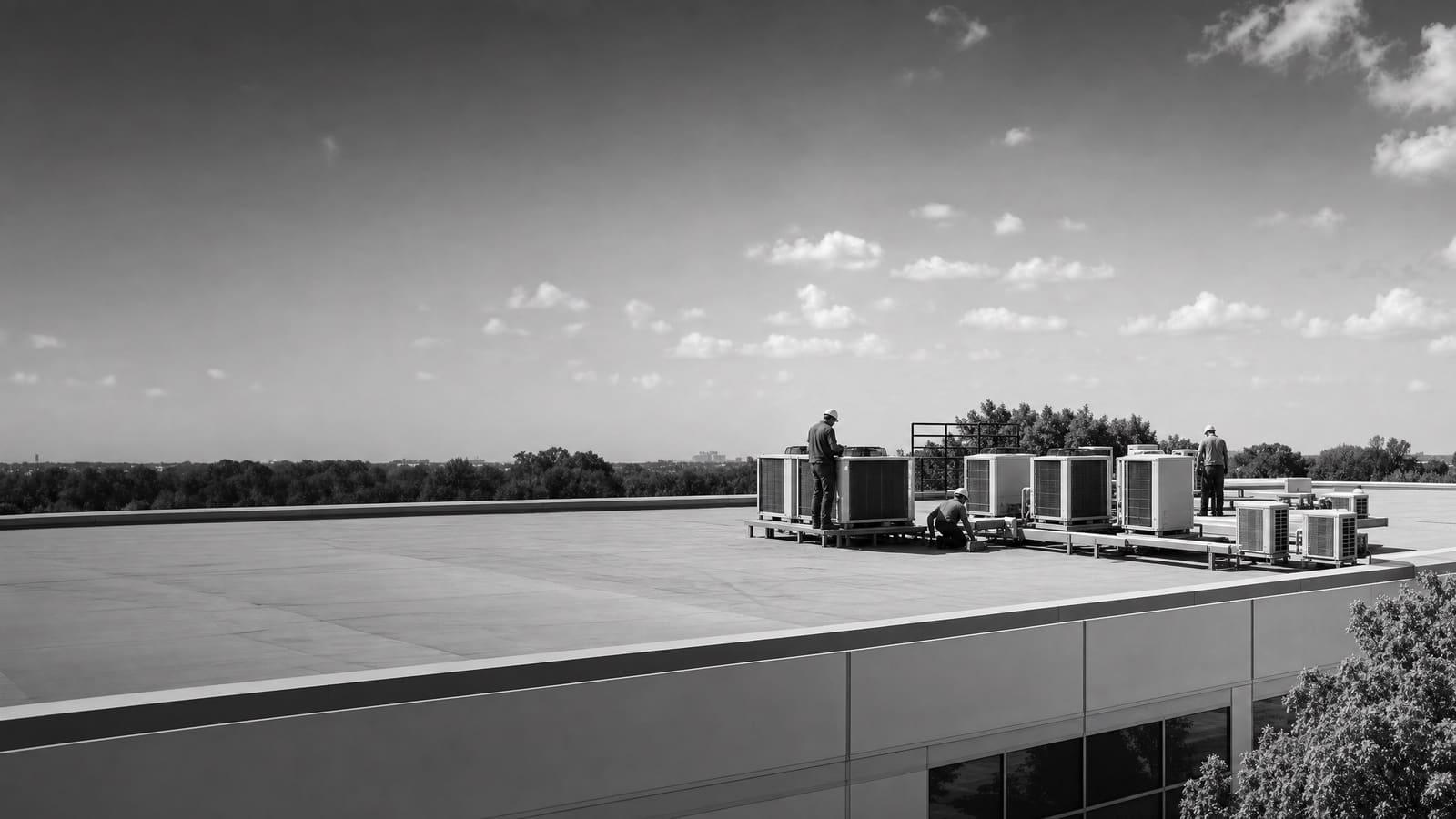
A commercial HVAC replacement covers the load calculation, equipment selection, refrigerant recovery from the old unit, rigging and set, a new curb or curb adapter, gas and electrical connections, controls integration, permits, and commissioning. Replacement beats another repair once a unit is past roughly 15 years and the failures are arriving closer together. Old, inefficient rooftop units can waste an estimated $900 to $3,700 each per year, so an aging unit is already spending your money every month it stays.
A site review still has to verify the real load, the roof and curb condition, crane access from the lot, and whether the existing electrical service and gas line support the unit you want.
THREE WAYS TO GO
Three replacement paths, and who each one fits
Most commercial buyers are choosing between three paths, and the tiebreaker is rarely the sticker price. It is how long you hold the building and what the old unit costs you to run right now.
There is also a fourth path nobody picks on purpose: replacement on failure. It is the most expensive of them all, because it removes your ability to shop. DOE's guidance describes the pattern plainly — facility teams delay a new rooftop unit until the current one stops conditioning the space, needs constant attention, or dies outright. By then you take the tonnage that is available, from whoever can get a crane out, at whatever the market is charging that week. Planning the swap while the old unit still runs is what buys you the choice below.
Efficiency tiers also matter more than they used to. DOE's high-performance rooftop unit challenge produced equipment built to cut energy use by up to 50 percent against the standard in force at the time, and more than 20 models now exceed that specification. If your unit runs long hours, that gap shows up in the meter every month, not just in the first year.
WHAT MOVES THE NUMBER
Where the money actually goes
Equipment is rarely the whole number, and it is almost never the part that moves. These are the lines that separate a clean swap from a small construction project, and the ones most likely to change after somebody has actually stood on the roof and opened the panel.
IN PRACTICE
Choosing the equipment before the emergency
The best commercial HVAC decision you can make is the one you make early. DOE's guidance is direct about it: replacing an inefficient, underperforming rooftop unit proactively is often the smarter business move compared with replacement-on-failure, or even with a like-for-like swap at the end of the unit's service life. The reason is leverage, not sentiment. A unit that still runs lets you take real bids, wait for the right equipment, and pick your own crane day.
Start with the load, not the nameplate. Fifteen or twenty years changes occupancy, plug load, lighting heat, hours of operation, and sometimes the envelope itself. The old plate records what someone sized for a building that no longer exists in that form. A unit matched to today's use fixes comfort complaints the last one could never solve, and it keeps you from paying to own and run tonnage you never call for.
Then check availability against your own calendar. Two units that look interchangeable on a spec sheet can be weeks apart on a truck, and the gap widens on larger tonnage and anything non-standard. A quote that prints a lead time beside the price is telling you the truth about your schedule. One that prints only a price is asking you to discover it later.
SIDE BY SIDE
What keeps a swap simple, and what turns it into a project
Two rooftop units that look identical from the parking lot can produce very different quotes. The difference is almost never the box itself. It is the list of things the building forces the installer to change on the way in, and how much of the site has to stop while that happens.
LOWER COMPLEXITY
Straight replacement
Same tonnage and same fuel, an existing curb that accepts an adapter, a roof that already carries the weight, clear crane reach from the lot, and controls that speak the same language as before. Permits stay routine and the visible work fits one morning.
HIGHER COMPLEXITY
Replacement that becomes a retrofit
A larger footprint or heavier unit, structural review, added electrical capacity for electric heat, new controls points, tight or shared parking that limits crane staging, and phased work so the building keeps operating through it. Plan this one in weeks, not days.
BEFORE YOU BUY
What a real site review checks
DOE publishes a checklist for owners weighing heat pump rooftop units, and it doubles as a scoping list for any replacement. It asks about climate zone and geography, cost and utility bill impact, emissions goals, building type, equipment availability, infrastructure, contractor availability and knowledge, and incentives. Work down that list before you compare prices and most of the surprises disappear.
Infrastructure is where the expensive ones hide, and it breaks into three questions. Does the electrical service have capacity for the unit you actually want, especially if electric heat is replacing gas heat? Do the physical constraints — curb size, roof structure, clearances, crane reach — allow that equipment onto the roof at all? And what happens to the existing gas line if the new unit no longer needs it?
Contractor familiarity is on that list for a reason. Newer high-efficiency and heat pump rooftop units stage, defrost, and communicate differently than the unit you are removing. A crew that has commissioned them before sets them up correctly the first time. A crew that has not hands you a unit that runs, which is not the same thing as a unit that performs to the specification you paid for.
Get the infrastructure answers in writing
Before you sign, ask for three things on paper: the available electrical capacity next to what the new unit draws, the structural and curb condition under the existing unit, and the crane plan with how long the lot is affected.
OWNERSHIP MATH
Two decisions that outlive the install
The crane day ends. The decision stays on the roof for the equipment's full service life, and two parts of it are easy to leave on autopilot.
Fuel is the first. A heat pump rooftop unit is technically similar to a straight air conditioning unit but adds reverse-cycle heating. Its heating efficiency falls as outdoor temperature drops, trending toward parity with electric resistance heat in real cold, which is exactly why the category splits into dual-fuel, all-electric, and cold-climate versions. Your winter heating load, your electrical capacity, and your actual electricity and gas prices should pick the version. A general preference for one fuel should not.
The second is everything already sitting on the roof, and how this new unit fits alongside it.
WHO PAYS, WHO SAVES
Split incentives
If the tenant pays the utility bill and the owner buys the equipment, a higher efficiency tier pays somebody else back. Settle that in the lease conversation before you pick the tier, not after the quote lands on your desk.
MIXED FLEETS
One roof, several vintages
Replacing units one at a time leaves you holding several refrigerants, control platforms, and service intervals at once. Section 608 rules govern refrigerant handling on every one of them. Decide whether you are standardizing the roof or just fixing today's failure.
PLANNING AHEAD
Phasing, procurement, and the number that matters
If more than one unit on the roof is aging out, replace them on a plan instead of on a schedule set by breakdowns. Rank by age, by run hours, by repair history, and by which spaces hurt most when they go down. The oldest hardest-working unit is usually the one quietly costing you the most, and it should go first even if it is not the one generating the loudest complaints.
The savings from doing this well are not theoretical. Through DOE's Advanced RTU Campaign, more than 200 public and private organizations upgraded over 43,000 rooftop units and cut a combined $37 million a year from their energy bills. Those were ordinary buildings making ordinary replacement decisions a little earlier and a little better than they had before.
Procurement follows the same logic. Bundling two or three units into one project usually earns better equipment pricing, one mobilization, one permit cycle, and one crane day instead of three. It also gives you a single controls scope, which is where phased projects tend to leak money and schedule. Ask any bidder for both numbers: the bundled price and the one-at-a-time price. The difference between them is the real cost of waiting.
APPLES TO APPLES
Five things a comparable quote shows
Two quotes for the same roof can be far apart and both be honest, because they are quietly pricing different scopes. The only reliable way to compare them is to require that each one shows the same five things in writing.
01
Tonnage, efficiency tier, and model
The specific unit, not a category. Efficiency tier is where two identical-looking bids usually separate.
02
Equipment lead time
Printed next to the price, so the schedule is part of the decision instead of a later surprise.
03
Curb, structural, and roofing scope
Adapter or new curb, any structural work triggered, and who patches and warranties the roof penetration.
04
Crane, permits, and inspections
Named as included or excluded, with rigging plan and lot closure hours stated.
05
Commissioning and documentation
Charge, airflow, and control settings verified against spec, then documented so the warranty stands.
Get a defensible number
Price the equipment and the building together.
Send the address, operating target, and target opening date. Flux will identify what must be verified before the project can be priced.
Get a free estimateQuestions
Straight answers.
When does replacing beat one more repair?
Once the unit is past roughly 15 years and repairs are landing closer together, replacement usually wins. DOE's guidance also warns about the hidden cost of waiting: a unit that fails completely removes your ability to choose tonnage, efficiency tier, or timing. You buy whatever is available that week.
Should you replace like-for-like or resize the unit?
Confirm the load either way. If occupancy, equipment, and operating hours have not changed since the last install, like-for-like is often right and it is the fastest path back. If they have changed, resizing fixes comfort problems the old unit could never solve and stops you paying for tonnage you never call for.
Is a heat pump rooftop unit the right call for a commercial building?
It depends on your winter heating load, your electricity and gas prices, and your electrical capacity. Heat pump heating efficiency drops as outdoor temperature falls, trending toward electric resistance parity in deep cold, which is why dual-fuel and cold-climate versions exist. Model the bill before you commit to a fuel.
How long does the actual swap take?
The on-site set is short when the existing curb accepts an adapter, the roof carries the weight, and crane reach from the lot is clear. What actually determines your date is equipment lead time. That is why availability belongs on the quote, right next to the price.
What does new equipment mean for refrigerant?
New commercial equipment ships on newer refrigerants, and EPA rules under Section 608 of the Clean Air Act govern how refrigerant is handled and recycled in stationary air conditioning and heat pump equipment. It changes nothing about day-one operation, but it belongs in your service contract and spare-parts plan on a mixed roof.
Are there incentives for a high-efficiency replacement?
Incentives sit on DOE's own decision checklist, and utility and program offerings change from year to year. Confirm what is actually open at the time you buy rather than assuming a past program is still running, and get the eligibility requirements and paperwork sequence settled before the equipment is ordered.
Sources used for this guide
- [1]betterbuildingssolutioncenter.energy.gov — DOE Advanced Rooftop Unit Replacement Guidance
- [2]betterbuildingssolutioncenter.energy.gov — DOE Commercial Heat Pump Rooftop Unit Replacement Guidance
- [3]betterbuildingssolutioncenter.energy.gov — DOE High-Efficiency Commercial Rooftop Unit Toolkit
- [4]energy.gov — DOE Efficient Commercial Rooftop Air Conditioner Program
- [5]epa.gov — EPA Stationary HVAC Refrigerant Management