THE SHORT VERSION
What a commercial HVAC replacement includes
A commercial HVAC replacement is a scoped project, not a swap. It covers a load check against how the building is used today, equipment selected against real availability, certified refrigerant recovery, curb and rigging work, permits and inspections, and commissioning at the end. Replacement usually beats another repair once a rooftop unit passes fifteen years, because an old, inefficient unit can waste roughly $900 to $3,700 a year on its own — a cost that keeps running after the repair is paid for.
A site review still has to confirm the curb and the roof structure under it, electrical capacity at the unit, the gas line, crane reach across your lot, and what current energy code requires of a replacement.
THE REAL CHOICE
Three ways to put a unit back on the curb
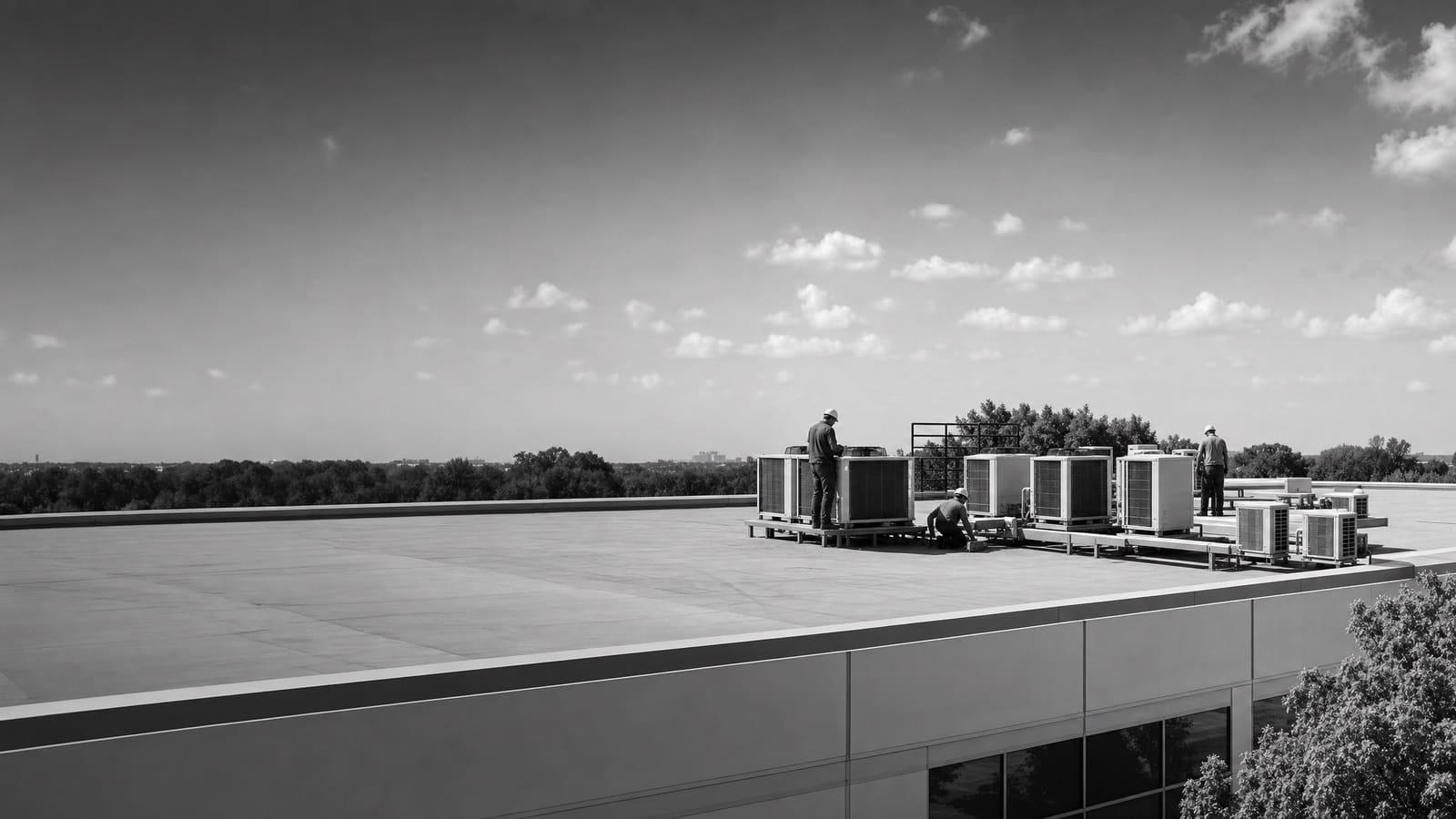
Rooftop units cool close to half of all commercial floor area in the country, so most replacement decisions come down to what goes back on that curb. There are three honest options.
The first is a like-for-like air-conditioning unit. It is the shortest path back to service and the cheapest engineering, but it carries forward whatever sizing mistake the old unit had.
The second is a high-efficiency air-conditioning unit. A federal performance challenge pushed manufacturers to build units that cut energy use by up to half against the older minimum standard, and more than twenty models now exceed that specification. On a cooling-led building in the desert Southwest, that gap shows up on every summer bill.
The third is a heat pump rooftop unit, either all-electric or dual fuel. Heat pump heating efficiency falls as outdoor temperatures drop, so these units do their best work where winters are mild. Across most of the South and West, current heat pump rooftop units handle most or all of the winter heating demand.
WHAT MOVES THE NUMBER
The line items that decide the price
Nobody can price a roof from a photo alone. But the same handful of line items decide where a commercial HVAC quote lands, and you can ask about every one of them before anyone climbs a ladder. These are roughly ordered by how much they swing.
BUYING GUIDANCE
Choosing between a swap and an upgrade
The cheapest quote and the cheapest decade are rarely the same quote. Waiting until a unit dies also removes your choices: replace-on-failure means taking whatever is on the shelf, at whatever it costs, on whatever day a crane is free. Units past fifteen years are the ones worth planning around, because a single old, inefficient rooftop unit can waste somewhere between $900 and $3,700 a year. Two or three of those on one roof is a real line in the operating budget.
The upgrade question is separate from the timing question. If the building is used the way it was when the last unit went in, and the complaints are about age rather than comfort, a like-for-like swap in a higher efficiency tier is usually the clean answer. If the floor plan changed, the tenants changed, or one section never held temperature, the load calculation should be redone before anyone quotes equipment.
The all-electric question is worth asking on every replacement now, not only when the gas heat section finally fails. Location drives that answer through three things: the building's heating load, local electricity and gas prices, and what your electrical service can already carry. Answer those three and the choice usually makes itself.
SCOPE CHECK
Simple swaps and complicated ones
Two replacements on the same street can be different projects. What separates them is rarely the unit itself — it is the footprint, the fuel, and whether the building can lose conditioning during business hours.
LOWER COMPLEXITY
Same fuel, same footprint
The new unit lands on the existing curb or a simple adapter, keeps the same fuel and roughly the same tonnage, and the existing feeder already carries it. Permitting is a straightforward mechanical and electrical package. Most of the schedule risk is equipment availability, not the work.
HIGHER COMPLEXITY
New footprint, new fuel, or occupied space
Growing the tonnage or footprint can pull in structural review. Going all-electric can mean panel and feeder work. Add damper coordination, duct changes, a three-story building, or a space that cannot lose conditioning during business hours, and the job needs engineering and phasing, not just a crane.
SCOPING
What the site review has to confirm
A quote written from a nameplate photo is a starting number, not a price. The site review is where it becomes real, and it exists to answer six questions.
First, the load — what the space needs today, not what the old unit was rated for. Second, the curb and the roof structure beneath it, since footprint and weight decide whether structural review joins the permit. Third, electrical capacity at the unit, which is the most common surprise on electric heating conversions. Fourth, the gas line: whether it stays, gets capped, or has to move. Fifth, crane access — reach across the lot, staging space, and how long stalls are out of service. Sixth, what current energy code requires of the replacement that the old unit never had to meet.
The review should also produce a commissioning plan. Charge, airflow, and control settings verified against the design is the difference between a unit that turns on in September and one that still holds temperature the following August.
Ask for these four before you sign
Equipment availability in writing next to the price. The rigging plan and who owns it. Permit and inspection responsibility, named. A commissioning report at handoff. A quote covering all four can be compared to another quote. One that does not is a guess with a total at the bottom.
LAS CRUCES
What New Mexico permitting expects
Commercial mechanical work in New Mexico is reviewed against a specific submittal list, and knowing it early keeps a replacement from stalling at the counter. The plans have to show the entire mechanical system: every HVAC unit, sizes, mounting details, all ductwork with duct sizes and mounting details, required smoke and fire damper locations, and the applicable equipment schedules. Energy code calculations must comply with the New Mexico Energy Conservation Code, so confirm the edition in force when you submit rather than reusing an old calculation set.
One threshold changes the budget directly. Plans, specifications, and calculations stamped by a mechanical engineer licensed in New Mexico may be required on mechanical permits valued at $50,000 or more, and on commercial buildings three stories and higher. Inspections are coordinated by the prime contractor, and the final mechanical inspection has to happen before final general. The state office that handles this work keeps a Las Cruces location, so plan review is not a remote process.
Price the stamp instead of splitting the job
If your replacement lands near $50,000 in permit value, decide early. Splitting one project into two permits to stay under the threshold usually costs more in mobilization and crane days than the engineer's stamp would have. Build the review time into the schedule and order equipment around it.
AFTER THE CRANE LEAVES
Two decisions that outlive the install
The install ends in a morning. Two decisions from it keep showing up in operating cost for the next fifteen years, and both are far cheaper to settle at purchase than to fix three years in. One is what refrigerant your roof ends up standardized on. The other is how the new unit actually lands on the utility bill, which is a local question rather than a specification question. Neither belongs in a footnote at the bottom of a proposal. Ask about both while you still have leverage over the equipment order.
FLEET STRATEGY
Refrigerant and service planning
Federal Clean Air Act rules govern how refrigerant is handled, recovered, and recycled in stationary air-conditioning and heat pump equipment, and certified technicians have to do that work. On a roof with mixed vintages, each replacement quietly adds another refrigerant and another parts strategy. Sequence the fleet deliberately.
OPERATING COST
Utility bills and incentives
Whether an electric option saves money depends on the building's heating load, local electricity and gas prices, and the grid it sits on — not on the brochure. Incentives are part of the same math and they change, so confirm what is actually available the month you order rather than what applied last year.
PROCUREMENT
Planning replacements instead of reacting to them
Facility managers usually delay a new rooftop unit until the old one stops holding temperature, needs constant service, or fails outright. That is understandable, and it is also the most expensive way to buy equipment. A failure in August sets the schedule, narrows the equipment list to whatever is available, and turns the load calculation into a formality nobody has time for.
There is evidence that planning ahead pays. Under a national campaign built around exactly this decision, more than two hundred public and private organizations upgraded over forty-three thousand rooftop units and now save a combined $37 million a year on energy bills. Those owners replaced units, or added advanced controls to them, on a schedule instead of on a failure.
For a multi-unit roof, the practical version is a fleet plan. Rank units by age and service history. Replace the worst one or two each budget cycle. Standardize the control platform and the refrigerant path so your service contract stays simple. Reuse the engineering and the curb details across identical units. Order early, because equipment availability, not labor, usually sets the schedule. And when a unit does fail unexpectedly, the plan means you already know what replaces it.
QUOTE CHECKLIST
Five things a comparable quote shows
Two quotes are only comparable when they describe the same project. These five items make a proposal checkable — and they are usually the ones missing from a number that looks surprisingly low.
01
Equipment, tonnage, and efficiency tier
The exact model, tonnage, efficiency rating, and refrigerant. Not "equivalent unit." You cannot compare two quotes that name different things.
02
Availability next to the price
Written lead time for the specific unit quoted, and what happens to the price if that unit is no longer available when you sign.
03
Curb, structure, and rigging scope
Curb adapter or new curb, any structural work, the rigging plan, crane size, and how much of the lot closes and for how long.
04
Permits, stamps, and inspections
Who pulls the mechanical and electrical permits, whether an engineer's stamp is included, and who coordinates the inspections.
05
Commissioning and closeout
Startup, charge, airflow, and control verification against the design, plus the documentation your warranty depends on.
Get a defensible number
Price the equipment and the building together.
Send the address, operating target, and target opening date. Flux will identify what must be verified before the project can be priced.
Get a free estimateQuestions
Straight answers.
When is replacing a rooftop unit better than one more repair?
Once a unit is past fifteen years, the math usually turns. An old, inefficient rooftop unit can waste roughly $900 to $3,700 a year in energy on its own, and that waste continues after you pay for the repair. Frequent service calls, poor temperature control, and a unit that no longer conditions the space the way it used to are the practical signals.
Does a heat pump rooftop unit make sense in southern New Mexico?
Heat pump efficiency drops as outdoor temperatures fall, so these units perform best where winters are mild. Across most of the South and West, current heat pump rooftop units handle most or all of the winter heating demand. Whether one saves money on your building still depends on the heating load, local electricity and gas prices, and whether your electrical service can carry it.
Does a commercial HVAC replacement need an engineer's stamp?
It can. In New Mexico, plans, specifications, and calculations stamped by a mechanical engineer licensed in the state may be required on mechanical permits valued at $50,000 or more, and on commercial buildings three stories and higher. Find out where your project sits before the equipment order, because the stamp affects both the budget and the review timeline.
What has to appear on the mechanical plans?
The submittal has to show the entire mechanical system: all HVAC units with sizes and mounting details, all ductwork with duct sizes and mounting details, required smoke and fire damper locations, and the applicable equipment schedules. Energy code calculations must comply with the New Mexico Energy Conservation Code edition in force at submittal.
What happens to the refrigerant in the old unit?
It gets recovered, not vented. Federal Clean Air Act rules govern how refrigerant is handled, recovered, and recycled in stationary air-conditioning and heat pump equipment, and certified technicians must do that work. On a roof with several unit vintages, it is worth tracking which refrigerant each unit carries so your service contract and spare parts stay manageable.
Sources used for this guide
- [1]betterbuildingssolutioncenter.energy.gov — DOE Advanced Rooftop Unit Replacement Guidance
- [2]betterbuildingssolutioncenter.energy.gov — DOE Commercial Heat Pump Rooftop Unit Replacement Guidance
- [3]betterbuildingssolutioncenter.energy.gov — DOE High-Efficiency Commercial Rooftop Unit Toolkit
- [4]energy.gov — DOE Efficient Commercial Rooftop Air Conditioner Program
- [5]epa.gov — EPA Stationary HVAC Refrigerant Management
- [6]rld.nm.gov — BUILDING PERMIT GUIDE FOR COMMERCIAL CONSTRUCTION