THE SHORT ANSWER
What a commercial HVAC replacement actually includes
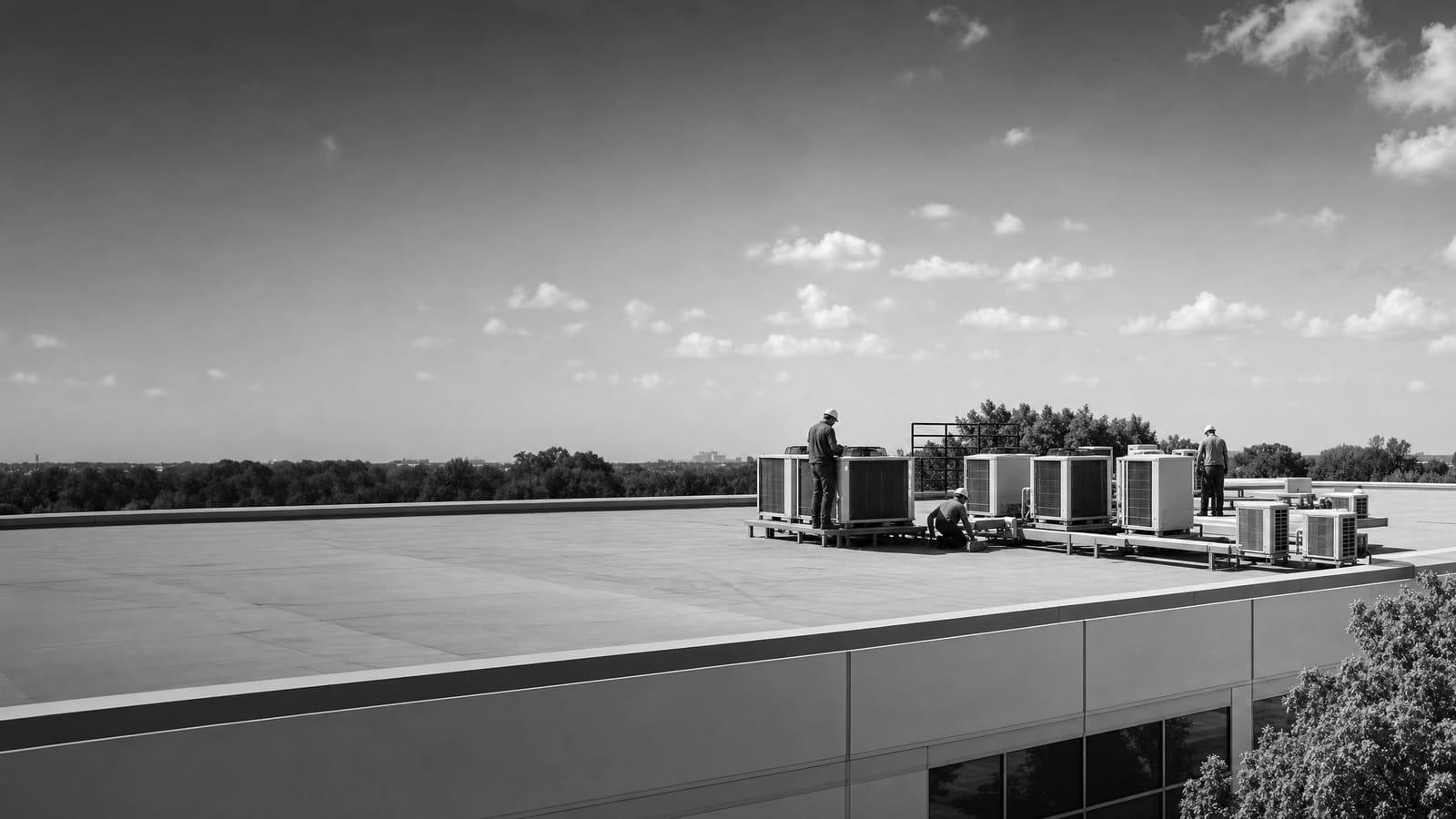
A commercial replacement covers load verification, equipment selection, refrigerant recovery from the old unit, rigging and set, gas and electrical connections, curb or duct adaptation, permits, and commissioning. Replacement beats another repair once a rooftop unit is past about fifteen years. Units that old waste an estimated $900 to $3,700 per unit each year against an efficient replacement, so repair spend at that point is buying time rather than performance.
A site review still sets the number. It has to confirm tonnage against current occupancy, the roof structure and curb, available electrical capacity and gas service, and how a crane reaches the unit.
THE THREE PATHS
Gas heat, dual fuel, or all-electric
Most replacements here come down to three paths, and the right one depends on winter more than summer. Heat pump heating efficiency falls as outdoor temperature drops, moving toward parity with electric resistance heat, so Colorado's coldest weeks govern the operating-cost math. Local electricity and gas prices matter as much as the equipment rating. Before selection, ask for a side-by-side estimate of annual operating cost under each option, and ask what each one needs from the building's electrical service. Capacity limits and physical constraints on the roof eliminate options faster than price does, and finding that out after equipment is ordered is the expensive version. Availability belongs in the decision too, since the option you can get on your timeline is sometimes not the option that models best.
WHAT MOVES THE NUMBER
The lines that separate two identical-looking buildings
No honest installed price exists before someone sees the roof. These are the lines that move the number most, ordered by how much they vary between two buildings that look the same from the parking lot.
IN PRACTICE
Buy the replacement, not just the box
The most expensive version of this project is the one that starts when the unit dies in August. Facility teams often wait until a rooftop unit fails, needs constant service, or stops holding the space, and by then the decision is whatever equipment is on a truck this week. Replacing an aging unit on purpose, ahead of failure, usually beats both replacement-on-failure and a like-for-like swap at the end of service life.
Planning ahead buys three things. You get to compare equipment types instead of accepting availability. You get to confirm the load against how the space is used now, since twenty years of tenants, plug load, and lighting changes rarely leave the original sizing correct. And you get a set day scheduled around your operating hours rather than around an emergency.
The equipment market also changed underneath this decision. Manufacturers built to a performance target meant to cut energy use by up to half against the older standard, and that gap runs every cooling hour of the year. So when two quotes land, compare the efficiency tier and the annual operating estimate alongside the installed price, not the installed price by itself.
COMPLEXITY
What makes this a simple job or a hard one
Two replacements of the same tonnage can differ by weeks of schedule and a wide spread in cost. The split is almost always infrastructure and access, not the equipment itself.
LOWER COMPLEXITY
Same fuel, same footprint, open roof
The new unit matches the existing curb and connections, the fuel source does not change, electrical capacity is already sufficient, and a crane can set up without closing a drive aisle. The scope stays mechanical and electrical, and the schedule is driven by equipment availability rather than by the building.
HIGHER COMPLEXITY
Fuel change, larger unit, tight access
Switching to all-electric heat, growing tonnage, or changing footprint pulls in electrical capacity work, structural review, curb adaptation, and sometimes gas line abandonment. Add a tight lot or occupied tenant space directly below and the rigging plan, not the equipment, becomes the schedule driver.
SCOPING
What the site review has to settle before pricing
A useful site review answers the questions that price cannot be guessed around. Start with the load. Sizing should come from how the space is used today, not from the nameplate on a unit installed when the tenant, the lighting, and the plug load all looked different. Then the roof itself: curb dimensions, structural capacity, and whether the new footprint lands on the existing opening or needs an adapter.
Infrastructure is where projects change shape. Electrical capacity decides whether a heat pump option is even on the table. Physical constraints decide the rigging plan. Existing gas lines decide whether a fuel change means abandonment work or nothing at all. Each of those is a yes-or-no that belongs at the walk, not on install day.
The last item is the crew. Ask how often the contractor installs the specific equipment type you are considering. Familiarity with a platform shows up in startup, in controls setup, and in how fast a warranty issue gets resolved. It is a fair question and a revealing one, especially on newer heat pump equipment.
Bring these to the walk
A nameplate photo of every unit, the electrical panel schedule, roof access and lot layout, your operating hours, and any comfort complaints listed by zone. Those five turn a rough number into a scope you can hold a contractor to.
IN LAKEWOOD
Permit valuation and how the permit gets pulled
Lakewood is specific about one thing that trips up rooftop replacements. The valuation amount on the permit application must include labor and materials for all construction, including the mechanical, electrical, and plumbing systems. That is not equipment cost. A quote that breaks out equipment, rigging, electrical, and controls still has to roll up into one honest valuation on the application.
The second point is the filing path. The city allows permits for system-only work, such as a furnace replacement or an electrical upgrade with no associated building permit, to be obtained separately through its eTRAKiT portal. Ask which lane your replacement falls into rather than assuming, because structural or footprint changes are the ones that pull a building permit in with them. The city's building line for questions is 303.987.7500.
Settle this before the crane is booked
Which permits this scope needs, who files them, whether it goes in as system-only work through eTRAKiT or under a building permit, and what valuation figure goes on the application. All four belong in the quote, not in a phone call later.
OWNERSHIP
Two things that outlive the install
The decision does not end when the crane leaves. Two items belong in the same conversation as equipment selection: what outside money is genuinely available right now, and how one new unit fits a roof full of older ones. Both change the ranking of your options, and both are far easier to settle before selection than after. Contractor familiarity sits in the same category. A crew that installs your chosen equipment type routinely is a real variable in how startup goes and how fast problems get closed out.
INCENTIVES
Confirm the program before you count on it
Incentives are a standard input to the rooftop replacement decision and can flip the ranking of two equipment options. They also expire and get rewritten. Ask for the specific program name, its status as of today, and who files the paperwork, before any of it lands in the budget.
SERVICE PLANNING
The rest of the fleet still has to be serviced
Refrigerant handling and recycling in stationary cooling and heat pump equipment is federally regulated, and a new unit will not match the older ones beside it. If you replace one unit a year, decide now how the mixed fleet gets serviced, stocked, and documented.
PHASING
Replacing a fleet one unit at a time
Most buildings do not replace a roof full of units at once. They replace one or two a year, which makes the order matter more than any individual quote. Rank by age and service history first, then by the space each unit serves. A twenty-year-old unit over a tenant who complains every July is worth more than a slightly older unit over a warehouse aisle.
Build the case on operating cost, not on failure risk alone. An old, inefficient rooftop unit can waste $900 to $3,700 a year against an efficient replacement, and that is a number you can multiply across a fleet and hand to whoever approves capital. More than 200 organizations have upgraded over 43,000 rooftop units through a national efficiency campaign and cut a combined $37 million a year from their energy bills. The math is not exotic.
Two procurement habits pay off across a multi-year plan. Standardize on an equipment line and a controls platform so your technicians learn one system and your spare parts overlap. And schedule the work in shoulder seasons, when the roof is not carrying peak load and a short outage is a scheduling note instead of an incident.
THE QUOTE
Five things a comparable quote has to show
Two quotes are only comparable when they show the same things. Ask for these five in writing, in this form, so the lower number is actually the cheaper project.
01
Equipment, spelled out
Make, model, tonnage, efficiency tier, heating type, and refrigerant. Not "new rooftop unit."
02
Load basis
Whether the tonnage came from a current load calculation or from the old nameplate, and which spaces the unit serves.
03
Infrastructure scope
Curb adapter, structural work, electrical capacity changes, gas line work, and recovery of the old unit's refrigerant.
04
Rigging and access plan
Crane placement, lot closure hours, the target day, and who coordinates with tenants.
05
Permits and commissioning
Which permits, who files them, the valuation figure, and the documented startup readings handed over at close.
Get a defensible number
Price the equipment and the building together.
Send the address, operating target, and target opening date. Flux will identify what must be verified before the project can be priced.
Get a free estimateQuestions
Straight answers.
When is replacement better than one more repair?
Once a rooftop unit is past roughly fifteen years, it can waste an estimated $900 to $3,700 a year against an efficient replacement, on top of rising service calls. If the unit also struggles to hold the space, another repair buys operating time without fixing the cost or the comfort problem.
Should a Lakewood building go all-electric?
It depends on the winter heating load and on local electricity and gas prices. Heat pump heating efficiency drops as outdoor temperature falls, trending toward parity with electric resistance heat, so cold weeks drive the math. Dual-fuel and cold-climate models exist for exactly that reason.
What does Lakewood require on the permit application?
The valuation amount must include labor and materials for all construction, including the mechanical, electrical, and plumbing systems, not just the equipment. System-only work with no associated building permit can be permitted separately through the city's eTRAKiT portal. Confirm the path with your contractor before the set date.
What usually delays a rooftop replacement?
Equipment availability is the common one, followed by electrical capacity discovered late, structural review triggered by a bigger unit, and an unsettled permit path. All four are findable at the site walk, which is why the walk should happen before the quote is priced.
What happens to the refrigerant in the old unit?
Refrigerant in stationary cooling and heat pump equipment is federally regulated for handling and recycling, so recovery from the old unit is a required line in the scope. Ask to see it named. It also matters for a mixed fleet, where new and older units carry different refrigerants.
Sources used for this guide
- [1]betterbuildingssolutioncenter.energy.gov — DOE Advanced Rooftop Unit Replacement Guidance
- [2]betterbuildingssolutioncenter.energy.gov — DOE Commercial Heat Pump Rooftop Unit Replacement Guidance
- [3]betterbuildingssolutioncenter.energy.gov — DOE High-Efficiency Commercial Rooftop Unit Toolkit
- [4]energy.gov — DOE Efficient Commercial Rooftop Air Conditioner Program
- [5]epa.gov — EPA Stationary HVAC Refrigerant Management
- [6]lakewoodco.gov — Permits for Contractors