THE DIRECT ANSWER
What commercial HVAC replacement includes
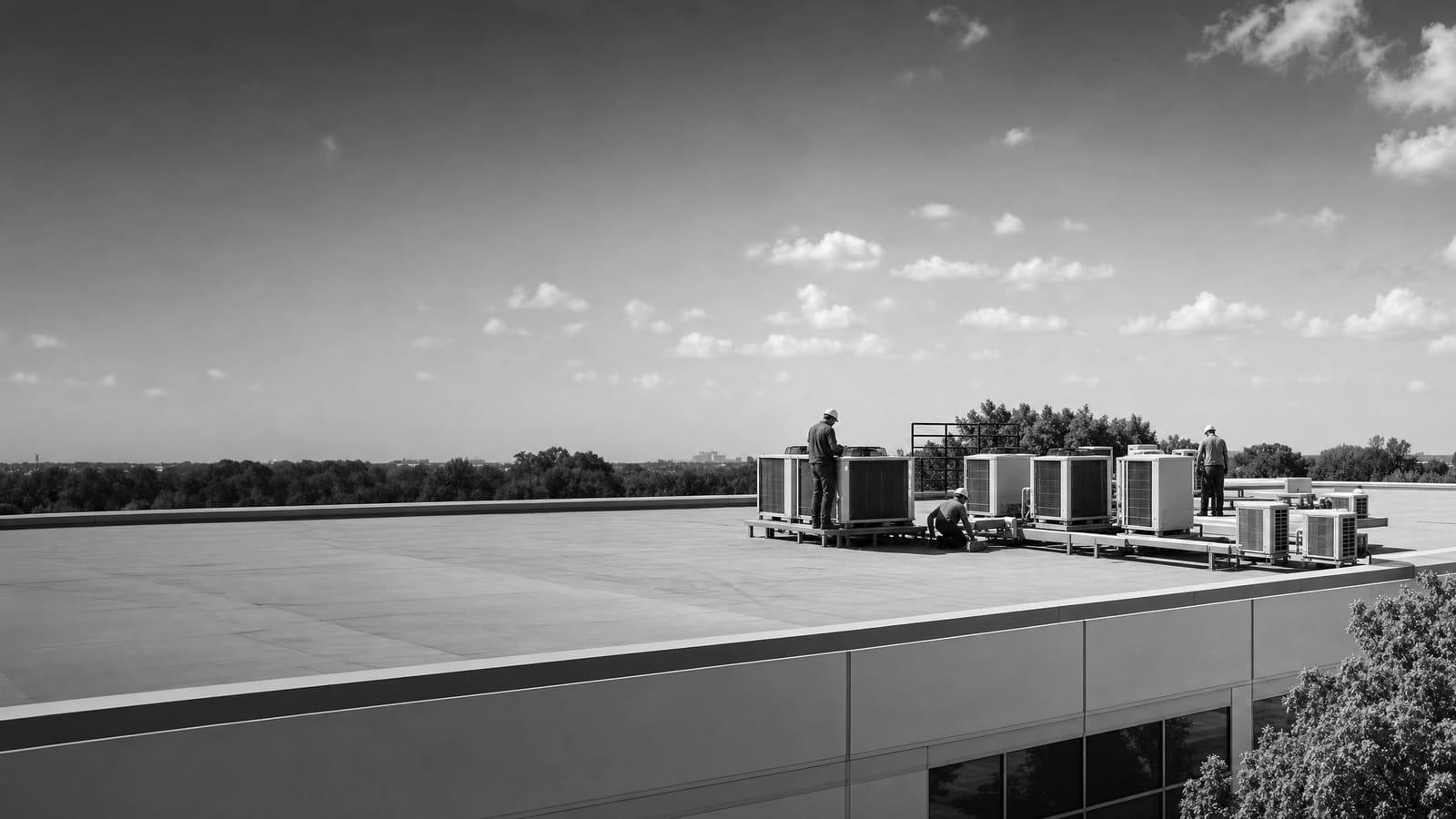
A complete commercial HVAC replacement covers sizing, equipment selection, permits, removal, rigging, connections, controls, startup, testing, and owner handoff. Replacement becomes more useful than another repair when an older unit cannot hold comfort, fails often, or puts daily operations at risk. DOE guidance says rooftop units over 15 years old can waste substantial energy compared with newer models.
A site review must verify the load, roof curb, structure, electrical service, gas connection, drainage, controls, ventilation, and crane access before the scope is firm.
FIRST DECISION
Repair, replace in kind, or improve the system?
Start with the business problem, not the equipment catalog. A repair can make sense when the unit is otherwise dependable, parts are available, and the work does not leave a weak system supporting a critical space. A like-for-like replacement can shorten design work when the old capacity, fuel, curb, ventilation, and controls still fit the building. It should not be automatic. The old nameplate may reflect a past layout or an earlier operating schedule.
A right-sized replacement deserves a closer look when occupancy, lighting, process equipment, walls, windows, or business hours have changed. It can also address rooms that have never cooled evenly. If the owner wants to reduce onsite fuel use, a commercial heat pump conversion can be studied beside a conventional rooftop unit. DOE identifies climate, utility rates, electrical capacity, physical limits, gas lines, equipment availability, and contractor knowledge as key parts of that choice.
BUDGET CONTROL
What moves the installed price
The supplied research does not support one universal installed price. Ask for the following items as separate lines so changes can be priced and approved without hiding them inside one allowance.
EQUIPMENT CHOICES
Choose the unit around the building
Packaged rooftop units place cooling, ventilation, and often heating in one roof-mounted cabinet. They are common across commercial buildings and can be practical when the building already has rooftop ductwork and usable curbs. A standard replacement may use gas heat with mechanical cooling. A heat-pump rooftop unit uses reverse-cycle heating and may be all-electric or paired with another heat source.
DOE says heat-pump rooftop units are well suited to mild-to-moderate winter heating. That makes them worth evaluating in Southern California, but geography alone does not settle the choice. Compare expected heating and cooling loads, electric and gas costs, emissions goals, electrical capacity, backup heat, physical space, and available equipment. An electric conversion may require more electrical work than a same-fuel replacement.
Efficiency also needs context. Higher-efficiency equipment can reduce energy use, but actual results depend on sizing, controls, ventilation, installation quality, and operating hours. Historic DOE demonstrations found major savings from efficient rooftop technology, yet those program results are not a promise for one Lakewood building. Request a project-specific operating estimate and list every assumption behind it.
PROJECT COMPLEXITY
What makes a replacement simple or involved
Two units with the same nominal capacity can produce very different projects. Existing conditions determine whether the work is mainly a planned swap or a coordinated building upgrade.
LOWER COMPLEXITY
Compatible replacement
The current load remains valid, roof structure is suitable, curb dimensions work, utilities are adequate, controls are simple, and crane setup can occur without major operating disruption.
HIGHER COMPLEXITY
Changed building or system
Capacity, weight, fuel, refrigerant, ventilation, electrical demand, duct layout, controls, or roof conditions change. The project may need added design, trades, shutdown planning, and verification.
SITE REVIEW
Measure first, then price the work
A useful survey starts with the equipment nameplate, model, serial number, age, service history, and reported failures. The reviewer should then look beyond the cabinet. Confirm which rooms the unit serves, the business schedule, occupancy, heat-producing equipment, outdoor-air needs, thermostat locations, and recurring comfort complaints. These details help show whether the old capacity should be carried forward.
On the roof, document the curb, duct openings, drain path, service clearances, disconnect, gas connection, roof condition, nearby obstructions, and safe access. Compare replacement dimensions and weight with the existing installation. At grade, identify crane setup space and anything that could affect people, vehicles, deliveries, or neighboring property during the lift.
Controls need their own review. State whether the new unit will use a local thermostat, stand-alone scheduling, or a building automation system. Define required alarms, occupied schedules, ventilation sequences, and sensor work. This keeps a basic startup from being mistaken for full system commissioning. The final survey record should include photos, measurements, assumptions, exclusions, and unresolved conditions.
Give bidders the same facts
Issue one site record and one operating brief to every bidder. Comparable information reduces guesswork and makes scope differences easier to find before a contract is signed.
OWNER PRIORITIES
Protect operations now and serviceability later
A replacement affects more than comfort. It can interrupt customers, staff, tenants, deliveries, parking, roof work, and sensitive indoor uses. Ask each bidder to explain shutdown length, temporary conditioning needs, lift controls, weather limits, noise, dust, and the steps for restoring service. If several units serve the property, decide whether to replace them together or phase them by condition and business risk.
The handoff should make the new asset easier to own. Record the selected refrigerant, filters, belts, sensors, controls, warranty terms, and required maintenance. EPA rules govern refrigerant handling and recycling in stationary air-conditioning and heat-pump equipment, so the scope should assign recovery and disposal to qualified personnel.
DAY OF WORK
Operating continuity
Set shutdown windows, tenant notices, lift boundaries, delivery access, weather decisions, and temporary comfort needs before equipment arrives.
YEARS OF SERVICE
Maintainable ownership
Favor safe access, available filters and parts, clear controls, usable documentation, and a maintenance plan that protects the warranty.
PROCUREMENT
Compare lifetime value, not one bid total
Begin procurement early enough to compare real equipment choices. A quote should identify the manufacturer and model, scheduled availability, substitution rules, deposit terms, and how long pricing remains valid. Special controls, uncommon voltage, added heat, or changed capacity may affect availability. Do not approve an unnamed “equivalent” without checking dimensions, weight, electrical needs, efficiency, controls, and warranty.
For several aging units, create an asset list and rank each unit by condition, repair history, space importance, comfort performance, and replacement difficulty. Planned phasing can reduce emergency purchases and combine design or mobilization work. It also lets the owner test a new equipment or controls approach before applying it across the property.
Compare bids over the expected ownership period. Include installation scope, projected energy use, maintenance needs, parts access, warranty coverage, controls support, and disruption risk. Treat any savings forecast as an estimate tied to stated weather, rates, schedules, loads, and control sequences. Incentives should be verified at the time of purchase; none of the supplied research establishes a current Lakewood program for August 2026.
QUOTE CHECKLIST
Five things every comparable quote should show
A low total is not useful when major work sits in exclusions. Require the same five categories from each bidder and resolve allowances before selection.
01
Exact equipment
List model, capacity, efficiency, heat type, refrigerant, voltage, ventilation options, controls, warranty, and expected availability.
02
Complete installation scope
Define removal, recovery, disposal, crane, curb, duct, drain, gas, electrical, roofing, controls, startup, and cleanup.
03
Assumptions and exclusions
State load assumptions, roof or structural limits, hazardous materials, hidden conditions, access limits, overtime, and owner-provided work.
04
Schedule and operating plan
Show procurement, permits, shutdowns, notices, lift timing, weather decisions, temporary service, inspection, and final completion.
05
Testing and closeout
Require airflow and control checks, startup reports, warranty registration, manuals, training, permit closeout, and an agreed deficiency process.
Get a defensible number
Price the equipment and the building together.
Send the address, operating target, and target opening date. Flux will identify what must be verified before the project can be priced.
Get a free estimateQuestions
Straight answers.
When should a commercial rooftop unit be replaced instead of repaired?
Consider replacement when an older unit has frequent failures, cannot maintain the space, uses too much energy, or creates unacceptable operating risk. DOE notes that rooftop units over 15 years old may waste substantial energy compared with newer equipment. Age alone is not the decision; review condition, repair history, parts, load, and business impact.
Should the new commercial HVAC unit match the old capacity?
Not without checking the current load. A matching capacity may be reasonable when the building use, occupancy, envelope, ventilation, and internal equipment have not changed. If they have changed, right-sizing can prevent another cycle of poor comfort, short cycling, or unnecessary capacity.
Is a heat-pump rooftop unit a good option in Lakewood?
It can be. DOE says heat-pump rooftop units are a good fit for mild-to-moderate winter heating, but the final choice should also account for electrical capacity, utility costs, backup heat, emissions goals, physical limits, equipment availability, and the building load.
What should happen during commissioning?
The team should verify startup settings, airflow, thermostat and sensor operation, schedules, ventilation, heating and cooling response, alarms, and any building automation connection. The owner should receive results, manuals, warranty records, and clear instructions for unresolved items.
Who should handle refrigerant from the old equipment?
The installation scope should assign recovery, handling, recycling, or disposal to properly qualified personnel. EPA Section 608 rules apply to refrigerants used in stationary air-conditioning and heat-pump equipment. Ask for this responsibility in writing instead of assuming it is included.
How much does commercial HVAC replacement cost in Lakewood?
The supplied research does not establish a reliable local installed range. The price depends on the selected unit, capacity, efficiency, curb and structure, crane access, utility changes, controls, permits, commissioning, and schedule. A site-based quote is more useful than an unsupported price per unit.
Sources used for this guide
- [1]betterbuildingssolutioncenter.energy.gov — DOE Advanced Rooftop Unit Replacement Guidance
- [2]betterbuildingssolutioncenter.energy.gov — DOE Commercial Heat Pump Rooftop Unit Replacement Guidance
- [3]betterbuildingssolutioncenter.energy.gov — DOE High-Efficiency Commercial Rooftop Unit Toolkit
- [4]energy.gov — DOE Efficient Commercial Rooftop Air Conditioner Program
- [5]epa.gov — EPA Stationary HVAC Refrigerant Management
- [6]californiacity-ca.gov — HVAC Permits