THE SHORT ANSWER
What a commercial HVAC replacement actually includes
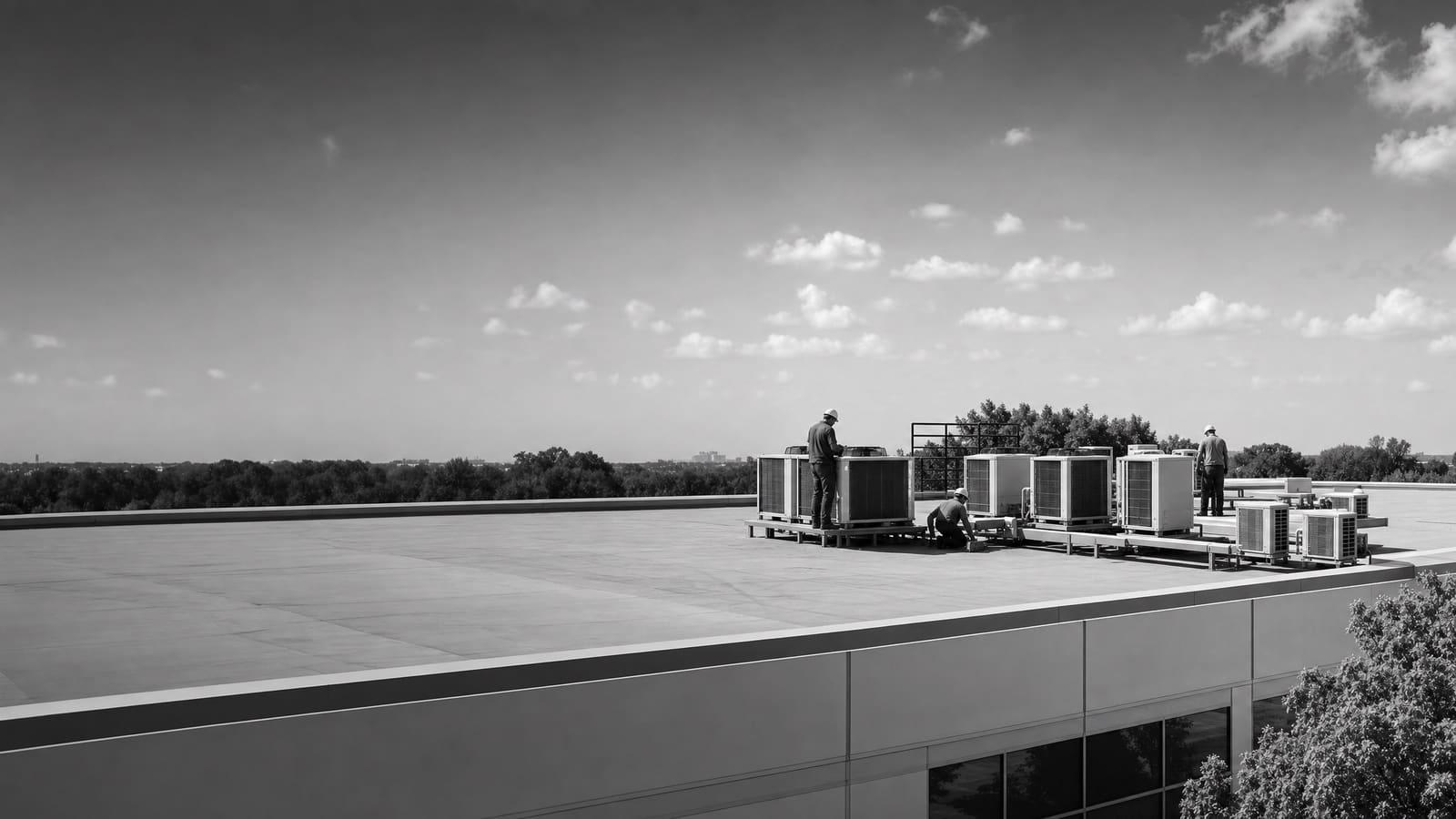
A commercial HVAC replacement covers the load check, equipment selection, rigging and set, connections, controls, and commissioning — not just the unit itself. Replacement beats another repair once equipment is past roughly 15 years, because units that old waste substantial energy against newer models. Federal work on commercial rooftop units puts that waste between $900 and $3,700 per unit each year, which is the number a repair invoice never shows you.
A site review still has to confirm the real load, the curb and roof structure, available electrical capacity, and crane access before any of that becomes a price.
THREE WAYS TO GO
Three operating choices on the table
Most buildings pick one of three paths, and the choice usually gets made for them by a compressor. Federal guidance on rooftop units describes the pattern plainly: managers delay a new unit until the old one stops holding the space, needs constant service, or fails completely. Replacing proactively with a more efficient unit can be the better business move than either replacement-on-failure or a like-for-like swap at the end of service life.
That does not make like-for-like wrong. It makes it a decision instead of a default. If the space is used the same way it was when the old unit was set, a matching replacement is fast, simple, and cheap to engineer. If the use changed, or the bills crept up, or the space never quite held temperature, the swap is your one chance in fifteen years to fix it.
WHAT MOVES THE NUMBER
The lines that decide your price
Nobody can price a roof from a nameplate photo alone. These are the lines that separate a clean swap from a project, and the ones a quote should break out rather than bury inside a single installed number.
CHOOSING EQUIPMENT
Gas heat, heat pump, or dual fuel
The biggest equipment question on a replacement today is no longer tonnage. It is what makes the heat. Heat pump rooftop units are built much like the air-conditioning units they replace, with one addition: they run the cycle in reverse and heat with it.
Federal guidance is direct about where that works. Heat pumps are most efficient in mild to moderate winter heating, and across most of the U.S. South and West, today's heat pump rooftop units are considered capable of covering most or all of the winter heating demand. As outdoor temperatures drop, heat pump efficiency trends toward electric resistance, and the same guidance notes that southern buildings still see occasional sharp cold — the February 2021 Texas freeze is the standing example. That is the case for dual-fuel units, which keep a gas burner for the coldest hours, over a fully all-electric set.
The rest of the decision is infrastructure and arithmetic. Electrical capacity, physical space on the roof, and existing gas lines decide what can be set at all. Electricity and gas prices decide whether the monthly bill improves. Neither answer is universal, and both should be checked against your building before anyone orders equipment.
SIMPLE OR NOT
What makes a swap simple, and what makes it a project
Two replacements with the same tonnage can be a one-morning job or a six-week coordination effort. The difference rarely shows up on the spec sheet. It shows up on the walkthrough, in the curb dimensions, the panel schedule, and the parking lot.
LOWER COMPLEXITY
Straight swap conditions
Same tonnage, same footprint on the existing curb, same heat source, and open lot access for a crane. Electrical and gas stay where they are, the scope stays mechanical and electrical, and the building loses conditioning for part of one day.
HIGHER COMPLEXITY
What turns it into a project
Larger tonnage or a new footprint, which pulls in structural review. A switch to all-electric heat, which depends on panel capacity. Tight access with nowhere to set a crane. Or occupied space that cannot lose conditioning, meaning temporary cooling and night work.
BEFORE THE QUOTE
What a real site review has to confirm
A price that arrives without anyone on the roof is a guess wearing a number. The review is short, but it has to hit specific things.
Start with the load. Sizing should come from how the space is used today, not from the old nameplate. Fifteen or twenty years changes occupancy, plug load, lighting, and sometimes the envelope, and an oversized unit short-cycles its way to poor humidity control and early failure.
Then the physical side: curb dimensions and roof structure, clearances, and how a crane actually reaches the set point. Then the services: available panel capacity and breaker space, gas line size and routing if gas stays, and where condensate goes. Federal heat pump guidance treats electrical capacity, physical constraints, and gas lines as gating items rather than details — they decide which equipment is possible before efficiency or price enters the conversation.
The last item is refrigerant. EPA regulations under the Clean Air Act govern how refrigerant is handled and recovered in stationary air-conditioning and heat pump equipment, so pulling the old unit is regulated work with documentation attached.
Ask for this before you compare prices
Two quotes are only comparable when both list the same tonnage and efficiency tier, the same curb and structural scope, the same electrical work, and the same commissioning. Missing scope is the most common reason a cheap bid stops being cheap.
OWNING THE DECISION
Two things owners weigh past day one
The install takes a week of your attention. The unit sits on the roof for the next fifteen or twenty years, and that is where the money actually gets spent or saved.
Two considerations carry most of that weight. The first is energy: old rooftop units are documented wasting between $900 and $3,700 each per year against newer models, and the high-efficiency specification behind today's better units was written to cut rooftop energy use by up to half compared with the older standard. The second is fleet consistency — what happens to service, parts, and technician coverage when one roof carries three generations of equipment.
ENERGY AND UTILITY BILLS
The bill is part of the price
Efficiency choices show up every month, and the gap is not small. Federal upgrade programs have tracked more than 43,000 rooftop units replaced or retrofitted across 200-plus organizations, saving a combined $37 million a year in energy costs.
FLEET AND SERVICE PLANNING
Mixed fleets cost more to keep
Every new unit joins a roof that still carries older ones. Refrigerant handling and recovery on existing equipment is regulated under EPA rules, so service contracts, spare parts, and technician certification need to cover the whole mix, not just the newest unit.
PHASING AND PROCUREMENT
When the roof has more than one aging unit
If a roof carries several aging units, the worst plan is the one that makes itself: replace each one the week it dies, in whatever season it picks, at whatever price is available that week. Emergency replacement removes every lever that saves money — equipment choice, competitive pricing, and a crane day scheduled around your tenants instead of against them.
Phasing fixes that. Rank the units by age, service history, and the load each one carries. Replace the worst offenders first, then hold a pace the budget can absorb — one or two a year, written to the same specification, so the roof converges on a single platform instead of five. Federal rooftop upgrade programs are built around exactly this pattern, and hundreds of organizations have moved their portfolios that way.
Procurement rewards the same discipline. A specification written once and reused gives every bidder identical scope, makes quotes genuinely comparable, and shortens the conversation each round. It also leaves room to check incentive programs before ordering, since incentives are a standard consideration in rooftop replacement planning and are usually claimed ahead of purchase rather than after installation.
THE QUOTE
Five things a comparable quote shows
When two bids differ by a wide margin, one of them is usually missing a line rather than winning on price. These five items make bids comparable and make the winning one hold at invoice.
01
Equipment, spelled out
Make, model, tonnage, efficiency rating, heat source, and confirmed availability — not just "new rooftop unit."
02
Curb, roof, and structural scope
Adapter or new curb, any framing, and who owns the roof penetration and its warranty.
03
Rigging and site plan
Crane size, staging area, stalls closed, and the hours the lift actually happens.
04
Electrical, gas, and controls
Disconnects, breaker or panel work, gas connection changes, and integration with the existing controls.
05
Commissioning and closeout
Startup readings, charge and airflow verified, permits and inspections, warranty registration, and documents handed over.
Get a defensible number
Price the equipment and the building together.
Send the address, operating target, and target opening date. Flux will identify what must be verified before the project can be priced.
Get a free estimateQuestions
Straight answers.
When does replacement beat another repair?
Once a rooftop unit is past roughly fifteen years, repairs stop being the cheap option. Federal work on commercial rooftop units found old, inefficient ones wasting between $900 and $3,700 each per year against newer models, and that cost runs whether or not the unit is currently broken.
How much does commercial HVAC installation cost in Lafayette?
There is no honest universal number, and any price given without a look at the roof is a guess. Cost is set by tonnage and efficiency tier, curb and structural work, crane access, and electrical or gas changes. Ask for those as separate lines so bids can actually be compared.
Is a heat pump rooftop unit a good fit here?
Often, yes. Heat pumps are most efficient in mild to moderate winter heating, and federal guidance considers today's heat pump rooftop units capable of covering most or all of the winter load across most of the U.S. South. Electrical capacity, roof space, and energy prices decide it for your building.
Should we replace like-for-like or resize?
Confirm the load either way. If the space is used the same way it was, like-for-like is usually right and always simpler. If occupancy, equipment, or operating hours changed, resizing is the one chance in the unit's lifetime to correct comfort and humidity problems the old unit could never fix.
What happens to the old unit's refrigerant?
It gets recovered, not vented. EPA regulations under the Clean Air Act govern refrigerant handling and recovery in stationary refrigeration, air-conditioning, and heat pump equipment, so removing the old unit is certified, documented work that belongs in the installer's scope and on the quote.
Sources used for this guide
- [1]betterbuildingssolutioncenter.energy.gov — DOE Advanced Rooftop Unit Replacement Guidance
- [2]betterbuildingssolutioncenter.energy.gov — DOE Commercial Heat Pump Rooftop Unit Replacement Guidance
- [3]betterbuildingssolutioncenter.energy.gov — DOE High-Efficiency Commercial Rooftop Unit Toolkit
- [4]energy.gov — DOE Efficient Commercial Rooftop Air Conditioner Program
- [5]epa.gov — EPA Stationary HVAC Refrigerant Management