THE DIRECT ANSWER
What a commercial HVAC replacement actually includes
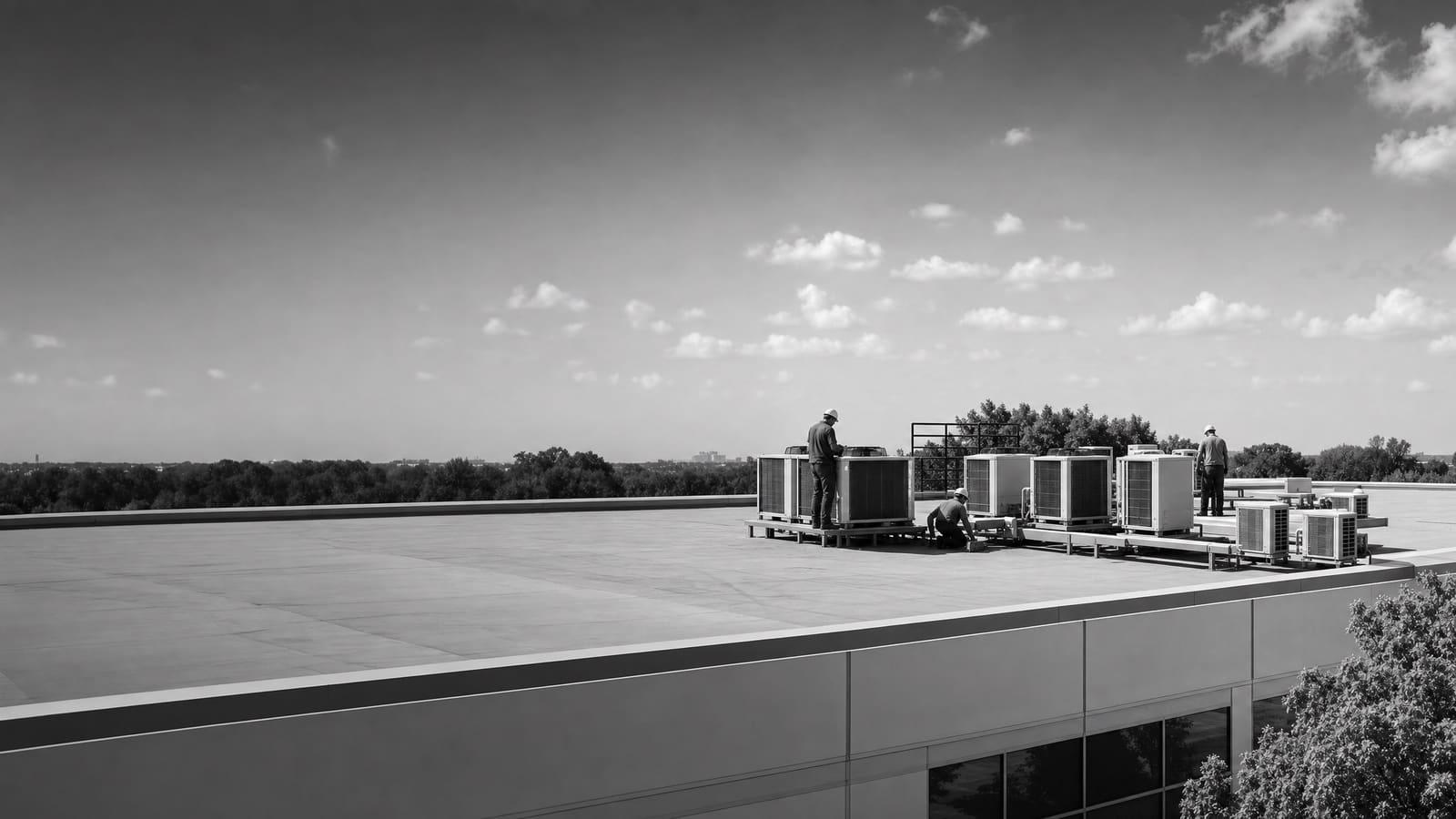
A commercial HVAC installation replaces the whole system serving a zone: the unit, its curb and connections, the controls, and the ductwork or refrigerant piping that ties it in. Replacement beats another repair when the equipment is past roughly fifteen years, when it can no longer hold the space, or when repairs have quietly become the maintenance schedule. Waiting for total failure usually costs more than replacing on a plan, because a failure picks the date, the equipment, and the price for you.
A site review has to confirm the actual load, the roof and curb condition, and whether the electrical service and gas line can carry what you are buying. Those three answers move the price more than the unit does.
THREE WAYS TO GO
The operating choice behind the purchase
Three paths cover almost every commercial replacement, and the unit you have now sets the floor, not the ceiling. A like-for-like swap is the fastest way back to service. A higher-efficiency unit changes what the building spends every month for the rest of the equipment's life. A heat pump unit changes the fuel the building runs on, which pulls electrical capacity and gas service into the decision. There is a fourth option worth naming before you commit: when the cabinet and coil still have life in them, retrofitting the existing unit with advanced controls can be the better financial move. Replace or retrofit is a real comparison, not a formality, so ask for both numbers.
WHAT MOVES THE NUMBER
The lines that decide the total
Nobody can quote a commercial installation from a tonnage number alone. These are the lines that move the total, roughly in the order they surprise people.
BUYING IT WELL
Plan the replacement before the equipment plans it for you
The most expensive version of this project is the one nobody planned. When a unit fails in the middle of a heat wave, the decision collapses to whatever is on a truck this week. That usually means a base-tier unit, at whatever price the market will bear, installed on the first day a crane is free. Planning the same replacement six months earlier gets you the tier you want, a lead time you can live with, and a lift scheduled around your tenants.
Start with the load, not the nameplate. A unit installed twenty years ago was sized for a building that no longer exists. Occupancy changed, plug loads changed, lighting changed, and sometimes the envelope did too. Carrying the old tonnage forward carries the old sizing mistake forward with it. Oversized equipment short-cycles, handles humidity poorly, and produces exactly the comfort complaints the replacement was supposed to end.
Then check availability against the calendar. What is actually in production shapes what you can specify, and so does finding installers who have done the type of unit you are choosing. That matters most on heat pump equipment, where the installation and the startup differ from a standard swap. Ask any bidder what they have installed recently and how the startup gets verified. The answer tells you more than the price line does.
SIDE BY SIDE
Simple swap or a real project
Two replacements with the same tonnage can be completely different projects. What separates them is rarely the unit itself.
LOWER COMPLEXITY
Same footprint, same fuel
The new unit matches the existing curb and connections, the space is still used the way it was designed, and the roof has clear crane access. Scope is predictable and the outage is measured in hours.
HIGHER COMPLEXITY
New fuel, bigger unit, tight site
Switching to electric heat, adding capacity, or landing a larger cabinet on an older deck. Now you are pricing electrical service work, structural review, curb adapters, and a lift staged around an occupied building.
SCOPING IT
What a real site review has to answer
A useful site review answers the questions a nameplate cannot. It starts on the roof: the condition of the deck and the curb, whether that curb will accept an adapter, how the unit is secured, and what shape the ductwork below it is in. Then it moves to capacity. What does the electrical service have left, where is the panel, and how far would a new feeder have to run? Where does the gas line come in, and what happens to it if the new unit does not need it?
The third part is access, and it is the part most quotes gloss over. Where does a crane set up, what does it have to reach over, which parking gets closed, and for how long? On a tight site, the rigging plan can cost more than the difference between two equipment tiers.
Finally, the review should look past the one unit. If the roof carries six units and three are the same age, the answer is rarely to replace one. Sequencing them across two or three budget years usually beats replacing them one emergency at a time, and it leaves you with standard equipment, standard parts, and one controls scheme instead of six.
Put these four in the scope before you compare prices
Measured load rather than nameplate tonnage. Curb and structural condition. Available electrical capacity with the panel location. Crane setup and closure hours. A bid missing any of the four is not a price. It is a starting point that will move once work begins.
AFTER THE INSTALL
Two things that outlive the crane day
Two questions follow this equipment for its whole life: who pays for the energy it uses, and who is responsible when its refrigerant circuit gets opened. Both should shape what you buy, not just how you operate it later.
If tenants pay their own utilities, a higher efficiency tier saves them money while you supply the capital. That split is worth checking against your lease, and worth pricing anyway if you plan to hold the building for a while. The second question is regulatory, and it does not go away after startup.
OWNERSHIP
Hold period versus payback
A higher-efficiency unit pays you back monthly, so the honest question is how long you intend to own the building. Short holds favor the lower capital cost. Long holds almost never do.
COMPLIANCE
Refrigerant handling and records
Refrigerant has to be recovered by certified technicians when the old unit comes down, not vented. Federal rules govern handling and recycling, so keep the recovery and service documentation in the equipment file.
THE LONGER VIEW
Phase the fleet, buy against lead time, judge the total
Think in fleets and in years rather than in units and weeks. Most commercial buildings do not have one aging rooftop unit. They have a group installed at the same time by the same contractor, which means the group will reach the end of its life in roughly the same window. Replacing them reactively buys you five separate emergency prices, five different models, and five sets of spare parts. Sequencing them across budget years buys one specification, one negotiated equipment package, and the same controls on every roof.
Procurement follows from that. Once the tier is settled, order against lead time instead of against a failure. What manufacturers are actually shipping shapes what you can specify, and that is one of the first things to confirm when a heat pump unit is under consideration. If a program incentive is part of your math, confirm eligibility before the order, because the efficiency tier you select is usually what determines whether the unit qualifies.
Then judge the total instead of the invoice. An old, inefficient rooftop unit can waste roughly $900 to $3,700 a year all by itself. Across the years you will own the replacement, the gap between a base unit and a better one is often smaller than the energy the base unit will burn through. That does not make the expensive unit automatically right. It makes the comparison worth doing with real numbers.
COMPARING BIDS
Five lines every quote should show separately
Bids only compare when they cover the same scope. Ask every bidder to break out these five items, and the cheap quote usually explains itself.
01
The equipment, spelled out
Make, model, capacity, efficiency tier, and heating type. Not a line that says new rooftop unit.
02
The basis for the size
Whether the capacity came from a load calculation or from the old nameplate, and which one they used.
03
Roof, rigging, and removal
Curb or adapter, structural work, crane plan, lot closure hours, permits and inspections, and disposal of the old unit.
04
Utilities and controls
Electrical, gas, and refrigerant work included, plus integration with the building controls you already run.
05
Lead time and commissioning
A real delivery window, and who verifies charge, airflow, and control settings before the job is handed over.
Get a defensible number
Price the equipment and the building together.
Send the address, operating target, and target opening date. Flux will identify what must be verified before the project can be priced.
Get a free estimateQuestions
Straight answers.
When does replacement beat one more repair?
Once equipment is past roughly fifteen years, it can waste a meaningful amount of energy compared with current models, and repair frequency tends to climb. If the unit can no longer hold the space, or if service calls have become the maintenance plan, replacement is usually the cheaper path. Planned replacement also beats replacement on failure, because failure sets the schedule and narrows your equipment options.
Should we replace like-for-like or resize?
Confirm the load either way. If the space and its use have not changed since the original install, like-for-like is often the right answer and the fastest one. If occupancy, equipment, lighting, or the envelope changed, sizing from today's conditions fixes problems the old unit was never able to solve.
Is a heat pump rooftop unit the right choice?
It depends on the building's winter heating load, local electricity and gas prices, available electrical capacity, physical constraints on the roof, and whether qualified installers are available for that equipment. Heat pumps are most efficient in mild to moderate heating conditions, and efficiency drops as outdoor temperatures fall. Dual-fuel and cold-climate versions exist for buildings that need heating capacity in colder weather.
What does a commercial HVAC installation cost?
There is no universal installed price, and any number quoted before someone looks at the roof is a guess. Capacity and efficiency tier set the base. Curb and structural work, electrical or gas changes, crane access, and controls integration move it from there. Weigh it against operating cost too, since an old inefficient rooftop unit can waste roughly $900 to $3,700 a year on its own.
What happens to the refrigerant in the old unit?
It gets recovered by certified technicians before the unit comes off the roof. Federal rules under the Clean Air Act govern how refrigerant in stationary air conditioning and heat pump equipment is handled and recycled, so venting is not an option. Keep the recovery documentation with the building's equipment records.
Sources used for this guide
- [1]betterbuildingssolutioncenter.energy.gov — DOE Advanced Rooftop Unit Replacement Guidance
- [2]betterbuildingssolutioncenter.energy.gov — DOE Commercial Heat Pump Rooftop Unit Replacement Guidance
- [3]betterbuildingssolutioncenter.energy.gov — DOE High-Efficiency Commercial Rooftop Unit Toolkit
- [4]energy.gov — DOE Efficient Commercial Rooftop Air Conditioner Program
- [5]epa.gov — EPA Stationary HVAC Refrigerant Management