THE DIRECT ANSWER
What a commercial HVAC replacement actually includes
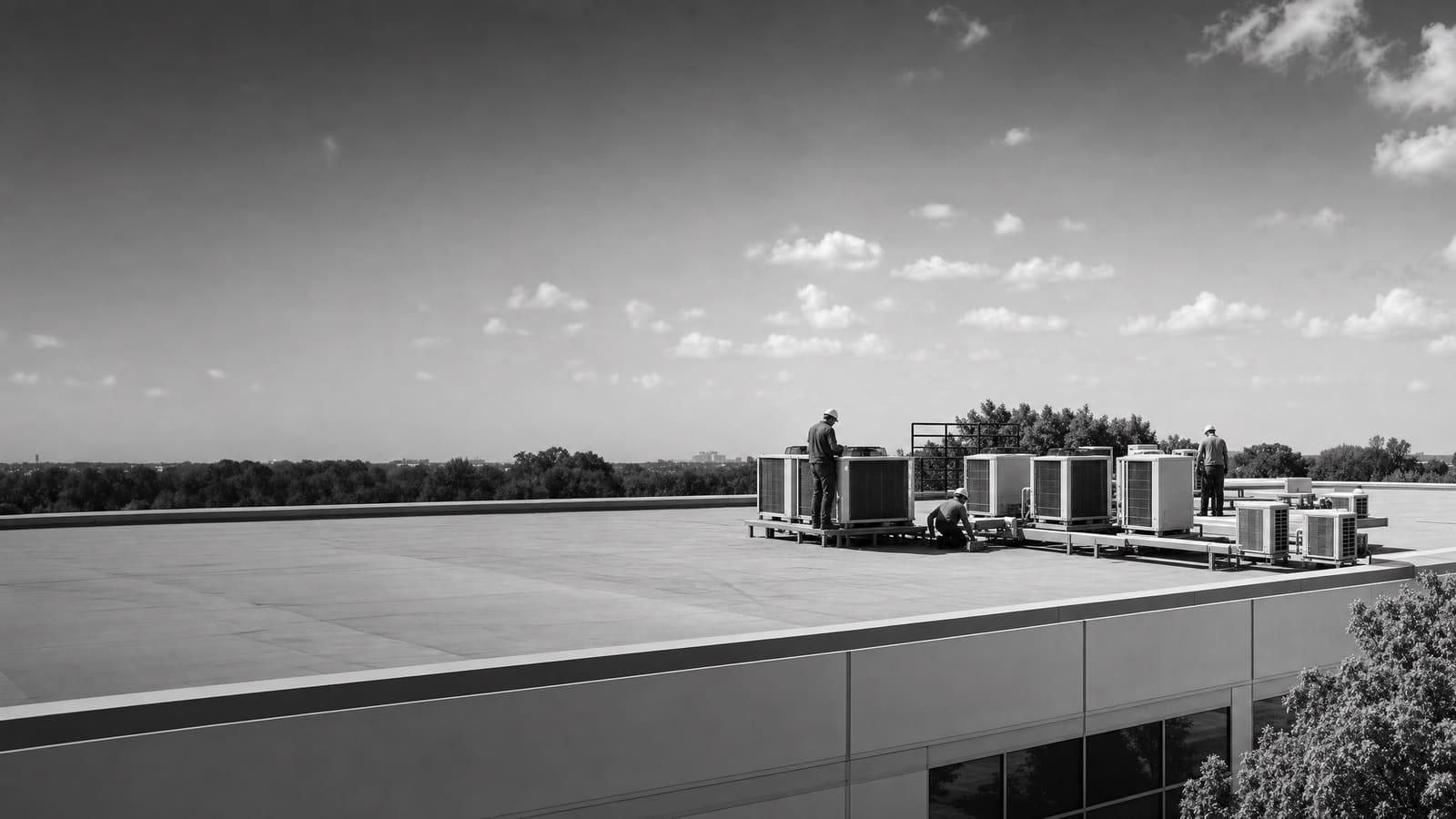
Commercial HVAC replacement covers more than the unit. It includes a load calculation, the equipment, a curb adapter or transition, the crane set, gas, electrical and refrigerant connections, the controls tie-in, and startup and commissioning. Replacement beats another repair once the unit wastes money every hour it runs. The Department of Energy puts that waste at $900 to $3,700 a year for an old, inefficient rooftop unit, and units past fifteen years old are usually the ones doing it.
A site review still has to confirm the real load, the roof structure and curb, available electrical capacity, crane access, and any code items replacement triggers that the old unit never had.
THREE WAYS THIS GOES
Replace on failure, replace on plan, or upgrade on plan
Most commercial buildings run packaged rooftop units. They condition close to half of all commercial floor space in the country, which means most replacement decisions look alike, and most of them come down to timing.
The expensive version is waiting for failure. Facility teams often do, because the unit makes cold air right up until it doesn't. Then the cost arrives as emergency labor, whatever equipment happens to sit in a regional warehouse, and a space that can't open.
The cheaper version is deciding early. When you pick the month, you can compare equipment, absorb a lead time, put the crane on a slow day, and hold the price. Deciding early also earns you the better question: should this be the same unit again, or a more efficient one?
WHAT MOVES THE PRICE
The lines that decide your installed number
None of these can be priced from a phone photo alone. All of them can be named up front, so nothing lands later as a change order.
CHOOSING EQUIPMENT
Same unit again, higher efficiency, or a heat pump
The floor under this decision moved years ago. A federal minimum efficiency standard for commercial rooftop units, finalized in 2015, lifted the entire market, and the high-performance specification that preceded it pushed manufacturers toward units using up to half the energy of the old baseline. A like-for-like replacement today is already better than what comes off the roof. The question is how much further you want to go.
The second question is fuel. A heat pump rooftop unit is the same machine as an air-conditioning unit with the heating cycle reversed, and it comes in all-electric, dual-fuel, and cold-climate versions. Heat pumps do their best work where winter heating is mild to moderate, which covers most of the South and West. As outdoor temperatures drop, heat pump heating efficiency slides toward electric resistance, and Texas has seen winter events sharp enough that dual fuel exists for exactly that reason.
Before either upgrade gets specified, the building has to support it: electrical capacity at the panel, physical room on the curb, and a clear decision about the gas line you keep or abandon.
SCOPE CHECK
What makes one replacement simple and another one long
Two buildings can both need a rooftop unit replaced and land in very different places on price and schedule. The difference is almost always what changes besides the box.
LOWER COMPLEXITY
Same tonnage, same fuel, easy roof
Use of the space hasn't changed, the curb takes an adapter, the panel already carries the load, and a crane can set up in the lot without blocking the entrance. Set and connected in a morning.
HIGHER COMPLEXITY
New tonnage, new fuel, or a hard roof to reach
Different footprint or weight, an electrical service that needs upgrading before an all-electric unit fits, a gas line to abandon, or a crane that needs street coordination and a bigger reach. Each one adds review time before anything gets lifted.
THE SITE REVIEW
What has to get verified before anyone quotes a number
Sizing should come from how the space is used now. Twenty years changes occupancy, plug loads, lighting, and sometimes the walls themselves. Carrying the old nameplate forward carries forward whatever mistake it already had, and oversized equipment short-cycles, controls humidity poorly, and generates the comfort complaints nobody can trace later.
Infrastructure is the second half. Federal guidance for heat pump rooftop units is blunt about this: electrical capacity, physical constraints at the curb, and gas line status decide whether an all-electric unit is even on the table before efficiency math matters. A panel that can't carry the new load turns a clean swap into an electrical project, and that discovery belongs in week one, not on crane day.
The third item is access. The rigging plan, the reach the crane needs, the stalls you can close, and the hours you can close them all price the lift. Contractor availability matters too — equipment that nobody nearby has installed before is a scheduling risk, not just a spec sheet.
Ask for these three before signing
The load calculation behind the tonnage. Written confirmation that the panel, curb, and roof structure support the unit selected. A rigging and lot plan that names the closure window and who owns it.
HOW YOU HOLD THE BUILDING
Ownership changes which replacement is right
The same rooftop unit deserves a different answer depending on how long you hold the building and how many units you are responsible for. Efficiency upgrades pay back through the utility bill over years, so who pays the bill and who holds the asset should be settled before equipment gets specified.
OWNER-OCCUPIED OR LONG HOLD
Buy the efficiency
You pay the energy bill and you keep the asset, so the higher tier or the heat pump has a real payback window. This is also where a right-sized replacement is worth the extra load work rather than a straight swap.
LEASED SPACE OR A FLEET
Settle who benefits, then phase
If the tenant pays utilities and the landlord buys equipment, the savings and the spend land in different pockets. With several units, the better plan is a replacement order by age and condition rather than one emergency at a time.
PHASING AND LIFETIME COST
Planning replacements before the equipment plans them for you
Planned replacement is not a theory. Through the federal Advanced RTU Campaign, more than 200 public and private organizations upgraded over 43,000 rooftop units, and those upgrades save a combined $37 million a year on energy bills. None of that happens on an emergency call at 4 p.m. in August.
Replacement also isn't the only move. Owners in that program either replaced aging units with more efficient equipment or retrofitted the existing units with advanced controls, depending on which pencils out. If a unit is mid-life and the cabinet is sound, controls can be the better spend this year and replacement the plan for a later one.
One procurement detail belongs in every scope: the old refrigerant. EPA rules govern how refrigerant is handled and recovered when equipment is serviced or removed, so recovery is licensed work with documentation, not something that happens quietly on the roof. Ask for that documentation with the closeout package, alongside the startup readings, so the file is complete if a warranty claim ever comes up.
COMPARING QUOTES
Five things a comparable quote has to show
Two quotes are only comparable when both spell out the same scope. If one is missing a line below, it isn't cheaper — it's less complete.
01
The load calculation, not just the tonnage
Tonnage and efficiency tier, plus what the sizing was based on.
02
Curb, structure, and roof restoration
Adapter, any structural work, and who patches and warranties the roof penetration.
03
The crane day, in writing
Rigging plan, closure window, hours of work, and whether it's included or billed separately.
04
Electrical, gas, and refrigerant scope
Panel and feeder work, gas line disposition, and documented recovery of the old charge.
05
Permits, inspections, and commissioning
Who pulls them, and a commissioning report with charge, airflow, and control settings verified.
Get a defensible number
Price the equipment and the building together.
Send the address, operating target, and target opening date. Flux will identify what must be verified before the project can be priced.
Get a free estimateQuestions
Straight answers.
When does replacement beat one more repair?
When the unit is old enough that it is losing money while running normally. Old, inefficient rooftop units waste roughly $900 to $3,700 a year each, and units past fifteen years are the usual candidates. If a repair on that unit is large, you are paying to extend the waste.
Should we replace like-for-like or right-size?
Confirm the load either way. If the space and its use haven't changed, like-for-like is often correct and it is the fastest path back to cooling. If occupancy, equipment, or layout changed, right-sizing fixes comfort problems the old unit could never solve.
Is a heat pump rooftop unit a reasonable option?
Often yes. Heat pump rooftop units perform best where winter heating demand is mild to moderate, which describes most of the South and West. The limits are practical: electrical capacity, room at the curb, and gas line status. Dual-fuel versions exist for the cold snaps Texas occasionally sees.
How long is the building without cooling?
The visible work on a straightforward swap is short — the crane sets the unit and the connections get made. The real schedule variable is equipment availability, which is why lead time belongs on the quote next to the price rather than being discovered after you sign.
What happens to the refrigerant in the old unit?
It gets recovered under EPA rules that govern refrigerant handling in stationary air-conditioning and heat pump equipment. That means certified handling and a paper trail. Ask for the recovery documentation in the closeout package along with the commissioning readings.
Sources used for this guide
- [1]betterbuildingssolutioncenter.energy.gov — DOE Advanced Rooftop Unit Replacement Guidance
- [2]betterbuildingssolutioncenter.energy.gov — DOE Commercial Heat Pump Rooftop Unit Replacement Guidance
- [3]betterbuildingssolutioncenter.energy.gov — DOE High-Efficiency Commercial Rooftop Unit Toolkit
- [4]energy.gov — DOE Efficient Commercial Rooftop Air Conditioner Program
- [5]epa.gov — EPA Stationary HVAC Refrigerant Management