THE SHORT ANSWER
What a commercial HVAC replacement actually includes
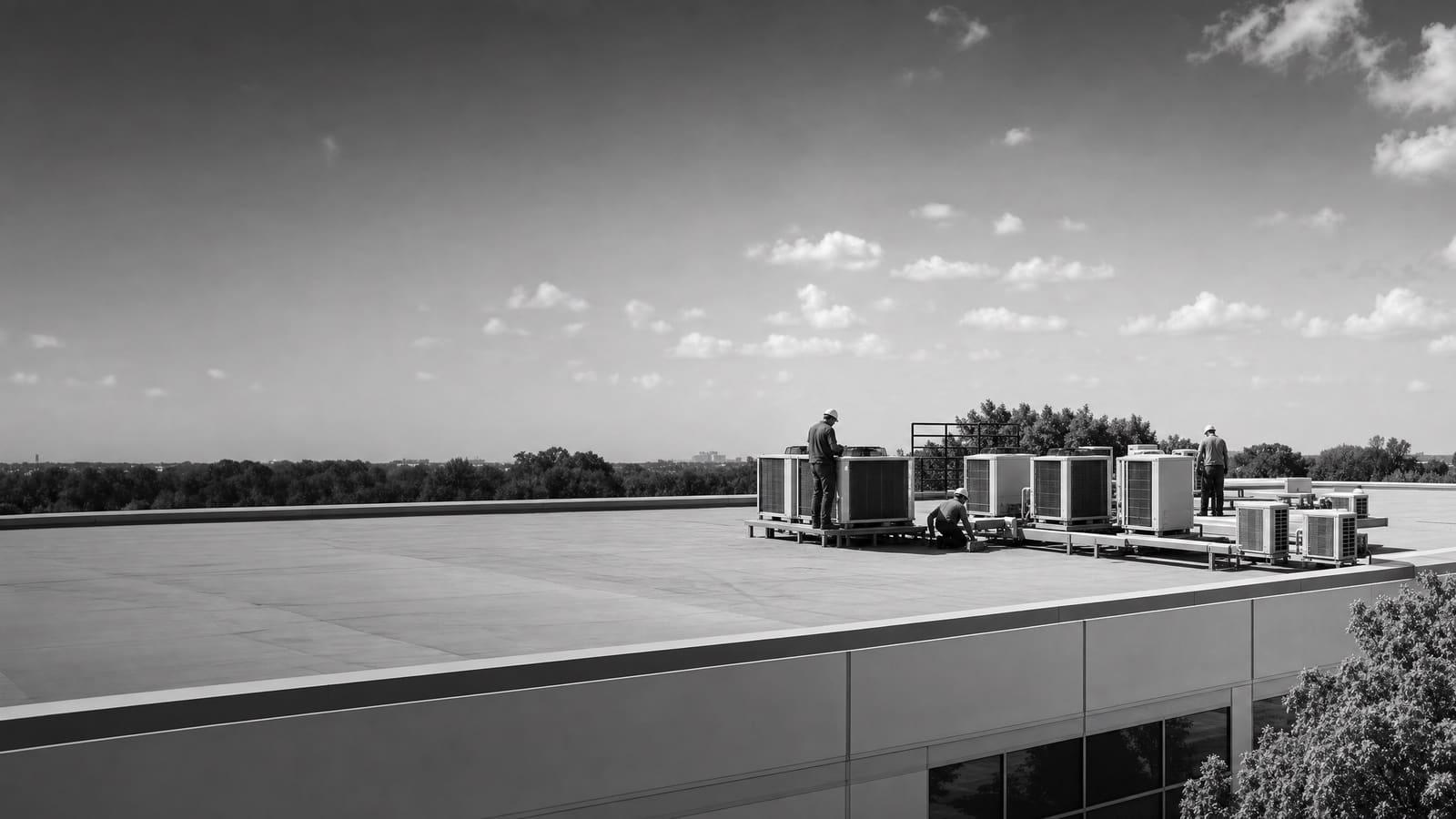
A commercial HVAC replacement covers the load calculation, equipment selection, removal with certified refrigerant recovery, curb or duct adaptation, gas and electrical connections, controls, plan review and permits, and commissioning. Replacement beats another repair once a rooftop unit is past about fifteen years. The Department of Energy puts the annual waste from old, inefficient rooftop units at $900 to $3,700 per unit, and that runs on top of what you are already spending on service calls.
A site review still has to confirm the real load, curb and roof condition, electrical capacity at the unit, and crane access before any of that turns into a price you can hold.
THREE WAYS TO GO
Three paths when a commercial unit is failing
Not every failing unit needs to be replaced this quarter, and not every replacement should be like-for-like. The Department of Energy frames the choice plainly for rooftop equipment: an owner can replace the old unit with a more efficient one, or retrofit the existing unit with advanced controls, depending on which makes better financial sense for that building.
Age is the cleanest first filter. Units past fifteen years waste real money against current equipment, and the waste on an old, inefficient rooftop unit has been measured at $900 to $3,700 a year each. Set that against two seasons of repair invoices and the decision usually stops being close.
The second filter is whether the space changed. If occupancy, hours, or plug load moved since the unit went in, a like-for-like swap carries the old sizing mistake forward for another fifteen years. That is the case for spending a day on a real load calculation before anyone picks a model number.
WHAT MOVES THE NUMBER
Where a Kenosha installation price actually moves
None of these can be priced from a desk. They are the six places the number moves once someone gets on the roof. Ask which ones were verified on site and which ones are allowances, because an allowance is a number that will change.
BUYING GUIDANCE
Choosing equipment you will still like in year ten
Equipment choice on a commercial roof comes down to three questions: what the building actually needs, what you can get, and what the building can feed. The load comes first, and it should be calculated from how the space is used today. Occupancy, plug loads, lighting, and envelope work all change what a space needs, and a nameplate from twenty years ago is a record of an old answer to a question nobody re-asked.
Availability is the second question, and it belongs in the decision rather than in a footnote. Federal rooftop guidance lists equipment availability right alongside climate and infrastructure as a deciding factor, because a specification you cannot get in season is not really a specification. Ask for the lead time next to the price on every option, not only on the one the contractor prefers.
The third question is infrastructure. DOE guidance on heat pump rooftop units puts electrical capacity, physical constraints, and existing gas lines at the center of the choice. An all-electric unit that needs more amps than the panel has is a service upgrade wearing an equipment price tag, and that surprise arrives late if nobody opened the panel during the walk. Efficiency tier is worth pushing on too: the high-performance rooftop specification DOE developed with manufacturers targeted up to half the energy use of the standard of its day, and units meeting it are widely available now.
COMPLEXITY
What makes a swap simple, and what does not
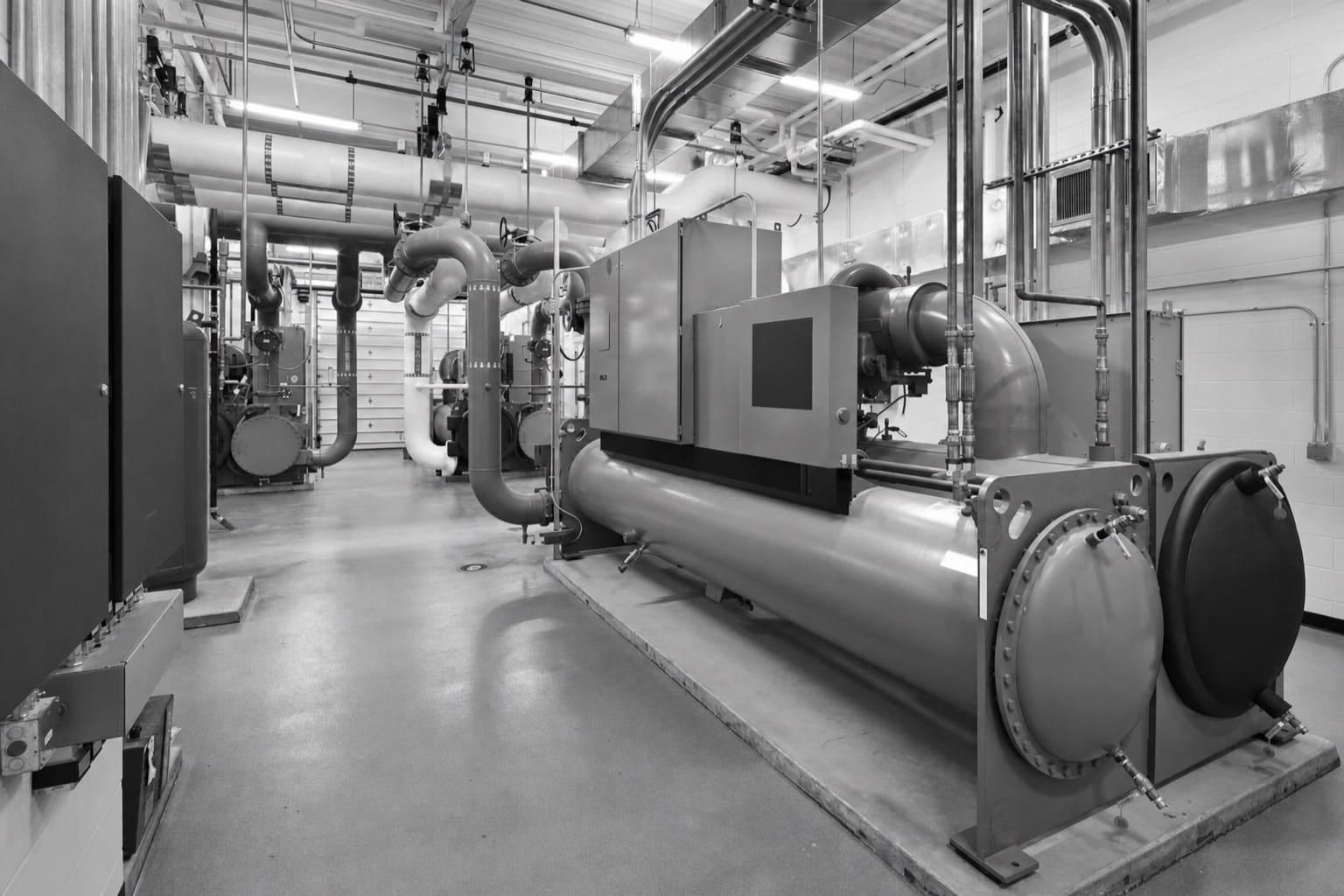
Two buildings can have the same tonnage on the roof and completely different projects underneath. The difference is rarely the equipment. It is the curb, the panel, the access, and whether the building can stand an outage during business hours.
LOWER COMPLEXITY
A straightforward swap
Same tonnage, the existing curb fits or takes a standard adapter, gas and power are already right-sized, the roof is reachable from the lot, and the space is used the way it was when the last unit went in.
HIGHER COMPLEXITY
Expect engineering
Tonnage or footprint grows, the roof needs a structural look, the panel is near capacity, you are changing fuel, ductwork moves, or the building runs on a schedule that will not tolerate a daytime outage.
SCOPING
What the site review has to settle
A quote you can compare starts with a walk, not a phone call. The person writing the number should get on the roof, read the nameplate, look at the curb, and open the electrical panel.
On the roof, the review confirms curb dimensions and whether an adapter or a new curb is needed, the condition of the membrane around the unit, and whether the structure carries the new weight. It confirms crane position, reach, and which stalls close for the morning. Inside, it confirms capacity at the disconnect and at the panel, gas line size if the unit fires, and how the existing controls talk to the rest of the building.
The review should also settle what gets submitted and to whom, instead of leaving it for an inspector to find. Wisconsin runs commercial building and HVAC plan review as its own process, and the state publishes a contractor memo specifically about HVAC equipment replacement. Reading that before equipment ships costs nothing. Reading it after costs a crane date.
Refrigerant belongs in the scope too. EPA Section 608 rules govern how refrigerant is handled and recycled when stationary equipment comes out, so recovery is a line item on the removal, not an afterthought on the invoice.
The three things people skip
Panel capacity at the unit, a structural check on the curb, and certified refrigerant recovery on the removal. Each one takes ten minutes on a walkthrough and costs a full day if it surfaces on crane morning.
WISCONSIN PLAN REVIEW
Where your submittal actually goes
Wisconsin handles commercial HVAC plan review through the Department of Safety and Professional Services, and that path shapes your schedule more than most owners expect. DSPS accepts several submittal types, including HVAC only, commercial building and HVAC, and HVAC with a kitchen hood. A straight equipment replacement does not automatically drag a full building review along with it.
The part worth checking early is which office reviews your project. DSPS publishes a list of delegated municipalities that handle commercial plan review locally instead of the state, so the answer depends on your specific building. Confirm that before you commit to a crane date. On most Kenosha replacements, the submittal path rather than the equipment is what sets the earliest honest install week.
Ask this before the crane is booked
Who is submitting the plan review, is it going to DSPS or to a delegated municipality, and is the HVAC-only path enough for this scope? Get that in writing with the quote.
OWNERSHIP
Two things that outlive the installation
The install is a morning. What you live with afterward is a service relationship and a lease clause, and both are easier to shape before the purchase order than after.
Rooftop equipment cools close to half of all commercial floor area in the country, which means most of these decisions are being made by owners who are not HVAC people. That is fine. It just means the two items below should be settled in plain language while you still have leverage with everyone involved.
REFRIGERANT
The service plan changes with the unit
New equipment arrives on newer refrigerants, and EPA Section 608 governs handling and recycling on stationary systems. On a mixed roof that means parts stocking, technician certification, and recovery procedures all belong in the service contract, not discovered at the first leak.
SCHEDULE
Who owns the downtime
In a leased building, the lease usually decides who pays for the unit and who approves the outage window. Settle that before equipment is ordered, because a landlord approval cycle can easily outlast the lead time on the unit itself.
PHASING
Replacing more than one unit
If you have several aging units, the worst plan is the one the equipment picks for you. Replacement on failure means emergency pricing, whatever is on the shelf, and a comfort problem your tenants noticed before you did. DOE makes the point directly: replacing inefficient, underperforming rooftop units proactively is often the smarter business move than waiting for failure, and sometimes better than a like-for-like swap at the end of service life.
Phasing works when you rank units by age, condition, and the value of the space they serve. Anything past fifteen years goes on the near list. Units serving revenue space move up regardless of age, because an outage there is not measured in repair dollars. Then buy in groups. Two or three units on one crane day cost less per unit than three separate mobilizations, and one controls scope can cover the whole set.
Lifetime cost should drive the order. The federal Advanced RTU Campaign tracked more than 43,000 upgraded units across over 200 organizations, and those upgrades were reported to save a combined $37 million a year on energy bills. Your building is not a campaign, but the arithmetic is the same: the bill you avoid every month for the next fifteen years usually outweighs the premium you argued about on day one.
COMPARE THE QUOTES
Five things a comparable quote shows
If two quotes are far apart, the gap is almost always in one of these five lines rather than in the equipment margin. Ask each contractor to show all five and the comparison gets simple.
01
Equipment, tonnage, and efficiency tier
Model number, capacity, and efficiency rating, so two bids can be compared on the same machine.
02
Lead time beside the price
Availability on every option quoted, not just the one the contractor would rather sell.
03
Curb, structure, and rigging
Adapter or new curb, any structural work, crane size, and how long the lot is closed.
04
Electrical, gas, and controls scope
Panel capacity confirmed, gas or refrigerant line changes named, and controls integration priced.
05
Permits, plan review, and commissioning
Who submits, to which office, and what startup documentation you receive at handoff.
Get a defensible number
Price the equipment and the building together.
Send the address, operating target, and target opening date. Flux will identify what must be verified before the project can be priced.
Get a free estimateQuestions
Straight answers.
When does replacement beat one more repair?
Age plus repair history usually answers it. Rooftop units past fifteen years waste substantial energy against current equipment, with old inefficient units measured at $900 to $3,700 per unit each year. Add two seasons of service invoices to that and the repair path stops looking cheap.
Should the new unit be a heat pump?
It depends on the building, not the trend. Heat pump efficiency falls as outdoor temperatures drop, so in a cold-winter climate the real options are cold-climate or dual-fuel equipment rather than a standard all-electric unit. Electrical capacity at the panel decides as much as the climate does.
Does a Kenosha replacement need state plan review?
Wisconsin runs commercial HVAC plan review through DSPS, and there is an HVAC-only submittal path so an equipment replacement does not always trigger a full building review. Some municipalities are delegated to review locally instead, so confirm which office has your project before booking a crane.
Should we replace like-for-like or resize?
Confirm the load either way. If the space and its use have not changed, like-for-like is often correct and it is the fastest path back to conditioned air. If occupancy, hours, or equipment load changed, a like-for-like swap locks in the old sizing error for another fifteen years.
What happens to the refrigerant in the old unit?
It gets recovered by a certified technician. EPA Section 608 regulations govern how refrigerant is handled and recycled in stationary air conditioning and heat pump equipment, so recovery should appear as a scoped line item on the removal rather than as an assumption.
Sources used for this guide
- [1]betterbuildingssolutioncenter.energy.gov — DOE Advanced Rooftop Unit Replacement Guidance
- [2]betterbuildingssolutioncenter.energy.gov — DOE Commercial Heat Pump Rooftop Unit Replacement Guidance
- [3]betterbuildingssolutioncenter.energy.gov — DOE High-Efficiency Commercial Rooftop Unit Toolkit
- [4]energy.gov — DOE Efficient Commercial Rooftop Air Conditioner Program
- [5]epa.gov — EPA Stationary HVAC Refrigerant Management
- [6]dsps.wi.gov — DSPS Heating, Ventilation, & Air Conditioning