THE SHORT VERSION
What a commercial HVAC replacement actually includes
A commercial HVAC replacement covers the load calculation, the equipment order, refrigerant recovery from the old unit, the crane set, electrical and gas connections, the curb adapter, permits, and commissioning. Replacement beats one more repair once a unit is past about fifteen years and the same failures keep returning. Federal energy guidance puts the cost of waiting plainly: an old rooftop unit can waste roughly $900 to $3,700 a year in energy alone.
A site review still has to confirm the real load, the roof structure under the curb, available electrical capacity, and crane access. Those four items decide whether the price you were quoted survives the install.
THREE WAYS TO GO
Three replacement paths worth pricing
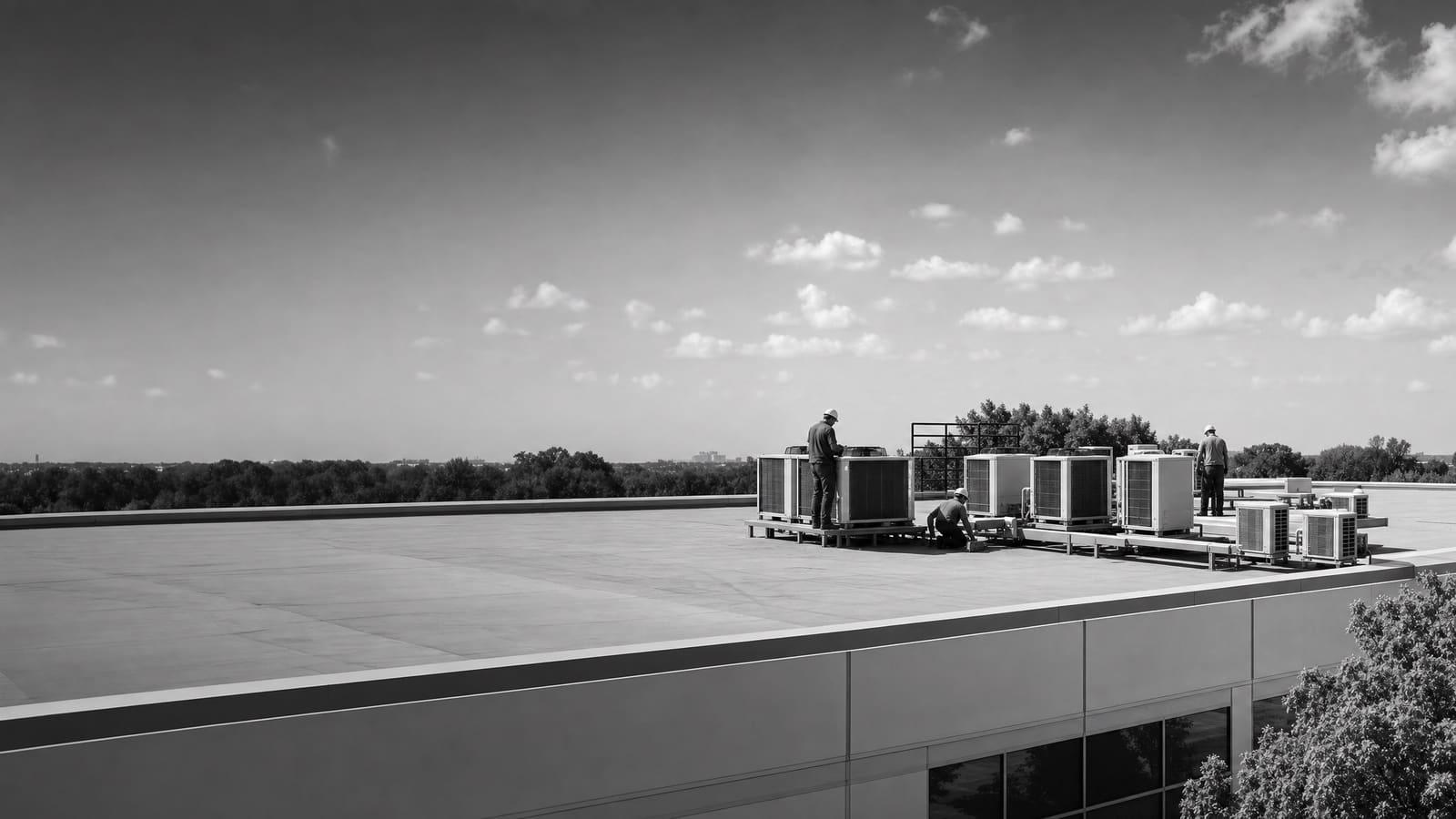
Most commercial buildings here cool through packaged rooftop units, the same equipment that conditions close to half of all commercial floor area in the country. When one reaches end of life you have three real choices, and each one should get a number.
The cheapest quote is rarely the cheapest decision. A like-for-like swap wins on speed. A right-sized high-efficiency unit wins on operating cost, and the market has caught up here: more than twenty models now exceed the high-efficiency performance spec DOE developed with manufacturers, and the federal minimum standard finalized in December 2015 raised the floor for everything sold since.
The third choice is the heat pump rooftop unit, which handles cooling and reverse-cycle heating in one box. Federal guidance says heat pump rooftop units are best suited to mild-to-moderate winter heating, and that across the South and West today's units can meet most or all of the winter heating demand. Southern California sits inside that description, so this belongs on the comparison sheet rather than being waved off.
WHAT MOVES THE NUMBER
Where a rooftop replacement budget actually goes
No two roofs price the same, so read a quote as a set of line items instead of one number. These are the lines that move most between a routine swap and a difficult one. Ask which are firm and which are allowances.
IN PRACTICE
How to buy this without getting surprised
The most expensive version of this project is the one nobody planned. Facility managers usually wait until a unit stops holding the space, needs constant service, or quits outright, then buy whatever can be on the roof soonest. Federal guidance names that pattern directly and says replacing tired units on purpose is usually the better business move, often better even than a like-for-like swap at the end of a unit's service life.
Planning ahead changes what you are able to buy. You compare equipment instead of taking what is in stock. You get the crane on a Saturday instead of a Tuesday. You have time to confirm whether the panel can carry an electric option, and time to sort out any incentive before the order goes in.
The way to start is boring and effective. Write down the age, tonnage, fuel type, and service history of every unit on the roof. Anything past fifteen years is a candidate, because that is the age where federal guidance flags serious energy waste. Sort by which failure would hurt the business most, then price the top two now, while nothing is broken. A quote you can read calmly in March is worth more than three quotes gathered in August with tenants calling.
SCOPE CHECK
Simple swap or a real project
Two replacements at the same tonnage can be a day apart or a month apart. The difference is almost never the equipment itself. It is what surrounds it: the curb, the power, the access, and how much the building has changed since the last unit went up.
LOWER COMPLEXITY
Same box, same job
The space is used the way it was when the unit was installed. Tonnage and fuel stay the same, the curb matches, the lot gives the crane open reach, and the panel has capacity. Permit scope stays simple and the set happens in a morning.
HIGHER COMPLEXITY
Something changed
Occupancy, layout, or plug loads shifted, so the size changes. Or you are switching fuel, which pulls electrical capacity, gas line work, and physical clearances into scope. Add a shared lot or a screened roof and the rigging plan starts driving the schedule.
BEFORE YOU SIGN
What a real site review has to verify
A quote written from a nameplate photo is a starting number, not a price. It is fine for a first conversation. It is not fine as the basis for a purchase order, because the items most likely to change the total are the ones a photo cannot show.
A proper review goes to the roof and checks four things. First, the load: what the space holds, runs, and does today, not what it did when the old unit was specified. Second, the physical constraints: curb dimensions, clearances, screen walls, roof structure, and whether the new unit's footprint lands where the old one sat. Third, the infrastructure: electrical capacity at the panel, the gas line if there is one, and where refrigerant and condensate runs go. Fourth, access: how the crane gets in, what it has to reach over, and how many stalls close for how long.
The same review should confirm equipment availability. Federal guidance treats availability as its own decision factor rather than a footnote, because the unit you can get quickly and the unit you actually want are often not the same unit.
The four answers that decide the price
Confirmed load, curb and structure, available electrical capacity, and crane access. Get all four in writing alongside the quote. If a bidder never went to the roof, treat the number as an estimate and expect a change order once the old unit is off.
IN JURUPA VALLEY
Permits, and the roof under the unit
California city building departments treat this as permitted work. Municipal permit lists in California cover electrical, plumbing, and mechanical upgrades or repairs, which means a rooftop unit swap needs a pulled permit even when nothing about the layout changes. Confirm the scope with the Jurupa Valley building division before work is scheduled, and confirm in the quote that your contractor pulls the permit and carries the inspection.
Those same permit lists also cover re-roofing, and that is the part worth acting on. If the roof membrane is within a few years of replacement, doing it after a crane has already set a new unit means paying twice for access and cutting into new flashing. Ask the roofer and the mechanical contractor for dates in the same conversation. Sequencing those two jobs together is usually the largest scheduling saving on the whole project.
Ask before the crane is booked
Who pulls the mechanical and electrical permits, who meets the inspector, and whether the roof membrane is close enough to end of life that the re-roof should happen first. All three are cheaper to answer now than during the set.
OWNERSHIP MATH
Two things owners weigh after the install
Buying the unit is one decision. Living with it is the longer one, and two questions decide how that goes.
The first is what happens to your service plan once the fleet stops matching. New equipment ships on newer refrigerants, and EPA rules under the Clean Air Act govern how refrigerant is handled, recovered, and recycled in stationary air-conditioning and heat pump equipment. A roof with three old units and one new one is a roof carrying two parts inventories.
The second is whether you replace one at a time or in a group. Single replacements are easier to fund. Grouped replacements buy better pricing, one crane day, and one permit cycle. A DOE-backed campaign reported participants upgrading more than 43,000 rooftop units and saving a combined $37 million a year, which is the case for treating rooftops as a fleet instead of a run of emergencies.
SERVICE PLANNING
Mixed fleets cost more to service
New units and old units rarely share parts or refrigerant. Update the service agreement when the first new unit lands, and decide whether you are keeping two inventories on purpose or by accident.
SEQUENCING
One at a time or all at once
Grouping buys one mobilization, one permit cycle, and better equipment pricing. Staging protects cash flow. Choose based on how many units are past fifteen years, not on which one failed first.
OVER THE LIFE OF THE UNIT
Where the money actually shows up
The purchase price is the number everyone compares. It is not the number that decides the outcome. A rooftop unit runs for well over a decade, and the energy it burns in that time can dwarf the gap between two bids. Federal regulators measured that gap before writing it into policy: the December 2015 efficiency standard was projected to save businesses $167 billion in utility bills over the lifetime of the products it covers.
So compare bids in three columns, not one. Installed price. Expected energy cost at the efficiency tier quoted. And the availability date, because a unit that lands six weeks late has a cost too, paid in portable cooling, overtime, or lost business.
Incentives belong in that math, but only the ones open right now. Federal, state, and utility offers for high-efficiency and heat pump rooftop units change over time, and what applied two years ago may not apply in 2026. Confirm in writing what is available for your account and your equipment type before you sign the order. An incentive you find out about during installation may already be out of reach.
QUOTE CHECKLIST
Five things a comparable quote shows
Three bids only mean something if they cover the same work. Before you compare totals, check that each quote answers these five. Anything missing is a change order waiting to happen.
01
Equipment, tonnage, and efficiency tier
Model number, capacity, refrigerant, and the efficiency rating. Not just "new rooftop unit."
02
Availability and install date
The real lead time for that specific model, and what happens to the price if it slips.
03
Curb, structure, and roof work
Adapter or new curb, any framing, and how the flashing ties back into the existing roof.
04
Crane day and lot impact
Rigging plan, hours on site, stalls closed, and who notifies tenants.
05
Permits, startup, and commissioning
Who pulls permits, who meets the inspector, and what gets verified and documented at startup.
Get a defensible number
Price the equipment and the building together.
Send the address, operating target, and target opening date. Flux will identify what must be verified before the project can be priced.
Get a free estimateQuestions
Straight answers.
When is replacement a better call than another repair?
Once a unit is past about fifteen years and the same failures keep returning. Federal guidance flags that age as the point where rooftop units waste real money, roughly $900 to $3,700 per unit each year, and says replacing proactively is usually a smarter business move than replacing on failure.
How much does a commercial HVAC installation cost?
There is no honest universal number, because tonnage, curb work, electrical capacity, and crane access each move the total on their own. Ask for a line-item quote instead of a lump sum, and ask which lines are firm and which are allowances.
Should a heat pump rooftop unit be on our list?
It belongs on the comparison sheet. Federal guidance says heat pump rooftop units suit mild-to-moderate winter heating, and that across the South and West today's units can meet most or all of the winter heating demand. The deciding factors are electrical capacity, physical clearances, the existing gas line, and your utility rates.
Do we need a permit to replace a rooftop unit?
Plan on it. California municipal permit lists cover mechanical, electrical, and plumbing upgrades and repairs, so even a like-for-like swap is permitted work. Confirm the scope with the Jurupa Valley building division, and confirm in your quote that the contractor pulls the permit and carries the inspection.
What happens to the refrigerant in the old unit?
It gets recovered, not vented. EPA rules under the Clean Air Act govern how refrigerant is handled and recycled in stationary refrigeration, air-conditioning, and heat pump equipment. That work should appear as a line on the quote, and it is why removing an old unit is not simple disposal.
Sources used for this guide
- [1]betterbuildingssolutioncenter.energy.gov — DOE Advanced Rooftop Unit Replacement Guidance
- [2]betterbuildingssolutioncenter.energy.gov — DOE Commercial Heat Pump Rooftop Unit Replacement Guidance
- [3]betterbuildingssolutioncenter.energy.gov — DOE High-Efficiency Commercial Rooftop Unit Toolkit
- [4]energy.gov — DOE Efficient Commercial Rooftop Air Conditioner Program
- [5]epa.gov — EPA Stationary HVAC Refrigerant Management
- [6]californiacity-ca.gov — HVAC Permits