THE DIRECT ANSWER
What a commercial HVAC replacement actually includes
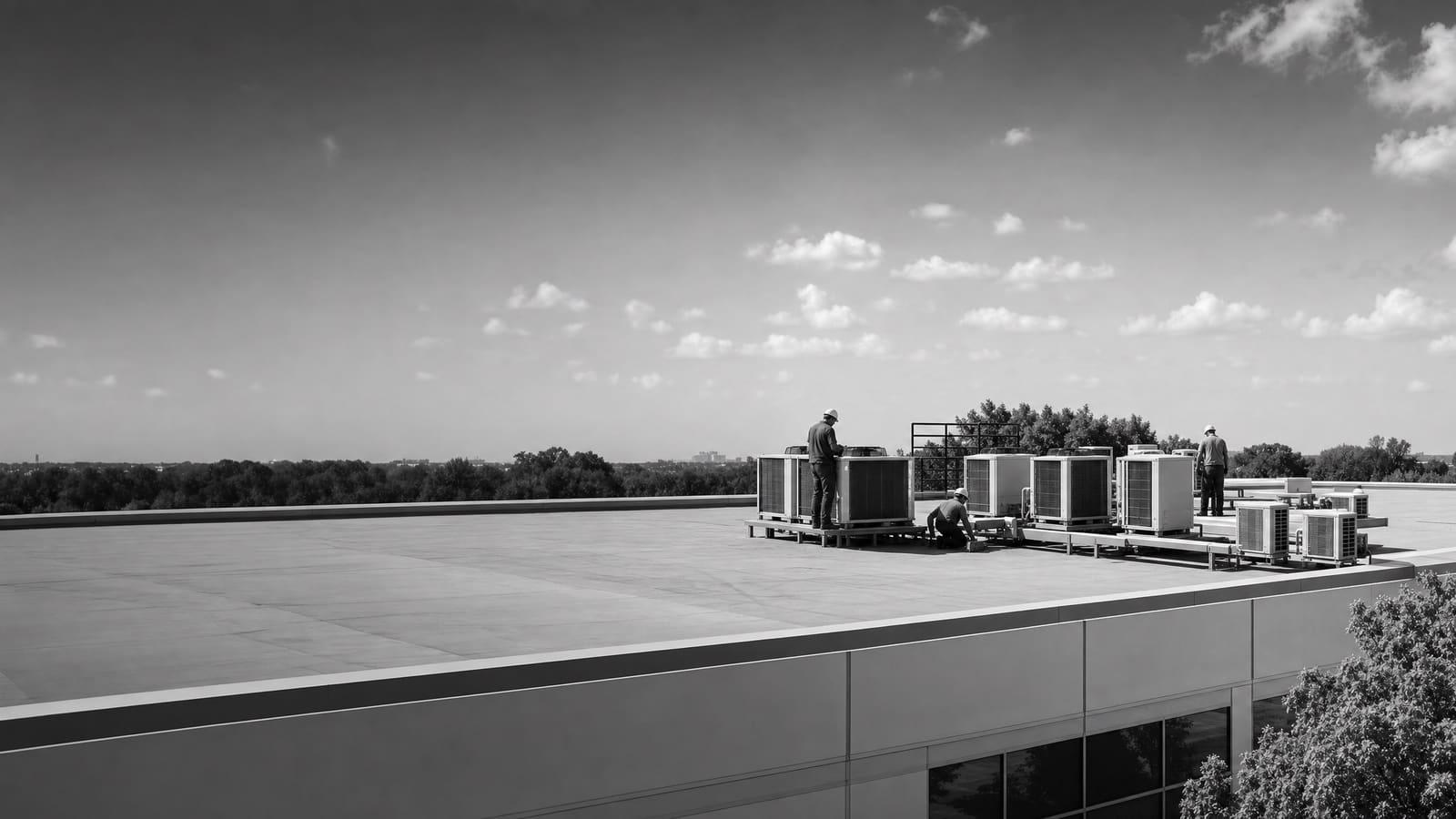
A commercial HVAC replacement covers load verification, equipment selection, removal with certified refrigerant recovery, rigging the new unit into place, gas and electrical connections, controls, permits, inspections, and startup. Replacement usually beats another repair once a rooftop unit is past fifteen years and service calls repeat. Federal work on commercial rooftop equipment found old, inefficient units waste $900 to $3,700 per unit each year — money that leaves whether or not the compressor is currently broken.
A site review still has to verify the real load, curb and structural fit, available electrical capacity, gas service, and roof access before any of that holds for your building.
THREE WAYS TO GO
Repair, replace in kind, or upgrade
Most buildings reach this decision the same way. A unit fails in season, and another repair looks like the fastest path. Federal guidance is blunt about the pattern: facility managers often delay replacement until the unit no longer conditions the space, needs constant service, or dies outright. By then the choice gets made under pressure, with whatever equipment is available that week.
The better move is to decide before the failure. Rooftop units past fifteen years waste substantial energy compared with newer models, and replacing them proactively is often a smarter business decision than replacement-on-failure — or even than a like-for-like swap at the end of service life. Units developed under a federal high-performance rooftop challenge were specified to cut energy use by up to half against the standard equipment of the day.
Three choices are real here. Each one is defensible. They just carry different risk, and the risk lands in different budgets.
WHERE THE MONEY GOES
The lines that move a rooftop replacement quote
No two roofs price the same, so compare bids line by line instead of on the bottom number. These are the items that swing most between contractors, and the ones most likely to reappear later as a change order if nobody wrote them down.
CHOOSING EQUIPMENT
Gas heat, dual fuel, or heat pump
The heating decision is where a Joliet replacement diverges most from the same project in a warm climate. Heat pump rooftop units are close cousins of standard air-conditioning rooftop units — same general shape, same curb family — but they run the refrigeration cycle in reverse to heat. Federal guidance sorts them into three types: dual-fuel, all-electric, and cold-climate models.
The catch is temperature. As outdoor air gets colder, heat pump heating efficiency drops and trends toward parity with electric resistance heat. That guidance places the technology's sweet spot in mild-to-moderate winter heating, and names the South and West as regions where today's units can carry most or all of the winter load. Northern Illinois is not that. It does not rule the technology out, but it moves the sensible options toward dual-fuel units that hand heating back to gas in deep cold, or cold-climate models built to hold capacity at low temperatures.
The rest of the decision is infrastructure and arithmetic. The same guidance tells owners to check electrical capacity, physical constraints, and gas lines before committing, alongside local electricity and gas prices, equipment availability, and whether contractors nearby actually install and service the technology. Get those answers before the specification locks, not after the unit is on the roof.
COMPLEXITY CHECK
What makes this project simple or hard
Two replacements can carry the same tonnage and land nowhere near each other on schedule. Sort your building into one of these before you set a budget or promise a date to tenants.
LOWER COMPLEXITY
Straight swap territory
Same use, same load, same fuel. The new unit lands on an adapted curb, reuses the existing gas and power, and the permit covers mechanical work with familiar inspections. Equipment availability is usually the longest pole in the tent.
HIGHER COMPLEXITY
Where the schedule stretches
Occupancy or process load changed, tonnage grows, the roof needs structural review, or the project moves toward electric heat and a service upgrade. Then add distribution changes, controls integration, and phased work in an occupied building.
SCOPING IT
What a real site review has to answer
Anyone can quote a rooftop unit from a nameplate photo. That is genuinely useful for a first number in an emergency, and it is not a scope. A nameplate tells you what somebody sized years ago for a building that has since changed tenants, lighting, equipment, and hours.
Start with load. Confirm it against how the space is used now, because oversizing carries forward as short cycling, humidity complaints, and a larger bill for the entire life of the unit. Then work through the physical constraints federal guidance puts on the list: electrical service and panel capacity, gas line availability, curb and structural fit, and clearance around the unit. Then handle access — where the crane sets up, how much of the lot closes, and for how long.
Two items get skipped constantly. First, the old refrigerant charge has to be recovered and handled under federal rules rather than vented, and that belongs in writing. Second, someone has to own permits and inspections. In Joliet that is not a formality, and it is worth settling before the equipment is ordered rather than the week the crane is booked.
Ask for this before you compare bids
A one-page scope naming tonnage, heating type, efficiency tier, curb treatment, electrical and gas work, crane plan, refrigerant recovery, permits, and commissioning. If two bids share that page, the price difference means something. If they don't, you are comparing guesses.
JOLIET SPECIFICS
Licensing, permits, and inspections in Joliet
Joliet has adopted the 2015 International Building Code, and the Building Inspectional Services Division runs permitting and inspection for commercial work.
Two items decide who can do your job. The city requires an HVAC contractor license, and it accepts a Joliet license or a municipal license from Aurora, Elgin, Rockford, Freeport, Springfield, Zion, or Peoria. A Letter of Intent is also required from each electrical, plumbing, and HVAC contractor listed on a project, so the contractor named on the permit has to be the contractor doing the work. Registration itself carries no forms or fees, except for sign erectors and for HVAC testing.
Inspections follow the work. The city inspects any underground HVAC, rough-in above the ceiling, and completed HVAC work, plus a final inspection after all HVAC work is finished and before the building is occupied.
Confirm licensing before you award
Ask each bidder which municipal HVAC license they hold and whether it sits on Joliet's accepted list. A contractor who cannot pull the permit cannot hold your schedule, no matter how good the number looks on paper.
OWNERSHIP ANGLES
Two things that change the answer
The right unit is not purely an engineering answer. Who pays, who benefits, and how long you hold the building all move the decision — sometimes more than tonnage does.
Federal guidance frames the same tension at portfolio scale: some buildings are better candidates for a given technology than others, and location drives heating load, energy prices, and emissions. The version for one building is simpler. Decide whether this replacement is a repair of the past or an investment in the next decade, then price it that way.
LEASE STRUCTURE
Who actually pays the bill
In a triple-net lease the owner buys the equipment and the tenant pays to run it, which quietly rewards the cheapest unit on the roof. If that is your structure, decide on purpose whether efficiency is worth funding anyway.
HOLD PERIOD
How long you own the outcome
The unit you buy this year is likely the unit your building keeps for well over a decade. Selling soon, first cost dominates. Holding long, operating savings compound and the higher efficiency tier usually wins.
PLANNING THE SPEND
Phasing, procurement, and lifetime cost
If you have more than one unit on the roof, you have a sequencing problem, not just a purchase. Replacing everything at once is one mobilization, one crane day, one permit cycle, and one negotiation — usually the lowest cost per unit. It is also the largest single check. Replacing the worst offender each year spreads the cash but repeats the setup costs and leaves you managing a mixed fleet of ages, efficiency levels, and control platforms.
The middle path is to rank the roof honestly. Age, service history, and annual run hours put units in order quickly. The federal figures on old, inefficient rooftop equipment — $900 to $3,700 wasted per unit each year — give you a rough way to see which units are quietly funding their own replacement and which can wait another season.
Procurement matters as much as price. Equipment availability sits on the federal checklist for a reason: a unit you cannot get for ten weeks is not really cheaper than one you can get in three. Ask for lead time next to price on every line, and ask what happens to the quote if that lead time slips. Then confirm the installing crew is available in the window you actually need, not the window that suits the order.
QUOTE CHECKLIST
Five things a comparable quote shows
Bids that look far apart usually differ in what they left out, not in what they charge. Line these five up across every proposal before you decide anything.
01
Equipment, tonnage, and efficiency tier
Model number, heating type, and the efficiency level named in writing — not just "new rooftop unit."
02
Curb, structural, and roof scope
Adapter or new curb, any structural review triggered, and who repairs the roof around the opening.
03
Crane plan and lot impact
Set date, staging area, how many stalls close, and for how long they stay closed.
04
Permits, inspections, and license
Which municipal HVAC license the contractor holds, who pulls the permit, and which city inspections are included.
05
Startup, commissioning, and warranty
Documented charge, airflow, and control settings at handoff, plus what the warranty covers and for how long.
Get a defensible number
Price the equipment and the building together.
Send the address, operating target, and target opening date. Flux will identify what must be verified before the project can be priced.
Get a free estimateQuestions
Straight answers.
Should I replace the unit or repair it again?
Repair makes sense when the unit is young, the failure is isolated, and a funded replacement date already exists. Once a rooftop unit is past fifteen years and repairs repeat, federal guidance is clear that proactive replacement usually beats waiting for failure. Old, inefficient units waste $900 to $3,700 each per year regardless of whether they are currently broken.
Does a heat pump rooftop unit make sense in Joliet?
Sometimes, but not the standard version. Heat pump heating efficiency falls as outdoor temperature drops, and federal guidance places the technology's sweet spot in mild-to-moderate winters. In northern Illinois that points toward dual-fuel units or cold-climate models rather than a straight all-electric swap.
Who can pull the HVAC permit in Joliet?
A licensed HVAC contractor. Joliet accepts its own HVAC contractor license or one from a short list of other Illinois municipalities, and it requires a Letter of Intent from each electrical, plumbing, and HVAC contractor named on the project.
What inspections does a commercial HVAC install need?
Joliet inspects any underground HVAC, rough-in above the ceiling, and completed HVAC work, plus a final inspection after all HVAC work is finished and before the building is occupied. Build that final inspection into your occupancy date rather than discovering it late.
What happens to the refrigerant in the old unit?
It gets recovered, not vented. EPA rules under Section 608 of the Clean Air Act govern the handling and recycling of refrigerant in stationary refrigeration, air-conditioning, and heat pump equipment. Make sure recovery appears on the quote instead of being assumed.
Should I right-size or replace like-for-like?
Confirm the load either way. If the space and how it is used have not changed, like-for-like is the fast, simple path. If occupancy, hours, or internal equipment changed, sizing to today's use fixes comfort problems the old unit was never able to solve.
Sources used for this guide
- [1]betterbuildingssolutioncenter.energy.gov — DOE Advanced Rooftop Unit Replacement Guidance
- [2]betterbuildingssolutioncenter.energy.gov — DOE Commercial Heat Pump Rooftop Unit Replacement Guidance
- [3]betterbuildingssolutioncenter.energy.gov — DOE High-Efficiency Commercial Rooftop Unit Toolkit
- [4]energy.gov — DOE Efficient Commercial Rooftop Air Conditioner Program
- [5]epa.gov — EPA Stationary HVAC Refrigerant Management
- [6]joliet.gov — Building Code and Contractor Information | City of Joliet, IL