THE SHORT VERSION
What a commercial HVAC replacement in Jackson includes
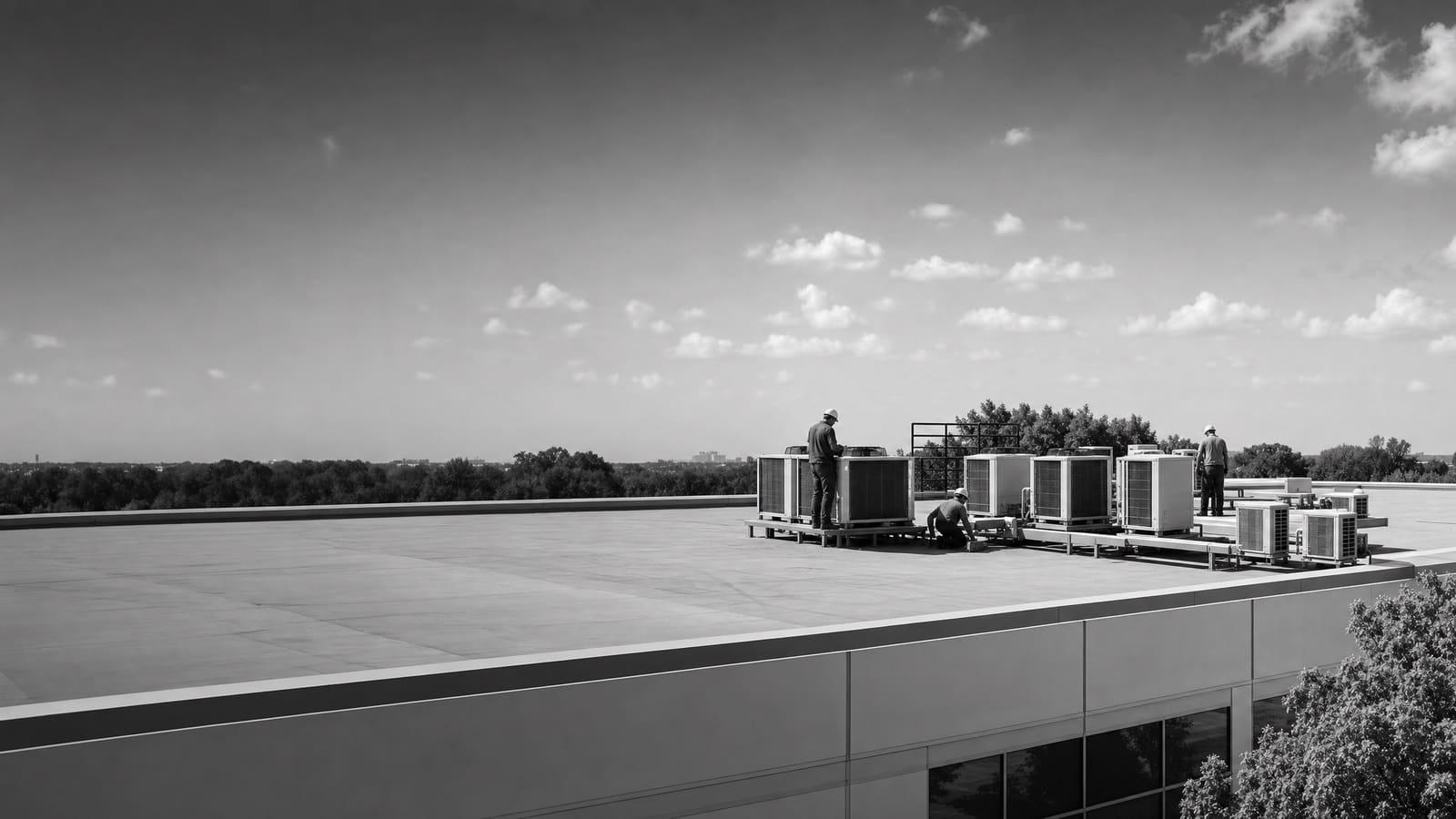
A commercial HVAC replacement confirms the load your building actually carries today, selects equipment against real availability, sets and connects the unit, and commissions it so it performs to spec. Replacement beats another repair when a rooftop unit is past fifteen years, needs frequent service, or no longer conditions the space adequately. Old, inefficient rooftop units waste roughly $900 to $3,700 per unit every year, so a tired unit keeps charging you between breakdowns.
A site review still has to verify roof structure and curb condition, electrical capacity at the panel, gas line and refrigerant routing, and crane access before any of that becomes a firm price.
THE THREE CHOICES
Three ways to handle a rooftop unit at end of life
Most commercial buildings arrive at the same fork. A unit is old, service calls are stacking up, and someone has to decide how much project to buy. There are three honest answers, and the right one depends on whether the equipment is genuinely finished or just neglected.
Waiting for failure is the most common choice and usually the most expensive. Federal guidance on rooftop replacement is direct about it: replacing an inefficient, underperforming unit on purpose is usually the smarter business move compared with replacement-on-failure. The emergency version costs you whatever equipment is available that week, at whatever price, plus the downtime.
Retrofitting controls is the middle path. Owners can replace old units with more efficient ones or retrofit the existing units with advanced controls, depending on which option makes better financial sense for that building. If the box still has real service life in it and the complaint is how it runs rather than whether it runs, controls can capture savings without a crane day.
Full replacement is the answer when the equipment is genuinely at the end of its life. That is also the moment to choose an efficiency tier, because the incremental cost of a better unit is small next to the cost of doing the whole project twice.
WHAT MOVES THE NUMBER
The lines that actually move an installed price
Nobody can price your roof from a nameplate photo alone, and any quote that does is guessing. But the variables are predictable. These are the items that separate two bids on the same building, and the ones worth asking about before you decide which number is actually lower.
BUYING THE EQUIPMENT
How to buy the unit, not just the install
The equipment decision deserves more attention than most buyers give it, because it is locked in for the life of the unit. Rooftop units condition close to half of all commercial floor space in this country, which is why federal efficiency work has focused on them so heavily. A minimum-efficiency standard announced in 2015 sets the floor for what manufacturers can sell. A separate high-performance specification pushed the market well past that floor: units built to it were challenged to cut energy use by up to half against the older standard, and more than twenty models now exceed the spec.
That history matters in a practical way. When more than two hundred organizations replaced over forty-three thousand rooftop units through a federal campaign, the combined result was about thirty-seven million dollars in annual energy savings. Spread across a portfolio, that is a real line on a budget. Spread across one building, it is the difference between a unit that pays part of its own way and one that quietly bills you every month.
So ask for two priced options on the same quote: the code-minimum unit and the high-efficiency tier, with the installed price difference shown plainly. Then compare that difference against what the old unit is wasting each year. If the payback lands inside the time you expect to hold the building, the higher tier is the cheaper decision, not the expensive one.
COMPLEXITY CHECK
What makes this project simple or complicated
Two buildings can need the same tonnage and land at very different installed prices. The gap is almost always infrastructure and access, not the equipment on the order. Here is how to tell which version of this project you have before the first quote arrives.
LOWER COMPLEXITY
Same size, same fuel, same curb
The replacement matches the old unit in capacity and fuel, the existing curb and connections carry over, the roof structure is unchanged, and the crane has a clear shot from a lot you can close for a morning. The schedule is driven mostly by equipment availability.
HIGHER COMPLEXITY
Different size, different fuel, tight site
Capacity changes, so the curb and possibly the structure change with it. Going all-electric puts electrical capacity on the critical path. A tight or shared lot limits crane placement and closure windows. Each of those adds scope, review time, and cost.
BEFORE YOU BUY
What a real site review has to answer
A quote written from a nameplate photo is a starting point, not a commitment. The federal guidance on rooftop replacement lists the same short set of questions every time, and a competent site review answers all of them before anyone signs a number.
Infrastructure comes first. Electrical capacity decides whether an electric option is even on the table without a service upgrade. Physical constraints — curb size, roof structure, clearances, and how a crane reaches the unit — decide the rigging plan. Gas lines decide whether you are abandoning a fuel or keeping it as backup. None of that is visible from the parking lot.
Equipment availability is the second question, and it belongs on the quote right next to the price. Availability is a named consideration in the federal guidance for good reason: the unit you can actually get inside your window may not be the unit that looks best on paper. Ask for real lead times with dates.
The third is whether the crew installs what you are buying regularly. Heat pump rooftop units are technologically similar to air conditioning units, but the commissioning, the controls, and the backup heat strategy are not identical. A contractor who sets them routinely will scope one correctly. One who does not will leave the gaps for you to find in the first cold week.
The four answers to get in writing
Electrical capacity at the panel, curb and structural condition, gas line disposition, and confirmed equipment availability with a date. If a quote does not address all four, it is an estimate of the easy version of your project.
OWNERSHIP
Two decisions that outlive the install
The install takes a few days. What you decide during it, you live with for a decade or more. Two items deserve a real conversation before the order goes in, because changing either one later is expensive and changing them now is mostly free.
The first is the fuel path — whether the building keeps burning gas, keeps it only as backup, or goes fully electric. The second is refrigerant, which sounds like a technician's problem right up until you are managing a mixed fleet with two different service plans.
Neither one shows up as a comfort complaint on day one. Both show up in your operating cost, your service contract, and your spare-parts strategy for as long as you own the building. Ask while both options are still priced side by side.
FUEL PATH
Gas, dual fuel, or all-electric
Heat pump rooftop units add reverse-cycle heating to the same basic machine. Across southern regions they are generally capable of covering most or all of the winter heating demand, but efficiency falls as outdoor temperatures drop, which is why dual fuel keeps a backup. Electricity price and your own winter load decide which is cheaper to run.
REFRIGERANT
What the new unit gets charged with
Federal rules govern how refrigerant is handled, recovered, and recycled in stationary cooling and heat pump equipment. A replacement means proper recovery on the old unit and a service plan for the new one. On a mixed fleet, ask how spare parts and technician training line up.
PLANNING AHEAD
Phasing a fleet instead of chasing failures
If you own more than one unit, sequencing matters more than any single quote. Facility managers routinely wait until a unit stops conditioning the space, needs constant maintenance, or fails outright. That is understandable, and it is also the most expensive pattern available, because every failure forces a decision with no leverage: no time to compare equipment, no time to bid the work, and no ability to schedule around your operating hours.
The alternative is to rank the roof. Age is the cheapest screen. Units past fifteen years are the ones wasting the most against current models, and an old inefficient rooftop unit accounts for somewhere between about nine hundred and thirty-seven hundred dollars of waste a year on its own. Put that next to the age of each unit you own and a two- or three-year replacement plan mostly writes itself.
Then buy in batches where the calendar allows. Ordering two or three units at once improves your position on price and gives you one mobilization instead of three emergencies. Schedule crane days in the shoulder seasons, when losing conditioning for a morning costs the building the least. And decide in advance what replaces the oldest unit if it fails first, so even the surprise has an answer. The goal is simple. Every replacement lands on your calendar, and none of them land on the equipment's.
APPLES TO APPLES
Five things a comparable quote shows
Quotes stop being comparable the moment one of them leaves something out. Ask every bidder for these five items in the same order and the same format. Once they are all visible, the cheapest number often stops being the cheapest project.
01
Tonnage, fuel, and efficiency tier
The exact model, its capacity, and how it compares against the code-minimum alternative on the same roof.
02
Confirmed equipment availability
A real lead time with a date attached, not a catalog assumption.
03
Curb, structural, and roofing scope
Whether the existing curb carries over, what adapter or framing is needed, and who patches the roof.
04
Rigging, permits, and inspections
The crane plan, the lot closure window, and every permit and inspection included in the installed price.
05
Startup and commissioning
Charge, airflow, and control settings verified against spec and documented, so the warranty holds.
Get a defensible number
Price the equipment and the building together.
Send the address, operating target, and target opening date. Flux will identify what must be verified before the project can be priced.
Get a free estimateQuestions
Straight answers.
When does replacing beat repairing again?
When the unit is past fifteen years, needs frequent maintenance, or no longer conditions the space adequately. Old, inefficient rooftop units waste roughly $900 to $3,700 per unit each year, so a tired unit keeps costing you in between the breakdowns.
Should you replace like-for-like or step up the efficiency tier?
Get both priced on one quote. Federal guidance is clear that a proactive, more efficient replacement usually beats both replacement-on-failure and a like-for-like swap at end of life. The installed price difference is often smaller than a couple of years of waste.
Is a heat pump rooftop unit a real option for this building?
Often, yes. Heat pump rooftop units are built like standard air conditioning units with reverse-cycle heating added, and across southern regions they are generally capable of covering most or all of the winter heating demand. Efficiency drops as it gets colder, so dual fuel is the hedge.
What usually blows up the budget?
Electrical capacity and curb work. A larger unit or an all-electric conversion can require panel work and structural review that a like-for-like swap never touches. Both are found in a site review, not on a nameplate.
Does the refrigerant matter to me?
Not much on day one, but yes for planning. Federal rules govern how refrigerant is handled and recovered in stationary cooling and heat pump equipment, so a replacement includes proper recovery on the old unit. Mixed fleets need a parts and service plan that covers both.
Sources used for this guide
- [1]betterbuildingssolutioncenter.energy.gov — DOE Advanced Rooftop Unit Replacement Guidance
- [2]betterbuildingssolutioncenter.energy.gov — DOE Commercial Heat Pump Rooftop Unit Replacement Guidance
- [3]betterbuildingssolutioncenter.energy.gov — DOE High-Efficiency Commercial Rooftop Unit Toolkit
- [4]energy.gov — DOE Efficient Commercial Rooftop Air Conditioner Program
- [5]epa.gov — EPA Stationary HVAC Refrigerant Management