THE SHORT VERSION
What commercial HVAC replacement and installation includes
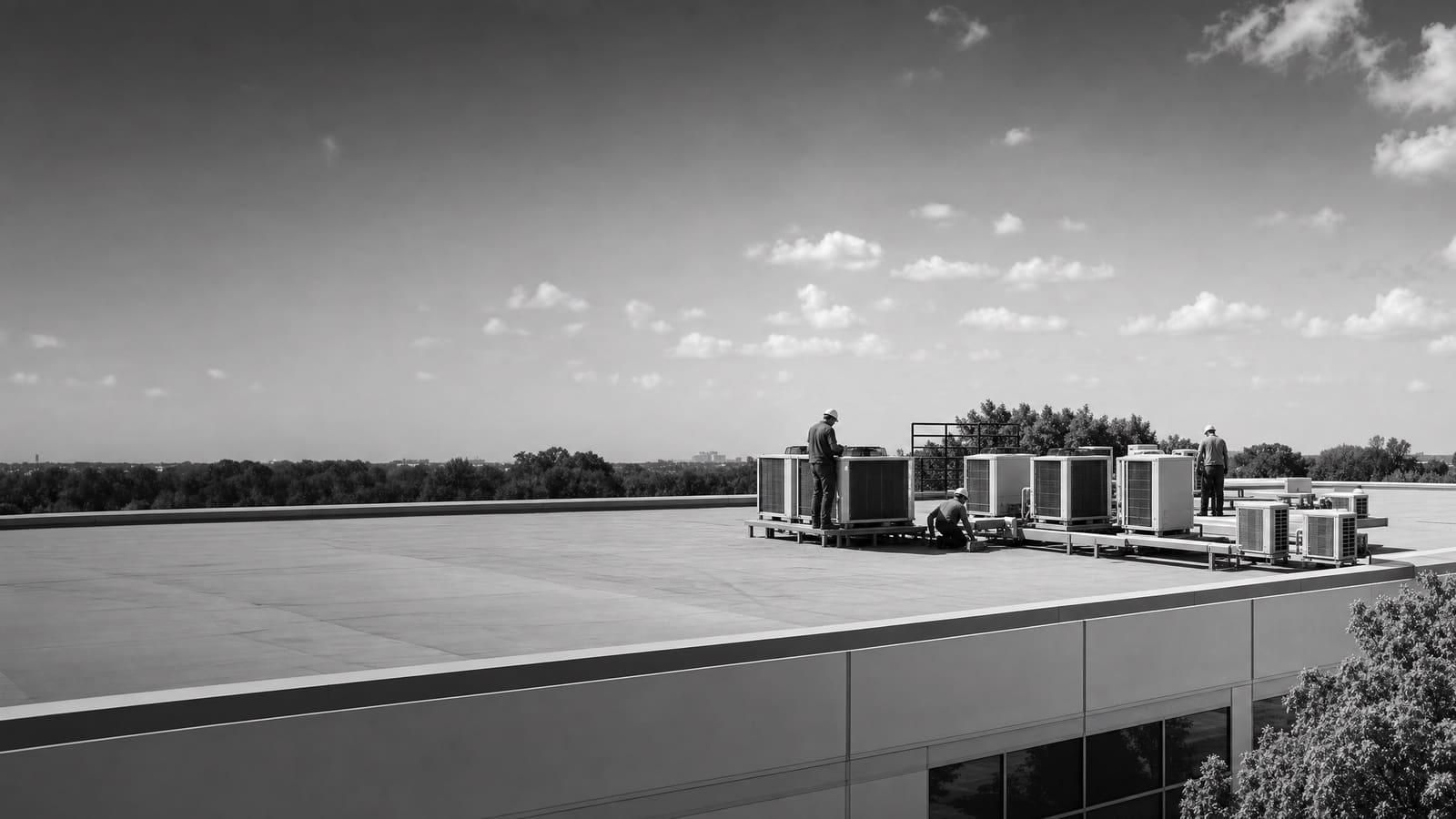
A commercial HVAC replacement covers the whole chain: confirming the load the building carries today, selecting equipment against real availability, recovering refrigerant from the old unit, setting the new one, and commissioning it before handoff. Replacement beats another repair once a unit is past its service life and the same failures keep returning. Federal estimates put the annual waste from old, inefficient rooftop units at roughly $900 to $3,700 each.
A site review has to verify the actual load, the roof curb and structure, available electrical capacity, and crane access before any of those numbers mean anything for your building.
THREE WAYS TO PLAY IT
Three ways owners approach a rooftop replacement
Most replacements fall into one of three patterns, and the difference is mostly about when you decide rather than what you buy. Federal guidance is direct on this point: facility managers often delay a new unit until the old one fails, needs constant service, or stops holding the space, and that delay is usually the expensive choice.
Deciding early is what buys you options. It gives you room to compare a like-for-like swap against a higher-efficiency or heat pump unit, to check whether the building can actually support an electric option, and to schedule the crane on a quiet day instead of a July afternoon. There is also a middle path worth pricing: when a unit still has usable life left, advanced controls can be retrofitted onto the existing equipment instead of replacing it, which is the better financial call on some roofs.
What you should not do is let the failure date pick the equipment for you. That is how buildings end up with whatever was on the shelf, sized off a twenty-year-old nameplate.
WHAT MOVES THE NUMBER
Budget lines that actually move a replacement quote
None of these are add-ons a contractor invents later. They are the parts of the job that vary by roof, which makes them the parts a real quote has to price instead of estimate. When a bid is missing one, that is the line most likely to come back as a change order.
THE EQUIPMENT DECISION
Like-for-like, high-efficiency, or heat pump
The cheapest replacement to engineer is the one that changes nothing: same tonnage, same curb, same connections. That is often the right call, but only after someone confirms the load. Twenty years changes occupancy, plug loads, lighting, and sometimes the envelope, so the old nameplate is a record of a building that no longer exists.
The second option is the same kind of unit at a higher efficiency tier. This is where the operating math lives. Rooftop units condition close to half of all commercial floor area in the country, and the federal high-performance specification was built around units that cut energy use by up to half compared with the standard in place at the time. Over a long hold, that gap is usually larger than the price difference at purchase.
The third option is a heat pump rooftop unit. These are technologically similar to standard air-conditioning units but add reverse-cycle heating, so one machine covers both seasons. National guidance rates them as fully capable across most of the South and West, where winters run mild to moderate. The catch is infrastructure rather than performance: the building needs electrical capacity, the roof has to physically accept the unit, and any existing gas service needs a decision. Southern cold snaps still happen, so the heating side needs a plan, whether that is a dual-fuel unit or electric backup heat.
SCOPE CHECK
What makes a replacement simple or complicated
Two replacements with the same tonnage can be very different jobs. The difference almost always shows up before the crane arrives.
LOWER COMPLEXITY
A clean swap
The new unit matches the old footprint and weight, the curb is sound, the electrical service already has room, and the lot has open space for the crane to set up. Work like this stays a short on-site job with straightforward paperwork.
HIGHER COMPLEXITY
Where scope grows
Tonnage or footprint changes, the curb needs an adapter or structural review, the panel has no spare capacity for an electric unit, or the only crane position closes the main entrance. Add a tenant that cannot lose conditioning and it becomes a phasing problem.
SCOPING THE JOB
What a site review has to settle before pricing
A quote is only as good as the walk that produced it. The first thing a site review settles is load: what the space is used for now, how many people are in it, what equipment runs in it, and whether the old tonnage still matches. That answer decides whether a like-for-like swap is honest or just convenient.
Next is the roof itself. The curb has to be sound and match the new unit, or an adapter is needed. Weight and footprint matter, because a heavier unit can require structural review. The path the crane takes matters as much as the spot the unit lands.
Then infrastructure, which is where electric options are won or lost. The building needs enough electrical capacity for a heat pump or all-electric unit, the roof has to physically accept the equipment, and any existing gas line needs a decision. National guidance also flags contractor familiarity as a real consideration, because equipment the local service market does not routinely install is harder to keep running.
Finally, controls. Economizer requirements, sensors, and how the new unit talks to your building automation are scope items, not afterthoughts.
Get the infrastructure answers in writing
Electrical capacity, curb condition, crane position, and what happens to the existing gas service are the four answers that turn a rough number into a real one. Ask for them before you compare bids, not after you sign one.
AFTER THE INSTALL
Two things that outlive the crane day
The install is one morning. The decisions inside it stay with the building for the life of the equipment, and they show up in two places: the monthly bill and the service plan. Both are worth pricing before you sign, because neither is easy to change once the unit is on the roof.
UTILITY BILLS AND INCENTIVES
The savings side
The efficiency tier you buy shows up every month for the life of the unit, and incentives can move the math further. Programs change and expire, though, so confirm what is actually open right now before you build it into a payback.
SERVICE AND REFRIGERANT
The fleet side
New equipment ships on newer refrigerants, and the old charge has to be recovered and handled under federal rules rather than vented. On a mixed roof, that shapes service contracts, technician familiarity, and how you stock spare parts.
PHASING AND PROCUREMENT
Planning replacements across a roof or a portfolio
Few buildings have exactly one aging unit. More often there are several of similar age, which makes the real question order rather than whether. Sequencing them turns an unpredictable run of emergencies into a budget line. The units serving the most sensitive spaces, or the ones already on their second major repair, go first.
Standardizing helps more than owners expect. When the units on a roof share a manufacturer and a control platform, service is simpler, spare parts are fewer, and the crew that works on one already knows the next. That advantage compounds across a portfolio.
Planned programs are not theoretical. Through a national campaign, more than 200 public and private organizations upgraded over 43,000 rooftop units and saved a combined $37 million a year on energy bills. Those savings came from deciding on a schedule instead of reacting to failures.
Two practical notes on procurement. Equipment availability belongs in the plan, because a unit you cannot get in the week you need it is not really an option. And ordering across a group of buildings at once usually buys both better pricing and a schedule you control.
WHAT A COMPARABLE QUOTE SHOWS
Five things every bid should spell out
Bids only become comparable when they describe the same job. These five items are what let you put two numbers next to each other and trust the difference between them.
01
The equipment, in full
Make, model, tonnage, efficiency rating, and heating type. Two bids are not comparable until you can see whether they priced the same machine.
02
Availability, not just price
The expected lead time for the specific unit quoted, and what the alternate is if that model slips.
03
Everything on the roof
Curb adapter, structural work, electrical or gas changes, and removal and handling of the old unit and its refrigerant charge.
04
The crane day
Who owns the rigging plan, how many stalls close, for how long, and which day the lift happens.
05
Startup and commissioning
Charge, airflow, economizer, and control settings verified against spec and documented, so the warranty holds and month-two complaints never start.
Get a defensible number
Price the equipment and the building together.
Send the address, operating target, and target opening date. Flux will identify what must be verified before the project can be priced.
Get a free estimateQuestions
Straight answers.
When is replacement better than one more repair?
When the unit is past its useful service life and the same failures keep coming back. Federal guidance points to units over 15 years old as the group that wastes substantial energy compared with current models, with old, inefficient rooftop units wasting roughly $900 to $3,700 per unit each year. Once repair visits are routine, that waste is the real cost of waiting.
Should you replace like-for-like or resize?
Confirm the load either way. If the space and how it is used have not changed, like-for-like is often the honest answer and the fastest path back to conditioning. If occupancy, equipment, or the envelope changed, resizing fixes the comfort complaints the old unit was never able to solve.
Does a heat pump rooftop unit make sense for a commercial building?
Often, yes. Heat pump rooftop units are technologically similar to standard air-conditioning units and add reverse-cycle heating, and national guidance treats them as fully capable across most of the South and West. The deciding factors are usually infrastructure: electrical capacity, physical fit on the roof, what happens to existing gas service, and whether a dual-fuel or backup-heat arrangement is needed for cold snaps.
How much does a commercial HVAC installation cost?
There is no single installed price, because tonnage, efficiency tier, curb and structural work, electrical capacity, and crane access all move the number on a given roof. The way to get a real figure is a site review that prices those lines individually. What is documented is the other side of the ledger: an old, inefficient unit can waste roughly $900 to $3,700 a year on its own.
What happens to the refrigerant in the old unit?
Federal rules govern how refrigerant is handled and recycled in commercial cooling and heat pump equipment, so the old charge is recovered rather than released. That work belongs on the quote as a line item, and on a mixed roof it is worth planning around, since newer units ship on newer refrigerants.
Sources used for this guide
- [1]betterbuildingssolutioncenter.energy.gov — DOE Advanced Rooftop Unit Replacement Guidance
- [2]betterbuildingssolutioncenter.energy.gov — DOE Commercial Heat Pump Rooftop Unit Replacement Guidance
- [3]betterbuildingssolutioncenter.energy.gov — DOE High-Efficiency Commercial Rooftop Unit Toolkit
- [4]energy.gov — DOE Efficient Commercial Rooftop Air Conditioner Program
- [5]epa.gov — EPA Stationary HVAC Refrigerant Management