THE DIRECT ANSWER
What a commercial HVAC replacement actually covers
A commercial HVAC replacement covers the load check, equipment selection, removal of the old unit, curb and connection work, the crane set, permits and inspection, and commissioning before handoff. Replacement beats another repair once a unit is past 15 years old and no longer holds the space. Federal analysis puts the annual waste of an old, inefficient rooftop unit at roughly $900 to $3,700 per unit. That number, not the repair bill, usually decides it.
A site review still has to confirm tonnage against how the space is used now, the roof structure under the curb, available electrical capacity, and whether crane access clears the building.
THREE WAYS TO GO
Like-for-like, right-sized, or heat pump
Most replacements come down to three choices, and they get decided before anyone prices equipment.
Like-for-like keeps the same fuel, the same tonnage, and usually the same curb. It is the fastest path back to conditioned space, and it is the right call when the space and its use have not changed.
Right-sizing recalculates the load from today's occupancy, plug loads, and envelope. Twenty years of tenant changes rarely leave the original nameplate correct. This is the path that fixes comfort complaints the old unit could never fix.
Heat pump rooftop units add reverse-cycle heating to the same basic machine. Federal guidance says today's units handle most or all winter heating demand across the U.S. South and West, which puts a building here squarely in range where the all-electric option is worth pricing. The decision then turns on electrical capacity, gas line status, and energy prices.
WHAT MOVES THE NUMBER
Where a commercial HVAC quote actually varies
Equipment is rarely the line that surprises anyone. The variable lines are the ones tied to your roof, your power, and your calendar. Ask for each of these separately, and two quotes that look nothing alike become comparable.
IN PRACTICE
How to buy the replacement, not just the unit
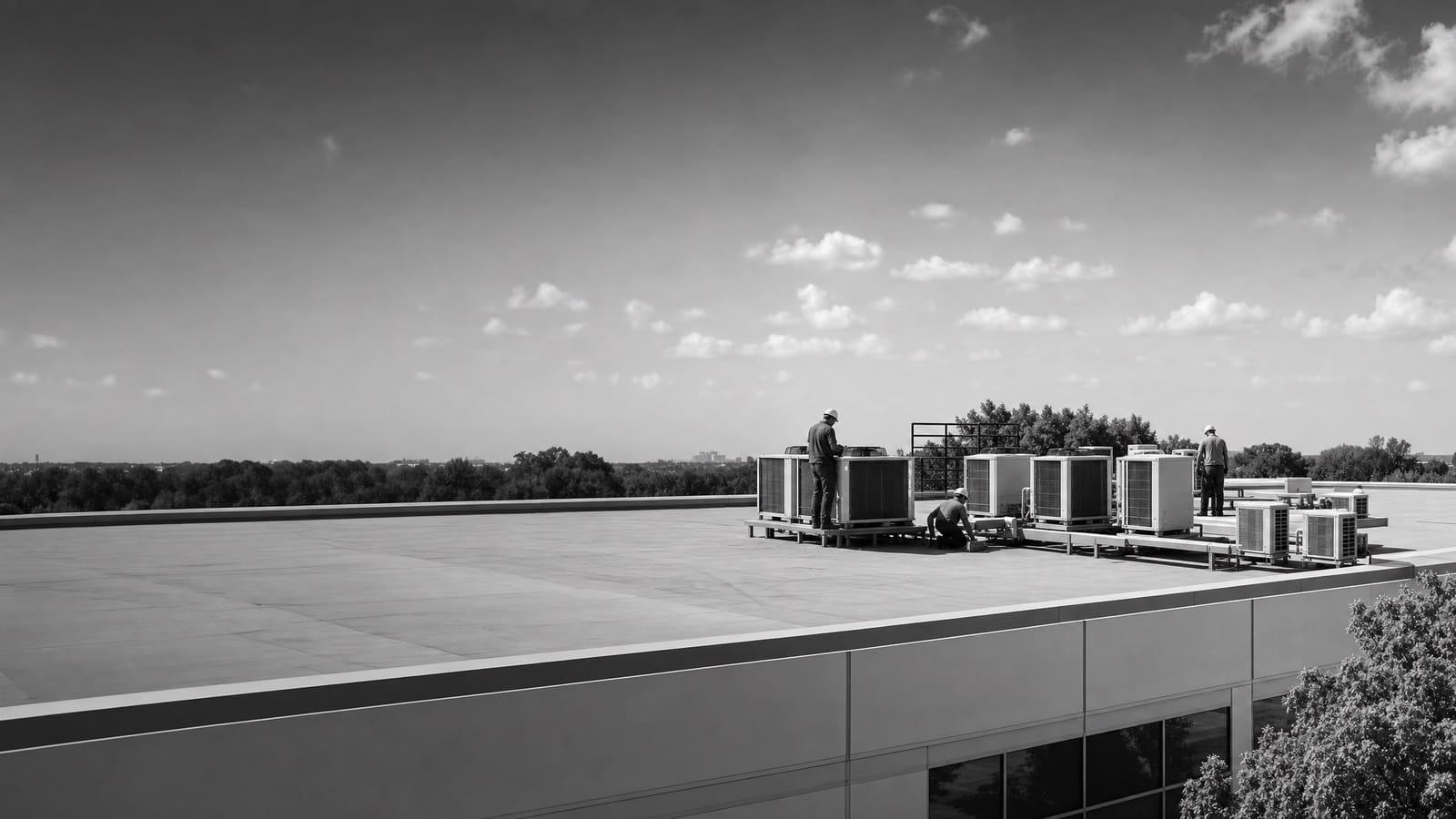
The visible part of a replacement is one morning. The crane arrives, stalls get coned off, the old unit comes off the curb, and the new one lands on an adapter measured weeks earlier. Everything that makes that morning boring happened in advance.
The buying mistake is treating the unit as the product. The product is a conditioned building, and the quote that wins on equipment price often loses on the lines around it: curb work, controls, disposal, and the day the lot is unusable. Ask each bidder to price the same scope in the same order.
Federal guidance is blunt about the other mistake, which is waiting for failure. Facility managers usually delay until the unit no longer conditions the space, needs constant service, or dies outright. Replacing proactively often beats replacement-on-failure, and it beats a like-for-like swap made under pressure. A planned project lets you shop equipment, schedule the crane on a slow day, and confirm incentives. An emergency swap takes whatever is available that week.
SCOPE CHECK
What makes a swap simple or complicated
Two replacements of the same tonnage can land a week apart on schedule and far apart on price. The difference is almost never the box. It is what surrounds it: the roof, the power, and the parking lot.
LOWER COMPLEXITY
Same size, same spot
The new unit matches the old footprint and weight. The existing curb takes an adapter, gas and electric stay as they are, and the lot gives a crane open reach. Permit scope stays mechanical and electrical, and the set happens in one morning.
HIGHER COMPLEXITY
New size, new service, tight roof
Tonnage or footprint grows, so the deck gets a structural look. Going all-electric adds panel and feeder work. A shared lot, a drive lane, or a neighbor's setback limits the crane, and the set gets split across nights or weekends.
BEFORE YOU PRICE IT
What a site review has to settle
A quote is only as good as the walk that produced it. The site review should end with four things settled, and you should be able to see all four in writing.
First, the load. Sizing from the old nameplate assumes nothing about the building changed, and something always changed: tenants, hours, lighting, a server closet, a wall that moved. Second, the roof. Someone has to look at the curb, the deck under it, and how the new unit's weight and footprint compare to what is up there now. Third, the infrastructure. Federal heat pump guidance calls out electrical capacity, physical constraints, and gas lines as the three items that decide whether an all-electric unit is even feasible at a given site. That check costs an hour and saves a change order. Fourth, access. Crane reach, lot closures, and the hours the building can afford to lose parking.
Contractor availability sits on that same federal checklist, and it is worth taking seriously. A unit type your service vendor cannot maintain is a problem you buy once and pay for every year after.
Ask for the four answers in writing
Load basis, roof and curb condition, electrical and gas capacity, and the crane plan. If a bidder cannot produce those four before quoting, the price is an estimate wearing a proposal's clothes, and the change orders will find you later.
IN INDIO
Permits and the desert heating question
Two local items change decisions here.
The first is the permit. In California, HVAC work is permitted through the city building department, and the triggers are written broadly. Mechanical upgrades and repairs are named alongside new installations, not just full replacements. Assume a rooftop change-out is permitted work, and confirm the current application and inspection sequence with Indio's building department before you set a crane date. Your contractor should carry that scope inside the installed price.
The second is the heating side of the equipment choice. Federal guidance places most of the U.S. West in the range where today's heat pump rooftop units handle most or all of the winter heating demand. For an Indio building, that means the all-electric option deserves a real price rather than a quick dismissal. The limiting factor is rarely the weather. It is the electrical capacity at the roof.
Confirm the permit path before the crane date
Permit review and inspection scheduling are the two things that slip a set day. Pull the application early, and make sure the quote states who files it, who meets the inspector, and whether the price includes both.
OWN IT OR OPERATE IT
Two things the quote does not decide
The install ends. The ownership does not. Two questions decide what the next decade costs, and both are easier to answer before you sign than after.
The first is the fleet. Most commercial buildings do not have one rooftop unit. They have several, at different ages. Rooftop equipment conditions close to half of all commercial floor area in the country, so this is the normal situation, not an unusual one. Replacing one failure at a time means you never get a volume price, never plan a crane day, and always buy under pressure.
The second is refrigerant. New equipment ships on newer low-GWP refrigerants while the older units on your roof do not. Federal rules govern how refrigerant is recovered, handled, and recycled, and certified technicians have to do that work. Mixed fleets are workable, but they change spare-parts strategy and what you should expect from a service contract.
FLEET PLANNING
Replace on a schedule, not on failure
Group the units by age and condition, then set a replacement order. A planned sequence gets you one mobilization, one permit cycle, and quotes you actually had time to compare.
SERVICE STRATEGY
Match the equipment to your vendor
Ask who maintains the new unit and whether they stock parts for it. Federal guidance lists contractor availability and knowledge as a real adoption constraint, and it shows up as downtime, not as a line on the quote.
THE LONGER VIEW
Phasing, procurement, and what the unit costs to run
Lifetime cost is where this decision actually gets made. An old, inefficient rooftop unit wastes somewhere between roughly $900 and $3,700 a year, per unit, by federal analysis. Multiply that by the number of tired units on your roof and by the years you plan to hold the building, and the case for moving early usually writes itself.
The efficiency spread is real too. The federal performance specification that pushed manufacturers to build better rooftop units targeted up to 50 percent less energy use than the standard of the day, and more than twenty models eventually exceeded it. The organizations that took this seriously, more than 200 of them across 43,000-plus units, reported a combined $37 million in annual energy savings. Those are portfolio numbers, not a promise for your building, but they show which direction the money runs.
On procurement, two habits pay. Ask for equipment availability next to the price, because a unit you cannot get is not a lower bid, it is a longer outage. And ask about incentives before you order. Federal guidance lists incentives among the factors that decide the equipment choice, and eligibility is far easier to confirm before a purchase order than after.
THE QUOTE CHECKLIST
Five things a comparable quote must show
Two bids for the same roof should read side by side. If one of these is missing, you are not comparing prices. You are comparing assumptions.
01
The load basis
How tonnage was determined: today's occupancy and use, or the old nameplate. The quote should say which.
02
Equipment and availability
Model, efficiency tier, refrigerant, and a real lead time sitting next to the price.
03
Roof and curb scope
Adapter, curb condition, any structural work, and who repairs the roofing around the opening.
04
Crane day and site impact
Rigging plan, hours, how many stalls close, and what happens if weather moves the date.
05
Permits, startup, and closeout
Who files, who meets the inspector, and what commissioning documents you receive: charge, airflow, controls, and warranty registration.
Get a defensible number
Price the equipment and the building together.
Send the address, operating target, and target opening date. Flux will identify what must be verified before the project can be priced.
Get a free estimateQuestions
Straight answers.
When does replacement beat another repair?
Once a unit is past 15 years old, no longer holds the space, and needs frequent service, the repair is buying time on a machine that federal analysis says can waste roughly $900 to $3,700 a year. Replacing before failure also gets you a planned schedule instead of whatever equipment happens to be available that week.
How long does the on-site work take?
The crane set and connections for a single packaged rooftop unit are a short, planned window, and tenants mostly notice the parking closure. The honest variable is equipment lead time, which is why availability belongs on the quote right next to the price.
Should an Indio building consider an all-electric heat pump unit?
It deserves a price. Federal guidance says today's heat pump rooftop units handle most or all of the winter heating demand across the U.S. South and West. The real screening questions are electrical capacity at the roof, physical constraints on the unit, and what happens to existing gas service.
Is a permit required to replace a rooftop unit?
Assume yes. California city building departments permit HVAC work, and the triggers are written to include mechanical upgrades and repairs, not only new installations. Confirm the current application and inspection steps with Indio's building department, and make sure the quote states who files and who meets the inspector.
What happens to the refrigerant in the old unit?
It has to be recovered by a certified technician. Federal rules under the Clean Air Act govern how refrigerant is handled and recycled in stationary air-conditioning equipment. New units ship on newer low-GWP refrigerants, which is worth planning for if your roof carries a mixed fleet.
Sources used for this guide
- [1]betterbuildingssolutioncenter.energy.gov — DOE Advanced Rooftop Unit Replacement Guidance
- [2]betterbuildingssolutioncenter.energy.gov — DOE Commercial Heat Pump Rooftop Unit Replacement Guidance
- [3]betterbuildingssolutioncenter.energy.gov — DOE High-Efficiency Commercial Rooftop Unit Toolkit
- [4]energy.gov — DOE Efficient Commercial Rooftop Air Conditioner Program
- [5]epa.gov — EPA Stationary HVAC Refrigerant Management
- [6]californiacity-ca.gov — HVAC Permits