THE DIRECT ANSWER
What a commercial HVAC replacement actually includes
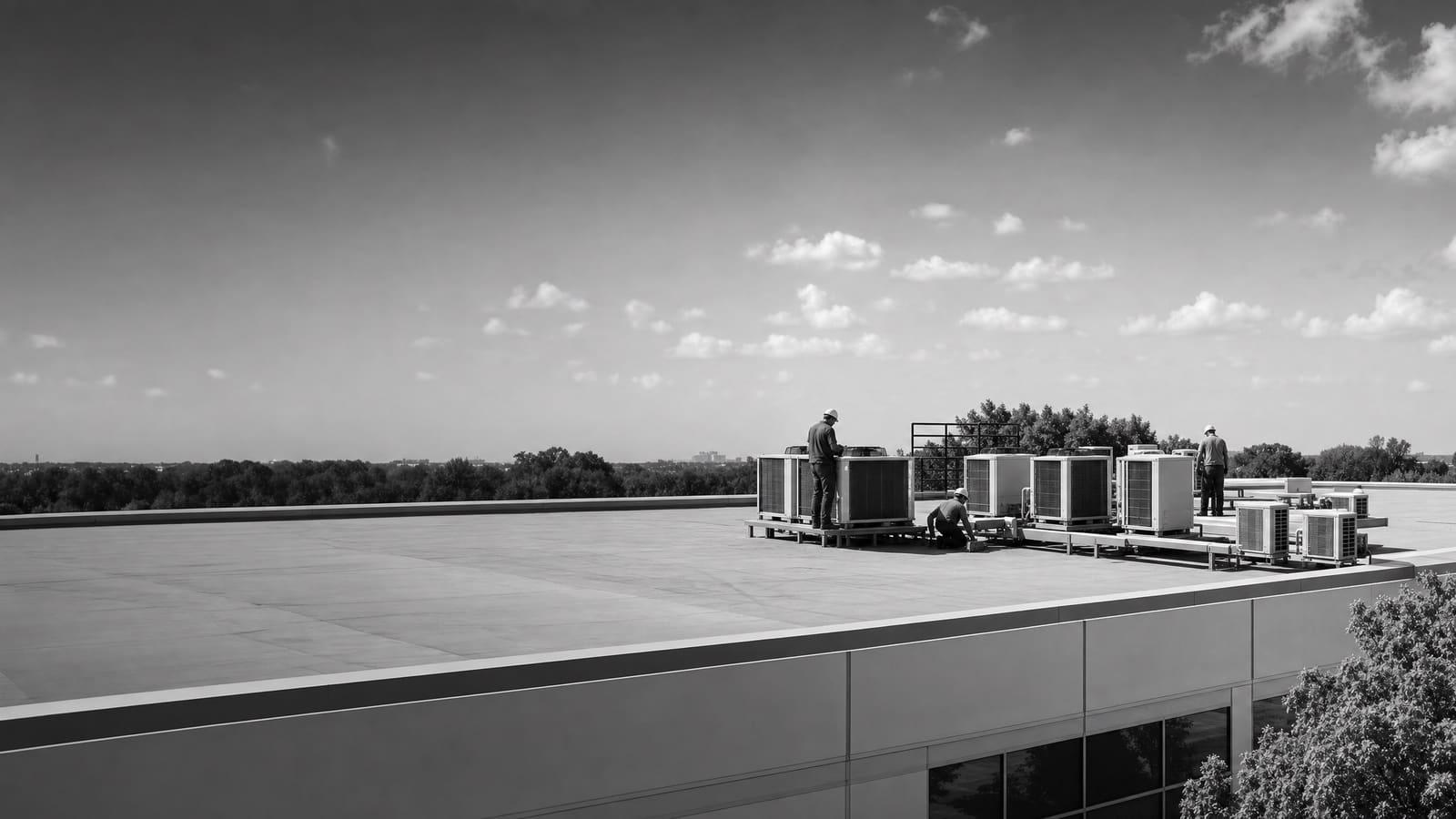
A commercial HVAC replacement covers a confirmed load calculation, equipment selected against real lead times, removal and rigging of the old unit, curb and connection work, and commissioning before handoff. Replacement beats another repair once the unit is wasting energy every hour it runs. Federal guidance flags rooftop units past fifteen years as substantial energy wasters, and estimates that old, inefficient units waste $900 to $3,700 per unit each year.
A site review has to confirm tonnage against how the space is used now, curb and roof condition, crane access, and whether the electrical service and gas lines support the equipment you actually want.
THREE WAYS TO GO
Three ways to handle an aging rooftop unit
Most owners treat rooftop replacement as an emergency purchase. Federal guidance points the other way: units get left in place until they stop holding the space, need frequent service, or fail outright, and that delay usually costs more than a planned swap would have. The same guidance is honest that replacement is not always the answer. A unit with service life left can sometimes be retrofitted with advanced controls instead, and the right call is whichever makes better financial sense for that specific unit.
The choice below is really about who sets the schedule. When the equipment sets it, you buy whatever is available that week. When you set it, you get to weigh efficiency tier, heating type, and install timing against your own operating calendar.
WHAT MOVES THE NUMBER
The budget lines that actually move
No one can price a commercial replacement from a tonnage number alone. These are the lines that separate a clean swap from an expensive one, and each should show up on the quote as its own number rather than disappearing into a single installed price.
BUYING GUIDANCE
How to choose the equipment, not just the size
The easiest replacement is a like-for-like swap: same tonnage, same fuel, same curb. It is fast and it is often correct, but it also carries forward whatever the old unit got wrong. If occupancy, layout, or plug load changed over the last two decades, the nameplate is a record of an older building, not the one you operate now.
The second decision is efficiency tier. Federal work with manufacturers produced a high-performance rooftop specification aimed at cutting unit energy use by up to half compared with the standard of its time, and more than twenty models now exceed that specification. A 2015 federal standard also raised the minimum any new commercial rooftop unit can meet, so even a base-tier unit today is meaningfully better than a twenty-year-old one.
The third decision is heating type. Heat pump rooftop units are built much like conventional air-conditioning units but add reverse-cycle heating. Federal guidance sorts them into dual-fuel, all-electric, and cold-climate versions, and states plainly that heat pump heating efficiency falls as outdoor temperature drops, trending toward electric resistance in the coldest hours. That is why the same guidance treats climate zone, electrical capacity, physical constraints, and existing gas lines as the checklist that decides which version, if any, fits a given site.
COMPLEXITY CHECK
What makes this job simple, and what makes it hard
Two replacements with the same tonnage can be very different projects. Before comparing prices, work out which of these descriptions matches your roof, because the gap between them is where quotes diverge.
LOWER COMPLEXITY
Same fuel, same footprint
The existing curb fits or takes a standard adapter, the space is still used the way it was designed, the electrical service already carries the load, and the lift has open lot space to work in. This is the swap that finishes on schedule with the fewest discovered items.
HIGHER COMPLEXITY
Fuel change or capacity change
Going all-electric, growing tonnage, or working around tight roof access adds review time. Federal guidance singles out electrical capacity, physical constraints, and gas lines as the items that most often stall a heat pump conversion, and any one of them can reset the schedule.
THE SITE REVIEW
What a real site review has to confirm
A quote written from a nameplate photo is a starting point, not a price. The nameplate tells you tonnage, fuel, and age. It tells you nothing about what the roof will allow, and roofs are where replacements get expensive.
A useful site review works through a short list. Is the load still what the nameplate says, given how the space is used today? Will the existing curb accept the new unit directly, or does it need an adapter, and can the structure carry the new weight? Where does the crane set up, how much of the lot does it occupy, and for how long? Does the electrical service have room for the equipment under consideration? Are the gas lines staying, moving, or being capped?
Federal heat pump guidance organizes much the same questions into a checklist, and it is worth borrowing whether or not a heat pump is on your list. Its point is that the infrastructure answers, not the equipment brochure, decide which options are genuinely available at a site. Answer them before you collect bids and the bids become comparable. Answer them afterward and the differences arrive as change orders.
Ask for the checklist, not just the number
Before you sign, ask which items were verified on the roof and which were assumed from drawings. Curb condition, structural capacity, electrical service, and crane staging are the four that most often turn into change orders when they were assumed.
OWNERSHIP CONSIDERATIONS
Two things that outlive the install
The install ends in a morning. The decision behind it stays on the roof for the rest of the unit's service life, and two consequences are worth settling before the order goes in.
The first is what the unit costs to run every hour it operates. Federal guidance is blunt that rooftop units past fifteen years can waste substantial energy compared with newer models, and a national upgrade campaign reported that more than 200 organizations upgrading over 43,000 units saved a combined $37 million a year on energy bills.
The second is what happens to the equipment you keep. Replacing one unit at a time is normal and sensible, but it leaves a building running a mix of generations. That mix is a service planning question more than a comfort question, and it is far easier to handle when it was chosen rather than discovered.
OPERATING COST
The bill you already pay
Old, inefficient rooftop units are estimated to waste $900 to $3,700 per unit each year. That figure never appears on a quote, which is why the cheapest unit on the page is not always the cheapest unit on the roof.
REFRIGERANT PLANNING
What the new unit runs on
EPA Section 608 rules cover the handling and recycling of refrigerant in stationary air-conditioning and heat pump equipment. Day-one operation does not change, but a fleet replaced unit by unit ends up with more than one refrigerant to service.
PHASING AND PROCUREMENT
Replacing several units without replacing them all at once
Buildings rarely have one aging unit. They have four, and three went up the same year. The temptation is to wait for each one to fail, which spreads the spending out but hands the schedule to the equipment. Federal guidance describes that pattern directly: owners delay until the unit no longer conditions the space, needs frequent maintenance, or fails completely, and proactive replacement is often the better business move than replacement-on-failure or even a like-for-like swap at the end of service life.
A phased plan does the same spreading on purpose. Rank the units by age, run hours, and how much service each absorbed last year. Replace the worst one first, using the specification you intend to standardize on. That first unit becomes your reference: you learn what curb work actually costs on your roof, how long the lift really takes, and whether the controls integrate the way the sales sheet promised. The next two get quoted against known conditions instead of guesses.
Lifetime cost is where phasing pays. The purchase price is a single event. The energy the unit uses, the service it needs, and the refrigerant it runs on repeat for as long as it stays up there. A unit chosen for the lowest install price and a unit chosen for the lowest ten-year cost are frequently different units, and the gap between them is almost never visible on a one-page quote.
QUOTE CHECKLIST
Five things a comparable quote has to show
Two quotes are only comparable when they price the same scope. If a bid is missing any of these, it is not cheaper — it is smaller. Ask for each one as its own line rather than a single installed number.
01
The exact unit, tier, and heating type
Model, tonnage, efficiency tier, and whether heating is gas, electric resistance, or heat pump.
02
Equipment lead time in writing
Availability belongs next to price. A cheaper unit twelve weeks out is a different offer than one sitting in regional stock.
03
Curb, adapter, and structural scope
What happens between the old curb and the new unit, and who pays if the roof needs work underneath it.
04
Crane day, lot closure, and rigging
Who supplies the crane, how much parking goes down, and for how long.
05
Refrigerant recovery, startup, and commissioning
Recovery from the old unit, plus documented charge, airflow, and controls verification before handoff.
Get a defensible number
Price the equipment and the building together.
Send the address, operating target, and target opening date. Flux will identify what must be verified before the project can be priced.
Get a free estimateQuestions
Straight answers.
When does replacement beat another repair?
Federal guidance points to age and run cost, not just the last breakdown. Rooftop units past fifteen years can waste substantial energy against newer models, and old, inefficient units are estimated to waste $900 to $3,700 each per year. When that waste plus repeat service is close to a payment on a new unit, replacement is the cheaper answer.
Should you replace like-for-like or resize?
Confirm the load either way. If the space is used the way it was designed, like-for-like is often right and it is the fastest path back to conditioning. If occupancy, layout, or equipment load changed, resizing fixes the comfort complaints the old unit was never able to solve.
Is a heat pump rooftop unit a good swap for a gas unit?
Sometimes. Heat pump rooftop units add reverse-cycle heating to otherwise similar equipment, and come as dual-fuel, all-electric, and cold-climate versions. Federal guidance is clear that heating efficiency drops as outdoor temperature falls, so the decision rests on climate zone, electrical capacity, physical constraints, and existing gas lines.
What sets the schedule on a replacement?
Equipment availability, more than the labor. The visible work on the roof is short and planned around your lot. The honest variable is how long the selected unit takes to arrive, which is exactly why lead time belongs on the quote next to the price.
Does a new unit change how refrigerant is handled?
The old unit's refrigerant has to be recovered under EPA Section 608 rules covering stationary refrigeration, air-conditioning, and heat pump equipment. Day-to-day operation of the new unit is unaffected, but a building replacing units one at a time should plan service contracts and spare parts around a mixed fleet.
Sources used for this guide
- [1]betterbuildingssolutioncenter.energy.gov — DOE Advanced Rooftop Unit Replacement Guidance
- [2]betterbuildingssolutioncenter.energy.gov — DOE Commercial Heat Pump Rooftop Unit Replacement Guidance
- [3]betterbuildingssolutioncenter.energy.gov — DOE High-Efficiency Commercial Rooftop Unit Toolkit
- [4]energy.gov — DOE Efficient Commercial Rooftop Air Conditioner Program
- [5]epa.gov — EPA Stationary HVAC Refrigerant Management