THE DIRECT ANSWER
What a commercial HVAC replacement actually includes
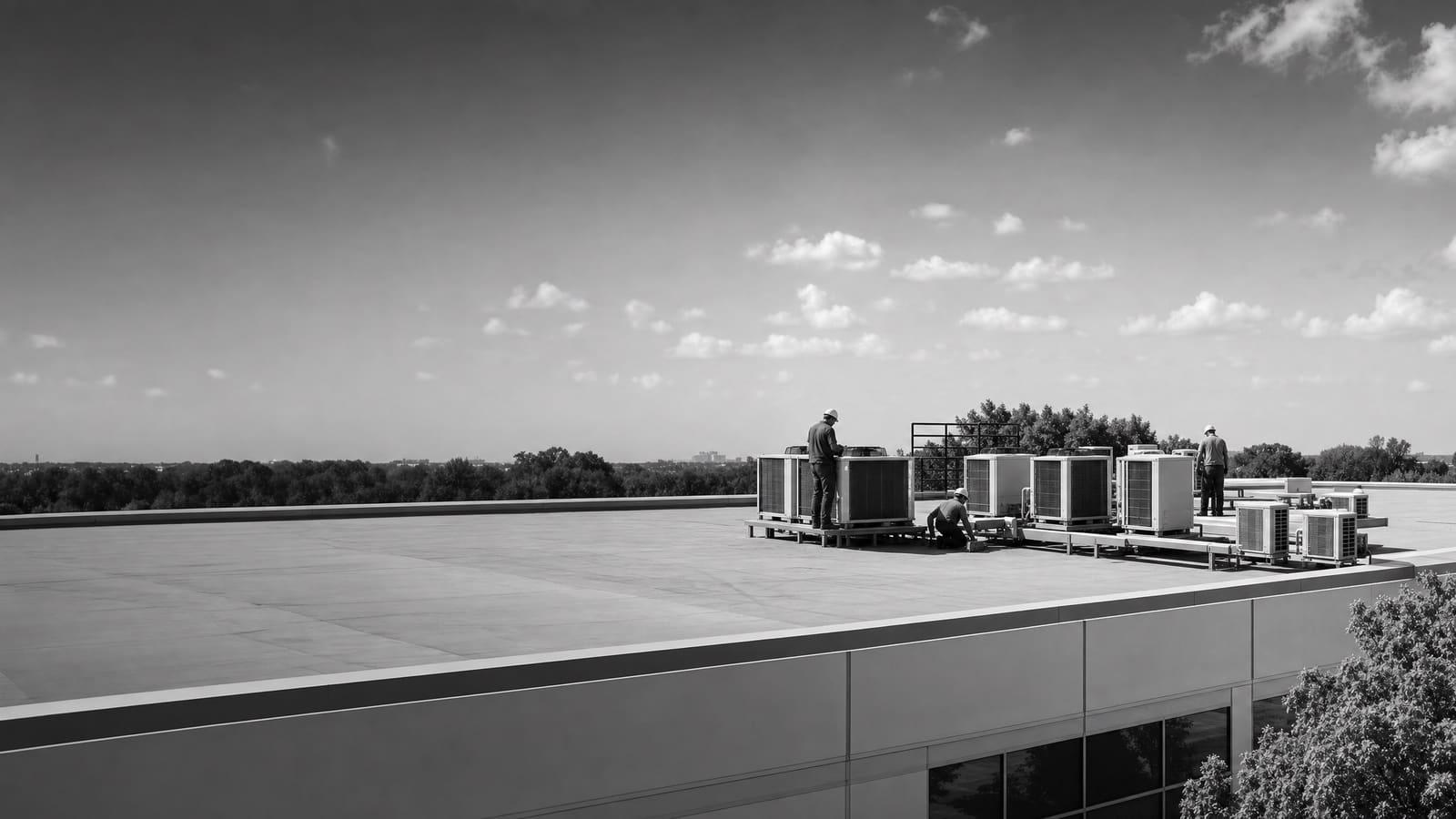
A commercial HVAC replacement covers load verification, equipment selection, certified recovery of the old refrigerant charge, removal and rigging, setting the new unit, gas and electrical connections, controls, permits, and commissioning. Replacement usually beats another repair once a rooftop unit passes about fifteen years. Old, inefficient units waste anywhere from $900 to $3,700 a year each in energy, and the repair bills keep arriving on top of that.
A site review still has to confirm tonnage against current use, curb dimensions and roof structure, crane access, and whether the electrical service has capacity for an all-electric unit.
THE DECISION
Three ways owners end up replacing a rooftop unit
Almost every commercial HVAC install starts from one of three positions, and the position you are in decides how much choice you actually get.
Waiting for failure is the most common and the most expensive. When a unit quits in August, you take whatever tonnage is available that week, pay emergency pricing, and then live with that selection for the next fifteen or twenty years.
A like-for-like swap at end of life is better. You control the date and the permits stay simple, but the old unit's sizing and efficiency tier come along for the ride.
A planned proactive replacement gives you the whole menu: right-sized equipment, a high-efficiency or heat pump unit, incentives confirmed before the order goes in, and a crane day scheduled around your tenants. Replacing an inefficient unit on purpose usually outperforms both replacement-on-failure and a like-for-like swap at the end of service life.
WHAT MOVES THE NUMBER
The lines that separate one quote from another
Nobody can price a rooftop replacement from a photo. These are the items that move the number most between one Huntington Beach roof and the next, ordered roughly by how much they vary.
EQUIPMENT CHOICE
Gas heat or a heat pump on the new unit
The biggest fork in a commercial replacement is no longer tonnage. It is whether the new unit heats with gas or with a reverse-cycle heat pump.
Heat pump rooftop units are close mechanical cousins of the air-conditioning units already sitting on most commercial roofs. They cool the same way and add heating by running the cycle backward. Their heating efficiency falls as outdoor temperatures drop, which is why they suit mild to moderate winters best. Across most of the South and West, today's heat pump rooftop units can cover most or all of a building's winter heating demand, and Huntington Beach sits squarely in that mild coastal band. The electric option deserves a real price here rather than a quick no.
Three configurations exist. Dual-fuel keeps a gas burner for the coldest hours. All-electric heats entirely with the heat pump and falls back to electric resistance heat. Cold-climate units are built for winters far harsher than this one. If you go all-electric, three things need checking before the order goes in: whether the service and panel can carry the added load, whether the unit's footprint fits the existing curb, and what happens to the gas line you are leaving behind.
SIDE BY SIDE
What makes one replacement simple and another complicated
Two buildings can carry the same tonnage and land in very different price brackets. The difference is almost always what the new unit asks of the building around it.
LOWER COMPLEXITY
Same fuel, same footprint
The replacement matches the old unit's tonnage, fuel type, and curb. The electrical service already carries the load, the roof deck is sound, and the crane has a clear shot from the lot. Permits stay routine and the swap lands inside one planned work window.
HIGHER COMPLEXITY
New fuel or new footprint
Tonnage grows, the unit goes all-electric, or the footprint no longer matches the curb. Now you may be looking at structural review, a service upgrade, a gas line to cap, tight crane reach, and a longer permit and inspection path.
SCOPING
What the site review has to confirm
A real quote comes out of a walk, not a phone call. The site review is where surprises get priced instead of discovered on crane day.
Start on the roof. Confirm the nameplate, the age, and the actual tonnage, then check curb dimensions and the structure underneath. Physical constraints matter more than owners expect: a unit two inches deeper than the old one can turn a simple set into a framing job.
Then the load. Twenty years of tenant changes, added equipment, and lighting retrofits mean the old nameplate is a starting guess, not an answer. Sizing from current use is what finally fixes comfort complaints the old unit could never resolve.
Then the infrastructure. Electrical capacity, gas line routing, and refrigerant line paths decide which equipment options are even on the table. Equipment availability belongs in that same conversation, because a unit you cannot get for ten weeks is not really an option in August.
Finally, incentives. Utility and federal programs for high-efficiency and heat pump rooftop units change over time, so confirm what is actually open before the order goes in rather than after.
Ask for this before crane day
A dated site report listing tonnage, curb dimensions, roof structure notes, electrical capacity, gas line disposition, crane staging, and a confirmed equipment lead time. A quote without those attached is an estimate wearing a quote's clothing.
LOCALLY
Permits and the Huntington Beach climate
Two local realities shape this project more than any other.
The first is climate. Winters here are mild by national standards, and heat pump rooftop units are at their most efficient in exactly that kind of weather. Current units across the West can typically carry most or all of a building's winter heating load, which is why the all-electric path is worth pricing rather than assuming gas.
The second is the permit. California building departments require a permit for mechanical equipment work and for the electrical work that comes with it. A rooftop replacement is a permitted job with an inspection attached, not a quiet same-day swap. Confirm current submittal and inspection requirements with the Huntington Beach building division before you set a crane date, because the inspection window, not the equipment, often decides your outage day.
Build the permit into the timeline
Have the contractor pull permits as part of the installed price and name the inspection step in the written schedule. Verify the current requirements and fees directly with the city building division, since local submittal rules change.
OWNERSHIP
Two questions to settle before picking equipment
Before a model number gets chosen, two questions decide who actually benefits from the decision.
The first is who pays and who saves. Under a net lease, the owner often funds the capital replacement while the tenant pays the utility bill. That split is the most common reason better equipment gets passed over: the party writing the check is not the party collecting the savings. Read the lease before you read the quote.
The second is whether this is one unit or the first of several. A building with four aging rooftop units is running a fleet, and fleet decisions are worth more than any single unit's price.
LEASE STRUCTURE
Who collects the savings
If the tenant pays the energy bill and the owner buys the equipment, someone has to bridge that gap. Some leases allow a capital pass-through for efficiency work. Check yours before ruling out the better unit.
FLEET PLANNING
One unit or the first of five
Standardizing tonnage, manufacturer, and controls across a roof shortens service calls, simplifies spare parts, and gives you leverage on the next order. Decide that on unit one, not unit four.
PHASING
Sequencing replacements instead of reacting to them
Most buildings do not replace one rooftop unit. They replace its neighbors over the following six years, usually in the worst possible order, which is whichever one fails first.
A phased plan reverses that. Inventory every unit with its age, tonnage, refrigerant, and condition. Rank by age and repair history, and put the oldest and least reliable at the front of the line. Then match that ranking to your capital calendar so replacements land in shoulder seasons, when lead times are shorter, crane scheduling is easier, and an outage does not cost you a summer day of business.
The savings argument compounds with each unit. The high-performance rooftop units developed under the federal efficiency challenge were built to cut energy use by up to half against the standard of their day, and the per-unit annual waste noted earlier stacks with every old unit you leave in place. Across four units, a phased plan often funds a meaningful share of itself.
The last piece is procurement. Lock lead times in writing. Equipment availability is a scheduling constraint, not a footnote, and it is the single item most likely to move your install date.
THE QUOTE
Five things a comparable quote has to show
Three quotes are only comparable if they describe the same job. When one of these lines is missing, you are not comparing prices, you are comparing assumptions.
01
Equipment, spelled out
Manufacturer, model, tonnage, efficiency tier, refrigerant, and heating type. Not simply "a 10-ton unit."
02
Confirmed lead time
A written availability date for the exact model quoted, not a general range.
03
Roof and curb scope
Curb adapter, any structural work, and who owns roof penetrations and patching.
04
Rigging and site logistics
Crane, lot closure time, staging, and the permit and inspection work included in the price.
05
Commissioning and closeout
Startup readings, charge, airflow, controls settings, refrigerant recovery records, and warranty registration.
Get a defensible number
Price the equipment and the building together.
Send the address, operating target, and target opening date. Flux will identify what must be verified before the project can be priced.
Get a free estimateQuestions
Straight answers.
When is replacing a rooftop unit better than one more repair?
Once a unit passes roughly fifteen years, the math usually turns. Units that old waste anywhere from $900 to $3,700 a year each in energy, and that runs alongside the repair invoices rather than instead of them. If the unit no longer holds the space, needs frequent service, or is on its second major component, replacement is the cheaper path.
Does a commercial HVAC replacement need a permit in Huntington Beach?
Plan on it. California building departments require permits for mechanical equipment work and for the electrical work that goes with it, and the job carries an inspection. Confirm current submittal requirements and fees with the Huntington Beach building division before scheduling the crane, and have the contractor include permits and inspection in the installed price.
Is a heat pump rooftop unit realistic on a building here?
Often yes. Heat pump rooftop units are most efficient in mild to moderate winters, and across the West current units can cover most or all of a building's winter heating demand. The deciding factors are local rates, whether your electrical service can carry the added load, and what happens to the existing gas line.
What actually sets the schedule on a replacement?
Rarely the crane. The physical set is usually the shortest part of the job. Equipment lead time and the permit and inspection window are what move the date, which is why a confirmed availability date belongs on the quote next to the price rather than in a follow-up email.
What happens to the refrigerant in the old unit?
Federal rules govern how refrigerant is handled and recycled when equipment is serviced or taken out of service, so the old charge must be recovered by certified technicians rather than vented. Ask for the recovery documentation as part of closeout, and confirm which refrigerant the new unit uses so service planning matches.
Sources used for this guide
- [1]betterbuildingssolutioncenter.energy.gov — DOE Advanced Rooftop Unit Replacement Guidance
- [2]betterbuildingssolutioncenter.energy.gov — DOE Commercial Heat Pump Rooftop Unit Replacement Guidance
- [3]betterbuildingssolutioncenter.energy.gov — DOE High-Efficiency Commercial Rooftop Unit Toolkit
- [4]energy.gov — DOE Efficient Commercial Rooftop Air Conditioner Program
- [5]epa.gov — EPA Stationary HVAC Refrigerant Management
- [6]californiacity-ca.gov — HVAC Permits