THE SHORT ANSWER
What a commercial HVAC replacement actually includes
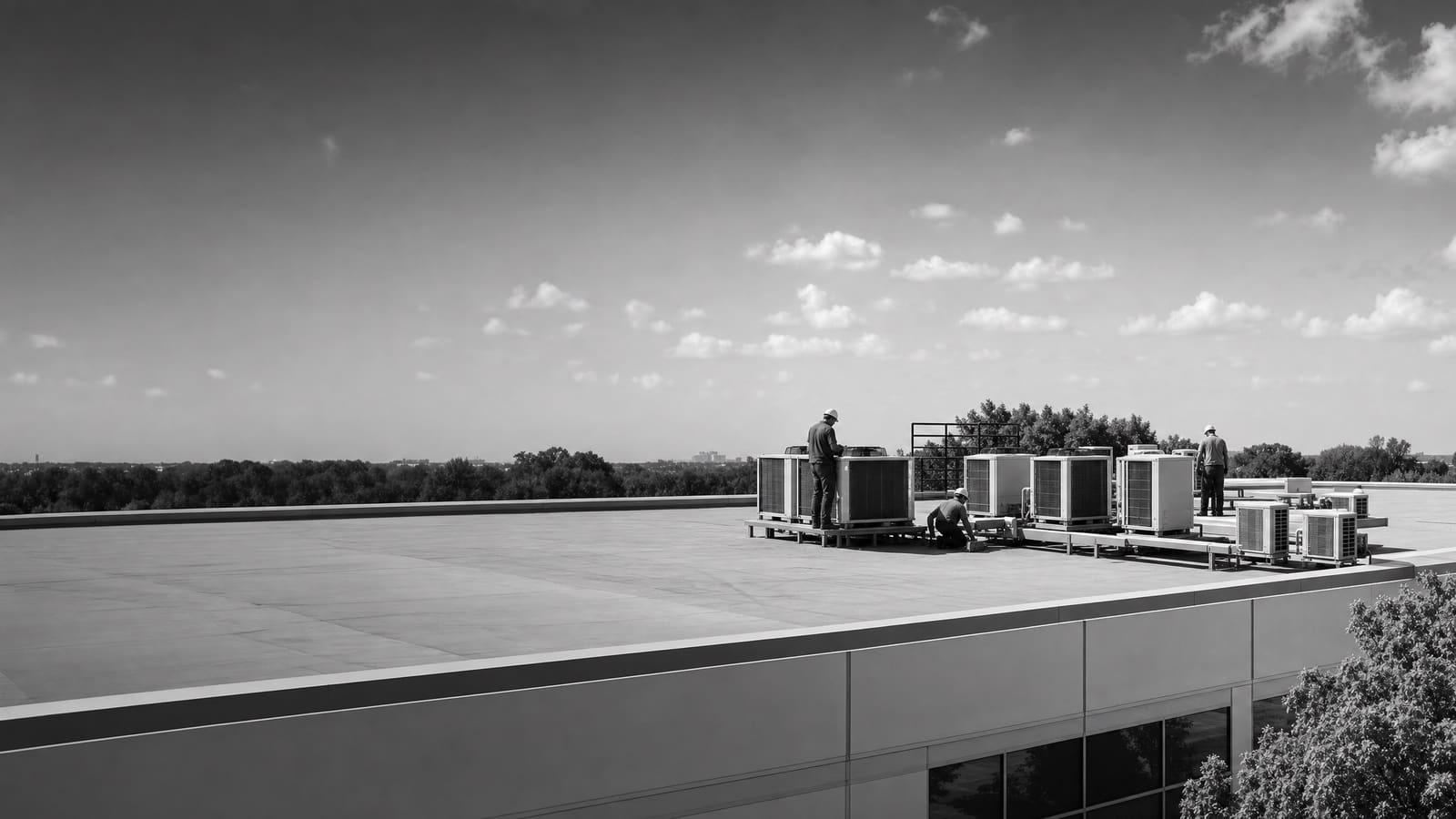
A commercial HVAC replacement covers a fresh load calculation, equipment selected against real lead times, curb adapter or structural work, the crane set, new gas, electric, and refrigerant connections, controls integration, permits, and commissioning. Replacement beats one more repair once the unit is losing money by itself. An old, inefficient rooftop unit can waste $900 to $3,700 a year in energy, and units past fifteen years are usually the ones doing it.
No price is real until someone stands on the roof. A site review has to confirm tonnage against current use, curb and structural condition, crane reach across the lot, and whether electrical service can carry the unit you want.
THREE WAYS TO GO
Three operating choices for the unit you are replacing
Most commercial replacements come down to three paths, and the difference between them gets decided before anyone orders equipment. The cheapest path repeats what is already on the roof. The middle path keeps the same fuel but corrects the size and buys a better efficiency tier. The third path changes how the building makes heat.
That third one deserves a real look now. Heat pump rooftop units are close cousins of standard air-conditioning units, and across the U.S. South today's models can handle most or all of a building's winter heating. What decides it is not the brochure. It is whether your electrical service has the capacity, whether the physical space on the roof works, what your gas and electric rates actually are, and whether a crew familiar with the equipment is available on your schedule. Some buildings in a portfolio pass that test and some do not, which is why the answer is per-roof rather than per-company.
WHAT MOVES THE NUMBER
The budget lines that decide your installed price
There is no single installed price for a commercial unit, and any number that arrives before a roof visit is a guess. What a real quote does is show which of these lines is carrying the cost, so you can see what you are paying for and where a choice still exists.
HOW TO BUY IT
How to decide between one more repair and a new unit
The honest test is not whether the unit still runs. It is whether it is quietly charging you every month for the privilege. Rooftop units condition close to half of all commercial floor space in this country, and the ones past fifteen years old are where the waste concentrates — often thousands of dollars a year per unit, before you count the repair calls. Set that against what another compressor costs and the math usually resolves itself.
What flips the answer toward repair is a young unit with a clean service history and a failure that is genuinely isolated. What flips it toward replacement is a pattern: two service calls a season, a refrigerant charge that never holds, comfort complaints the technician cannot fix, and a nameplate from a decade you would rather not name.
The trap in the middle is replacing on failure. Waiting until the unit dies hands the decision to whoever has stock that week. You take the tonnage that is available, the efficiency tier that is available, and the crane date that is available, and you pay a premium for the rush. Planning the swap a season ahead lets you compare equipment, price the curb work honestly, and pick a week when the building can spare the parking.
SITE COMPLEXITY
What makes one roof simple and another one complicated
Two buildings can order the same unit and get quotes that land far apart. The gap almost never comes from the equipment. It comes from what has to happen around it before the unit can land and run.
LOWER COMPLEXITY
Straight swap on an open lot
Same tonnage, an existing curb that is still sound, gas and electric already sized for the unit, and a lot with room for the crane to set up and reach. Occupancy has not changed since the last replacement. This is the one-morning version, and the quote should read that way.
HIGHER COMPLEXITY
Grown load, tight access, changed fuel
Tonnage went up, the curb needs an adapter or the deck needs structural review, the crane has to work from a street with limited staging, or electrical service has to be upgraded before an all-electric unit can run. Expect a longer schedule and more trades.
BEFORE YOU SIGN
What a proper site review has to confirm
A quote written from a nameplate photo is fine for a ballpark and useless for a contract. The site review is where surprises get priced instead of discovered.
Start with the load. Twenty years changes occupancy, plug load, lighting heat, and how much of the space is actually used. Sizing from the old nameplate carries forward whatever mistake was made last time, and oversized units short-cycle, dehumidify poorly, and wear themselves out early. Then the roof itself: curb dimensions, deck condition, and whether new weight triggers a structural look.
Infrastructure comes next, and this is where fuel-switch projects live or die. An all-electric unit needs electrical capacity a gas-heat building may never have needed. Confirm the panel, the service, and the conductor runs before anyone gets attached to the idea. Gas lines matter the same way in reverse.
Last, the refrigerant question. Federal rules govern how refrigerant is recovered, handled, and recycled when the old unit comes down, and that work belongs to the installer, not to a line you discover later.
Four things to nail down before the order goes in
A confirmed load from today's use, not the old nameplate. Curb and structural condition in writing. Electrical and gas capacity verified for the unit you actually want. And a stated equipment lead time, because availability moves your date more than anything else on the quote.
OWNERSHIP MATH
Two things that outlive the install day
The install is one morning. The consequences run for the life of the unit. Two decisions made during the quote stage set most of what you pay after the crane leaves, and neither shows up as a separate line on the invoice. The first is the efficiency tier, which is really a monthly utility decision wearing the costume of a one-time purchase. The second is whether the system gets commissioned or simply switched on. Both are easy to trade away when you are comparing bids under pressure, and both are expensive to fix afterward. Neither is exotic. They just get quiet when the conversation turns to the lowest number on the page.
OPERATING COST
Efficiency is a monthly bill, not a spec
High-performance rooftop units were built to cut energy use by as much as half against the old baseline, and more than twenty models now beat that specification. The tier you pick shows up on every utility bill for the rest of the unit's life, which is why it deserves more than a shrug during bid comparison.
PROOF OF WORK
Commissioning is what makes the warranty real
Startup, refrigerant charge, airflow, and control settings verified against spec and documented. It is the difference between a unit that performs like the one you bought and a unit that merely runs. Ask for the commissioning report by name and make handing it over a condition of final payment.
PHASING AND PROCUREMENT
Replacing several units without replacing your whole budget
Buildings rarely have one aging unit. They have five, and three of them went in the same year. That is a budgeting problem more than an engineering one, and it responds well to sequencing.
Rank the fleet by what each unit costs you now, not by age alone. The unit serving the space with the most complaints and the highest run hours is usually the one bleeding the most. Replace that one first, measure what actually changed on the bill, and use the result to justify the next two. A phased plan also spreads crane mobilizations across budget years instead of stacking them into one painful quarter.
Procurement is the other lever. Equipment lead time, not labor, is usually what sets your date, so order early and let the schedule follow availability rather than fight it. If you are weighing a fuel switch anywhere in the fleet, sort the roofs before you shop: the ones with electrical headroom and physical room are candidates now, and the ones that would need a service upgrade become candidates when that upgrade is on the table for another reason. Portfolio decisions almost never come out uniform, and a plan that pretends otherwise gets rewritten the first time someone opens a panel.
COMPARING QUOTES
Five things a comparable quote has to show
Bids that look far apart usually differ in what they left out. Line these five up side by side and most of the gap explains itself. If a quote will not put them in writing, that is your answer about how the project will run.
01
Equipment, named
Make, model, tonnage, efficiency tier, and heating type. Not "a 10-ton unit" — the actual model number you can look up yourself.
02
Lead time, in writing
Quoted availability with a date, not "a few weeks." This is the number most likely to move your project.
03
Curb, structural, and roof work
Adapter, any deck or framing work, and who is responsible for the roof penetration and the roof warranty afterward.
04
Crane and site logistics
Rigging plan, hours of lot closure, staging location, and whether after-hours work is included or billed extra.
05
Commissioning and closeout
Startup, charge, airflow, and controls verified against spec, plus documentation, warranty registration, and permits closed out.
Get a defensible number
Price the equipment and the building together.
Send the address, operating target, and target opening date. Flux will identify what must be verified before the project can be priced.
Get a free estimateQuestions
Straight answers.
How do you know when to replace instead of repair a commercial unit?
Look at the pattern, not the last breakdown. Repeat service calls, a charge that never holds, and complaints a technician cannot fix all point one direction. Old, inefficient rooftop units can waste $900 to $3,700 a year in energy on their own, and units past fifteen years are usually where that waste sits.
Is a heat pump rooftop unit worth considering for this building?
It is worth a look. Across the U.S. South, today's heat pump rooftop units can cover most or all of a building's winter heating. Whether yours qualifies depends on electrical capacity, roof space, your gas and electric rates, and crew availability, which makes it a per-building answer rather than a blanket one.
What does a commercial HVAC installation cost in Hoover?
Nobody can answer that from a phone call, and a number offered before a roof visit is a guess. Tonnage and efficiency tier set the base. Curb work, crane access, electrical or gas changes, and controls move it from there. Ask for those lines broken out so you can see what is actually driving the price.
How long does the replacement take once equipment arrives?
The visible work on a straightforward packaged swap is short: the crane sets, connections get made, and the unit is commissioned. Equipment lead time is the long pole, which is why availability belongs on the quote right next to the price.
What happens to the refrigerant in the old unit?
It is recovered and handled under federal rules that govern refrigerant in stationary air-conditioning equipment. That is the installer's responsibility and should sit inside the installed price. If you run a mixed fleet, ask how the new unit's refrigerant affects your parts and service planning.
Sources used for this guide
- [1]betterbuildingssolutioncenter.energy.gov — DOE Advanced Rooftop Unit Replacement Guidance
- [2]betterbuildingssolutioncenter.energy.gov — DOE Commercial Heat Pump Rooftop Unit Replacement Guidance
- [3]betterbuildingssolutioncenter.energy.gov — DOE High-Efficiency Commercial Rooftop Unit Toolkit
- [4]energy.gov — DOE Efficient Commercial Rooftop Air Conditioner Program
- [5]epa.gov — EPA Stationary HVAC Refrigerant Management