THE DIRECT ANSWER
What a commercial HVAC replacement includes
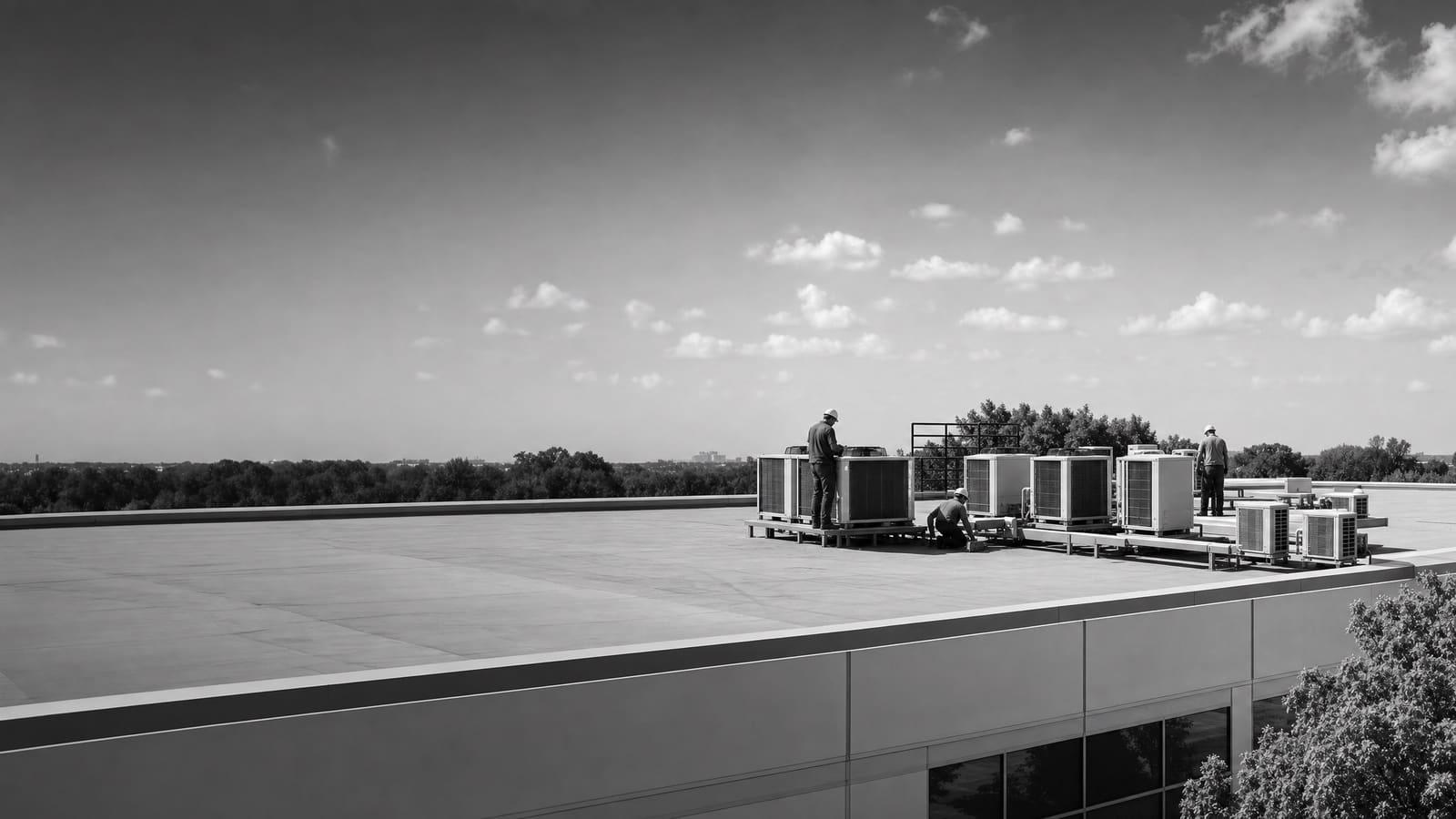
A commercial HVAC replacement covers a confirmed load calculation, equipment selected against real lead times, sealed permit drawings, curb work, the crane set, power and control connections, refrigerant recovery, and documented startup. Replacement beats one more repair once a rooftop unit passes about 15 years, because units that old waste far more energy than current models — the Department of Energy puts that waste at $900 to $3,700 per unit each year.
A site review still has to confirm curb size and roof structure, available electrical capacity, and whether current use matches the old nameplate. Those three checks decide whether the quoted price survives the install.
THREE WAYS TO GO
Three paths for a commercial rooftop replacement
Three paths cover almost every commercial replacement, and the right one depends on what changed in the building since the last unit went in.
Like-for-like is the fastest way back to cooling and the cheapest to engineer, but it carries forward whatever sizing mistake the old unit had. Right-sizing costs a design step and pays it back every month the unit runs. It is the honest answer when occupancy, plug loads, or operating hours have shifted.
The third path is the one more South Florida owners are weighing now. Heat pump rooftop units are built much like the air-conditioning units they replace, but add reverse-cycle heating. Department of Energy guidance says today's models handle most or all winter heating demand across the U.S. South, which describes Hollywood well. The catch is infrastructure: electrical capacity, physical fit, and existing gas lines decide whether the switch is a swap or a project.
WHAT MOVES THE PRICE
Where a commercial HVAC budget actually moves
Nobody can price a commercial rooftop replacement from a phone call, but the variables are knowable. These are the lines that move a real number, roughly in order of how much they swing it.
HOW TO BUY IT
Buy the installation, not just the box
The unit itself is the part everyone shops. It is also the part with the least room for a bad decision, because current models sit above an efficiency floor that a 2015 federal standard locked in. What separates two quotes for the same building is almost never the box. It is who owns the load calculation, the sealed drawings, the rigging plan, the inspections, and the startup report.
Ask every bidder to price the same scope. If one quote includes a curb adapter and a structural check and another does not, they are not the same project, and the cheaper one will find that work in week three. Controls are the same story: tying a new unit into an existing building automation system is either in the price or it is a change order.
Efficiency tier is the one place where a buying decision really is a buying decision. A higher tier costs more up front and returns it every month the unit runs. Before you order, check whether a utility or program incentive applies to the exact model you picked. Incentives are a standard part of the rooftop upgrade decision and their terms change, so confirm what is live when you buy rather than assuming last year's offer still stands.
COMPLEXITY CHECK
What makes this project simple or hard
Two replacements on the same street can price weeks apart. The gap is usually not the equipment. It is what has to change around it.
LOWER COMPLEXITY
Same curb, same power, same use
The new unit matches the old footprint, the electrical service already carries the load, the roof needs no framing work, and the space is used the way it was when the last unit went in. Permitting is straightforward and the set is a single morning.
HIGHER COMPLEXITY
New footprint or new fuel
Tonnage or footprint grows, framing has to be verified or reinforced, a gas unit becomes electric and the panel needs work, or the unit has to be craned over an occupied entrance. Each of those adds design time before it adds install time.
THE SITE REVIEW
What a real site review has to confirm
A site review is not a formality. It is where the quote either becomes real or falls apart, and three things get measured before anyone prices equipment.
First, the curb: its exact dimensions, its condition, and whether the structure under it carries the new unit's footprint and weight. A different footprint is what turns a mechanical job into a structural one.
Second, capacity at the panel. This is the check that decides whether an electric or heat pump option is affordable. If the new unit draws more than the old one and the service has no headroom, the electrical work can rival the cost of the equipment. Physical constraints and existing gas lines get walked at the same time.
Third, actual use. Sizing pulled from the old nameplate repeats a twenty-year-old assumption about a space whose occupancy, lighting, and plug loads have all changed since. A load calculation against how the building runs today is cheap next to living with a unit that short-cycles or never quite keeps up in August.
What to require in writing
Ask that the quote name the curb adapter, the structural verification, the electrical scope, and the basis for the load. If any of those four is missing, you are comparing bids on different projects.
IN HOLLYWOOD
Florida permitting adds a design step before the crane
Florida building departments treat commercial HVAC work as a design submittal, not a paperwork formality. Published guidance for commercial alteration permits calls for mechanical plans signed and sealed by a Florida-licensed engineer or architect whenever the scope includes installing or relocating equipment such as HVAC. Energy calculations are required any time the scope touches heating, ventilation, or air conditioning. Drawings have to show equipment location, and if roof framing is repaired or altered to carry a new curb, framing plans and sections come with it.
That shapes sequencing more than cost. Started early, the design step runs alongside equipment lead time. Started late, it runs after it. Submittal checklists are published per jurisdiction, so confirm Hollywood's current requirements with the city building department before drawings go out.
Start the drawings, not just the order
If a unit is already failing, engage the engineer the same week you request equipment pricing. Sealed mechanical plans and energy calculations take time you cannot buy back once the crane date is set.
AFTER THE CRANE LEAVES
Two things that outlive install day
The install day gets the attention, and it is the shortest part of the decision. What you are really buying is a long-lived asset on your roof and the service relationship that keeps it running. Two questions are worth settling before the crane shows up: what refrigerant the new unit runs and how that fits the rest of your fleet, and whether the next replacement will be a plan or an emergency. Neither one changes the price on this quote. Both change what the next several years cost to operate.
REFRIGERANT
Plan for a mixed roof
New equipment ships on newer low-GWP refrigerant, so a roof replaced in phases will run more than one type at once. EPA rules under the Clean Air Act govern how refrigerant is handled and recycled in stationary air-conditioning and heat pump equipment, so recovery from the old unit is certified work with a paper trail.
TIMING
Decide before the unit decides
Managers commonly delay until a unit can no longer hold the space, needs constant service, or fails outright. Replacing proactively usually beats replacement-on-failure, because you control the model, the lead time, the crane date, and whether the building stays open through it.
PHASING AND LIFETIME COST
Replacing a roof full of units without doing it all at once
Buildings rarely have one unit and one problem. A roof with six units usually has six different ages, and replacing all of them in one year is a capital request nobody approves. Phasing works better anyway. Replace the oldest and worst-performing first, measure what actually changed on the bill, and use that result to justify the next two.
There is a real argument for moving before failure. Wait for the breakdown and the replacement gets chosen under pressure, from whatever is in stock, with a crane scheduled at whatever a rush costs. Planned replacement of old, inefficient units is frequently the better business move than replacement-on-failure, and often better than a like-for-like swap at the end of service life.
The scale here is not small. More than 200 organizations upgrading over 43,000 rooftop units together cut about $37 million a year from their energy bills. That is an average across a lot of buildings, not a promise about your roof, but it points the direction. Model the multi-year cost of keeping the old unit — service calls, refrigerant, and the energy penalty — next to the installed price of the new one, and the decision usually makes itself.
COMPARING QUOTES
Five things a comparable quote shows
Two commercial HVAC quotes are only comparable if they show the same five things. If one is missing, ask for it before you compare totals. The gap between the numbers is usually hiding right there.
01
Model, tonnage, and efficiency tier
The exact model number and its efficiency rating, plus whether it is stocked or built to order and the lead time that comes with that answer.
02
The basis for the sizing
A plain statement of where the load came from: today's occupancy and equipment, or the old unit's nameplate.
03
Roof, curb, and structural scope
Curb adapter, any framing work, and who verifies that the structure carries the new footprint and weight.
04
Design, permit, and inspection line
Sealed mechanical plans, energy calculations, permit fees, and which inspections the contractor owns from submittal to sign-off.
05
Rigging, startup, and closeout
Crane plan and lot closure, certified refrigerant recovery, commissioning results, and the warranty registration documents you keep.
Get a defensible number
Price the equipment and the building together.
Send the address, operating target, and target opening date. Flux will identify what must be verified before the project can be priced.
Get a free estimateQuestions
Straight answers.
When does replacement beat another repair?
Past about 15 years, the math usually favors replacement. Units that old waste substantial energy against current models, and the Department of Energy puts that waste at $900 to $3,700 per unit each year. Add repeat service calls and a unit that no longer holds the space, and repair is just rent on the problem.
Does a heat pump rooftop unit make sense in South Florida?
Often, yes. Heat pump rooftop units are built much like the AC units they replace, and federal guidance says today's models cover most or all winter heating demand across the U.S. South. Before committing, check three things: electrical capacity at the panel, physical fit on the existing curb, and what happens to any gas line serving the old unit.
What does Florida permitting require for a rooftop replacement?
Commercial alteration work that installs or relocates HVAC equipment calls for mechanical plans signed and sealed by a Florida-licensed engineer or architect, energy calculations, and drawings showing equipment location. If roof framing is altered to carry a new curb, framing plans come too. Confirm Hollywood's current submittal checklist with the city building department.
What happens to the refrigerant in the old unit?
It gets recovered, not vented. EPA regulations under the Clean Air Act govern how refrigerant is handled and recycled in stationary refrigeration, air-conditioning, and heat pump equipment, so recovery is certified work. Ask for the recovery documentation as part of closeout, especially if the old unit runs an older refrigerant.
Why won't anyone quote a firm price over the phone?
Because the three things that move the number most are only visible on site: the curb and the structure under it, the electrical headroom, and how the space is actually used today. A phone number is a guess. Send a nameplate photo to start equipment options and lead times, then let the site review fix the price.
Sources used for this guide
- [1]betterbuildingssolutioncenter.energy.gov — DOE Advanced Rooftop Unit Replacement Guidance
- [2]betterbuildingssolutioncenter.energy.gov — DOE Commercial Heat Pump Rooftop Unit Replacement Guidance
- [3]betterbuildingssolutioncenter.energy.gov — DOE High-Efficiency Commercial Rooftop Unit Toolkit
- [4]energy.gov — DOE Efficient Commercial Rooftop Air Conditioner Program
- [5]epa.gov — EPA Stationary HVAC Refrigerant Management
- [6]tampa.gov — Permit Application Guide Commercial Alteration