THE SHORT ANSWER
What a commercial HVAC replacement includes
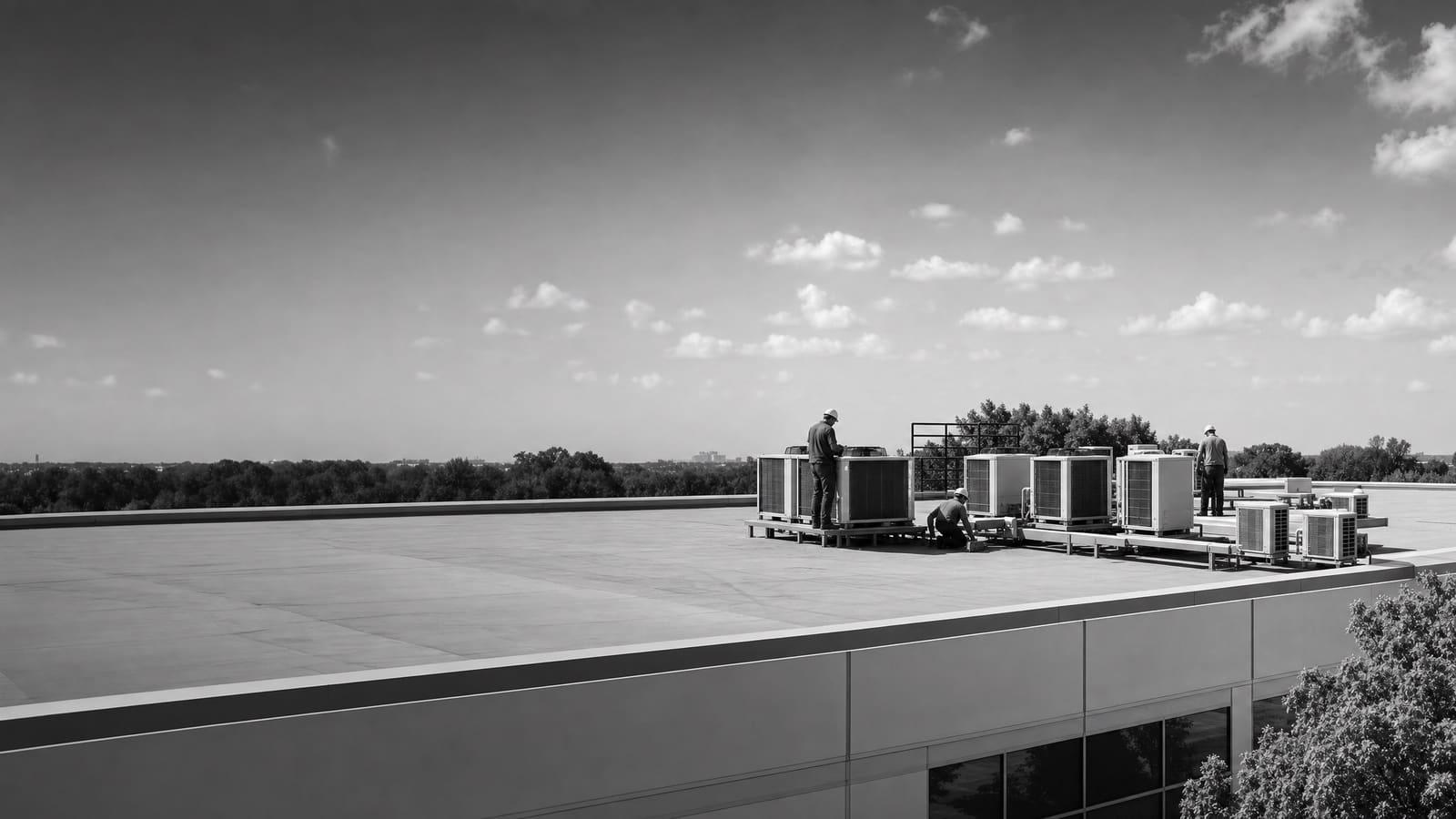
A commercial HVAC replacement covers the load calculation, equipment selection, rigging and set, the curb adapter that mates a new unit to an old opening, gas and electrical connections, controls, permits, and commissioning. Replacement beats one more repair once the unit is losing money every month it runs. Federal analysis puts the waste from an old, inefficient rooftop unit at roughly $900 to $3,700 a year, and units past fifteen years are the usual culprits.
A site review still has to confirm what the price assumes: real load for how the space is used now, roof and curb condition, available electrical capacity, and crane access.
THREE WAYS TO GO
Three replacement paths worth pricing
Packaged rooftop units condition close to half of all commercial floor area in the country, so most replacement decisions narrow to three paths. Like-for-like keeps the existing curb, connections, and fuel. A high-efficiency unit spends more up front to cut run cost; the federal performance specification that pushed this class into the market targeted energy use up to 50 percent below the prior standard, and more than twenty models now exceed it. A heat pump rooftop unit is built much like a cooling unit but adds reverse-cycle heating, and it comes in dual-fuel, all-electric, and cold-climate versions. Which path fits depends on run hours, heating load, and what your electrical service can carry.
WHAT MOVES THE NUMBER
Where the money actually goes
The unit is rarely the line that surprises people. The work around the unit is. These are the lines to make a quote show separately, so you can tell whether two bids are priced on the same scope.
IN PRACTICE
Choosing between one more repair and a replacement
Most facility teams wait. Federal guidance describes the pattern plainly: managers hold off on a new unit until the old one stops holding the space, needs constant service calls, or dies outright. That habit is expensive. The same guidance points out that replacing a tired unit on purpose often beats both replacement-on-failure and a plain like-for-like swap at the end of service life, because a failure forces you to take whatever equipment is available that week.
So the useful question is not whether the unit can be repaired. It usually can. The question is what the next three years look like. If the unit is past fifteen years, needs refrigerant more than once a season, and the space still runs warm on design days, another repair is buying time at a bad price.
When replacement is the answer, size it against how the building is used today. Occupancy, plug loads, lighting, and envelope work all change what the space needs, and the nameplate on a twenty-year-old unit records none of that. A short load calculation is cheap next to a unit that short-cycles for the next two decades.
SCOPE CHECK
Simple job or complicated one
Two buildings on the same street can get very different numbers for the same tonnage. Complexity comes from the conditions around the unit, not the unit.
LOWER COMPLEXITY
Straight swap conditions
Same tonnage and fuel, existing curb reused, clear crane setup within reach of the roof, adequate electrical service already in place, and a controls package the building can already talk to.
HIGHER COMPLEXITY
Conditions that add scope
Larger footprint or tonnage, a curb that needs structural review, tight or shared parking that limits crane setup, a service upgrade for all-electric equipment, and gas line changes on the way out.
BEFORE YOU SIGN
What a real site review has to settle
A quote written from a phone call is a guess wearing a number. Someone has to get on the roof first.
The review should confirm the load for current use, the condition of the curb and the roofing around it, and whether the new unit will land on the existing opening or need an adapter. It should confirm how a crane gets set, what it can reach, and how long the lot can be closed. On the mechanical side, it should confirm available electrical capacity, existing gas service, and any physical constraints on the roof. Federal heat pump guidance lists exactly those three infrastructure items, plus equipment availability and contractor familiarity with the technology, as the things that decide whether a switch is realistic.
It should also settle timing. Availability belongs next to price on the quote, because the fastest crew on paper is not fast if the unit is eight weeks out. Finally, ask whether any incentive program applies to the equipment class you are considering, and confirm the current terms in writing before you count on the money.
Confirm these five before the price is final
Load calculated from today's use. Curb and roof condition documented. Electrical capacity and gas service verified. Crane setup and lot closure planned. Equipment availability stated as a date, not a hope.
OWNING THE DECISION
Two things that outlive the install
The install ends in a day or two. The consequences of how you bought it last as long as the equipment does. Two of them are worth thinking about before you pick a path, because they are hard to change afterward.
The first is whether you are replacing on a schedule or on a failure. The second is what happens to your service strategy when one roof carries equipment from different eras, on different refrigerants, with different parts behind them.
TIMING
Planned beats forced
A planned replacement lets you compare equipment, take a lead time, and pick your outage window. A failure in season removes all three choices at once and usually costs more for a worse fit.
FLEET
Mixed equipment, mixed service
New units ship on newer refrigerants. That changes nothing day one, but it does affect parts stocking and technician coverage. EPA Section 608 rules govern handling on both the old unit and the new one.
PHASING AND LIFETIME COST
Replacing several units without a single painful year
If your roof carries more than one aging unit, phasing is the real decision. Replacing all of them at once gets the best equipment pricing and one mobilization, but it puts the whole cost in one budget year. Replacing one at a time spreads the spend and lets you learn from the first install, at the cost of repeating the crane day.
A middle path works for most buildings. Rank the units by age, service history, and how much of the occupied space they carry. Replace the worst one first, on purpose, and let it set the standard for the rest. Then hold the remaining units on maintenance until their number comes up or they fail, whichever arrives first.
The portfolio math supports patience with a plan. Through the federal rooftop unit campaign, more than 200 organizations upgraded over 43,000 units and cut a combined $37 million a year from their energy bills. None of that came from one heroic budget year. It came from replacing tired equipment deliberately, unit by unit, instead of waiting for each one to quit.
QUOTE CHECKLIST
Five things a comparable quote shows
If two bids differ by a wide margin, one of these lines is usually missing from the cheaper one. Ask for all five in writing before you compare prices.
01
The unit, spelled out
Make, model, tonnage, fuel type, and efficiency tier. Not just tons.
02
Curb and roof scope
Whether the existing curb is reused, what adapter is needed, and who patches the roofing.
03
Rigging and lot plan
Crane size, setup location, closure hours, and who coordinates with tenants.
04
Permits and inspections
Which permits the contractor pulls and who carries the inspections to sign-off.
05
Commissioning and lead time
Startup checks documented at handoff, plus a real equipment availability date.
Get a defensible number
Price the equipment and the building together.
Send the address, operating target, and target opening date. Flux will identify what must be verified before the project can be priced.
Get a free estimateQuestions
Straight answers.
When does replacement beat another repair?
When the unit is old enough that running it is the expense. Federal guidance flags units past fifteen years as heavy energy wasters, and puts the annual waste from an old, inefficient rooftop unit at roughly $900 to $3,700. Repeated repairs on top of that rarely pencil out.
Should the new unit match the old one's size?
Only if the space is used the same way. Occupancy, equipment loads, lighting, and envelope changes all move the number, and the old nameplate records none of that. A load calculation before selection costs little and prevents twenty years of short cycling.
Is a heat pump rooftop unit worth considering?
It is worth pricing. Heat pump rooftop units are built much like cooling units but add reverse-cycle heating, and they come in dual-fuel, all-electric, and cold-climate versions. They do their best work where winter heating demand is mild to moderate, so confirm your heating load and electrical capacity first.
What is most likely to blow up the budget?
Not the unit. It is the work around it: a curb adapter and structural review when the footprint changes, difficult crane access, and electrical service that cannot carry all-electric equipment. Federal guidance names electrical capacity, physical constraints, and gas lines as the infrastructure checks to run early.
What happens to the refrigerant in the old unit?
It has to be recovered by a certified technician. EPA Section 608 rules under the Clean Air Act govern how refrigerant is handled and recycled in stationary cooling and heat pump equipment. That work belongs on the quote as a compliance line, not as something to shop for a discount on.
Sources used for this guide
- [1]betterbuildingssolutioncenter.energy.gov — DOE Advanced Rooftop Unit Replacement Guidance
- [2]betterbuildingssolutioncenter.energy.gov — DOE Commercial Heat Pump Rooftop Unit Replacement Guidance
- [3]betterbuildingssolutioncenter.energy.gov — DOE High-Efficiency Commercial Rooftop Unit Toolkit
- [4]energy.gov — DOE Efficient Commercial Rooftop Air Conditioner Program
- [5]epa.gov — EPA Stationary HVAC Refrigerant Management