THE DIRECT ANSWER
What a commercial HVAC replacement actually includes
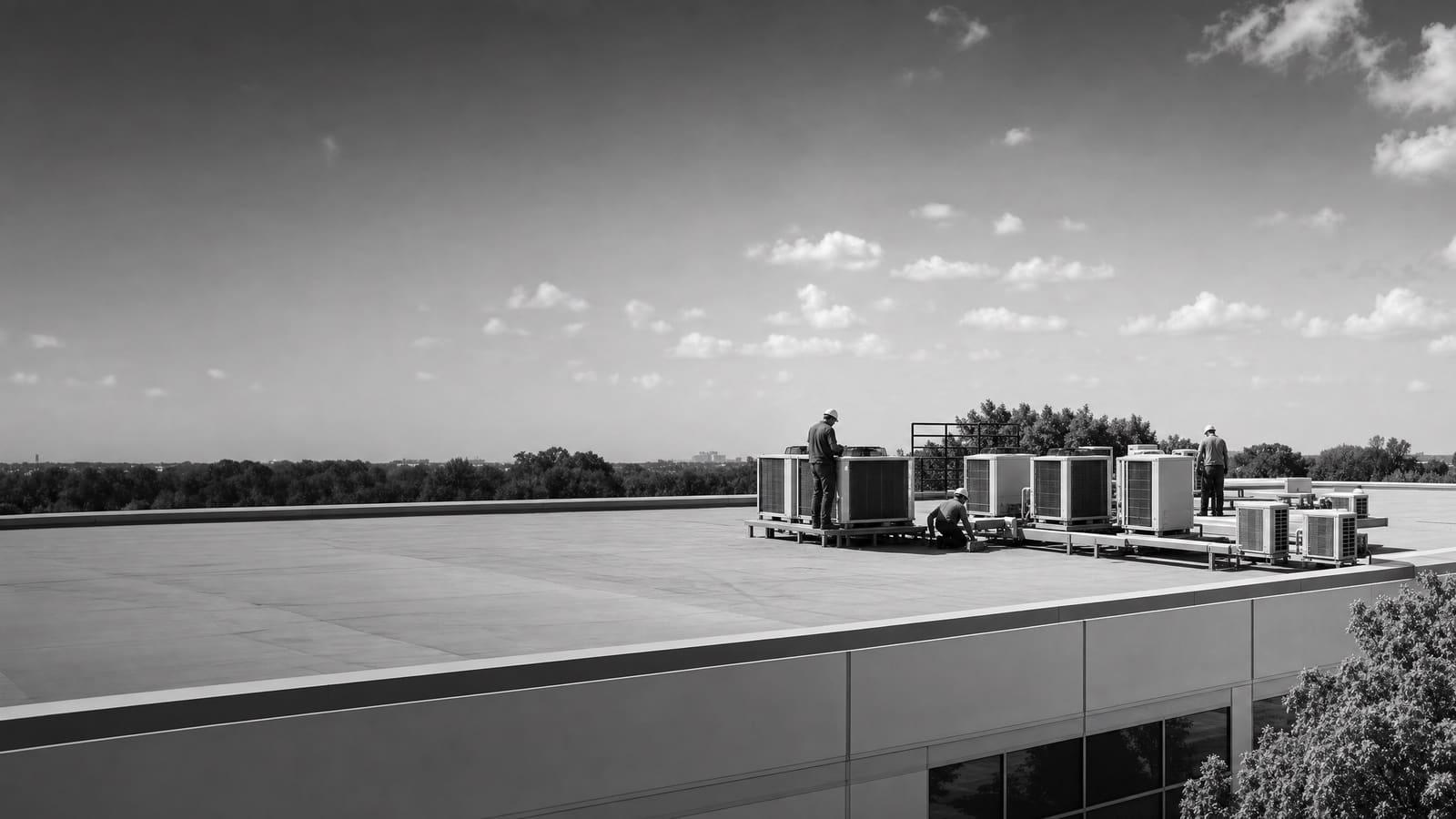
A commercial HVAC replacement covers a confirmed load calculation, equipment selected against real lead times, rigging the old unit off, curb and connection work, permits and inspections, controls integration, and documented commissioning. Replacement usually beats another repair once a unit passes about 15 years. Department of Energy figures put the annual waste from an old, inefficient rooftop unit at $900 to $3,700. Past that point, repair dollars are buying time on equipment that is already costing you money every month.
A site review has to confirm the actual load, the curb and roof structure, available electrical capacity, and crane reach before any of those numbers hold.
THREE WAYS TO GO
Three replacement paths worth pricing
Most commercial replacements land on one of three paths, and the right one depends on how much you want to change while the crane is already there.
The cheapest decision today is a matching unit on the same curb. It is also the decision that carries forward whatever the old unit got wrong. A high-efficiency unit costs more up front and pays back through the meter; the Department of Energy's high-performance rooftop specification targeted energy use up to 50 percent below the prevailing standard, and manufacturers responded with more than twenty models that exceed it. A heat pump rooftop unit adds reverse-cycle heating and comes in dual-fuel, all-electric, and cold-climate versions.
Heat pump units are the choice with the most homework attached. Federal adoption guidance points at climate and heating load, electricity and gas prices, electrical capacity at the panel, physical constraints on the roof, existing gas lines, and available incentives. Any of those can rule the option in or out before price ever enters the conversation.
WHAT MOVES THE NUMBER
Where commercial HVAC quotes actually diverge
Two quotes for the same tonnage can sit thousands apart, and the gap is almost never the box itself. These are the lines that move, listed with how much they tend to swing.
IN PRACTICE
Buying the unit versus buying the install
Rooftop units cool close to half of all commercial floor space in the country, which makes the packaged replacement the most routine project in commercial mechanical work — and one of the easiest to buy badly. The equipment is a catalog item. The install is not.
The part worth your attention is the sizing decision. Twenty years changes a building: occupancy shifts, lighting loads drop, plug loads climb, and someone put a wall where the plan showed open floor. A load calculation done from current use gives you a real answer about whether the replacement should match the old tonnage or move off it. Skipping it means paying for the original mistake a second time.
The second is timing. Federal guidance is blunt about the pattern: facility managers tend to wait until a unit fails outright, then buy whatever is available that week. That is the most expensive way to make this decision. A planned replacement lets you compare efficiency tiers, order ahead of the lead time, schedule the crane on a low-traffic morning, and negotiate. An emergency replacement lets you do none of that. If a unit on your roof is past fifteen years, the useful move is to price the replacement now and hold the number.
COMPLEXITY CHECK
What makes this a simple job or a hard one
Before you get a number, it helps to know which project you have. The difference shows up in permitting, in lead time, and in how long the crane sits in your lot.
LOWER COMPLEXITY
Straight swap on an existing curb
Same tonnage, same fuel, same footprint, and an open lot the crane can reach. Structural and electrical stay as they are, permitting is routine, and the on-site work is measured in a morning rather than a week.
HIGHER COMPLEXITY
New footprint, new fuel, or new load
Tonnage changes, the unit moves to a heat pump, or the roof needs structural review. Now you are coordinating panel capacity, gas line abandonment, curb adaptation, and a longer permit path — plus equipment that may not sit in regional stock.
BEFORE YOU BUY
What a real site review has to settle
A quote written from a phone call is a guess with a number attached. The site review is what turns it into a price you can hold someone to, and it is short — usually an hour on the roof and in the electrical room.
The reviewer should come off the roof knowing the existing unit's tonnage, age, and refrigerant, the condition of the curb, whether the deck can carry a heavier unit, and how much clear space surrounds the equipment. In the electrical room, they should know the available panel capacity and what the existing feed can support. Both matter more than usual if a heat pump is on the table, since federal adoption guidance treats electrical capacity, physical constraints, and existing gas lines as gating items rather than details.
The other half happens in the parking lot. Crane reach determines how many stalls come out of service and for how long, which in a tenant-occupied building is the part people actually notice. Get the closure window in writing.
Refrigerant handling is not optional and belongs on the scope. EPA rules under Section 608 govern how refrigerant is recovered and handled when equipment comes out of service, and pulling your old unit falls under them.
Ask for these five before signing
The load calculation, the tonnage and efficiency tier selected, the curb and structural plan, the confirmed lead time, and the parking closure window. If a quote is missing any of them, you are comparing prices for different projects.
AFTER THE INSTALL
Two things that outlive the invoice
The install ends. The decisions you made during it keep showing up on the operating budget and in the service contract for as long as the unit stays on the roof.
Two of them matter more than the rest. The first is what you did about efficiency, because that difference shows up monthly whether or not anyone thinks about it. The second is refrigerant, because new commercial equipment ships on newer low-GWP refrigerants and most buildings will not switch a whole fleet at once. That mixed condition is manageable, but it wants planning rather than discovery.
Neither is an argument for a specific unit. Both are arguments for asking the question while the decision is still open, rather than after the crane leaves.
OPERATING COST
Efficiency compounds quietly
The gap between a baseline unit and a high-efficiency one never announces itself. It just changes the bill every month. A federal campaign that upgraded more than 43,000 rooftop units reported roughly $37 million in combined annual energy savings.
SERVICE PLANNING
Mixed refrigerant fleets
A new unit arrives on current refrigerant while older units on the same roof run on what they were built for. Day-one operation is unaffected, but spare parts, technician certification, and recovery procedures under EPA rules all have to cover both.
PLANNING AHEAD
Phasing a roof with more than one unit
Buildings with several rooftop units rarely replace them all at once, and they should not have to. The useful approach is to rank the roof by age and condition, then replace on a schedule instead of on failure.
Ranking is straightforward. Pull nameplates, note install dates, and flag anything past fifteen years. Those units are burning the most energy and generating the most service calls, so a planned replacement returns the most there. Newer units stay in maintenance until their turn comes.
Procurement gets easier once the roof is sequenced. You can standardize on one manufacturer and control tier, which trims training and spare-parts cost across the fleet. You can order ahead of the lead time instead of taking whatever is on a truck. And you can group two or three replacements into a single crane mobilization, which spreads rigging and lot-closure cost across more units than a one-off swap ever will.
The last piece is treating this as a lifetime cost rather than a purchase. The efficiency tier, the controls, and the refrigerant path you choose now set your operating cost and your service reality for as long as that equipment stays on the roof. A cheaper day-one number that raises the monthly bill for the life of the unit is not a savings.
APPLES TO APPLES
Five lines every quote should show
If two quotes disagree by thousands, one of them is usually scoping something the other left out. These five lines make the comparison honest — and if a bidder will not put them in writing, that is itself an answer.
01
Tonnage, efficiency tier, and model number
Named specifically, and tied to a load calculation rather than the old nameplate.
02
Confirmed equipment lead time
In writing, with a date. Availability moves schedules more than any other single factor.
03
Curb, structural, and roof scope
Adapter, patching, and any structural review, priced rather than buried in an allowance.
04
Crane, rigging, and lot closure
Who supplies the crane, how many stalls come out of service, and for how long.
05
Permits, commissioning, and startup records
Permits pulled and inspections passed by the installer, with commissioning results documented and handed over.
Get a defensible number
Price the equipment and the building together.
Send the address, operating target, and target opening date. Flux will identify what must be verified before the project can be priced.
Get a free estimateQuestions
Straight answers.
When does replacement beat another repair?
Once a unit is past about fifteen years, repair spending tends to prop up equipment that is already expensive to run. Department of Energy figures put the annual waste from an old, inefficient rooftop unit at $900 to $3,700. A second major repair on a unit that age is usually a down payment on the replacement you will make anyway.
Should we match the old tonnage or resize?
Confirm the load before deciding. If occupancy, layout, and equipment have not changed, a like-for-like unit is often right and is the fastest path back to service. If any of that has changed, matching the old nameplate carries the original sizing error forward into another fifteen years of operation.
Is a heat pump rooftop unit the right replacement for us?
It depends on things a site review settles: winter heating load, electricity and gas prices, panel capacity, physical constraints on the roof, and existing gas lines. Heat pump rooftop units perform best where winters are mild to moderate, since heating efficiency drops as outdoor temperatures fall. They come in dual-fuel, all-electric, and cold-climate versions, which keeps the option open in more buildings than people expect.
What does the refrigerant change mean for our building?
New commercial equipment ships on newer low-GWP refrigerants, and that changes nothing about how the unit runs on day one. It does matter for a roof with mixed equipment: spare parts, technician certification, and the recovery and handling rules EPA enforces under Section 608 all have to cover both the new unit and the older ones beside it.
How disruptive is the installation itself?
Less than most owners expect, when it is planned. The visible part is the crane morning — coned stalls, the old unit off, the new one set on a prepared curb. Everything that keeps that morning short happens weeks earlier: the rigging plan, the curb measurement, confirmed gas and electrical, and a weather call. Emergency replacements are disruptive mainly because none of that got done first.
Sources used for this guide
- [1]betterbuildingssolutioncenter.energy.gov — DOE Advanced Rooftop Unit Replacement Guidance
- [2]betterbuildingssolutioncenter.energy.gov — DOE Commercial Heat Pump Rooftop Unit Replacement Guidance
- [3]betterbuildingssolutioncenter.energy.gov — DOE High-Efficiency Commercial Rooftop Unit Toolkit
- [4]energy.gov — DOE Efficient Commercial Rooftop Air Conditioner Program
- [5]epa.gov — EPA Stationary HVAC Refrigerant Management