THE SHORT ANSWER
What a commercial HVAC replacement actually includes
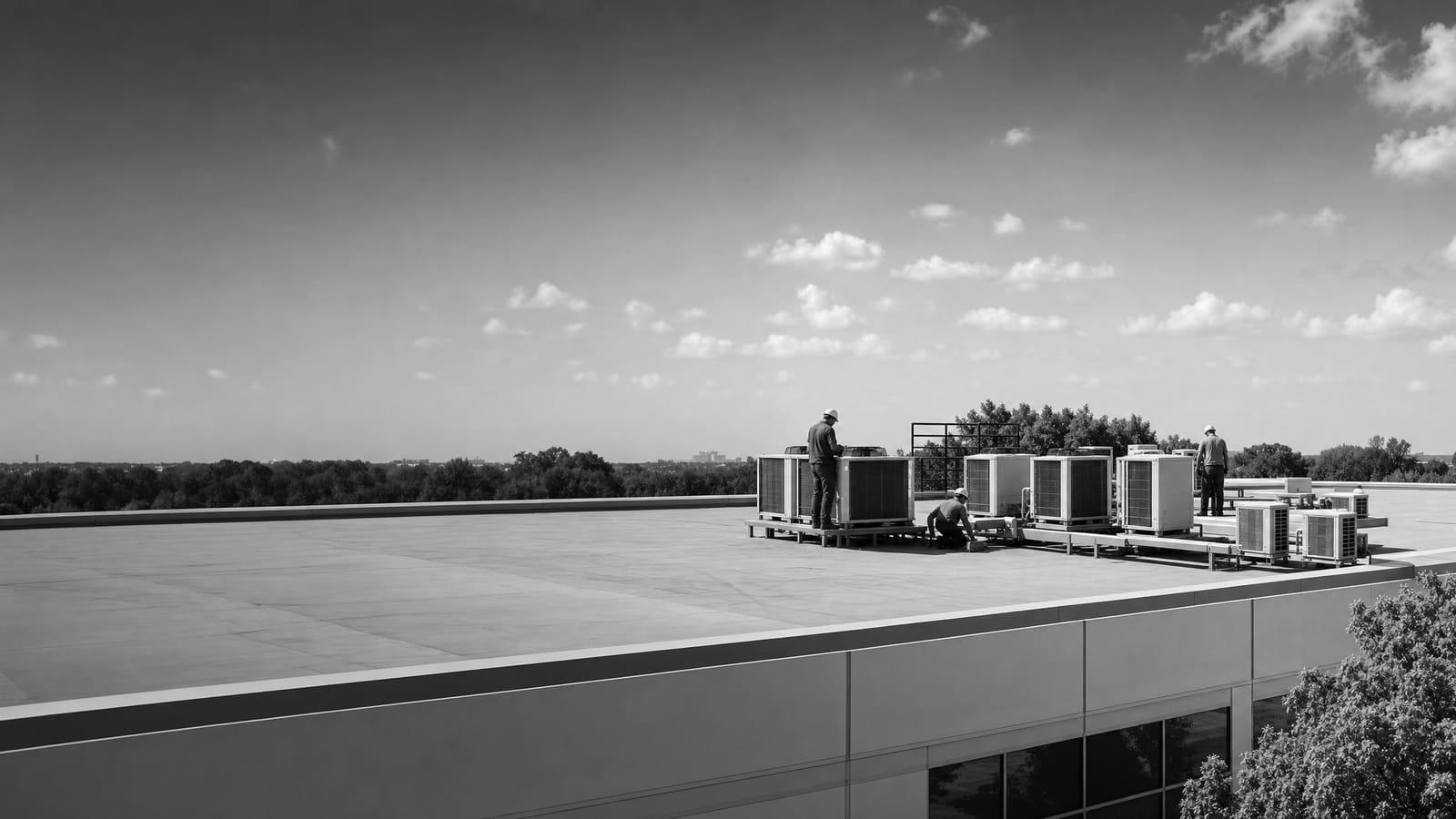
A commercial HVAC replacement covers load verification, equipment selection, certified refrigerant recovery on removal, curb and structural work, power and control connections, permitting, and commissioning. Replacement usually beats one more repair once a rooftop unit passes 15 years, because an old unit can waste $900 to $3,700 a year in energy while repair calls start clustering in cooling season. In Hialeah, that clustering arrives when you can least afford it.
A site review still has to confirm tonnage against current use, curb fit, roof support, available electrical capacity, and crane access before any of that becomes a real price.
THREE WAYS TO GO
The three replacement choices worth pricing
Most Hialeah buildings are cooling-dominant, so the real question is not whether to replace but which tier of equipment goes back on the curb. A like-for-like swap is the fastest way to get a space conditioned again and the cheapest to engineer. A high-efficiency unit costs more up front and earns it back on the bill, which matters most on a roof that runs long hours. A heat pump rooftop unit adds reverse-cycle heating, and in a climate with mild winter demand it can carry the heating load without a gas connection. Decide the tier before the unit is ordered, because the curb, the electrical feed, and the controls all follow from it. Waiting for a failure removes the choice entirely: whatever can be delivered becomes the decision.
WHAT MOVES THE NUMBER
The lines that decide your installed price
Nobody can quote a commercial rooftop replacement from a photo. These are the lines that move the number most, and the ones worth asking about before you set two bids side by side.
IN PRACTICE
Buy the unit, not the emergency
Rooftop units condition close to half of all commercial floor space in the country, which is why the replacement decision feels routine right up until it isn't. The common pattern is to wait: keep paying for repairs until the unit can no longer hold the space, then buy whatever can be delivered this week. That choice gets made under a deadline, and deadlines are expensive.
Planning the swap changes what you get to decide. You can compare a like-for-like unit against a high-efficiency or heat pump option on installed price and operating cost together. You can time the crane day around a slow week instead of a Tuesday in August. And you can order a unit sized for the load your building carries now, not the load it had when the last unit was set.
Units past fifteen years are the ones to look at first. If a unit is in that range, is on its second or third major repair, and sits over a space that runs long hours, it is already costing more than the quote to replace it.
SCOPE CHECK
Simple swap or a real project
Two replacements on the same street can carry very different scopes. What separates them is almost never the unit itself. It is the roof, the lot, and the power.
LOWER COMPLEXITY
Same size, same spot
Tonnage stays the same, the existing curb accepts an adapter, the lot gives the crane a clear pick, and the power and duct connections do not move. Permitting is straightforward and the on-site work is measured in days.
HIGHER COMPLEXITY
New footprint or new power
A different footprint, added tonnage, or an all-electric conversion brings in structural review, electrical capacity work, and controls integration. Tight access or a building that cannot go dark adds phasing and after-hours labor on top.
BEFORE THE QUOTE
What a real site review has to produce
A useful walk takes an hour and prevents most of the surprises that show up later as change orders. It starts on the roof with nameplate data from every unit in scope, curb dimensions and condition, and the shape of the duct connection underneath. It looks at the roof surface and the path the crane will lift over, then at the disconnect, the feed size, and whether the panel has room for anything larger.
The second half happens at ground level. Where does the crane set up, how much reach does it need, and how many parking stalls come out of service. Whether the building can lose conditioning for part of a day or needs temporary cooling. What hours the work is allowed to happen.
The last piece is the load itself. Twenty years changes occupancy, plug loads, lighting, and how the space gets used. Sizing from the old nameplate carries forward every mistake the last install made, and in a cooling-dominant climate an oversized unit short-cycles and dehumidifies poorly.
One question that sorts good bids from cheap ones
Ask what the contractor measured on your roof. A bid built from nameplate tonnage and a satellite photo is a guess. A bid built from curb dimensions, panel capacity, and a rigging plan is a price you can hold someone to.
HIALEAH SPECIFICS
The permit path is where Florida schedules slip
A rooftop replacement in Hialeah runs through a commercial alteration permit, and the paperwork usually costs more calendar time than the crane does. Florida commercial alteration requirements are consistent on three points that affect your date. Mechanical plans covering the installation or relocation of HVAC equipment must be signed and sealed by a Florida-licensed engineer or architect. Energy calculations are required whenever the scope includes heating, ventilation, or air conditioning. And the drawings have to show where the equipment actually sits, with roof framing details when the structure gets touched. None of it is difficult, but it takes a design professional and real turnaround time. Confirm current submittal requirements with the Hialeah building department before you promise a tenant a date.
Ask who is sealing the plans
If a quote does not name who seals the mechanical plans and who prepares the energy calculations, that cost and that delay are still coming. They are just not on the page yet.
OWNERSHIP ANGLE
Two things to settle before you spec
The technical decision is usually the easy part. The two questions that stall commercial replacements are who pays and how many units are really in play. Settle both before the equipment gets specified, because each one changes what you should buy. A lease that sends savings to one party and the invoice to another argues for a different tier than a single-owner building. A roof with six aging units argues for a standard, not a one-off purchase made in a hurry.
LEASE TERMS
Who pays and who saves
In a leased building, the capital cost and the utility savings often land with different parties. Read the lease before choosing an efficiency tier, since a unit that pays back on the tenant's bill is a harder case to make from the ownership side.
FLEET PLANNING
One unit or the whole roof
Replacing units one at a time as they fail leaves a roof with mixed ages, mixed controls, and possibly mixed refrigerants. Standardizing across the roof simplifies parts, service contracts, and what your staff has to know.
PLANNING AHEAD
Phasing, procurement, and what the unit costs over its life
When several units are near end of life, sequence them instead of reacting to them. Rank by age, repair history, and the criticality of the space underneath, then replace worst first. Grouping two or three swaps into one crane mobilization spreads that cost across units, and it lets you split the spend across budget years while still knowing what the plan is.
Order early. Equipment availability, not labor, is what usually sets the date on a commercial replacement, and a committed delivery window belongs on the quote next to the price. It is also worth asking your utility about incentives for high-efficiency rooftop equipment before the order goes in rather than after, since an incentive discovered late is often one you can no longer claim.
Then judge the number over the whole life of the unit. A commercial rooftop unit stays on the roof for fifteen to twenty-five years, and its energy use over that span dwarfs the difference between two bids. The cheapest install that was chosen in a panic is the one you keep paying for every month until the next crane day.
COMPARING BIDS
Five things a comparable quote shows
Two bids are only comparable when both spell out the same five things. If one is missing any of them, you are not looking at a lower price. You are looking at a smaller scope.
01
The equipment, spelled out
Make, model, tonnage, efficiency tier, refrigerant, and heating type, so the two bids describe the same machine.
02
Lead time beside the price
A committed delivery window rather than "in stock," plus what happens to your date if the factory slips.
03
The rigging and lot plan
Crane size, staging area, stalls closed, and the hours the work happens on an occupied site.
04
Permits and sealed plans
Who prepares and seals the mechanical plans and energy calculations, who pulls the permit, and who meets the inspector.
05
Commissioning and closeout
Startup readings, charge, airflow, control setpoints, and the documentation that keeps the warranty intact.
Get a defensible number
Price the equipment and the building together.
Send the address, operating target, and target opening date. Flux will identify what must be verified before the project can be priced.
Get a free estimateQuestions
Straight answers.
How long does a commercial rooftop replacement take in Hialeah?
The visible part is short. What sets the calendar is equipment lead time and the permit path, including sealed mechanical plans and energy calculations. Ask for both dates in writing, because the crane day is the easy one to schedule.
When is replacement better than one more repair?
Once a unit passes fifteen years, needs frequent service, or can no longer hold the space, replacement usually wins. An aging rooftop unit can waste $900 to $3,700 a year in energy, which is money spent whether or not it breaks again.
Does a heat pump rooftop unit make sense here?
South Florida's winter heating demand is mild, and today's heat pump rooftop units are capable of covering most or all of it in southern climates. The check is electrical: confirm the panel and feed can carry an all-electric unit before specifying one.
What does the permit require for an HVAC swap?
In Florida, mechanical plans for installing or relocating HVAC equipment must be signed and sealed by a licensed engineer or architect, energy calculations are required, and the drawings must show equipment location. Confirm current requirements with the Hialeah building department.
What happens to the refrigerant in the old unit?
Federal rules govern how refrigerant is handled and recovered from stationary air-conditioning equipment, so recovery is done by qualified technicians and documented. Newer equipment may not use the same refrigerant as the unit it replaces, which matters for parts and service planning on a mixed roof.
Sources used for this guide
- [1]betterbuildingssolutioncenter.energy.gov — DOE Advanced Rooftop Unit Replacement Guidance
- [2]betterbuildingssolutioncenter.energy.gov — DOE Commercial Heat Pump Rooftop Unit Replacement Guidance
- [3]betterbuildingssolutioncenter.energy.gov — DOE High-Efficiency Commercial Rooftop Unit Toolkit
- [4]energy.gov — DOE Efficient Commercial Rooftop Air Conditioner Program
- [5]epa.gov — EPA Stationary HVAC Refrigerant Management
- [6]tampa.gov — Permit Application Guide Commercial Alteration