THE SHORT VERSION
What a commercial HVAC replacement includes
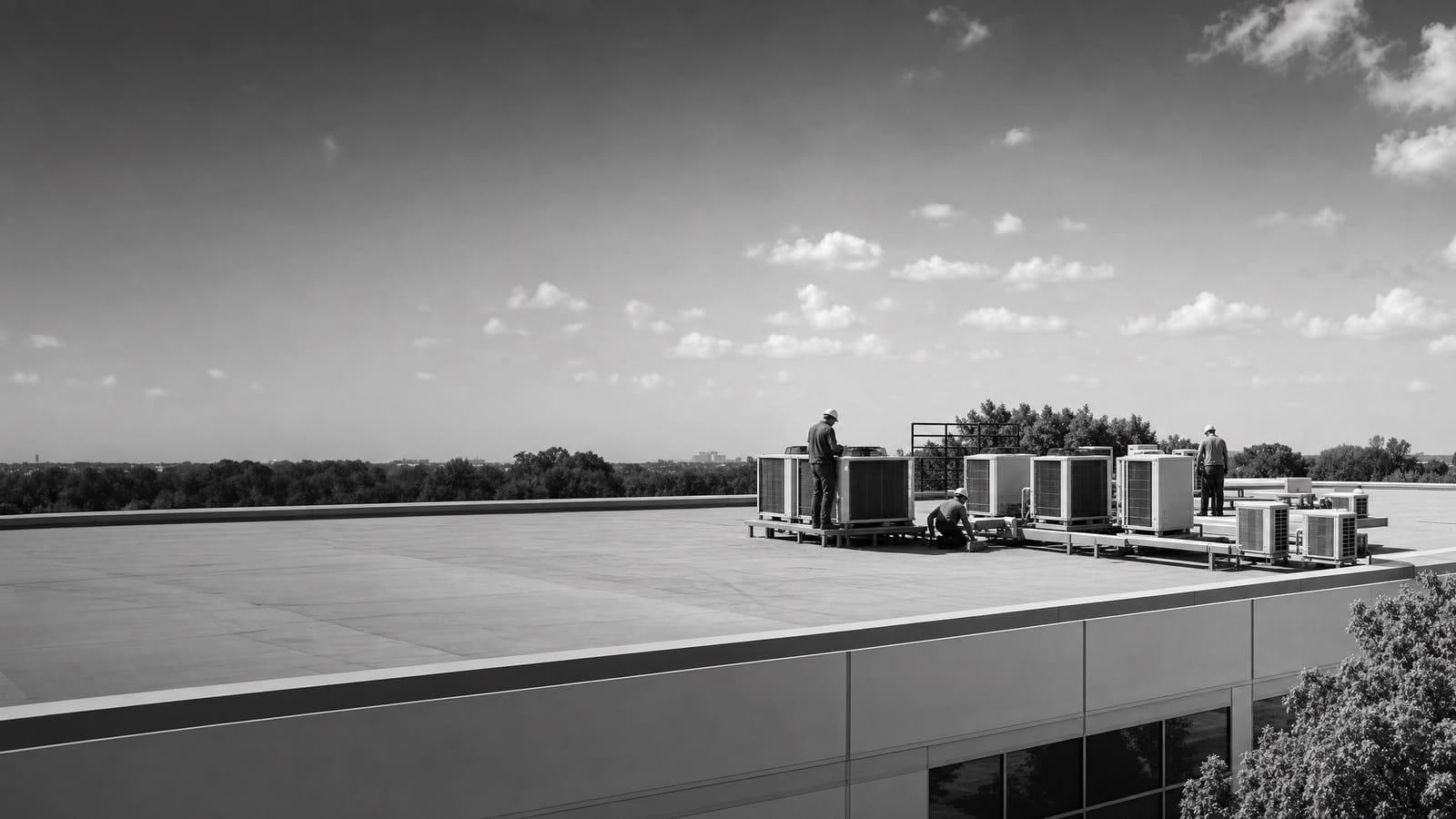
A commercial changeout is a full swap. The old rooftop unit comes off, a new one lands on a matched curb, and power, gas, ductwork, and controls get reconnected and commissioned before handoff. Replacement usually beats one more repair once a unit passes about fifteen years. DOE puts the annual energy waste of an old, inefficient rooftop unit at roughly $900 to $3,700 — money that leaves the building every year, whether or not the compressor failed this week.
A site review still sets the number. Roof structure at the curb, crane reach across the lot, panel capacity, and any work the permit review adds all get verified before a price means anything.
THREE WAYS TO GO
Three replacement paths worth pricing
Most buyers think the first choice is which brand. The real choice is which of three paths the building takes, and it gets settled before anyone quotes a model number.
The default is like-for-like: same tonnage, same fuel, same curb footprint. It is the fastest way back to conditioned space and the cheapest engineering, and it carries forward whatever sizing error the last unit had.
The second path is a high-efficiency unit at the same tonnage. DOE's rooftop unit challenge pushed manufacturers to build equipment that cuts energy use by up to half against the older standard, and more than twenty models were built to exceed that specification. On a building with long cooling hours, that gap is the whole argument.
The third is a heat pump rooftop unit, either dual-fuel or all-electric. DOE's guidance places most of the West inside the range where today's heat pump units handle most or all of the winter heating demand, which makes it a live option here rather than a stretch.
WHAT MOVES THE NUMBER
The lines that decide your installed price
An installed price is not one number, it is six. Ask which of these your quote actually covers, because the lines a contractor leaves out are the ones that come back as a change order after the crane is gone.
IN PRACTICE
How to buy the unit instead of the price
The cheapest quote and the cheapest project are rarely the same document. Rooftop units condition close to half of all commercial floor space in the country, so most facility owners are buying the same category of equipment and getting very different results from it. The difference usually traces to two decisions made before purchase: whether the load was recalculated, and whether the unit was matched to how the building actually runs.
Recalculating the load is the step most often skipped. Twenty years changes occupancy, lighting, plug loads, and sometimes the envelope itself. A unit sized to the old nameplate can be oversized for the building it serves now, which shows up as short cycling, weak humidity control, and comfort complaints that no service call ever fixes.
The second decision is operating hours. A high-efficiency unit earns its premium through part-load performance across a long season. On a building running twelve or more hours a day, that premium comes back in utility spend. On a lightly occupied building, the same money is better spent on controls, on curb and duct condition, or on commissioning a standard-efficiency unit properly. Both are defensible answers. What is not defensible is choosing without running the comparison.
SCOPE CHECK
What makes a changeout simple or complicated
Two replacements of the same tonnage can differ by weeks and by a large share of the budget. It comes down to what the new unit has to match and what it has to change. Sort your building into one of these before you commit to a schedule.
LOWER COMPLEXITY
Straight curb-to-curb swap
Same tonnage and fuel, a curb footprint that matches or takes a standard adapter, open lot for the crane, and existing power that is already adequate. Set and connected in a morning, with the permit as the long pole.
HIGHER COMPLEXITY
Fuel switch or size change
Tonnage grows, the footprint changes, or gas heat becomes electric. Now you may be adding structural review, a panel or feeder upgrade, and duct changes — and the schedule is set by plan check and the utility, not by the crane.
BEFORE YOU PRICE IT
The site review that makes a quote real
A quote written from a phone call is a guess with a dollar sign on it. The visit that turns it into a number takes an hour or two and answers a short list of questions, all of which cost real money if they get answered wrong later.
On the roof: the nameplate, the curb dimensions and condition, the deck under it, and how much clearance the unit has for service and airflow. Inside: the panel, the capacity actually available, the disconnect, and where the gas line lands if there is one. Outside: where a crane can set up, what it has to reach over, and how many stalls come out of service that day.
Then there is the part nobody photographs. How the building actually runs — hours, occupancy, the hot and cold complaint history, and what the last three service calls were for. That history usually reveals whether you are replacing a unit that failed or a unit that was wrong from the day it was installed. Those are different problems with different correct answers, and only one of them is solved by buying the same thing again.
Ask for the load calculation, not the recommendation
Anyone can name a tonnage. The contractor worth hiring will show how that number was reached from current occupancy and use, and will explain what changed since the original install.
HESPERIA SPECIFICS
Permit timing belongs on the critical path
California building departments treat mechanical work as permit work, and the threshold is low. Mechanical, electrical, and plumbing upgrades and repairs generally require a pulled permit, not only full replacements. For a rooftop changeout, that usually means a mechanical permit, plus an electrical permit when the disconnect, feeder, or panel changes.
The decision this drives is sequencing. Permit review and inspection sit alongside equipment lead time, not after the install. Confirm with Hesperia's building division what the submittal requires for your specific scope before the crane is booked, because a unit waiting on a truck for plan review costs far more than the permit ever will.
Then make the installing contractor own the permit, the inspection, and any corrections as part of the installed price.
Settle this before the deposit
Ask who pulls the permit, who schedules inspection, and what happens to the schedule if plan review adds scope. If the answer is vague, that risk has quietly transferred to you.
OWNERSHIP TERMS
Two things the new unit changes for years
A replacement resets more than your comfort complaints. It resets the service relationship, the refrigerant your fleet runs on, and the paperwork you need the day something fails under warranty. Both items below are cheap to handle at install and expensive to handle later, and neither one shows up in a headline price. Treat them as terms of ownership rather than line items, and decide them while you still have leverage.
REFRIGERANT
The old charge is regulated
Federal rules under Section 608 govern how refrigerant is handled and recovered when equipment is serviced or taken out of service. The old unit's charge gets recovered by certified technicians rather than vented, and new equipment arrives on newer refrigerants — worth planning for on a mixed fleet.
COMMISSIONING
Startup is the warranty record
Charge, airflow, and control settings verified against spec and documented at handoff. It is the cheapest hour on the job and the only proof you hold when a manufacturer asks whether the unit was installed correctly.
THE LONGER VIEW
Planning replacements instead of reacting to them
Most rooftop units get replaced the week they die, in season, at whatever price and lead time the market offers that week. It is the most expensive way to buy equipment, and it is avoidable. DOE's advanced rooftop unit campaign worked the other side of that problem: more than two hundred organizations upgraded over forty-three thousand units, and the group reported a combined thirty-seven million dollars a year in energy savings. Those were planned projects, not emergencies.
For a building with more than one unit on the roof, that argues for a replacement order rather than a replacement event. Rank the units by age, service history, and the hours each one runs. Replace the worst one now, budget the next for the following cycle, and share a single crane mobilization when two units sit close enough to come off the same day.
That same campaign also found the answer is not always new equipment. Some units are better served by adding advanced controls and keeping the box, depending on which option makes financial sense for that unit. Worth asking about a fifteen-year-old unit that still cools reliably. The equipment decision and the timing decision are separate, and keeping them separate usually saves money.
QUOTE CHECKLIST
Five things a comparable quote shows
Two quotes are only comparable when they cover the same scope. Ask every bidder to put these five items in writing, then compare. The gaps you find are usually the whole difference between the numbers.
01
Tonnage and how it was determined
The efficiency tier and the load basis behind the selection, not just a model number.
02
Equipment lead time, in writing
A real availability date for the unit quoted, and what changes if that date slips.
03
Curb, rigging, and lot plan
Adapter or new curb, crane placement, closure hours, and who coordinates with tenants.
04
Permits, inspection, and corrections
Which permits get pulled, by whom, and whether corrections are inside the price.
05
Startup, commissioning, and warranty
What is verified at handoff, what documentation you receive, and what the labor warranty covers.
Get a defensible number
Price the equipment and the building together.
Send the address, operating target, and target opening date. Flux will identify what must be verified before the project can be priced.
Get a free estimateQuestions
Straight answers.
How fast can a failed rooftop unit be replaced?
The visible work is short once the equipment is on site. The honest variables are availability of the unit you selected and permit review, and both belong on the quote next to the price rather than being discovered after you sign.
When does replacement beat another repair?
Once a unit is past roughly fifteen years, the arithmetic usually flips. DOE estimates an old, inefficient rooftop unit wastes about $900 to $3,700 a year in energy. That loss continues between repairs, so a cheap fix on a tired unit is rarely the cheap option.
Should we switch to a heat pump rooftop unit?
DOE's guidance says today's heat pump rooftop units handle most or all of the winter heating demand across most of the West, so it is a real option here. The deciding factors are available electrical capacity at the panel and your electricity-to-gas price spread. Dual-fuel is the middle path when either one is uncertain.
How much does a commercial HVAC installation cost?
It is set by tonnage and efficiency tier, curb and roof condition, crane access, electrical work, and whatever the permit review adds. Anyone quoting a price before seeing the roof is quoting a different building. What is measurable up front is the operating side: an old unit's yearly energy waste is a documented range, and that is the number a replacement is competing against.
Do we need a permit to replace a rooftop unit?
Yes. California building departments treat mechanical upgrades and repairs as permit work, and an electrical permit is typically added when the disconnect, feeder, or panel changes. The installing contractor should pull it, schedule inspection, and handle corrections as part of the installed price.
Sources used for this guide
- [1]betterbuildingssolutioncenter.energy.gov — DOE Advanced Rooftop Unit Replacement Guidance
- [2]betterbuildingssolutioncenter.energy.gov — DOE Commercial Heat Pump Rooftop Unit Replacement Guidance
- [3]betterbuildingssolutioncenter.energy.gov — DOE High-Efficiency Commercial Rooftop Unit Toolkit
- [4]energy.gov — DOE Efficient Commercial Rooftop Air Conditioner Program
- [5]epa.gov — EPA Stationary HVAC Refrigerant Management
- [6]californiacity-ca.gov — HVAC Permits