Direct answer
Replacement is a load decision, not a box swap.
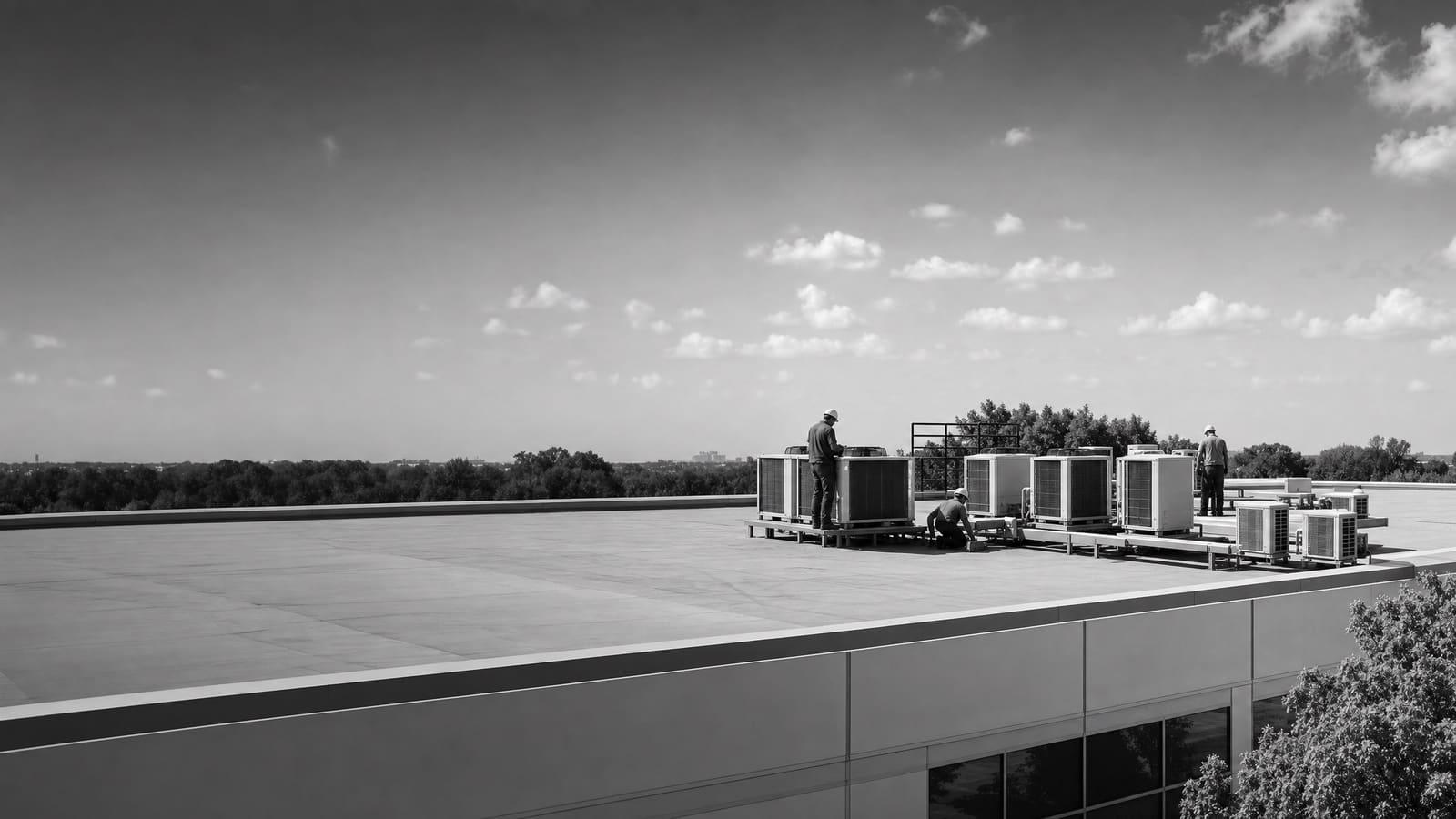
A commercial replacement covers confirming the building load, selecting equipment against real availability, setting the unit and adapting the curb, reconnecting power, gas, and controls, and commissioning the result so it performs to spec. Federal research puts the annual energy waste of an old, inefficient rooftop unit at roughly $900 to $3,700. Once a unit past fifteen years needs repeated repairs or can no longer hold the space, another repair is usually renting time at that rate.
A site review still has to verify tonnage against how the space is used today, the curb and roof structure, available electrical capacity, gas service, and crane access before any of that becomes a price.
Choose the replacement path
Three ways to replace, and when each one is right
The first choice is timing. Federal guidance is blunt about the common pattern: owners delay until the unit fails, then buy whatever lands fastest. Replacing on failure, in season, removes every option you would have had — efficiency tier, sizing correction, fuel choice — and leaves you with the unit the supply house has on the floor.
The second choice is sizing. A like-for-like swap carries the old nameplate forward, which is fine when the space and its use have not changed. When occupancy, plug load, lighting, or operating hours have changed, that tonnage is a twenty-year-old answer to a question nobody re-asked.
The third choice is fuel. Heat pump rooftop units are the same basic machine with reverse-cycle heating added. Department of Energy guidance says heat pump rooftop units are best suited to mild-to-moderate winter heating, and that across most of the U.S. South and West today's units are capable of covering most or all of the winter heating demand. That puts a real decision on a Hemet roof: all-electric, dual fuel, or a straight air-conditioning unit. The answer turns on electrical capacity at the roof, the existing gas service, local energy prices, and any incentive the project can capture.
Build the whole number
What belongs in a replacement budget
Equipment is the line everyone compares. The work around it is where two quotes on the same roof separate. Ask for these broken out so a low equipment price cannot hide an expensive roof or an undersized electrical service.
Do not order the box first
Select equipment after the building has been measured
A model number cannot tell you whether the roof can carry the unit, whether the panel has capacity for it, or whether the curb under the old unit will accept it without an adapter. Equipment selection should follow the load calculation and a real look at the roof. The federal rooftop unit work is a useful frame here: the high-performance specification developed with manufacturers targeted units using up to half the energy of the standard equipment of the time, and more than twenty models now exceed that specification. Efficiency tier is a genuine choice with a genuine price, not a checkbox.
Compare more than rated efficiency. Ask about physical footprint against the existing curb, weight against the roof structure, electrical requirements against the panel that feeds it, gas connection, economizer and controls compatibility, sound at the property line, filter access, and parts availability from a nearby supply house. Then ask when the unit actually ships. Equipment availability is one of the considerations federal guidance lists by name, and it belongs next to the price on every option.
One selection factor is human. That same guidance lists contractor availability and knowledge as a deciding consideration, because a heat pump rooftop unit is only as good as the startup and the service that follows it. If nobody nearby will service the choice at six in the morning in August, it is the wrong choice.
The expensive version
Why two Hemet roofs price differently
Set a same-size unit on an existing curb with a clear crane path and the work stays close to a one-day event. Move that same unit onto a roof with no matching curb, a tight lot, a shared electrical room, and tenants who cannot lose cooling during business hours, and the project grows in every direction. The equipment did not change. The building did.
Lower-complexity replacement
Fewer building changes
• Same tonnage on the existing curb
• Straight crane shot from an open lot
• Existing feeder and disconnect are adequate
• Existing controls carry over unchanged
Higher-complexity replacement
More work around the unit
• Curb adapter, structural review, or roof repair
• Fire lane or street closure for the crane
• Panel capacity or feeder upgrade for an electric unit
• Off-hours phasing to keep tenants conditioned
Replace guesses with site facts
What a real site review has to answer first
The first visit is not a tape measure on the old unit. The reviewer should confirm how the space is used now — occupancy, hours, plug load, kitchen or process equipment, and anything added since the last replacement — because that is what sets the tonnage. Then come the physical questions: curb dimensions and condition, roof structure and deck, the state of the membrane around the curb, drainage, and how much of the roof a crane can actually reach.
The electrical review matters just as much. Federal guidance lists electrical capacity, physical constraints, and gas lines as the infrastructure questions that decide whether a heat pump rooftop unit is even feasible at a site. In practice that means locating the panel that feeds the unit, confirming spare capacity, checking the feeder and disconnect, and settling whether the gas line stays, gets capped, or has to move.
The operating interview closes the gap. Ask which hours the building cannot lose cooling, who approves a lot closure, how tenants get notified, whether a second unit can carry the space during the swap, and who holds the keys at five in the morning on crane day. Those answers set the schedule, and the schedule sets a real part of the price.
A nameplate photo is a starting point, not a scope.
Photos and a model number can narrow the equipment list and produce a range. They cannot confirm curb dimensions, roof structure, panel capacity, or crane access. A useful proposal names every assumption still waiting on a field visit.
Hemet permitting
Open the permit before the crane is scheduled
California building departments treat this as permitted work, and the list is broad: electrical, plumbing, and mechanical upgrades or repairs each require a permit, and re-roofing — overlay or tear-off — sits on that same list. A rooftop replacement usually touches more than one of those categories at once, which is why the application and inspection sequence belong on the schedule next to the equipment lead time rather than after it.
The roofing line is the one that catches owners off guard. If the membrane around the curb is near the end of its life, you are looking at two separately permitted projects on the same square of roof. Doing them out of order means cutting into new roofing, or flashing carefully around a unit you plan to remove next year. Decide the sequence before either job is scheduled.
The Hemet takeaway
Confirm with the local building department which permits your replacement triggers and which inspections it needs while the schedule is still flexible. Then decide whether the roof and the unit get replaced together. Both are permitted work, and the wrong order pays for the same access twice.
After the crane leaves
Two questions the install quote will not answer
The install price is a one-time number. The unit will likely still be on that roof past its fifteenth year, which is the age federal guidance points to when it describes rooftop units wasting substantial energy and money. The gap between the cheapest bid and the best one usually shows up on utility bills rather than the invoice: an old, inefficient rooftop unit can waste roughly $900 to $3,700 a year, every year it stays up there. Across a multi-unit roof, that is the difference between a replacement plan and a repair habit.
The second question is refrigerant. EPA rules under Section 608 of the Clean Air Act govern how refrigerant is handled and recycled in stationary air-conditioning and heat pump equipment, including recovery from the unit coming off. New equipment also ships on newer refrigerants, so a roof carrying mixed vintages needs a service plan built for more than one.
Model before you sign
Operating cost over the life
Compare efficiency tiers on annual energy, not just install price. On a unit that runs hard through a long cooling season, the higher tier often wins by the second or third summer.
Put it in the contract
Refrigerant and service
Recovery from the old unit, refrigerant type in the new one, parts availability, and who responds when it fails on a Friday in August. Mixed-refrigerant roofs need this in writing.
Replace on a plan, not on a failure
Phasing a multi-unit roof beats one-at-a-time panic
Federal guidance describes the pattern most facility managers recognize: the new unit gets delayed until the old one can no longer condition the space, needs constant maintenance, or fails outright. Replacing proactively is often the better business move, and it beats both replacement-on-failure and a like-for-like swap at the end of service life. The reason is leverage. A unit replaced on your schedule can be right-sized, specified to a higher efficiency tier, and set on a day the building can spare the parking. A unit replaced in an August emergency is whatever is on the truck.
On a roof with several units, the plan matters more than any single decision. Rank them by age, repair history, and how much of the building each one serves. Replace the worst performer first, and use that project to learn the site: what the crane actually needs, how the curbs are built, what the permit path costs in days, and what the electrical service can support. The second and third replacements get faster and cheaper because the surprises already happened.
The scale here is not theoretical. The federally backed rooftop unit campaign reports more than 200 organizations upgrading over 43,000 units, saving a combined $37 million a year on energy bills.
Before you compare bids
Five things a comparable quote has to show
Ask every bidder to price the same tonnage, the same efficiency tier, the same curb assumption, and the same access plan. If one quote excludes curb adapters and permit fees while another includes them, you are not comparing prices. You are ranking what each one left out.
01
The load calculation behind the tonnage, not just the old nameplate
02
Efficiency tier and heating type, with any heat pump alternate priced separately
03
Curb adapter, structural check, and the roof or flashing work included
04
Crane plan, lot closure hours, and whether the lift happens off-hours
05
Permits, inspections, refrigerant recovery, startup, and commissioning documentation
Get a defensible number
Price the equipment and the building together.
Send the address, operating target, and target opening date. Flux will identify what must be verified before the project can be priced.
Get a free estimateQuestions
Straight answers.
Should you repair a rooftop unit again or replace it?
Federal guidance points at units past about fifteen years that need frequent maintenance or can no longer hold the space. At that point another repair mostly buys months, while an old, inefficient unit keeps wasting roughly $900 to $3,700 a year in energy.
Is a heat pump rooftop unit a real option in Hemet?
It is usually worth pricing as an alternate. Federal guidance says heat pump rooftop units suit mild-to-moderate winter heating, and that across most of the West today's units can cover most or all of the winter heating demand. Electrical capacity at the roof decides feasibility.
Do you need a permit to replace a rooftop unit?
Plan on it. In California, mechanical, electrical, and plumbing upgrades and repairs each require a permit, and re-roofing is permitted separately. Confirm the exact set with the local building department before the crane day is booked.
How is a like-for-like swap different from right-sizing?
Like-for-like carries the old tonnage forward and is defensible when the space and its use have not changed. If occupancy, hours, or equipment changed, run the load first. Otherwise you inherit the old unit's sizing mistake for the life of the new one.
What does refrigerant change about a replacement?
EPA Section 608 rules govern how refrigerant is handled and recycled when the old unit comes off, and new equipment ships on newer refrigerants. On a roof with mixed vintages, service contracts and spare parts have to cover more than one.
Sources used for this guide
- [1]betterbuildingssolutioncenter.energy.gov — DOE Advanced Rooftop Unit Replacement Guidance
- [2]betterbuildingssolutioncenter.energy.gov — DOE Commercial Heat Pump Rooftop Unit Replacement Guidance
- [3]betterbuildingssolutioncenter.energy.gov — DOE High-Efficiency Commercial Rooftop Unit Toolkit
- [4]energy.gov — DOE Efficient Commercial Rooftop Air Conditioner Program
- [5]epa.gov — EPA Stationary HVAC Refrigerant Management
- [6]californiacity-ca.gov — HVAC Permits