THE DIRECT ANSWER
What a commercial HVAC replacement includes
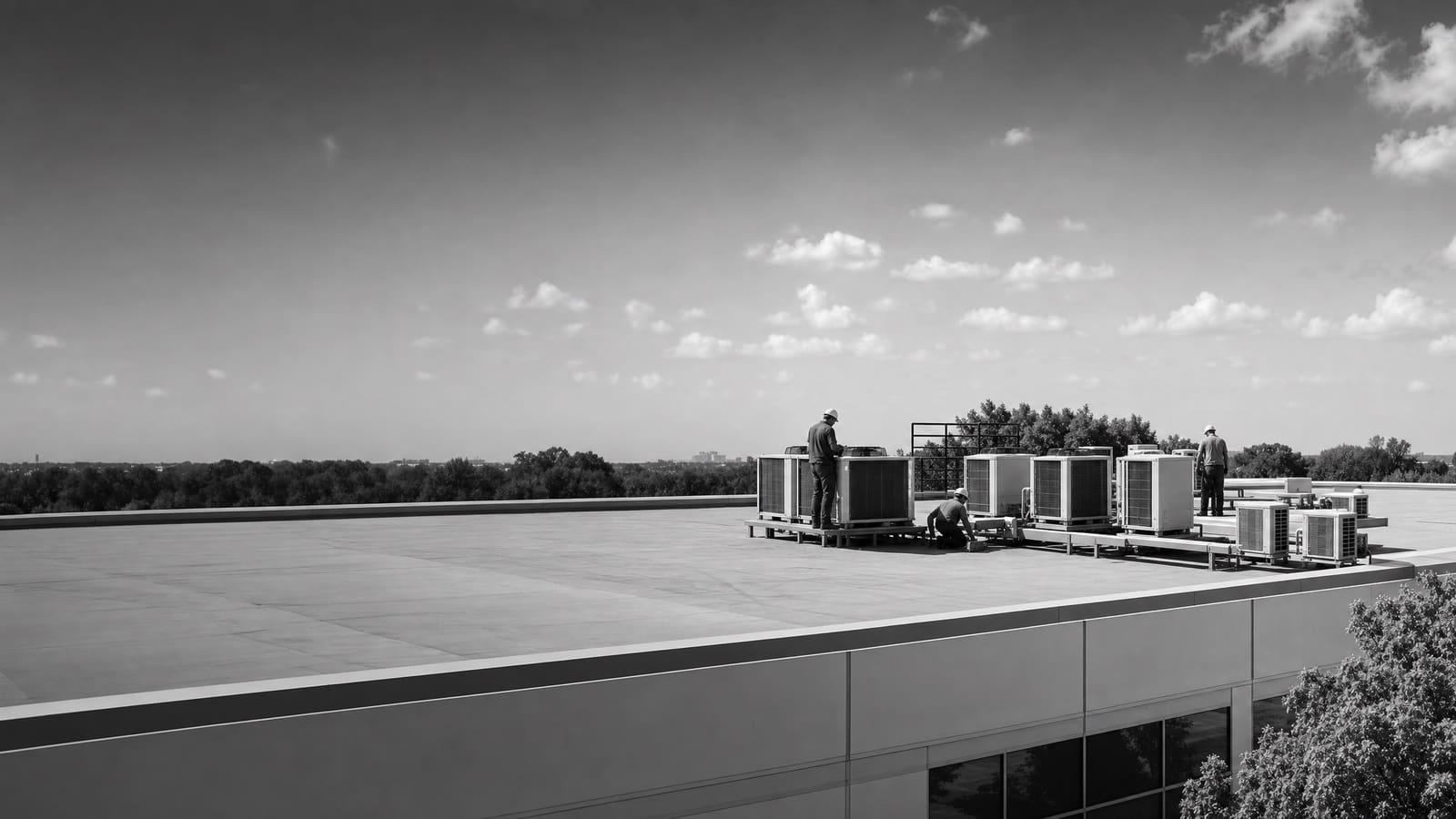
A commercial HVAC replacement covers a load check against how the building is used now, equipment selection against real lead times, recovery of the old refrigerant charge, rigging and set, gas and electrical connections, curb or curb-adapter work, permits, and commissioning. Replacement usually beats another repair once a unit is past roughly 15 years and service calls are stacking up. Federal figures put the annual energy waste of an old, inefficient rooftop unit at $900 to $3,700 per unit.
A site review has to confirm tonnage against current occupancy, the roof structure and curb size, available panel capacity, and crane access before any of those numbers hold.
THREE WAYS TO GO
Three replacement paths worth pricing
Most buildings are choosing between three versions of the same project. The equipment lands on the same roof and the crane day looks alike, but the paperwork, the panel work, and the operating cost afterward are different. Like-for-like is the quickest path back to conditioned space and the cheapest to engineer. A high-efficiency unit costs more up front and earns it back on the meter; the federal high-performance rooftop specification targeted units using up to 50% less energy than the standard of the time. A heat pump rooftop unit swaps reverse-cycle heating for the gas burner, which matters if you have emissions goals or a gas line you would rather retire. Price at least two of the three. The spread is usually smaller than owners expect once the shared costs are stripped out.
WHAT MOVES THE NUMBER
The budget lines that actually move
There is no single installed price for a commercial unit, because these six lines move independently on every roof. Ask for them itemized so you can tell a real difference in scope from a difference in margin.
IN PRACTICE
Choose the equipment before you choose the contractor
Pick the equipment class before you collect bids, or you will be comparing quotes that describe different projects. Start with the unit you have: nameplate tonnage, age, fuel, and whether the space it serves still does what it did when the unit was set. Rooftop units condition close to half of all commercial floor area in the country, so most buildings are having this conversation about a packaged unit on a curb rather than a central plant.
From there the choice narrows quickly. If the load is unchanged and the budget is tight, a like-for-like packaged unit is defensible. If the building runs long hours or the bills have crept up, the efficiency tier is where the money sits. If you are weighing electrification, the deciding factors are physical rather than philosophical: panel capacity, roof space, and whether the gas line is worth keeping.
Only after that does contractor selection matter, and then it matters a great deal. Ask who performs the load calculation, who owns the rigging plan, and who signs the commissioning report.
COMPLEXITY CHECK
What makes this a simple job or a hard one
Two buildings with the same tonnage can be very different projects. What separates them is rarely the unit itself. It is access, structure, and how much of the building has to keep running while the work happens.
LOWER COMPLEXITY
Straight swap on an accessible roof
Same tonnage on the existing curb, a lot with room to set the crane, panel capacity already in place, and a tenant who can lose conditioning for a morning. Permits are routine, and the schedule is driven mostly by equipment lead time.
HIGHER COMPLEXITY
Bigger unit, tight site, or fuel switch
Growing tonnage or footprint pulls in structural review. Street-side rigging adds closures and off-hours work. All-electric conversions can require panel or service upgrades, and spaces that cannot go without cooling need temporary equipment in the plan.
THE SITE REVIEW
What a real site review has to confirm
A quote written from a photo is a guess. The site review is where the number becomes real, and it should take a technician onto the roof, into the electrical room, and through the space the unit serves.
On the roof: nameplate data, curb dimensions, the condition of the membrane around the curb, and whether the structure carries a heavier unit. Federal guidance on rooftop heat pumps puts electrical capacity, physical constraints, and existing gas lines at the top of the feasibility list, and that order holds for conventional replacements too. In the electrical room: available panel space, feeder size, and whether the new unit's minimum circuit ampacity fits what is already there.
Inside the space: how it is actually used now. Occupancy, plug loads, operating hours, and standing comfort complaints tell you whether the old tonnage was ever right. Twenty-year-old sizing reflects a twenty-year-old tenant.
The review should also confirm which current energy-code items the replacement triggers, such as economizer or control requirements, so they land in the bid instead of a change order.
Ask for the review before the number
A contractor who prices a commercial replacement without seeing the roof, the panel, and the space is pricing an average building rather than yours. When the site review is skipped, the difference shows up later as a change order, not a discount.
IN HAYWARD
Permits and the order you do the work
Permitting is the step most likely to move your date. In California cities, HVAC work is permitted as its own item: mechanical and electrical upgrades or repairs are permit-triggering work, and re-roofing carries a separate permit on the same list. That combination decides the order of operations on an older building.
If the roof membrane is within a few years of replacement, do the roof and the unit together. The crane is already booked, the curb is already open, and flashing a new curb into an old membrane is work you would rather not pay for twice. If the roof is sound, keep the scopes separate and protect the membrane in the rigging plan.
Confirm the exact submittal set and inspection sequence with the Hayward building division before you commit to a crane date.
Put the permits on the quote
The installed price should name every permit the job needs — mechanical, electrical, and roofing if the membrane is touched — and say who files them and who meets the inspector. Unclaimed permit responsibility is a common cause of a delayed startup.
OWNERSHIP MATH
Two decisions that outlive the crane day
Two things are far easier to settle before the unit is ordered than after it is running. The first is refrigerant. New commercial equipment ships on newer low-GWP refrigerants, and the charge in your old unit cannot simply be released: EPA rules under Section 608 govern how refrigerant is recovered, handled, and recycled when stationary equipment is serviced or taken out of service. The second is who carries the asset. In a leased building, a replacement moves cost, control, and the efficiency benefit between owner and tenant in ways the lease often does not anticipate.
REFRIGERANT
Plan the fleet, not just the unit
One new unit in a fleet of older ones means two refrigerants, two parts lists, and two service procedures. Ask your service provider what that does to the maintenance contract before the order goes in.
LEASE AND OWNERSHIP
Who pays, who benefits
A capital replacement paid by the owner often lowers a bill the tenant pays. Where that split is unclear, the efficiency upgrade is the first thing cut from scope. Fix the language before you fix the roof.
PHASING AND PROCUREMENT
Replace on your schedule, not the unit's
The cheapest version of this project is the one you schedule. Waiting for failure hands the timeline to the equipment: you buy whatever is available, at whatever price, in whatever season it dies. Federal guidance on rooftop replacement is blunt about the pattern — facility managers routinely delay until a unit no longer conditions the space, needs frequent service, or quits entirely, and proactive replacement is usually the smarter business move than replacement-on-failure, or even than a like-for-like swap at the end of useful life.
Across a portfolio, that argues for a rolling plan instead of a fire drill. Rank units by age, service history, and how much downtime each space can absorb. Replace the worst two each year in shoulder season, when lead times are calmer and crane scheduling is flexible. Organizations working through the federal Advanced RTU Campaign upgraded more than 43,000 units and reported a combined $37 million in annual energy savings — the shape of the payback at scale, not a promise for a single roof.
Lifetime cost is the honest comparison. A maintained commercial unit runs for well over a decade, so an efficiency difference is measured against a decade and a half of operating cost, not against this quarter's budget.
QUOTE CHECKLIST
Five things a comparable quote shows
Bids only compare when they describe the same job. Ask every contractor to put these five in writing, on one page. Anything missing is not a lower price; it is a smaller scope that gets corrected later at your expense.
01
Equipment, named
Manufacturer, model, tonnage, efficiency tier, and fuel type — not just "new rooftop unit."
02
Lead time and availability
A real ship date next to the price, and what happens to your schedule if it slips.
03
Roof and rigging scope
Curb or adapter, structural work, crane size, lot closure hours, and membrane protection.
04
Permits and inspections
Which permits, who files them, who meets the inspector, and whether fees are included.
05
Commissioning and documentation
Startup, charge, airflow, and controls verified against spec, with a report you keep for warranty.
Get a defensible number
Price the equipment and the building together.
Send the address, operating target, and target opening date. Flux will identify what must be verified before the project can be priced.
Get a free estimateQuestions
Straight answers.
When is replacement better than one more repair?
When the unit is past roughly 15 years, failures are stacking up, or it no longer holds the space on design days. Federal figures put the annual energy waste of an old, inefficient rooftop unit at $900 to $3,700 per unit, which often exceeds what the next round of repairs costs.
How much does commercial HVAC installation cost in Hayward?
There is no single installed price, because tonnage, curb and structural work, crane access, and electrical capacity move independently on every roof. Ask for those lines itemized instead of a lump sum, and price at least two equipment options so you can see what the efficiency tier actually costs.
Is a heat pump rooftop unit realistic for a building here?
Often yes. Heat pump rooftop units are most efficient with mild-to-moderate winter heating, and federal guidance treats today's units as capable of most or all winter heating demand across the West. The deciding factors are electrical capacity, roof space, and whether the gas line is worth keeping.
What permits does a rooftop replacement need?
Mechanical work is permitted work, electrical changes are permitted as well, and re-roofing carries its own permit if the membrane is being replaced. Confirm the submittal set and inspection sequence with the Hayward building division, and make permit responsibility explicit on the quote.
What happens to the refrigerant in the old unit?
It has to be recovered, not vented. EPA rules under Section 608 of the Clean Air Act govern how refrigerant is handled and recycled when stationary air-conditioning equipment is serviced or removed, so recovery belongs in the written scope and on the invoice.
Sources used for this guide
- [1]betterbuildingssolutioncenter.energy.gov — DOE Advanced Rooftop Unit Replacement Guidance
- [2]betterbuildingssolutioncenter.energy.gov — DOE Commercial Heat Pump Rooftop Unit Replacement Guidance
- [3]betterbuildingssolutioncenter.energy.gov — DOE High-Efficiency Commercial Rooftop Unit Toolkit
- [4]energy.gov — DOE Efficient Commercial Rooftop Air Conditioner Program
- [5]epa.gov — EPA Stationary HVAC Refrigerant Management
- [6]californiacity-ca.gov — HVAC Permits