THE DIRECT ANSWER
What commercial HVAC replacement includes
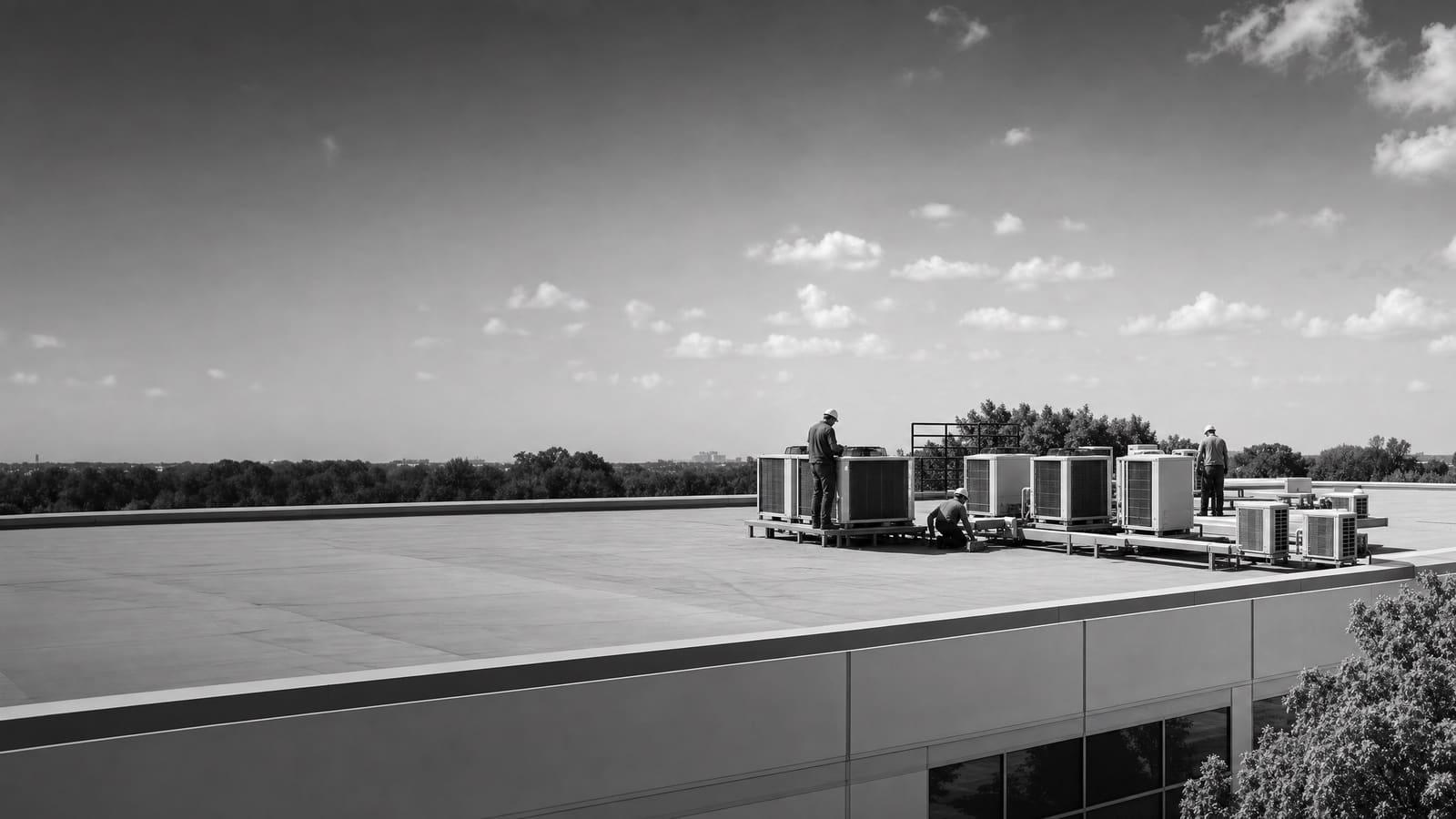
Commercial HVAC replacement includes sizing, equipment selection, removal, rigging, utility connections, controls, startup, and final testing. Replacement becomes more useful than another repair when an older unit cannot hold comfort, fails often, or needs rising maintenance. DOE guidance notes that rooftop units over 15 years old can waste substantial energy compared with newer equipment.
A site review must verify the load, roof and curb, electrical service, gas connection, outdoor-air needs, controls, access, and equipment availability.
THREE OPERATING CHOICES
Choose the replacement path before choosing a model
The best option is not always a direct copy of the old unit. First ask whether the building use, occupancy, hours, or internal heat loads have changed. A close replacement may reduce design work when the old system was properly sized and the space still serves the same purpose. Right-sizing is more useful when rooms run hot, humidity or airflow is uneven, tenants have changed, or the old unit cycles poorly.
A heat-pump rooftop unit adds electric heating through the same packaged system. DOE guidance says heat-pump RTUs are well suited to mild-to-moderate winter heating, including much of the West. That does not make every conversion automatic. The decision still depends on electrical capacity, local energy prices, existing gas service, physical space, equipment availability, and the building’s heating load.
A planned upgrade gives the owner time to compare these paths. Waiting for failure can narrow the choice to whatever equipment is available fast enough.
BUDGET CONTROL
What moves an installed commercial HVAC price
The supplied research does not support one universal installed price. A useful budget separates the equipment from the work needed to make it fit, run, and pass final review.
EQUIPMENT FIT
Start with the building load, not the old nameplate
An old nameplate is a starting point, not a load calculation. It shows what was installed, but not whether that unit was sized well or whether the building still works the same way. Ask the bidder to document current floor use, occupancy, hours, internal equipment, outdoor-air needs, envelope conditions, and known hot or cold areas. A remodel, new tenant, added process load, or longer schedule can change the answer.
Oversized and undersized systems create different problems. Too little capacity can leave the building uncomfortable during busy periods. Too much capacity can cause short cycles and uneven control. The right selection also needs enough airflow and ventilation for the actual space. If comfort problems existed before the failure, copying the old capacity may copy the problem.
For rooftop equipment, physical fit matters too. Confirm the curb dimensions, unit weight, service clearances, duct openings, drain path, electrical characteristics, gas connection, and controls before ordering. If an adapter is needed, it should appear in the quote with the related roof and flashing work. This early check protects the schedule because a mismatch discovered on lift day can stop the entire replacement.
PROJECT COMPLEXITY
A box swap and a system change are different projects
Two units with similar capacity can require very different installation plans. Define which condition applies before comparing totals.
LOWER COMPLEXITY
Close replacement on a sound curb
The existing load remains valid, utilities match, controls are simple, roof access is clear, and the new unit fits directly or through a planned adapter.
HIGHER COMPLEXITY
Capacity, fuel, or control change
A larger unit, heat-pump conversion, electrical upgrade, duct change, structural question, automation connection, or occupied phasing adds design and coordination.
SITE REVIEW
Turn unknown conditions into a written scope
A serious site review should reach beyond the equipment label. The estimator needs to see the roof route, crane setup area, curb, duct transitions, drains, disconnect, panel information, gas piping, thermostat or controls, and the spaces served. Staff should explain comfort complaints, failure history, operating hours, shutdown limits, and any areas that cannot lose conditioning at the same time.
Ask what happens to the old refrigerant and equipment. EPA rules govern refrigerant handling and recycling in stationary air-conditioning and heat-pump equipment. The quote should assign recovery to qualified personnel and state whether disposal, recycling, and related records are included. This matters because removal is part of the installation, not an unpriced task for the owner to solve later.
The review should also identify items that cannot be confirmed until work begins. Examples include concealed duct damage, roof deterioration below the curb, unavailable electrical capacity, or controls that do not communicate as expected. A good proposal states how those conditions will be documented, priced, and approved. That makes change management clear before the building is open and the old unit is off the roof.
Give bidders the same starting information
Provide nameplate photos, service records, floor plans when available, operating hours, comfort complaints, shutdown limits, roof rules, and the desired completion window.
HAWTHORNE PLANNING
Verify the local approval path before equipment is released
The supplied material does not establish Hawthorne’s current permit forms, adopted code edition, fees, or review times as of August 2026. Treat those items as project checks, not assumptions. Before ordering, confirm the current mechanical, electrical, structural, energy, and inspection requirements with the authority serving the property.
This check is especially important when capacity, weight, fuel, electrical demand, ventilation, or the rooftop footprint changes. The quote should name who prepares documents, files applications, answers review comments, schedules inspections, and pays stated fees. Equipment should not be released on a permit-dependent design until the required scope is understood.
Do not price Hawthorne from another city’s form
Local requirements are jurisdiction-specific and time-sensitive. Require the bidder to verify the Hawthorne path for the property and identify every assumed approval in writing.
OWNERSHIP VIEW
Balance first cost with operating and failure risk
DOE has reported that older commercial rooftop units can waste energy and that high-efficiency replacements have produced real operating savings in commercial use. Those findings support comparing efficiency, but they do not predict savings for one Hawthorne building. A site-specific comparison needs the present equipment, operating hours, loads, controls, maintenance condition, and utility rates.
The other cost is disruption. A failed unit can force an urgent purchase, limit available models, interrupt tenants, and compress crane and permit planning. A planned replacement can be grouped by condition and business priority. Start with units that are older, unreliable, costly to maintain, or responsible for important spaces. Keep sound units in service when inspection and operating data support that choice.
KEEP AND PLAN
Maintain a stable unit
Continue service when performance is dependable, parts remain practical, and a planned replacement date controls the risk.
REPLACE PROACTIVELY
Act before failure
Advance replacement when age, repeat faults, weak comfort, high energy use, or critical service makes downtime expensive.
PROCUREMENT AND PHASING
Build the schedule backward from the shutdown
The installation date is only one part of the schedule. Before that date, the team may need field measurements, load review, equipment selection, submittal approval, local review, fabrication, delivery coordination, curb or adapter work, electrical preparation, and crane planning. Ask for a schedule with decision dates, not a single promised completion date.
For an occupied building, decide which spaces can be offline together and for how long. Coordinate noise, roof access, parking restrictions, delivery routes, security, and tenant notices. If several units are being replaced, phasing can preserve conditioning in part of the building and reduce operating disruption. It can also create repeated mobilization, so compare the operational benefit with the added logistics.
Do not release equipment until the written submittal matches the proposal. Check model, capacity, heating method, voltage, efficiency, airflow options, curb solution, controls, accessories, warranty terms, and stated availability. If substitutions are allowed, require written approval and a clear comparison. At closeout, collect startup sheets, test results, warranty information, model and serial numbers, control instructions, filter details, and the recommended maintenance plan.
QUOTE CHECKLIST
Five things every comparable quote should show
Compare scope line by line. A low total is not useful when curb work, rigging, controls, permits, testing, or disposal appears later.
01
Exact equipment
List model, capacity, heating type, efficiency, voltage, options, warranty, availability, and approved substitutions.
02
Complete removal and rigging
State delivery, crane, access control, old-unit removal, refrigerant recovery, recycling, disposal, and roof protection.
03
Every building connection
Define curb, duct, drain, electrical, gas, ventilation, thermostat, sensors, and automation work.
04
Approval and schedule ownership
Assign design documents, permit checks, fees, inspections, submittals, lead times, shutdowns, and tenant coordination.
05
Commissioning and closeout
Require airflow, controls, heating, cooling, drainage, safety, startup records, training, warranties, and correction of defects.
Get a defensible number
Price the equipment and the building together.
Send the address, operating target, and target opening date. Flux will identify what must be verified before the project can be priced.
Get a free estimateQuestions
Straight answers.
When is replacement better than repairing a commercial rooftop unit?
Replacement deserves a full comparison when an older unit cannot maintain comfort, breaks often, consumes more energy than expected, or needs a major repair without restoring dependable service. DOE guidance specifically flags rooftop units over 15 years old as candidates for proactive review. Age alone does not decide the project. Consider condition, failure history, repair cost, parts support, space importance, efficiency, and the cost of an unplanned outage.
Should a Hawthorne business replace HVAC equipment like for like?
A close replacement can work when the old unit was correctly sized, the space use has not changed, comfort was good, and the curb and utilities remain suitable. Recheck the load when occupancy, hours, floor layout, ventilation, or heat-producing equipment changed. If the old system had hot rooms, short cycling, weak airflow, or persistent complaints, copying its nameplate may preserve the same fault.
Is a commercial heat-pump rooftop unit worth considering?
Yes, it is a valid option to study. DOE says heat-pump rooftop units are appropriate for much of the West and perform best where winter heating is mild to moderate. The study should still compare electrical capacity, heating load, utility rates, existing gas service, equipment availability, physical fit, controls, and business goals. An all-electric choice should be based on the specific building rather than climate alone.
How much does commercial HVAC installation cost in Hawthorne?
The supplied research does not support a universal installed Hawthorne price or price per ton. The total depends on the selected equipment, capacity, efficiency, curb fit, crane access, roof condition, electrical and gas work, controls, ventilation, approval needs, and commissioning. Request an itemized installed proposal after a site review. Compare exclusions and allowances along with the total so missing scope does not appear as a later change.
What should happen before a rooftop unit is ordered?
Confirm the load, existing model, curb dimensions, unit weight, duct openings, voltage, electrical capacity, gas connection, drain route, ventilation needs, controls, roof access, crane setup, and current local approval path. Then review the equipment submittal against the proposal. Ordering before those checks can create an adapter problem, utility mismatch, redesign, or schedule delay after the unit has already been released.
What does proper commercial HVAC commissioning include?
Commissioning should prove that the installed system performs as intended. The closeout scope should cover startup, airflow, heating and cooling operation, refrigerant setup, drainage, thermostat and sensor response, economizer or outdoor-air functions when included, safety controls, and building automation communication. The owner should receive startup records, model and serial numbers, warranty details, operating instructions, filter information, and a list of corrected issues.
Who should handle refrigerant recovery and old-equipment disposal?
The proposal should assign these tasks to the installing team or another clearly named qualified party. EPA rules address refrigerant handling and recycling for stationary air-conditioning and heat-pump equipment. The quote should say whether recovery, required records, hauling, recycling, and disposal are included. Do not assume the crane or equipment-removal line automatically covers refrigerant work.
How can an owner compare commercial HVAC bids fairly?
Give each bidder the same operating information and require the same scope categories. Compare exact equipment, availability, curb and roof work, crane service, utility changes, controls, ventilation, permit responsibility, inspections, startup, documentation, warranties, exclusions, and allowances. Ask each bidder to mark unknown conditions. The best comparison is the cost to deliver a complete working system, not the equipment price by itself.
Sources used for this guide
- [1]betterbuildingssolutioncenter.energy.gov — DOE Advanced Rooftop Unit Replacement Guidance
- [2]betterbuildingssolutioncenter.energy.gov — DOE Commercial Heat Pump Rooftop Unit Replacement Guidance
- [3]betterbuildingssolutioncenter.energy.gov — DOE High-Efficiency Commercial Rooftop Unit Toolkit
- [4]energy.gov — DOE Efficient Commercial Rooftop Air Conditioner Program
- [5]epa.gov — EPA Stationary HVAC Refrigerant Management
- [6]californiacity-ca.gov — HVAC Permits