THE DIRECT ANSWER
What a commercial HVAC replacement actually includes
A commercial HVAC replacement confirms the load your building carries today, selects equipment against real availability, sets and connects the unit, and commissions it to spec before handoff. Replacement beats another repair when the unit is past 15 years, needs frequent service, or no longer holds the space in peak weather. Old, inefficient rooftop units waste roughly $900 to $3,700 each per year, and that loss keeps running every month the decision waits.
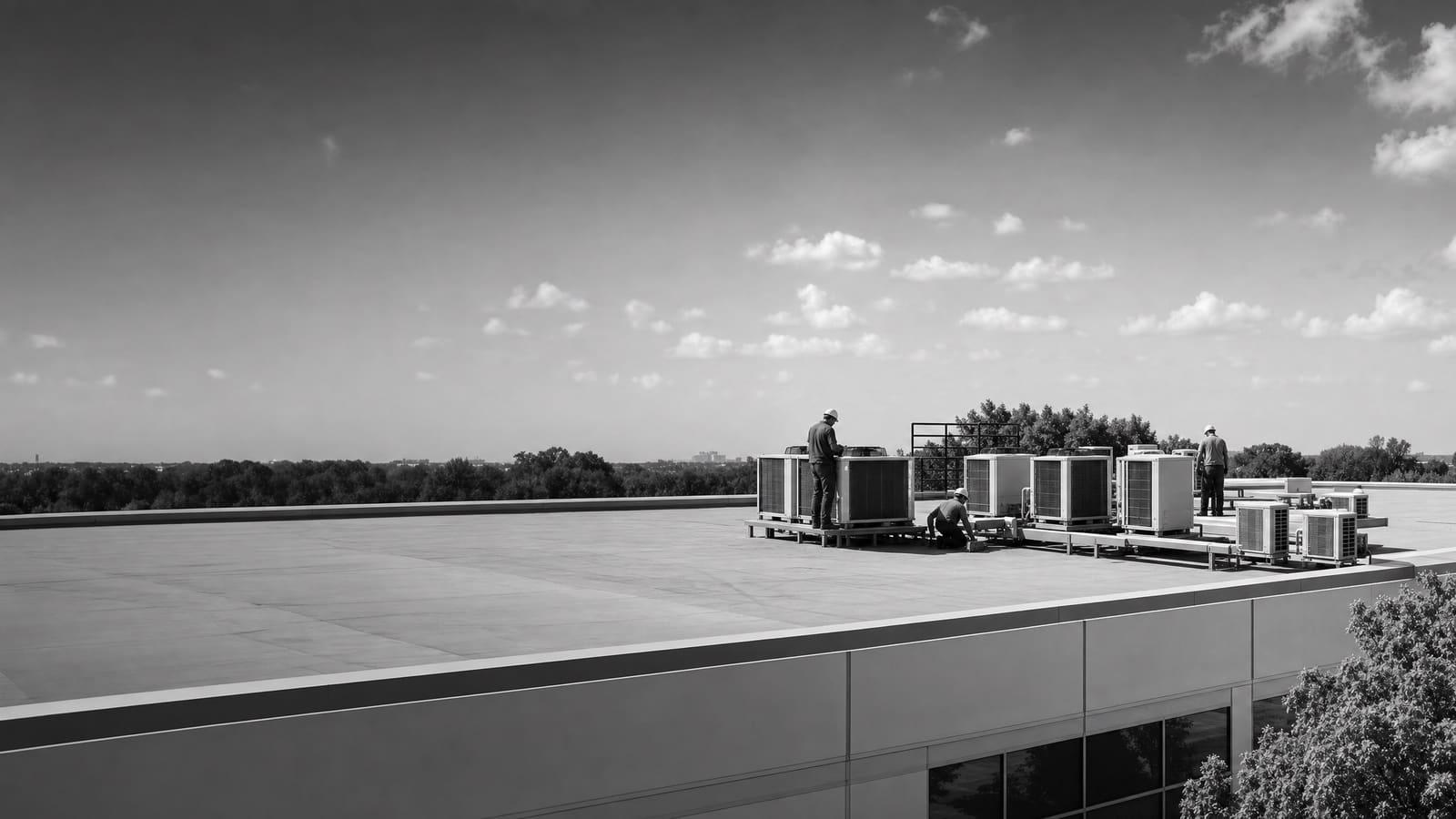
A site review still has to verify curb size and roof structure, electrical capacity at the unit, gas line status, crane reach across the lot, and whether the old tonnage still matches how the space is used.
THREE WAYS TO GO
The three replacement paths worth pricing
Almost every commercial replacement lands in one of three lanes, and the right lane depends less on the equipment catalog than on what your roof already has.
Like-for-like keeps the same curb, the same fuel, and the same connections. High-efficiency replacement uses the same footprint with a better unit; a federal performance challenge pushed manufacturers toward rooftop units that cut energy use by up to half against the old standard, and more than twenty models now exceed that specification. A heat pump rooftop unit goes further and adds reverse-cycle heating, which moves heating load onto electricity and changes what the electrical service has to carry.
Price all three while the old unit still runs. Waiting for a failure quietly removes two of them, because a building with no cooling in August takes whatever can be delivered.
WHAT MOVES THE NUMBER
The budget lines that decide your price
Nobody can price a rooftop replacement from a phone call, because equipment is only part of the number. These are the lines that separate two quotes on the same building. Each one should appear as its own item rather than disappear into a lump sum, since a lump sum hides exactly the scope you need to compare.
IN PRACTICE
How to buy this without guessing
Start with the load, not the nameplate. A unit installed twenty years ago was sized for the occupancy, lighting, and plug loads of that time, and lighting alone has changed since. If nobody recalculates, you buy the previous owner's sizing mistake a second time and then pay to run it for another two decades.
Then settle the fuel question before you shop equipment, because it changes scope more than any other choice. A heat pump rooftop unit is technically close to the air conditioning unit it replaces, but it puts heating on the electric side. That runs straight into electrical capacity, physical constraints at the roof, and what happens to the gas line you are leaving behind. Heat pump heating also gets less efficient as outdoor temperature falls, so the honest test is your building's winter design temperature and how hard the unit will lean on backup heat.
Last, treat availability as part of the price. Equipment six weeks out is a different decision than equipment sitting in a regional warehouse, especially if the building cannot go a summer without cooling. A quote that leaves lead time off the page is not a complete quote yet.
SCOPE CHECK
What makes a replacement simple or hard
Two buildings on the same street can produce very different quotes for identical tonnage. The difference is almost always access, electrical capacity, and whether anything about the installation itself changes. Knowing which side you are on before you request pricing saves a round of surprises and tells you how much calendar to plan for.
LOWER COMPLEXITY
Straight swap on an open roof
Same tonnage and same fuel, an existing curb the new unit fits, an open lot for the crane, adequate electrical at the unit, and a building on a normal schedule. This is a one-morning set with straightforward permits.
HIGHER COMPLEXITY
Fuel switch or a changed building
A tonnage change, a new curb footprint, tight or shared parking, a panel already near capacity, gas that has to be reworked, or a tenant who cannot lose conditioning during business hours. Each one adds cost and calendar.
THE SITE REVIEW
What a real walk-through has to confirm
A quote written from a nameplate photo is a starting number. The number you actually sign should come from someone who stood on the roof and looked at the unit.
The walk-through confirms physical fit first: curb dimensions, clearance around the unit, roof structure under the new weight, and whether the existing opening lines up with the new supply and return. Then infrastructure: electrical capacity at the unit and back at the panel, gas line condition, and where the condensate goes. Then access: where the crane sets up, what it has to reach over, how many stalls close, and what hours the lot is empty enough to work in.
Refrigerant belongs on that list too. Taking the old unit off means recovering its refrigerant under federal handling and recycling rules, and the new equipment will almost certainly ship on a different refrigerant than the rest of your units use. That does not change day-one operation. It does change spare parts and service planning across a mixed fleet, which is worth knowing before you sign rather than after.
Ask for this before you sign
One page that lists tonnage and efficiency tier, the curb and structural work, the crane plan and lot closure hours, the electrical and gas scope, and who pulls the permits. If any line is missing, the quotes in front of you are not comparable yet.
OWNERSHIP MATH
Two things owners get wrong at replacement time
Replacement-on-failure is the most expensive way to buy a rooftop unit, and it is still the most common. The unit dies in season, the building gets uncomfortable, and the decision narrows to whatever can be delivered this week at whatever efficiency it happens to carry. Every option that might have paid back over the next fifteen years is gone before the conversation starts.
Planned replacement inverts that. You compare fuel, efficiency, and availability while the old unit still runs, which is the only time those comparisons are honest. It is also the only time incentives are worth chasing, because most programs want paperwork approved before the work begins, not a receipt afterward.
WHO PAYS
Lease structure changes the answer
If the tenant pays the utility bill and the owner buys the equipment, nobody is rewarded for efficiency. Sort out who captures the savings before you pick an efficiency tier, or the cheapest unit wins by default.
FLEET THINKING
One roof, several units, one plan
Buildings with several rooftop units rarely fail all at once. Group replacements by age and condition, standardize on equipment you can stock parts for, and phase the spend instead of reacting one unit at a time.
THE LONG VIEW
Phasing, procurement, and the cost that outlives the invoice
The invoice is the smallest number in this project. A commercial rooftop unit stays on the roof for well over a decade, and the energy it burns across that span dwarfs the spread between two bids. That is the entire reason the efficiency tier deserves an argument instead of a shrug. Organizations that replaced aging rooftop units rather than nursing them along have documented tens of millions of dollars in combined annual energy savings across tens of thousands of units — same buildings, same use, better equipment.
Procurement follows from that. Get the load calculation done early so it never becomes the reason the schedule slips. Ask for two or three equipment options with availability attached, not a single recommendation. If your building carries several units, order together where the sizes allow and set them on the same crane day, because mobilization is a real line item and splitting it across three visits pays for it three times.
Build the incentive check into the front of the schedule too. Utility and federal programs change from year to year, and most require approval before equipment is ordered. Confirm what is actually open at the time you buy rather than assuming last year's program is still there.
BEFORE YOU SIGN
Five things a comparable quote shows
Two quotes are only comparable when both show the same scope. Ask every bidder to break out these five items, then compare them line by line instead of comparing bottom numbers that were built from different assumptions about your roof.
01
Equipment, tonnage, and efficiency tier
Model number, capacity, efficiency rating, and the refrigerant the unit ships on.
02
Load basis
Whether the size came from a current load calculation or from the old nameplate.
03
Curb, structural, and roof work
Adapter, framing, curb modification, and any patching the roof membrane needs.
04
Crane and site plan
Set date, lot closure window, staging area, and who coordinates with tenants.
05
Permits, startup, and commissioning
Who pulls permits, who meets the inspector, and what gets verified and documented at startup.
Get a defensible number
Price the equipment and the building together.
Send the address, operating target, and target opening date. Flux will identify what must be verified before the project can be priced.
Get a free estimateQuestions
Straight answers.
When is replacement a better call than another repair?
Once a unit is past 15 years and needs frequent service, repairs stop being the cheaper path. Old, inefficient rooftop units waste roughly $900 to $3,700 each per year in energy alone. Replacing before failure also keeps the efficiency and fuel choice open, which a failure takes away from you.
Is a heat pump rooftop unit the right replacement?
It depends on your winter design temperature, your electrical capacity, and what happens to the gas line. Heat pump heating loses efficiency as outdoor temperature drops and leans harder on backup heat. It fits best where winter heating loads are mild to moderate and the electrical service can carry the added load.
How much does commercial HVAC installation cost?
Installed price depends on tonnage, efficiency tier, curb and structural work, crane access, and electrical or gas changes, so a real number follows a real look at the roof. What can be stated up front is the operating side: an old, inefficient unit wastes roughly $900 to $3,700 a year.
What does commissioning actually cover?
Startup, refrigerant charge, airflow, and control settings verified against the design and then documented. It is the step that separates a unit that turns on from a unit that performs, and it prevents the comfort complaints that otherwise appear a month or two after handoff.
Will the new unit use a different refrigerant?
Most likely yes. New commercial equipment ships on newer refrigerants, and the old unit's charge has to be recovered under federal handling and recycling rules when it comes off the roof. Day-one operation does not change, but plan for it in service contracts and spare parts across a mixed fleet.
Sources used for this guide
- [1]betterbuildingssolutioncenter.energy.gov — DOE Advanced Rooftop Unit Replacement Guidance
- [2]betterbuildingssolutioncenter.energy.gov — DOE Commercial Heat Pump Rooftop Unit Replacement Guidance
- [3]betterbuildingssolutioncenter.energy.gov — DOE High-Efficiency Commercial Rooftop Unit Toolkit
- [4]energy.gov — DOE Efficient Commercial Rooftop Air Conditioner Program
- [5]epa.gov — EPA Stationary HVAC Refrigerant Management